Wize University Biochemistry Textbook > Fundamental Concepts of Biochemistry
Energy and Metabolism: Gibbs Free Energy
Popular Courses
Find My Course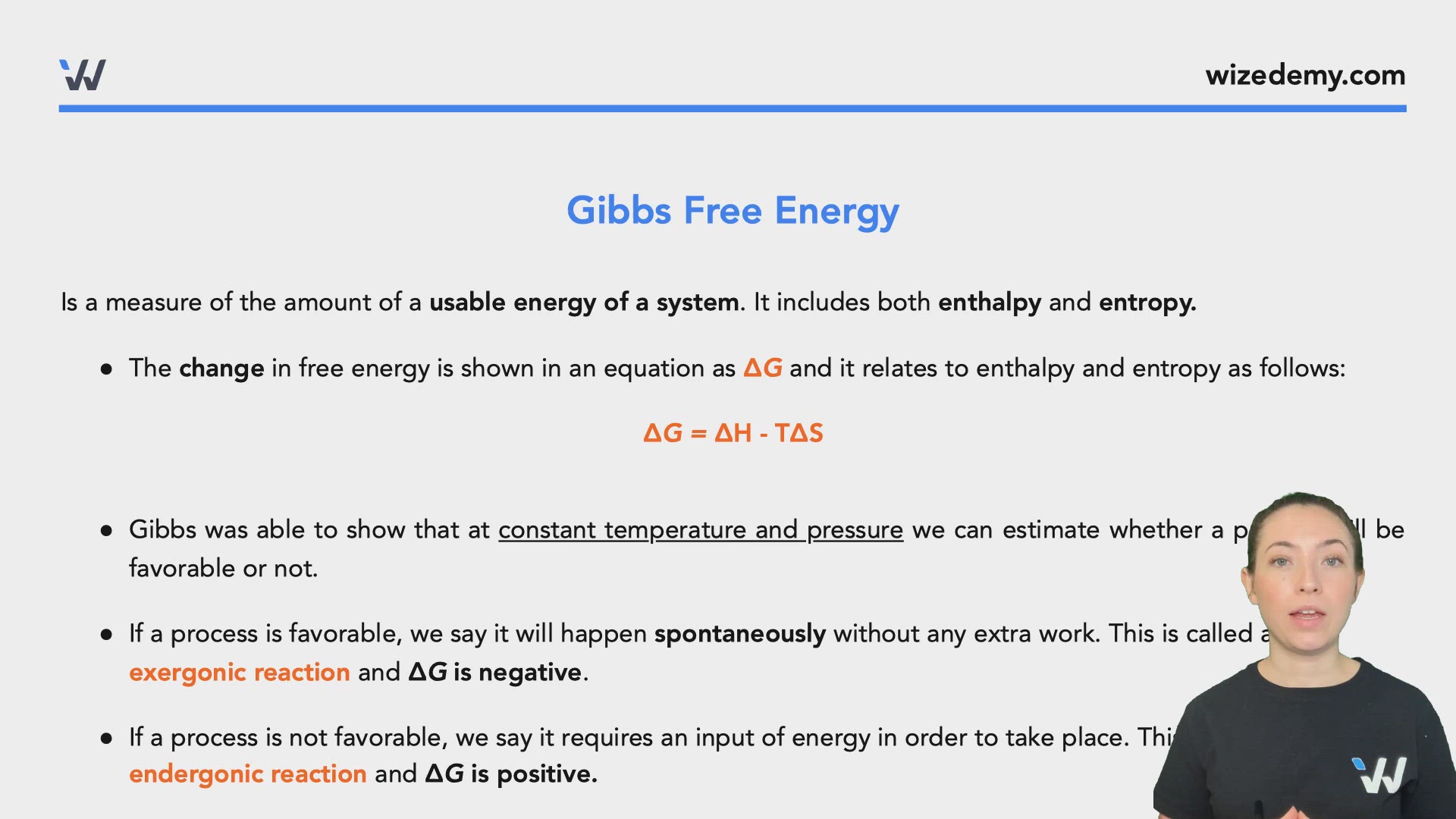
0:00 / 0:00
Gibbs Free Energy
Is a measure of the amount of a usable energy of a system. It includes both enthalpy and entropy.
- The change in free energy is shown in an equation as ΔG and it relates to enthalpy and entropy as follows:
ΔG = ΔH - TΔS
- Gibbs was able to show that at constant temperature and pressure we can estimate whether a process will be favorable or not.
- If a process is favorable, we say it will happen spontaneously without any extra work. This is called an exergonic reaction and ΔG is negative.
- If a process is not favorable, we say it requires an input of energy in order to take place. This is called an endergonic reaction and ΔG is positive.

Standard Free Energy Change (ΔGo) is sometimes used.
- It is the change in free energy under standard conditions (298 K, 1 atm partial pressure of each gas, 1 M concentration of each solute). Note that ΔG which might occur intracellularly, is sometimes different than ΔGo.
Wize Concept
Spontaneous reactions have an overall negative ΔGo. If a reaction is spontaneous, then under the same conditions, it would be non-spontaneous in the reverse direction.
- If ΔG < 0 the process is irreversible (exergonic) and proceeds forward.
- If ΔG > 0 the process is (endergonic) which means it will proceed "backwards".
- If ΔG = 0 the process is reversible and can go in either direction.
0:00 / 0:00
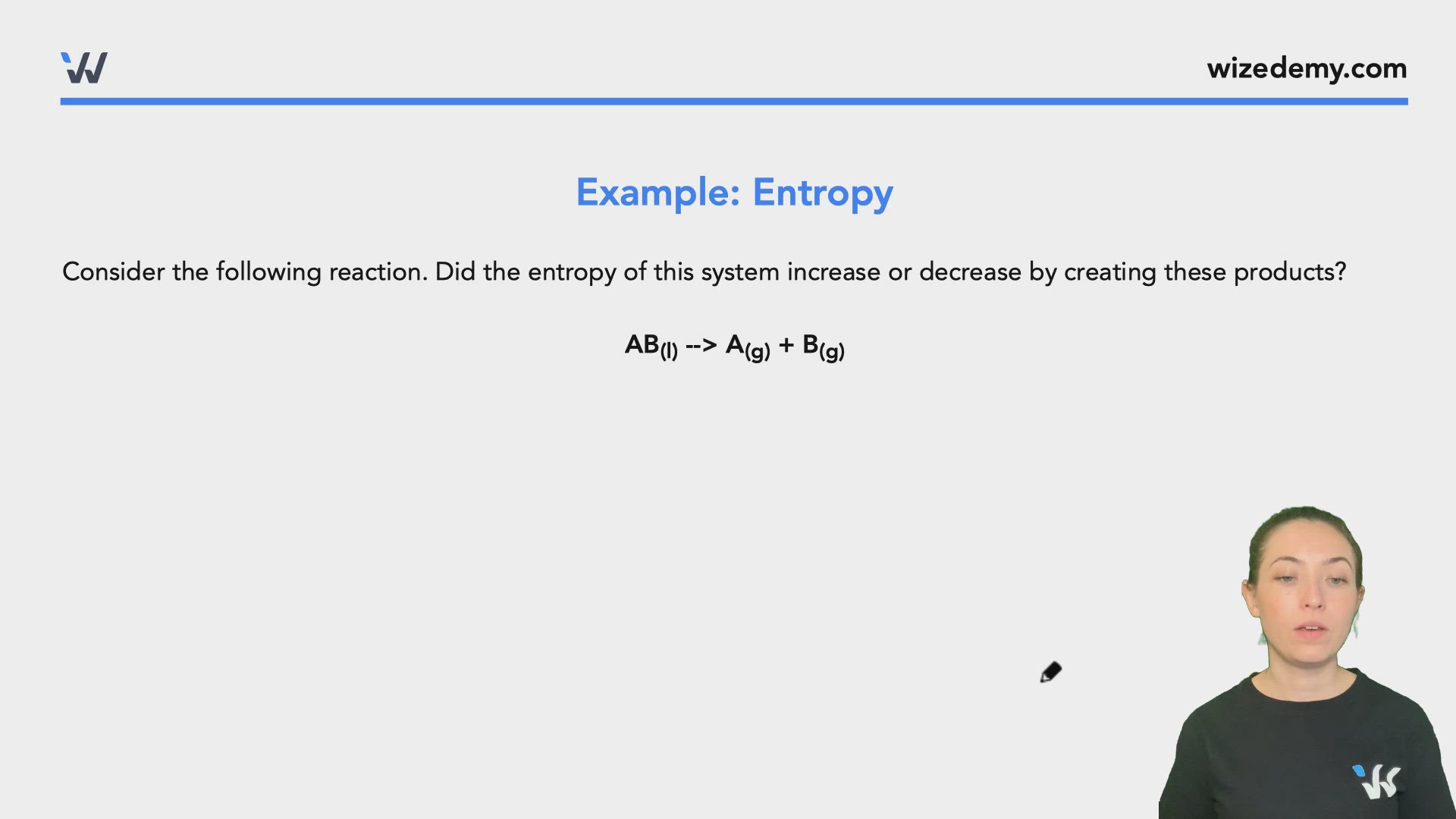
Example: Entropy
Consider the following reaction. Did the entropy of this system increase or decrease by creating these products?
AB(l) --> A(g) + B(g)
This may seem like a strange problem, but it's an easy way to think about entropy. In this system, where there was once one molecule, now there are two. This system became more disorganized and there are more possible states for it now that it has two molecules rather than one. Therefore, the entropy of this system increased.