Wize University Biochemistry Textbook > Fundamental Concepts of Biochemistry
Biological polymers
Popular Courses
Find My Course
0:00 / 0:00
From Monomers to Polymers
There are four types of major macromolecules in a cell:
- Proteins
- Nucleic Acids
- Polysaccharides
- Lipids
Macromolecules are made out of smaller units:
- Macromolecules are polymers, which are molecules made out of two or more repeating building blocks called monomers.

How are monomers joined together to form polymers?
- Monomers are linked together by a type of reaction called a dehydration or condensation reaction.
- In this type of reaction, a water molecule is lost and a bond is formed between the two monomers.
- The type of bond that forms between the monomers is different depending on the types of molecules involved, but the type of reaction that forms the bond is always a dehydration / condensation reaction.

How are polymers broken apart?
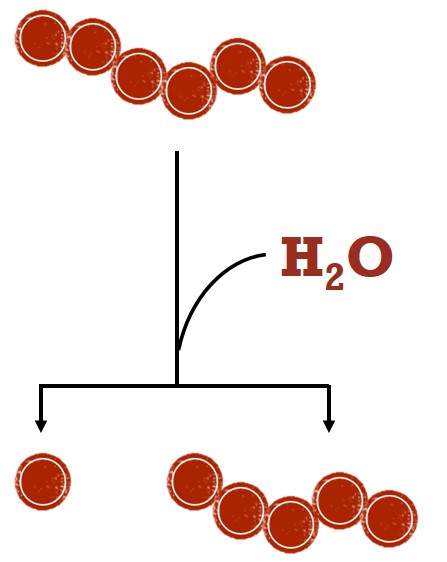
- Polymers are broken back down into their monomers by the opposite type of reaction, called a hydrolysis reaction.
- A hydrolysis reaction involves adding a water molecule in order to break the bond between the monomers.
- The monomers can then be recycled to form new polymers.