0:00 / 0:00
pH Scale
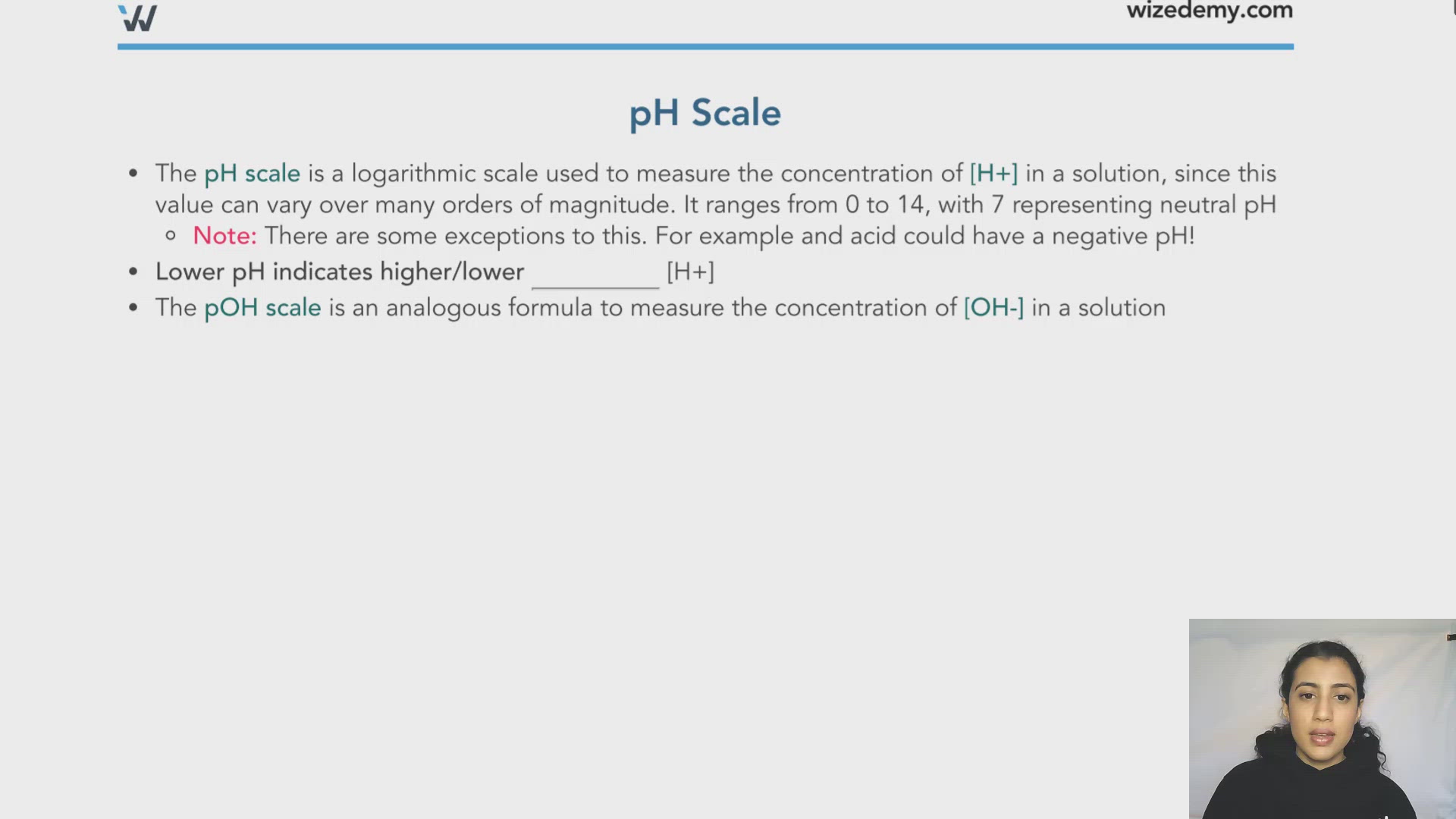
- The pH scale is a logarithmic scale used to measure the concentration of [H+] in a solution, since this value can vary over many orders of magnitude. It ranges from 0 to 14, with 7 representing neutral pH
- Note: There are some exceptions to this. For example and acid could have a negative pH!
- Lower pH indicates higher/lowerhigher[H+]
- The pOH scale is an analogous formula to measure the concentration of [OH-] in a solution
We also have Ka and pKa equations:
pKa=-log [Ka]
[Ka]=10-pKa
What does it mean to be a logarithmic scale?
How does the [H+] change as the pH goes from 1 to 2 or 1 to 3??
pH 1
|
V
pH 2
|
V
pH 3
- Since pH is a logarithmic scale, each 1 unit change in the pH corresponds to a 10-fold change in [H+]!
0:00 / 0:00
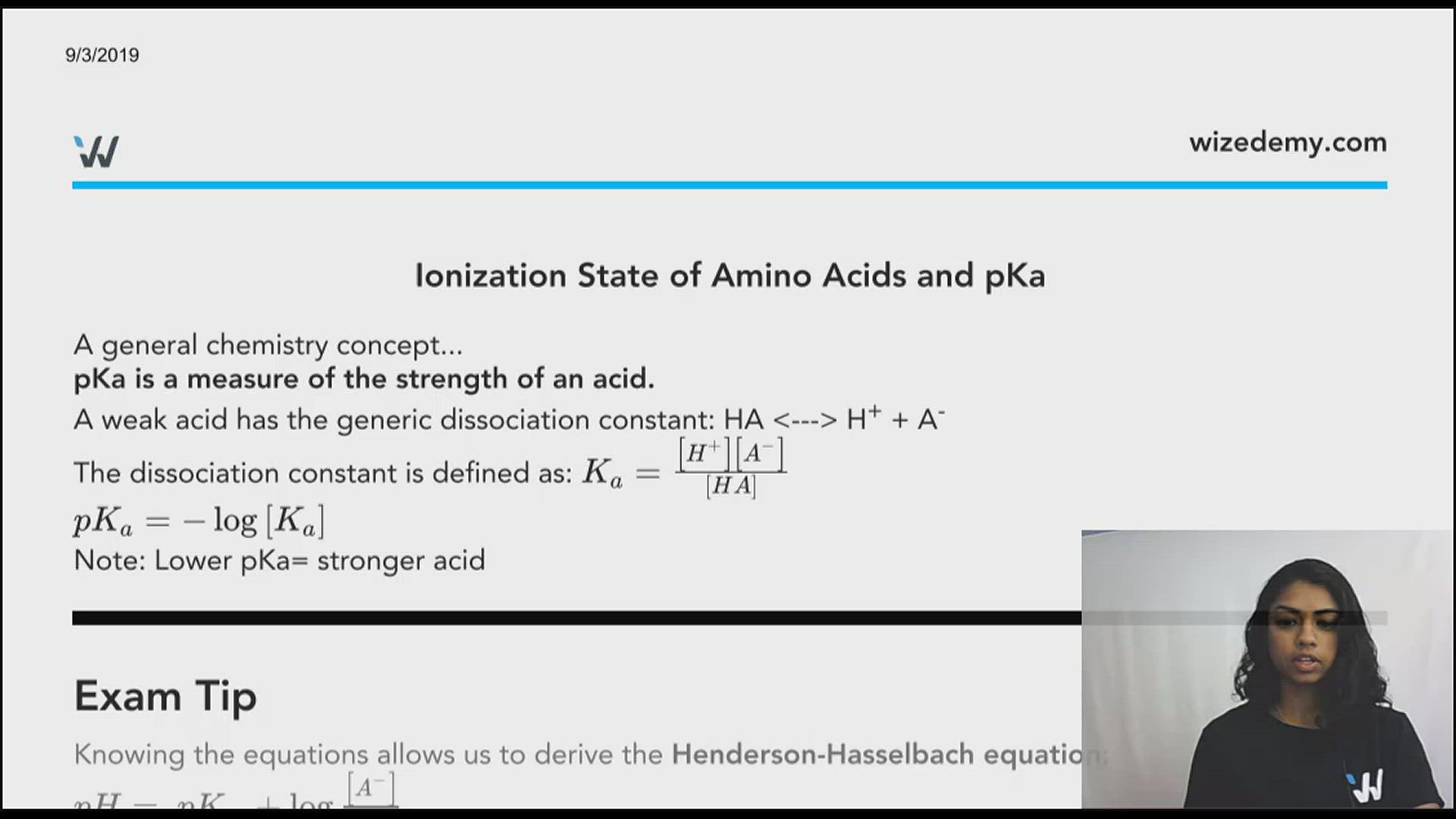
Ionization State of Amino Acids and pKa
A general chemistry concept...
pKa is a measure of the strength of an acid.
A weak acid has the generic dissociation constant: HA <---> H+ + A-
The dissociation constant is defined as:
Note: Lower pKa= stronger acid
Exam Tip
Knowing the equations allows us to derive the Henderson-Hasselbach equation:
How does this relate to amino acids??
Amino acids are weak acids due to their carboxyl group, which can be de-protonated: COOH --> COO-
Amino acids are weak bases due to their amino group, which can be protonated: NH2 --> NH3+
The net charge of certain amino acid side chains can also change depending on pH.
Thus, the ionization state of an amino acid depends on the pH and can greatly affect protein structure.
Using the Henderson-Hasselback equation, you can calculate the net charge of a group on an amino acid (amino group, carboxyl group or side chain)
For example: If pH=3, what is the net charge of a carboxyl group, assuming a pKa=2?
Our dissociation equilibrium equation is: COOH <-----> COO- + H+
Henderson-Hasselbach equation:
Therefore, [COO-], which has a charge of -1 = ~90%
and [COOH], which has a charge of 0 =~10%
The net charge of the carboxyl group is -1 (0.9) + 0(0.1) = -0.9
If you know the pKa of the amino group, carboxyl group and the side chain, you can calculate the net charge for each group. The sum of these three charges will be the overall net charge of the amino acid at that particular pH.
0:00 / 0:00
Backbone and pKa
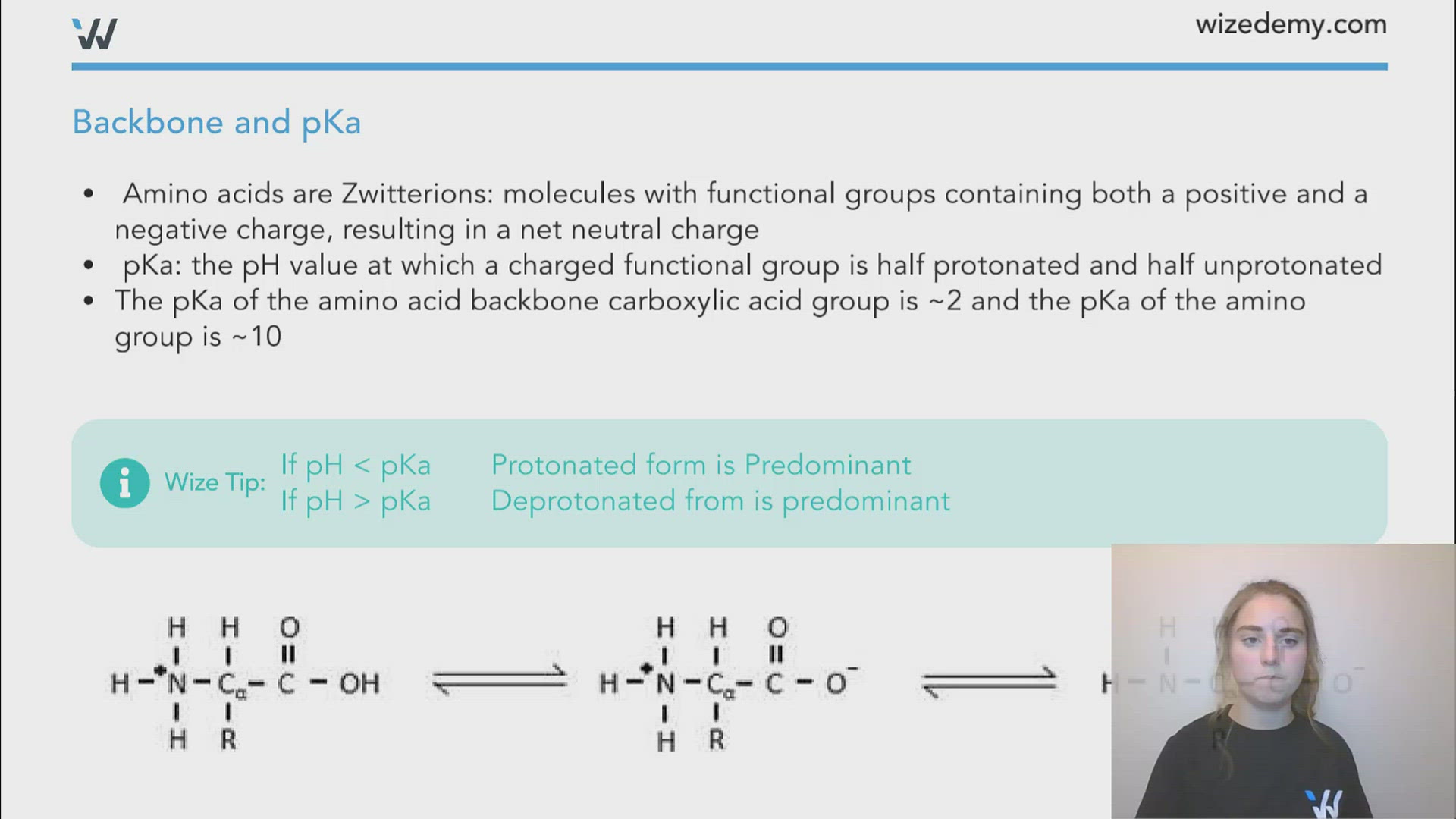
- Amino acids are Zwitterions: molecules with functional groups containing both a positive and a negative charge, resulting in a net neutral charge
- pKa: the pH value at which a charged functional group is half protonated and half unprotonated
- The pKa of the amino acid backbone carboxylic acid group is ~2 and the pKa of the amino group is ~10
Wize Tip
If pH < pKa Protonated form is Predominant
If pH > pKa Deprotonated from is predominant

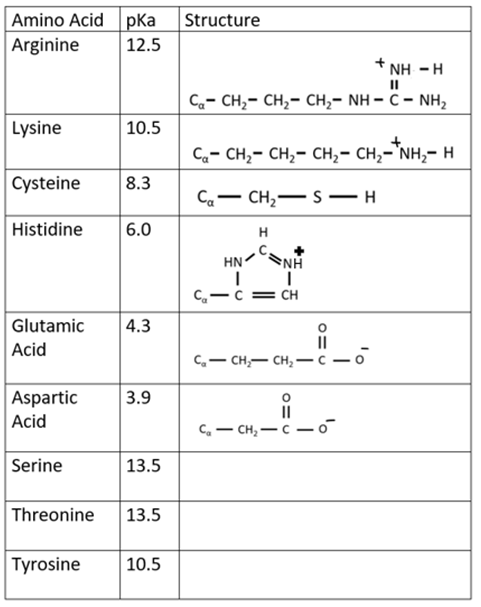
pKa of Side Chains
- At physiological pH

0:00 / 0:00
Amino Acid Isoelectric Point
Isoelectric Point (IP) - the pH at which a particular molecule carries no net electrical charge or is electrically neutral
The IP of an amino acid is the pH where all the charges balance out to 0. For example, all amino acids possess an amine and carboxylic acid moieties that are charged at neutral pH. If we just look at the relevant pKas of the protonated amine and carboxylic acid group (H3N+R = 10, CO2H = 2.5), the average pKa is about 6. At this pH, the two charges cancel each other out.

Things are complicated since amino acids can have a variety of side chains that may be acidic or basic.
- If the side chains are basic (for example amines) the IP is at a higher pH since these functional groups are protonated at neutral pH, giving a more positive overall molecule charge.
- f the side chains are acidic (for example carboxylic acids) the IP is at a lower pH since these functional groups are deprotonated at neutral pH, giving a more negative overall molecule charge.
Key for Determining Isoelectric Points for Amino Acids
if R = H/alkyl/aryl/alcohol/thioether, pH (IP) ~ 6
if R = carboxylic acid, pH (IP) ~ 3
if R = amine, other basic moiety, pH (IP) ~ 10

0:00 / 0:00
a. Explain why Arginine is positively charged at pH 7.
pKa is the pH value at which half of the like molecules in a solution are protonated and half are deprotonated. pH is a measurement related to the concentration of H+ molecules in solution. We know that the lower the pH, the greater the concentration of H+ and vice versa. Therefore if the pH is lower than the pka then there will be more H+ in solution than are needed to maintain that protonated/deprotonated balance and there for the molecules will be protonated and the reverse leads to the molecules being deprotonated when pH is higher than the pKa. Since the arginine side chain has a pKa of 12.5, at pH 7 the amino group will be protonated, leading it to have 4 bonds surrounding the nitrogen and a positive charge.
b. Explain why Glutamic acid is negatively charged at pH 7.
The pKa of the glutamic acid side chain is 4.3. Since this is lower than physiological pH, this means that the carboxylic acid will be deprotonated at pH 7. This leads to the oxygen only having one bond and a negative charge.