
0:00 / 0:00
Peptide Bond
- Proteins are polymers (long chains of repeating sub-units/monomers) with Amino acids being the monomers
- Amino acids are joined together with peptide bonds
- Peptide bonds are a dehydration synthesis/condensation reaction

Wize Concept
Proteins are synthesized through translating mRNA. Amino acids are always added from N-terminal to C-terminal.
- The peptide bond is planar and is in trans conformation between the oxygen of the carbonyl group and the hydrogen of the amide group
- Due to resonance within the structure there is a partial double bond between the C and N
- Therefore, there is no rotation between these two atoms, but there is free rotation around the alpha carbon
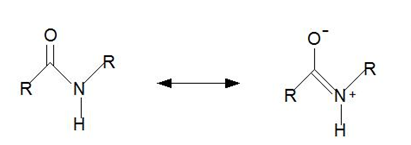
https://commons.wikimedia.org/wiki/File:Amide_Bond_Resonance.jpg. The author Vkchang released this image into public domain.

0:00 / 0:00
Peptide Bond Angles
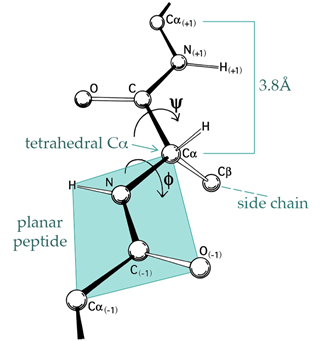
https://commons.wikimedia.org/wiki/File:PhiPsi_drawing_with_plane_and_labels.jpg. The author Dcrjsr has this file licensed under the Creative Commons Attribution 3.0 Unported license.
- Every bond found in the backbone has rotation to some extent and each has a designated symbol
- The angle around the N - Cα bond is referred to as phi (φ) while the Cα – C=O bond rotation is referred to as psi (ψ)
- The peptide bond angle (omega/ω, C – N bond) is restrained at a 180o angle
- The side chain rotation is called the chi (χ) angle
- Protein secondary structures have very specific amino acid backbone angles
0:00 / 0:00
Draw a small peptide corresponding to the following sequence, label the bond angles appropriately for one of the amino acids.
-Ala-Glu-Pro-Phe-
Refer to video for answer (time 4:15).
0:00 / 0:00
Which statement is TRUE about peptide bonds?
a) It is a bond that joins two amino acids through the addition of a water molecule.
b) The bond forms between the amino group of the side chain and the alpha carbon.
c) The peptide bond is stabilized by a partial double bond and held at 180o angle.
d) The peptide bond typically holds the amino acid in a cis conformation.
c) The partial double bond is formed between the C=O and C-N of the peptide bond through resonance. The rigidity of this bond hold the peptide bond at specifically 180.
0:00 / 0:00
Explain how peptide bonds hold a partial double bond characteristic using figures and resonance in your explanation.
The double bond found between C=O shares electrons with the C-N bond (the peptide bond). This is because both O and N being electronegative atoms, meaning they both attract electrons from the less electronegative carbon. This feature makes the bond rigid and holds the participating atoms it at an 180o angle.