0:00 / 0:00
Introduction and Passive Transport
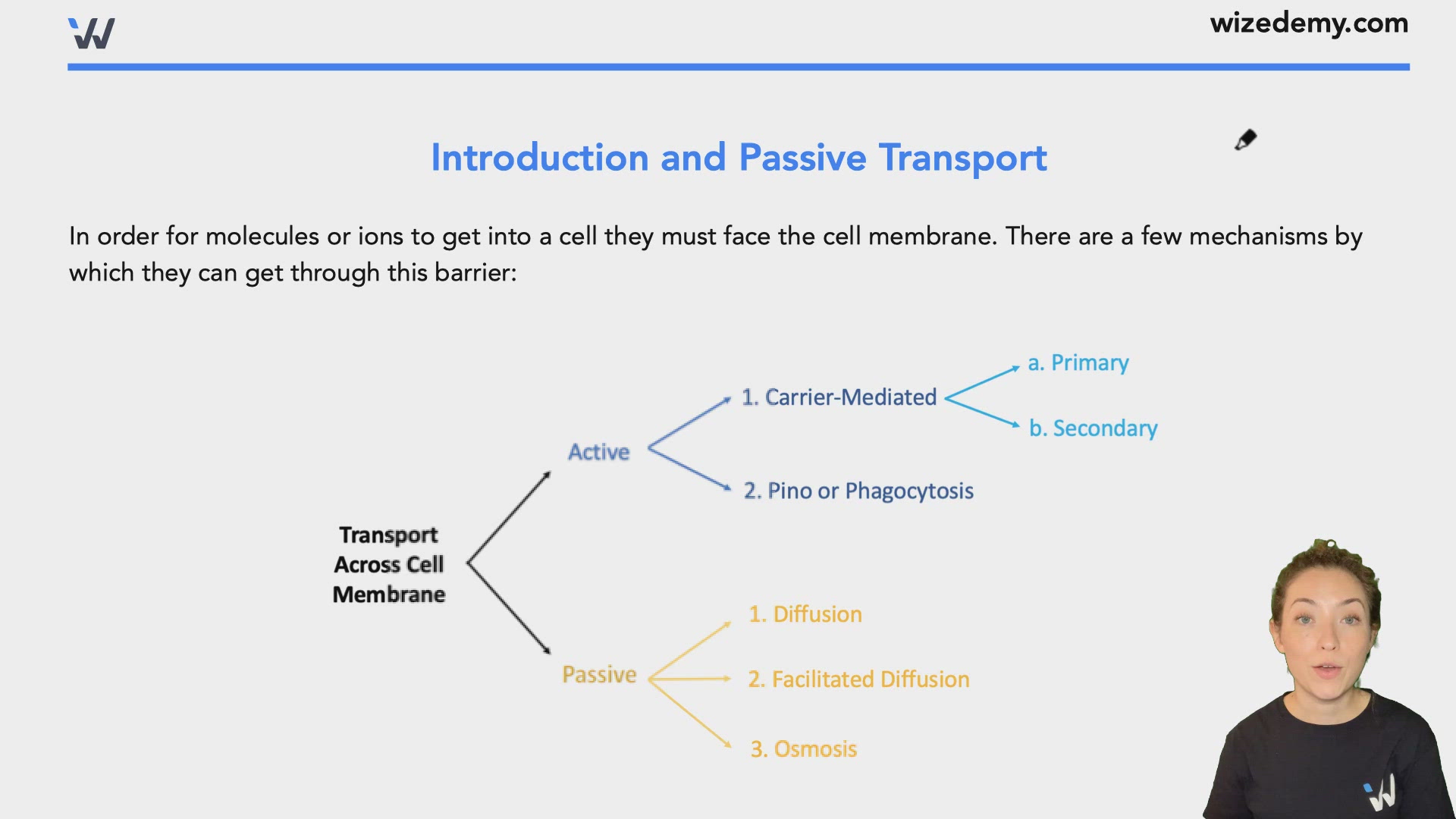
In order for molecules or ions to get into a cell they must face the cell membrane. There are a few mechanisms by which they can get through this barrier:

(Simple) Diffusion
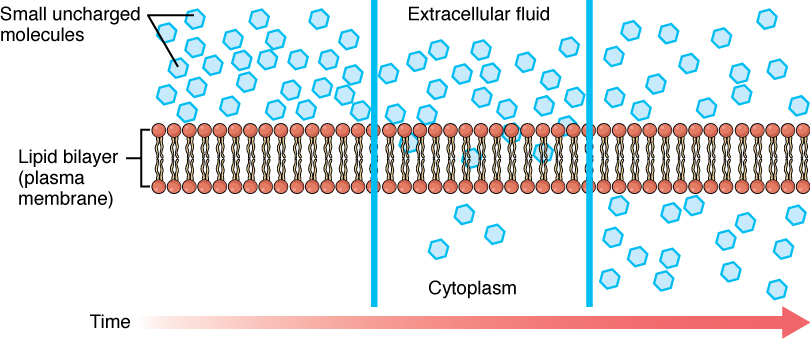
Simple diffusion occurs due to random thermal motion of molecules. When you add a drop of red dye to a glass of water, some time later the drop will have spread and the entire water will be pink. This is diffusion!
- Diffusion always occurs from high to low concentration regions (driving force), also known as the concentration gradient.
- When the concentrations are equal throughout, this system is said to be at equilibrium.
- In order for diffusion to occur across a membrane, the membrane must be permeable to the molecule.
Diffusion of Non-Electrolytes
Small, uncharged and lipophilic molecules can cross right through the lipid bilayer.
Facilitated Diffusion
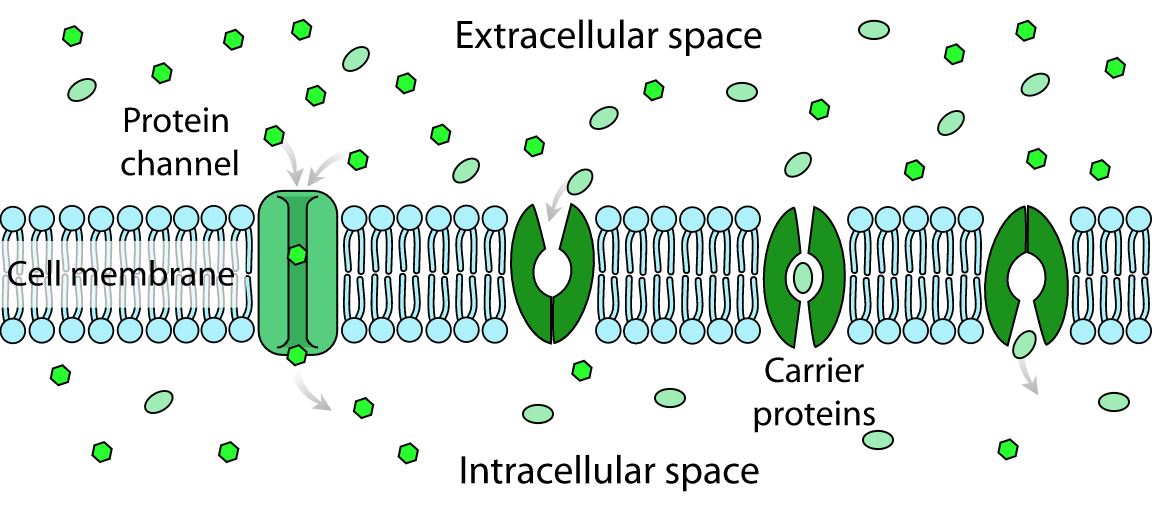
Molecules that cannot diffuse through the membrane require additional help of transport proteins to get into a cell.
- No energy required just like simple diffusion but instead uses the help of a membrane protein.
- Down the concentration gradient (i.e. molecules go from areas of high to low concentration).
- Two types of membrane proteins that help in facilitated diffusion: Channel Proteins and Carrier Proteins
- Channel proteins
- Specific for a certain molecule;
- Can be open all the time or need a trigger ("gated"). Example: channels for Na+ or Cl- ions.
- Carrier proteins
- Not just a hollow channel: when its specific molecule binds, it changes shape (conformation) and enables the passage of the molecule inside. Example: glucose transporters.

0:00 / 0:00
Active Transport
Also involves a carrier or transporter. There are two types: primary and secondary active transport.
- Can transport solutes against its concentration gradient.
- Therefore, requires the input of energy.
- When there's no energy available, this cannot occur.
Primary Active Transport
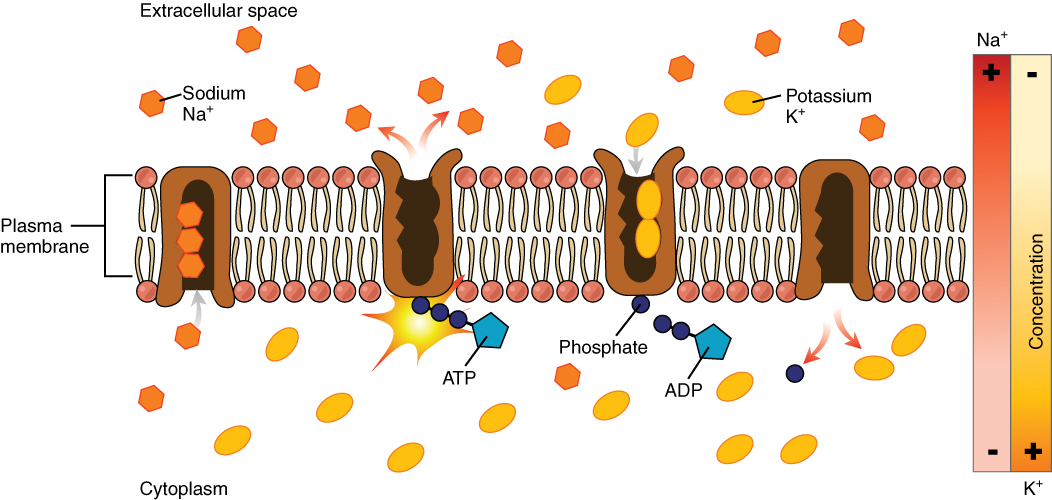
- ATP is used as the source of energy.
- The transporter/carrier itself is an ATPase enzyme.
- Carrier takes a phosphate from ATP, changing its conformation. Examples: Na+/K+ ATPase, Ca2+ ATPase, H+ ATPase, H+/K+ ATPase
Secondary Active Transport
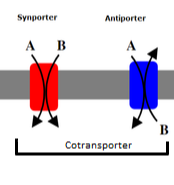
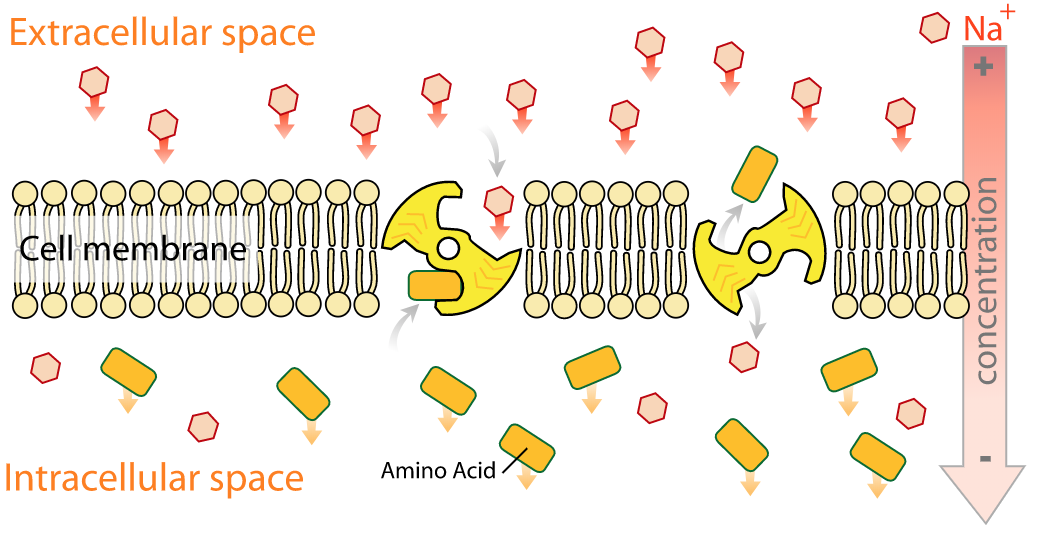
- Also known as co-transport. Energy used is from the movement of one ion down its electrochemical gradient, while another ion moves up its gradient.
- When both solutes move in the same direction, the carrier molecule is called a symporter (hitching a ride). Example: Na+/glucose cotransporter, Na+/amino acid cotransporter.
- When solutes move in opposite directions, the carrier molecule used is called an antiporter (club is at capacity). Example: Na+/H+ exchanger, Cl-/HCO3-exchanger, Na+/Ca2+ exchanger.
Summary
- Both require input of energy.
- Both move solutes against their electrochemical gradients
- Primary active transport uses ATPases.
- Secondary active transport uses another molecule that moves down its gradient.
0:00 / 0:00
Ion Channels
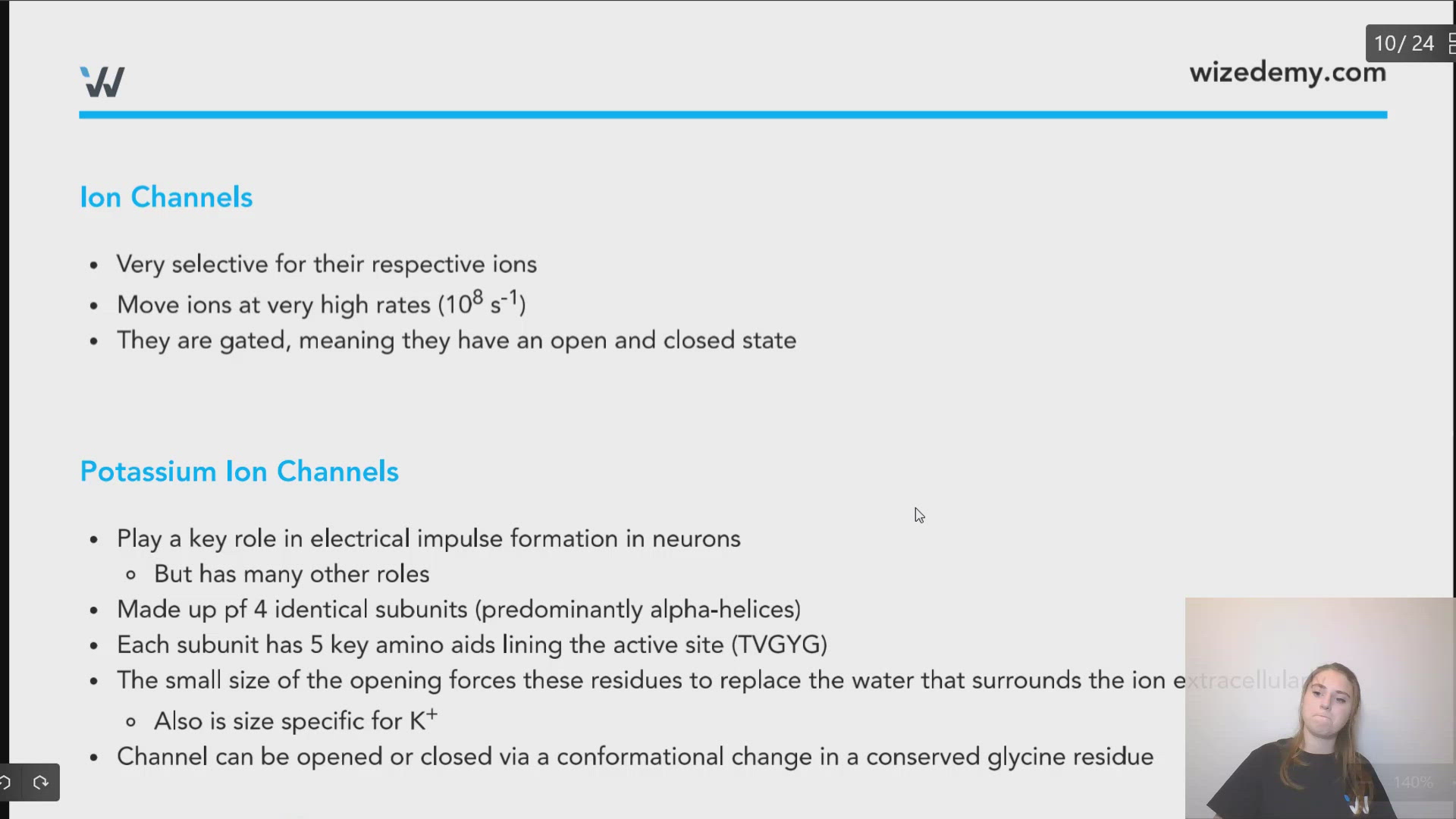
- Very selective for their respective ions
- Move ions at very high rates (108 s-1)
- They are gated, meaning they have an open and closed state
Potassium Ion Channels
- Play a key role in electrical impulse formation in neurons
- But has many other roles
- Made up pf 4 identical subunits (predominantly alpha-helices)
- Each subunit has 5 key amino aids lining the active site (TVGYG)
- The small size of the opening forces these residues to replace the water that surrounds the ion extracellularly
- Also is size specific for K+
- Channel can be opened or closed via a conformational change in a conserved glycine residue
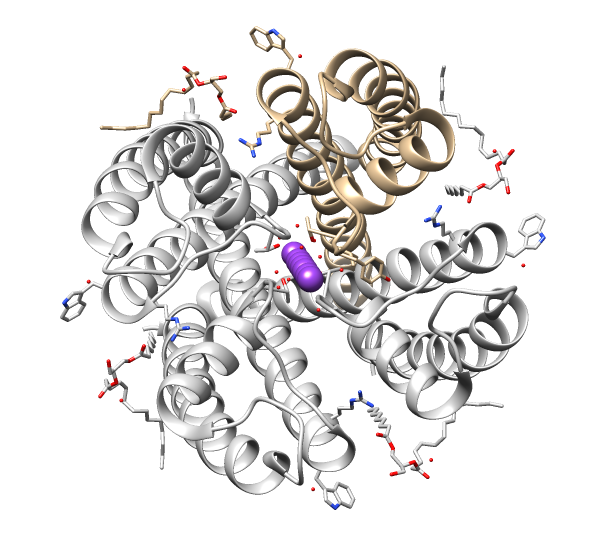
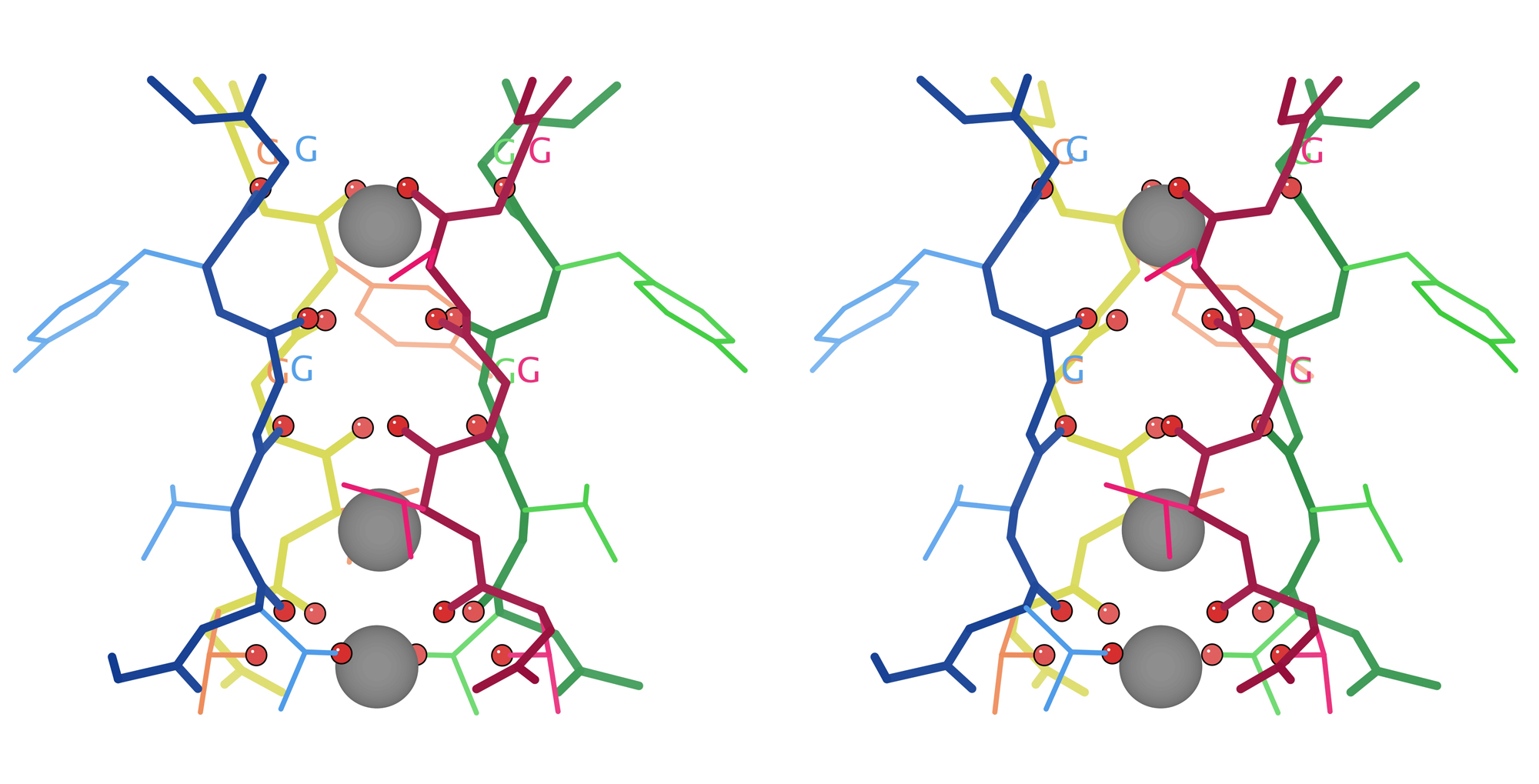
https://commons.wikimedia.org/wiki/File:My_molecule_image_2.png. Wikiassign247. This file is licensed under the Creative Commons Attribution-Share Alike 4.0 International license.
https://commons.wikimedia.org/wiki/File:F42_K%2Bchannel_select_stereo.jpg. Dcrjsr. This file is licensed under the Creative Commons Attribution 3.0 Unported license.
0:00 / 0:00
Describe the difference between active and passive transport across a cellular membrane.
Active transport moves molecules against their concentration gradient and requires energy to facilitate this action. Passive transport moves molecules with their concentration gradient and does not require external energy.
What statement is NOT true about potassium ion channels