
0:00 / 0:00
Ion Channels Receptors
Ion receptor channels are ion channels that open and close upon binding of a signaling molecule.
- Upon binding of the ligand (signaling molecule), it causes the channel to open.
- This allows for the flow of ions (e.g. K+, Na+, Ca+, Cl-) from an area of high concentration to an are of low concentration.


0:00 / 0:00
G-Protein Coupled Receptors (GPCRs)
The following are cell-surface receptors. Remember that these are integral (transmembrane) proteins anchored on the cell's lipid bilayer. They perform signal transduction, or the relaying of information from the cell's exterior to the interior.
GPCRs are a type of receptor which interacts with G proteins. Humans have over 1000 different types of GPCRs and they carry out a very wide array of functions in our cells.
- A G protein is attached to the intracellular side of the membrane.
- They have three subunits: the alpha, beta, and gamma subunits.
- G proteins have the ability to bind GTP and GDP.
- The variety of GPCRs comes from the variety of molecules they activate.
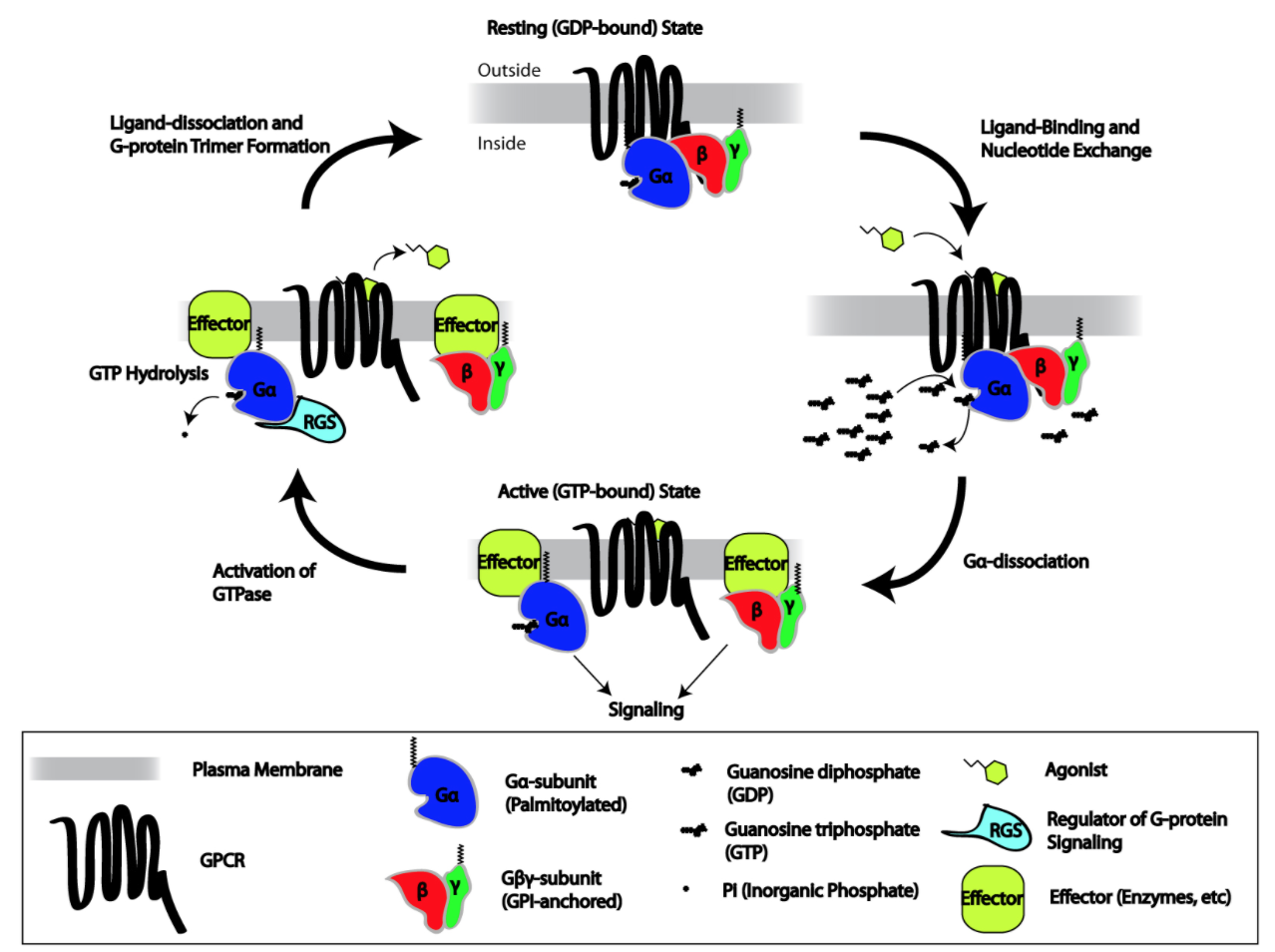
General GPCR pathway:
- Before the ligand binds, the G-protein is associated with its subunits, holding a GDP.
- The signal molecule binds to the cell surface receptor.
- Upon binding, the receptor undergoes a conformational change that activates the G-protein.
- The G protein's alpha subunit then lets go of GDP and picks up GTP and is now active.
- The G protein then dissociates from the GPCR and into alpha and beta-gamma subunits.
- These subunits can go activate other proteins as a result.
- Eventually the GTP is hydrolyzed to GDP.
- The subunits re-associate and the cycle starts again.
0:00 / 0:00
Receptor Tyrosine Kinases (RTKs)
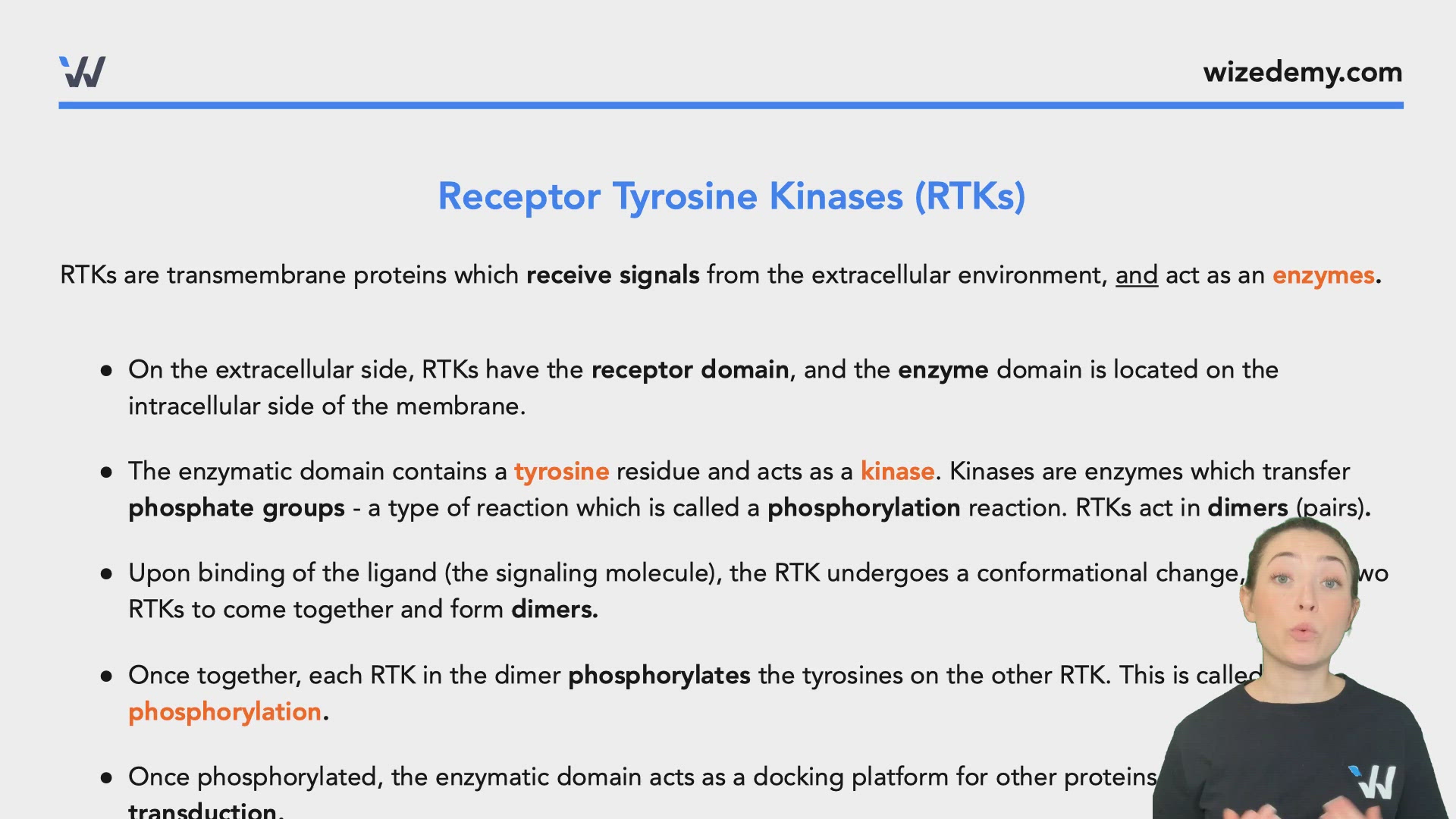
RTKs are transmembrane proteins which receive signals from the extracellular environment, and act as an enzymes.
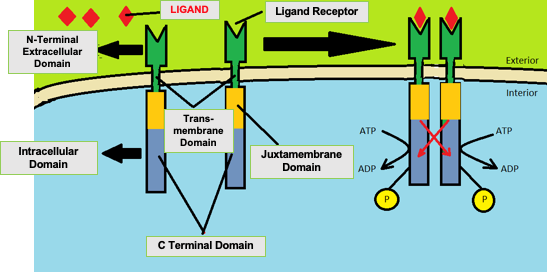
- On the extracellular side, RTKs have the receptor domain, and the enzyme domain is located on the intracellular side of the membrane.
- The enzymatic domain contains a tyrosine residue and acts as a kinase. Kinases are enzymes which transfer phosphate groups - a type of reaction which is called a phosphorylation reaction. RTKs act in dimers (pairs).
- Upon binding of the ligand (the signaling molecule), the RTK undergoes a conformational change, causing two RTKs to come together and form dimers.
- Once together, each RTK in the dimer phosphorylates the tyrosines on the other RTK. This is called cross phosphorylation.
- Once phosphorylated, the enzymatic domain acts as a docking platform for other proteins involved in signal transduction.
0:00 / 0:00
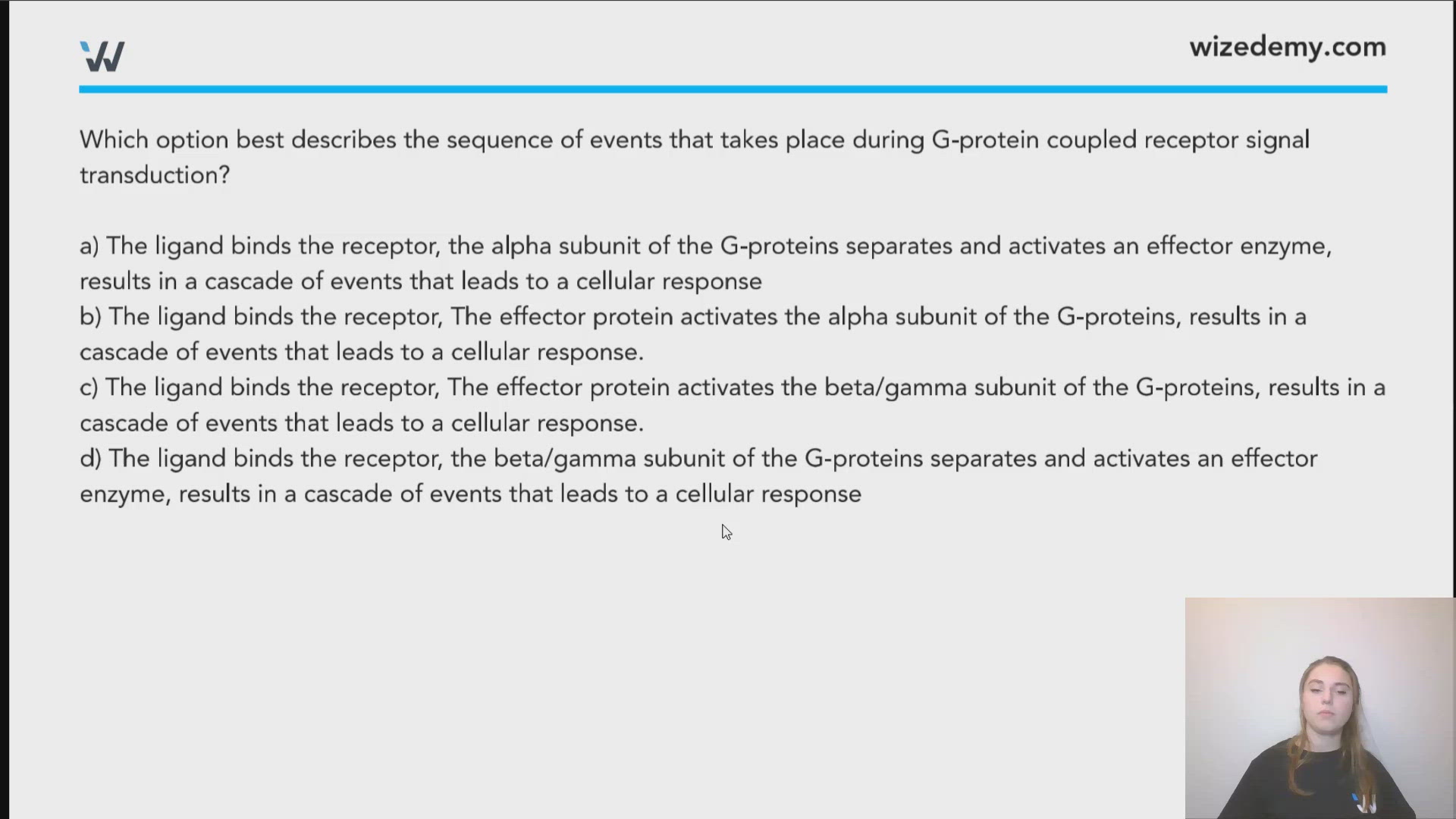
Which option best describes the sequence of events that takes place during G-protein coupled receptor signal transduction?
a) The ligand binds the receptor, the alpha subunit of the G-proteins separates and activates an effector enzyme, results in a cascade of events that leads to a cellular response
b) The ligand binds the receptor, The effector protein activates the alpha subunit of the G-proteins, results in a cascade of events that leads to a cellular response.
c) The ligand binds the receptor, The effector protein activates the beta/gamma subunit of the G-proteins, results in a cascade of events that leads to a cellular response.
d) The ligand binds the receptor, the beta/gamma subunit of the G-proteins separates and activates an effector enzyme, results in a cascade of events that leads to a cellular response
a) The ligand binds the receptor, the alpha subunit of the G-proteins separates and activates an effector enzyme, results in a cascade of events that leads to a cellular response