Wize University Biology Textbook > Energy & Metabolism
Overview of Metabolism
Popular Courses
MCAT
General Course
AP Biology Exam Prep Course
AP Exam Prep
Biology
General Course
General Biology
University Study Guides
BIOLOGY 1002B
Western University
BIOL 211
University of Calgary
BIOL 107
University of Alberta
BIOL 102
Queen's University
BIOL 112
University of British Columbia
Grade 12 Biology
Canada High School
High School Biology
US High School
DAT
General Course
General Biology
University Study Guides
BIOL 130
University of Waterloo
SC/BIOL 1000 3.00
York University
BIO 1141
University of Ottawa
BLG 143
Toronto Metropolitan University
BIOL 112
McGill University
BIOL 186
University of Victoria
BIOL-1101
University of Windsor

0:00 / 0:00
Overview of Metabolism
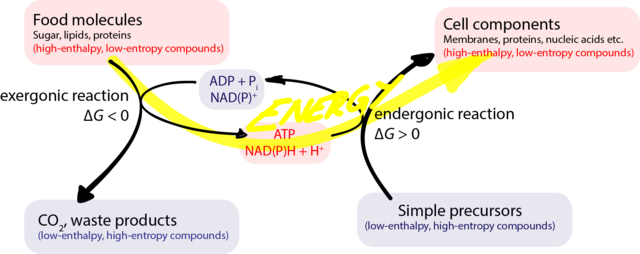
Metabolism is the collection of all chemical reactions that take place inside the cell.
- Anabolism refers to the metabolic pathways that synthesize complex molecules from simpler ones, using up energy. Example: making glucose from photosynthesis; proteins from amino acids.
- Catabolism refers to the metabolic pathways that break down complex molecules to simpler ones, releasing energy. Example: cellular respiration (breaking down glucose).
0:00 / 0:00
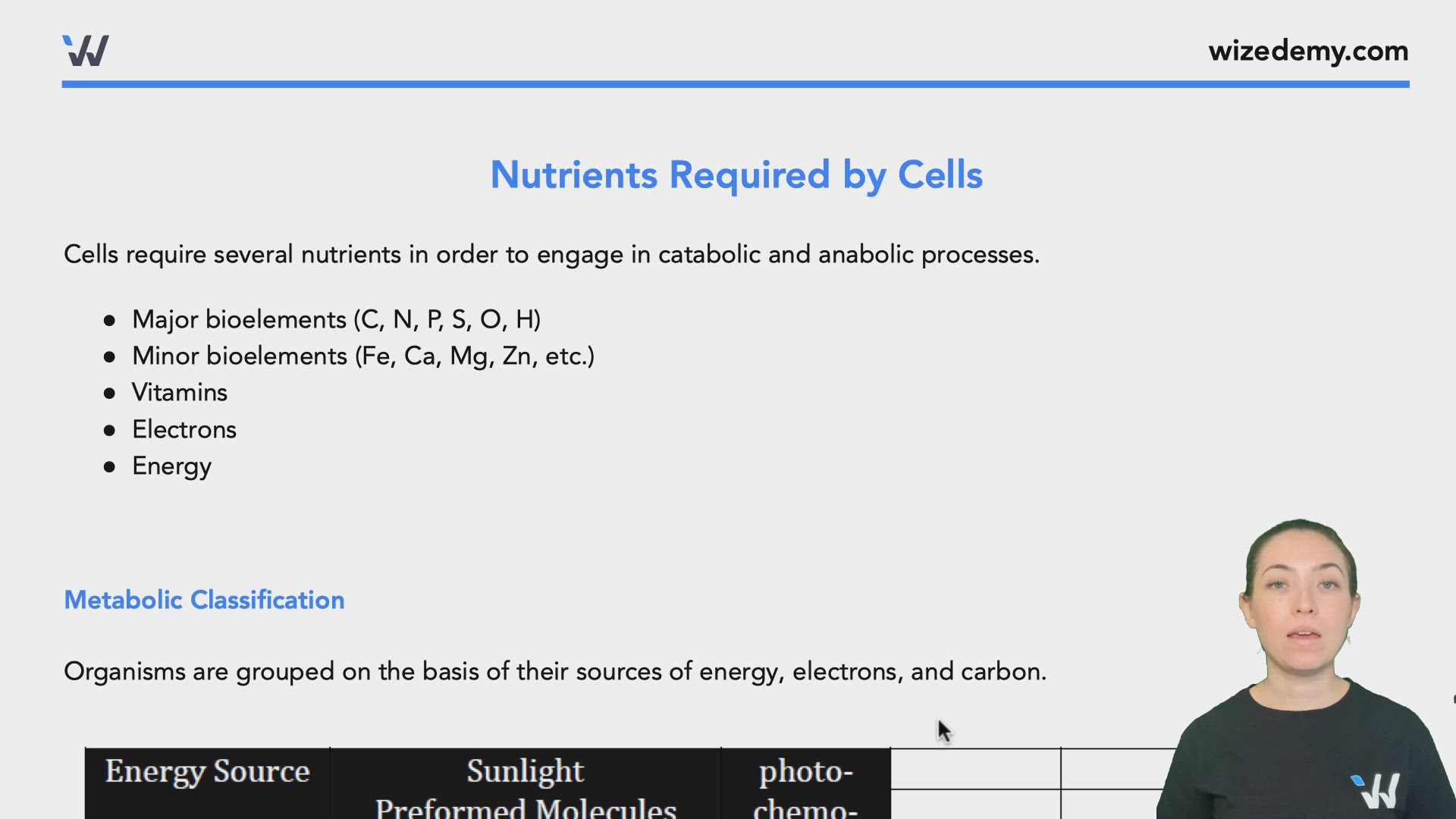
Nutrients Required by Cells
Cells require several nutrients in order to engage in catabolic and anabolic processes.
- Major bioelements (C, N, P, S, O, H)
- Minor bioelements (Fe, Ca, Mg, Zn, etc.)
- Vitamins
- Electrons
- Energy
Metabolic Classification
Organisms are grouped on the basis of their sources of energy, electrons, and carbon.

Practice: Organism Classifications
Describe the energy, electron and carbon source of the following organisms
a) Photoorganoheterotroph:
Energy source is (sunlight/ preformed molecules) .
Electron donor is (organic/ inorganic) compound.
Carbon source is (organic/ inorganic) compound.
b) Chemolithoheterotroph:
Energy source is (sunlight/ preformed molecules) .
Electron donor is (organic/ inorganic) compound.
Carbon source is (organic/ inorganic) compound.
Practice: Anabolism
Define anabolism:
Practice: Major Bioelements
Which one of the following is not a MAJOR bioelement?