Wize University Biology Textbook > Cellular Respiration
The Electron Transport Chain [short]
Popular Courses
MCAT
General Course
AP Biology Exam Prep Course
AP Exam Prep
Biology
General Course
General Biology
University Study Guides
BIOLOGY 1002B
Western University
BIOL 211
University of Calgary
BIOL 107
University of Alberta
BIOL 102
Queen's University
BIOL 112
University of British Columbia
Grade 12 Biology
Canada High School
DAT
General Course
High School Biology
US High School
General Biology
University Study Guides
BIOL 130
University of Waterloo
BIOL 111
McGill University
BIOL 186
University of Victoria
BIOL 1010
Dalhousie University
BIOL-1101
University of Windsor
BIOL 1201
Western University
BISC 101
Simon Fraser University

0:00 / 0:00
Electron Transport Chain Overview
Occurs at the inner mitochondrial membrane and uses electron donor molecules NADH and FADH2 produced from glycolysis and the citric acid cycle. Steps involved:
- Electrons from NADH and FADH2 are used by membrane proteins to pump hydrogen ions across the membrane.
- This creates a hydrogen ion gradient on the outside of the membrane (between the outer and inner membrane of the mitochondria).
- The H+ gradient (potential energy) is used by ATP synthase to make ATP.
- The movement of hydrogen ions down their gradient is called chemiosmosis.
What happens to the extra electrons at the end of ETC?
- They are accepted by oxygen molecules.
- This generates water upon electron accepting.

Products of ETC
- Uses all the NADH and FADH2 from the rest of cellular respiration and produces ATP from them.
- Net ATP production (entire process from glucose to O2) = 30 - 32 ATP.
- Lack of O2 causes a build up of electrons. This happens because there is nothing available to accept the electrons, so they just end up sitting and waiting.
- Poisons (such as cyanide) dissipate H+ ions and block ATP synthesis. If this happens, the body will be starved of energy. The process is fatal within minutes.
Explain how the ETC uses the energy of electrons to indirectly make ATP.
- The high energy electrons are passed through a chain of proteins in the inner membrane of the mitochondria.
- Their energy excites the membrane proteins, causing them to pump H+ ions from [low] to [high].
- The H+ ions have potential energy because of their growing concentration gradient.
- They are allowed back through the membrane through the ATPase pump.
- This pump harnesses the potential energy from the H+ ions as they come through, creating ATP.
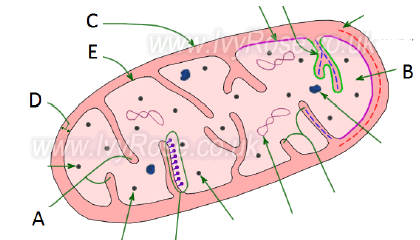
Letter A is pointing to the location of:
You are testing a drug that causes the inner mitochondrial membrane to become permeable to H+. How would this drug affect mitochondrial ATP output?