Wize University Biology Textbook > Cellular Respiration
The Electron Transport Chain [detailed]
Popular Courses
MCAT
General Course
AP Biology Exam Prep Course
AP Exam Prep
Biology
General Course
General Biology
University Study Guides
BIOLOGY 1002B
Western University
BIOL 211
University of Calgary
BIOL 112
University of British Columbia
Grade 12 Biology
Canada High School
DAT
General Course
High School Biology
US High School
General Biology
University Study Guides
SC/BIOL 1000 3.00
York University
BIOL 111
McGill University
BIO 1141
University of Ottawa
BLG 143
Toronto Metropolitan University
BIOL 112
McGill University
BIOL 186
University of Victoria
BIOL 1201
Western University
BIOL 1P91
Brock University
BIOLOGY 2601A/B
Western University

0:00 / 0:00
The Electron Transport Chain
Glycolysis, pyruvate processing, and the citric acid cycle transferred energy from glucose to 10 NADH and 2 FADH2 and produced 4 ATP by substrate level phosphorylation.
- The electron carriers NADH and FADH2 are then used to produce more ATP by oxidative phosphorylation by transferring electrons to the electron transport chain.
- The electron transport chain consists of a series of 4 transmembrane complexes and a transmembrane ATP synthase.
- The energy from NADH and FADH2 is used to transport H+ ions across the membrane to generate an electrochemical gradient.

The electron transport chain can be broken down into the following steps:
- NADH transfers electrons to complex I, which transports 4 H+ across the membrane. The 4 electrons (e-) are transported by coenzyme Q (CoQ) to complex III.

- FADH2 transfers electrons to complex II. The electrons (e-) are transported by coenzyme Q (CoQ) to complex III. (NOTE: no H+ are transported by complex II).

- Complex III transfers electrons to complex IV through cytochrome C. Complex III transports 4 H+ across the membrane.
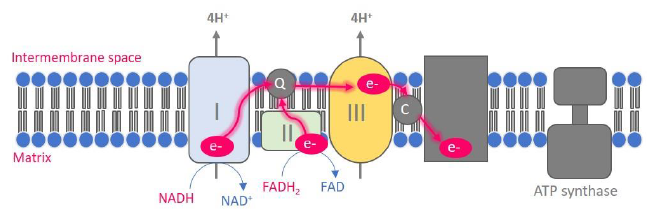
- Complex IV transfers electrons to reduce ½ O2 to H2O. Complex IV transports 2 H+ across the membrane.

- The electrochemical gradient that was generated in steps 1 through 4 is used to synthesize ATP. H+ ions flow through ATP synthase to produce ATP from ADP and Pi. This is called oxidative phosphorylation.

ATP YIELD: 30 - 32 ATP per glucose (Note: 2 ATP from glycolysis + 2 from TCA cycle)
Summary
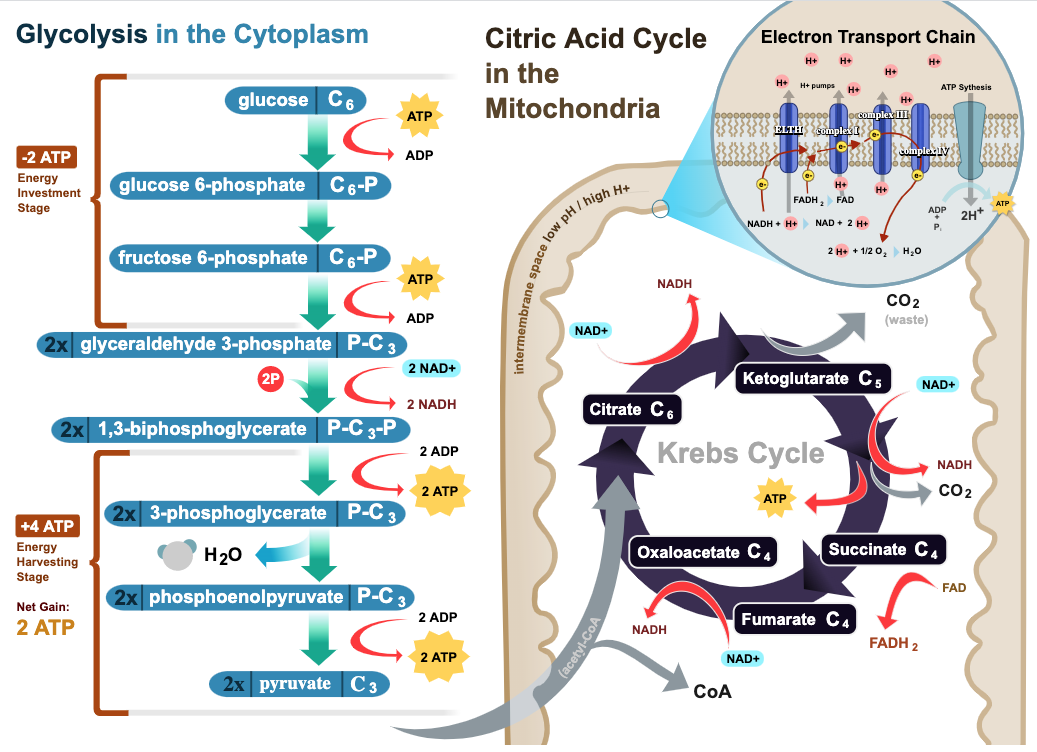
How much ATP is produced from the oxidation of 1 molecule of glucose?

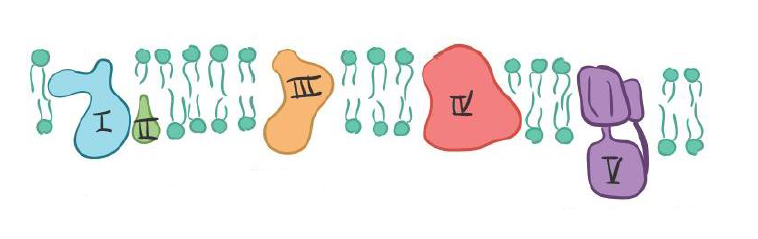

Practice: Complexes of ETC
Which complex in the electron transport system initially accepts electrons from FADH2?
Practice: Names of Complexes
Match the full name to the ETC complex. (Even though not specified in the video lesson, the names match function)
A.
Ubiquinol/cytochrome c oxidoreductase
B.
Succinate/Q reductase
C.
NADH-Q reductase complex
D.
Cytochrome c oxidase
Complex I
Complex II
Complex III
Complex IV
Practice: H+ Gradient
Which of the following is FALSE regarding the H+ gradient?
Practice: Cascade of Electrons
How do electrons cascade down the electron transport chain (ETC)?
Extra Practice
ATP Production
Which processes in central metabolism are able to generate ATP? Select all that apply.
ATP Production
Which processes in central metabolism are able to generate ATP? Select all that apply.