Wize University Biology Textbook > Photosynthesis
Photorespiration
Popular Courses
Biology
General Course
General Biology
University Study Guides
BIOLOGY 1002B
Western University
BIOL 211
University of Calgary
BIOL 102
Queen's University
DAT
General Course
High School Biology
US High School
General Biology
University Study Guides
SC/BIOL 1000 3.00
York University
BLG 143
Toronto Metropolitan University
BIOL 112
McGill University
BIOL 186
University of Victoria
BIOL-1101
University of Windsor
BIOL 1201
Western University
BISC 101
Simon Fraser University
BIOL 1011
Dalhousie University
BIOL 1P91
Brock University
BIOLOGY 2601A/B
Western University
BS 161
Michigan State University
BIOL 1020
University of Manitoba
0:00 / 0:00
Photorespiration
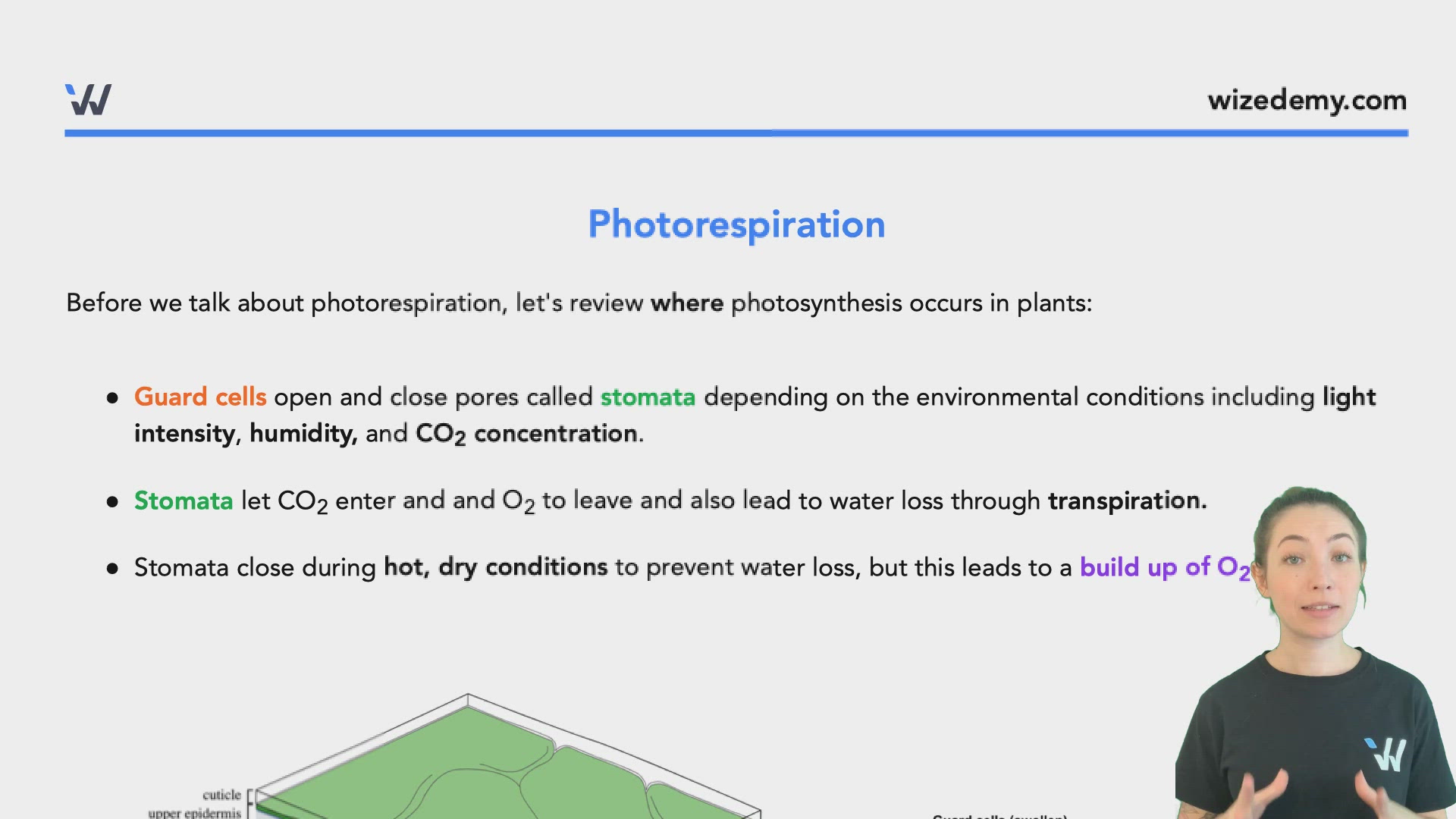
Before we talk about photorespiration, let's review where photosynthesis occurs in plants:
- Guard cells open and close pores called stomata depending on the environmental conditions including light intensity, humidity, and CO2 concentration.
- Stomata let CO2 enter and and O2 to leave and also lead to water loss through transpiration.
- Stomata close during hot, dry conditions to prevent water loss, but this leads to a build up of O2.

Why is build up of O2 a problem?
- Rubisco, the enzyme that usually fixes CO2 can also use O2 as a substrate.
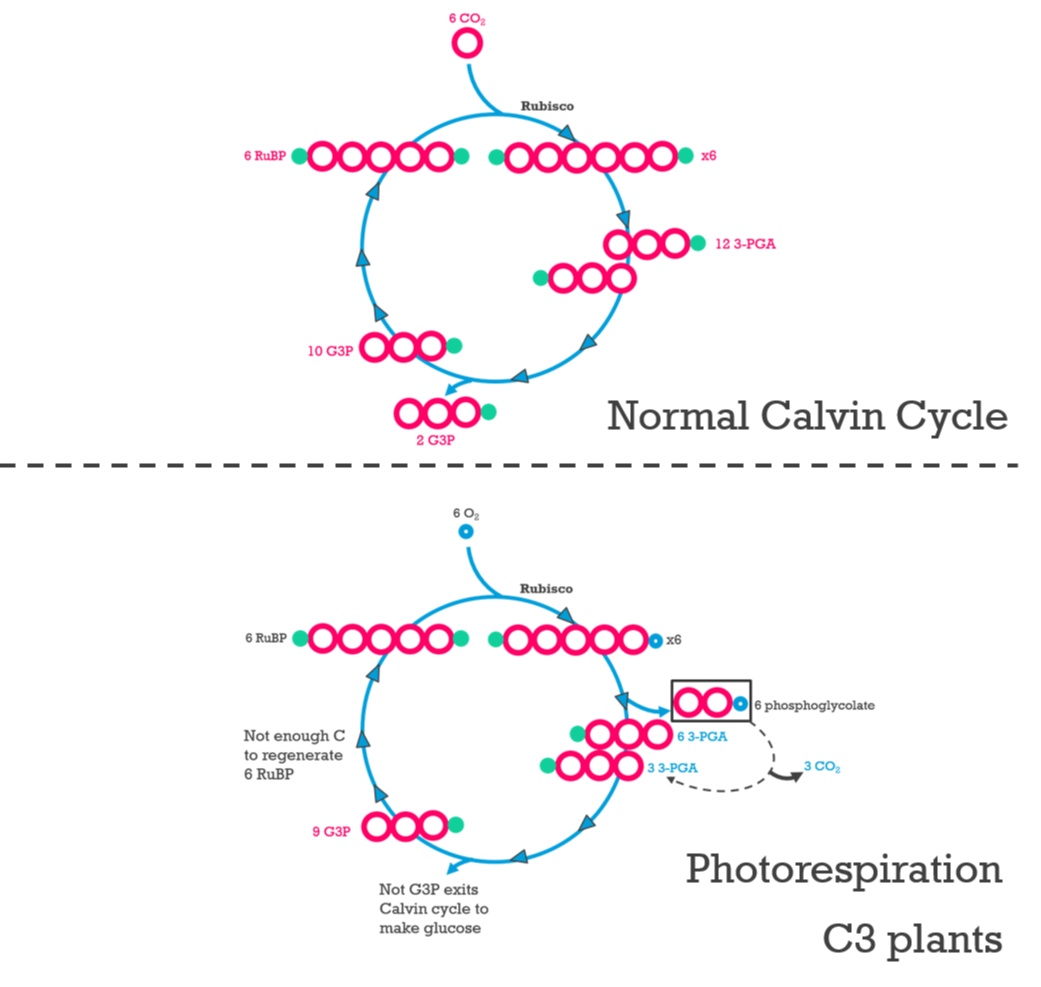
- Photorespiration, also known as oxidative photosynthetic carbon cycle or C2 photosynthesis, is the process in which Rubisco adds an O2 to RuBP, rather than a CO2 as in the Calvin Cycle.
- This wastes energy and decreases sugar production.
- Under hot, dry conditions, photorespiration increases.


Watch Out!
Don't be alarmed that this cycle is showing the required amount of CO2 (6) to make a full molecule of glucose instead of 3 which is required amount to allow one molecule of G3P to leave.
- Some plants - C4 plants and CAM plants - have strategies to minimize this problem
- In C3 plants, 6 molecules of phosphoglycolate are produced in photorespiration.
- Three of these go through a salvage pathway, recovering half of the 3-PGA. The other 3 are lost to CO2.
Practice: Problem of Photorespiration
Why is photorespiration a problem for plants?