Wize University Biology Textbook > Gene Expression & Regulation
Prokaryotic Operons: Maltose (mal) Operon
Popular Courses
MCAT
General Course
Biology
General Course
General Biology
University Study Guides
BIOLOGY 1002B
Western University
BIOL 112
University of British Columbia
Grade 12 Biology
Canada High School
DAT
General Course
General Biology
University Study Guides
BIOL 130
University of Waterloo
SC/BIOL 1000 3.00
York University
BLG 143
Toronto Metropolitan University
BIOLOGY 2581A/B
Western University
BIOL 112
McGill University
BIOL-1101
University of Windsor
BIO230H1
University of Toronto
BIOL 1201
Western University
MBG*2040
University of Guelph
BIOL 1P91
Brock University
BS 161
Michigan State University
BIOL 1020
University of Manitoba

0:00 / 0:00
The Maltose (mal) Operon
The mal operon encodes for proteins required to take up and degrade maltose (MalP and MalQ).
- The mal operon is positively regulated by an activator (MalT).
- When maltose binds to MalT, it can bind the initiator sequence and promote transcription.
- Maltose is aninducer.
When maltose is present...
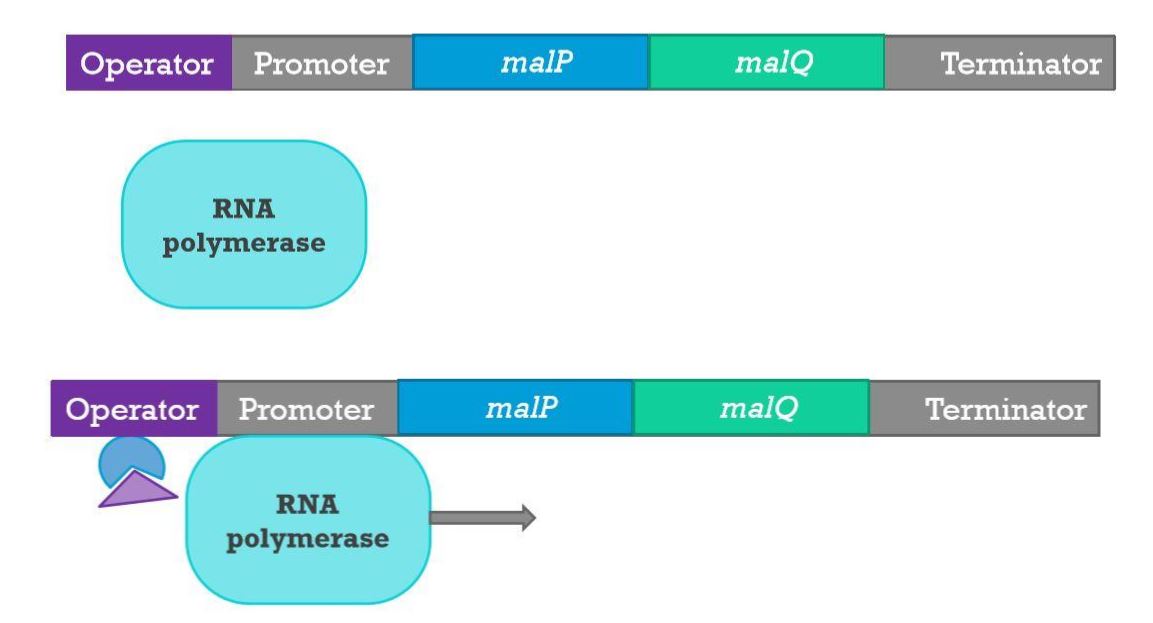
Maltose binds to the activator MalT, which can then bind to the operator, promoting transcription by RNA polymerase.
When maltose is absent...
The activator cannot bind to the operator and transcription does not occur.
Wize Concept
As with the lac operon, this ensures that energy is not wasted transcribing and translating the genes for maltose uptake and degradation when maltose is not present.
Wize Tip
Genes are written in lower case and italics (e.g. malP, malQ), while proteins are written with the first letter capitalized and not italicized (e.g. MalP, MalQ). When written by hand, gene names are underlined instead of being italicized. Make sure you use the correct writing convention.
Example: Positive Regulation
The bacterial maltose operon is shown in the picture below. It encodes genes involved in metabolism the sugar maltose but is only activated when maltose is available to the cells. In this scenario, the maltose regulatory protein is an activator, and maltose is an inducer. Without maltose bound, the maltose regulatory protein is not bound to DNA.

Predict the level of transcription in the following examples and draw out what the operon would look like in each of these situations:
1. Maltose is not present in the system
If there is no maltose, the positive regulatory protein cannot bind to the operator. The maltose molecule binds to a region of the regulatory protein and causes a conformational change that increases the proteins affinity to the DNA (specifically the operator). The regulatory protein them recruits RNA polymerase to bind the promoter. Without maltose, neither the regulatory protein nor the RNA polymerase can bind so no transcription occurs.
2. Maltose is present in the system
When maltose is present (inducer), it binds to the regulatory protein causing its shape to change so it can bind to the operator. It then recruits RNA polymerase to bind to the promoter region and activate transcription. Therefore transcription of the maltose metabolism enzymes does occur.

Practice: MalT Mutant
Predict the phenotype of a malT mutant in which malT can no longer bind to the operator:
Practice: MalT in Mutant Cell
Predict the phenotype if a wild-type malT gene is introduced into the malT mutant cell (MalT can no longer bind the operator)
Practice: Determining Type of Regulation
You are doing an experiment to determine the mechanism of gene expression of a bacterial operon responsible for the utilization of trehalose. You know Bcd1 is the regulator. You have two strains of the bacteria: one has the normal Bcd1 regulator (+bcd1), and the other does not (-bcd1). You obtain the following results when growing the two strains with and without trehalose:

Is this system....