Wize University Biology Textbook > Gene Expression & Regulation
Prokaryotic Operons: Lactose (lac) Operon [detailed]
Popular Courses
MCAT
General Course
Biology
General Course
General Biology
University Study Guides
BIOLOGY 1002B
Western University
BIOL 112
University of British Columbia
Grade 12 Biology
Canada High School
DAT
General Course
General Biology
University Study Guides
BIOL 130
University of Waterloo
SC/BIOL 1000 3.00
York University
BIOL 311
University of Calgary
BLG 143
Toronto Metropolitan University
BIOLOGY 2581A/B
Western University
BIOL 112
McGill University
BIOL 1010
Dalhousie University
BIO230H1
University of Toronto
BIOL 1201
Western University
MBG*2040
University of Guelph
BIOL 1P91
Brock University
BIOL 331
University of Calgary

0:00 / 0:00
The Lac Operon
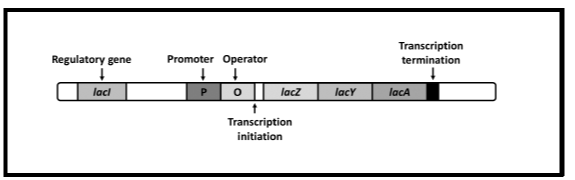
Lactose metabolism is under the control of a single promoter.
- lacZ = β-galactosidase
- lacY = permease
- lacA = transacetylase
- lacl = Lac repressor
When there is NO lactose…
- Lac repressor, expressed from lacl gene, binds the operator.
- Lac repressor binding blocks RNA polymerase from binding the promoter.
- Sometimes the Lac repressor dissociates and some lac gene expression occurs.

When lactose is present…
- Permease, a lactose transporter, transports lactose into the cell.
- Lactose is converted to allolactose by β-galactosidase.
- These proteins are present because of the low levels of transcription from repressor dissociation.
- Allolactose binds the allosteric site on the Lac repressor.
- Causes a change in repressor conformation = does not allow it to bind the operator.
- RNA polymerase can bind the promoter and induce lac gene expression.


0:00 / 0:00
The Lac Operon & Glucose Regulation
When lactose is present AND glucose is absent…
- Permease transports lactose into the cell.
- β-galactosidase converts lactose to allolactose.
- Low glucose levels activates adenylyl cyclase that synthesizes cAMP.
- cAMP activates the CAP protein.
- CAP is an activator protein.
- cAMP is an inducer.
- Active CAP binds the CAP sequence in the Lac promoter.
- CAP binding to the promoter promotes RNA polymerase binding and transcription = high transcription levels.

When lactose AND glucose is present…
- Permease transports lactose into the cell.
- β-galactosidase converts lactose to allolactose.
- High glucose levels inactivate adenylyl cyclase, thus decreases cAMP levels.
- No cAMP inactivates the CAP protein.
- Inactive CAP cannot bind promoter and promote transcription = low transcription levels.

Wize Tip
Think about it like this: if glucose is available, lactose does not need to be broken down to be used for energy.
Lac Operon Summary

Example: Mutations Affecting Lac Operon
How would each of the following mutations, that cause the protein/sequence nonfunctional, change lac operon expression when lactose is present and glucose is absent?
a. lacZ
b. lacI promoter
c. Operator
d. lacY
A mutation in...
a) lacZ = no β−gal = no allolactose = no LacR inhibition = no lac gene expression
b) lacl promoter = no Lacl transc. = no Lac R
BUT! = no change in gene expression
c) operator = LacR no longer recognizes operator
BUT! = no change in lac gene expression
d) lacY = no permease = no lactose transport
=no allolactose =no LacR inhibition
= no gene expression
Example: Positive and Negative Regulation of Operons
In bacteria, there are three enzymes that break down the sugar, lactose. When lactose is being broken down, it is known as lactose metabolism. These enzymes are LacZ, LacY, and LacA (collectively called LacZYA). Production of these enzymes is regulated by a regulatory protein known as LacI. LacI normally binds to the start of these genes and prevents the production of LacZYA when there is no lactose in the cell. When lactose is present, LacI releases its hold and LacZ, LacY, and LacA are produced.
A. What is likely occurring here? How is LacI regulated by lactose?
Lactose is most likely binding to LacI at an allosteric site since the main active site is binding to the DNA that encodes LacZYA. Lactose is therefore an inhibitor of lactose metabolism. When lactose binds to LacI, it changes its active site so it no longer binds to the DNA and LacZYA can be expressed. When lactose is absent, LacI is bound to the DNA encoding LacZYA and prevents their expression/production.
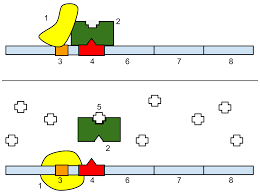
Yellow: RNA polymerase which is going to read the DNA and help produce LacZYA (genes number 6,7,8)
Green: LacI (it binds to the DNA at the red site to prevent the LacZYA genes from being expressed)
Crosses: Lactose molecules
Interestingly, a second substrate and a second regulatory protein also have a role in regulating the production of LacZYA which is another sugar called glucose (substrate) and CAP (regulatory protein). CAP is actually need to activate the expression or production of LacZYA (it promotes the binding of RNA polymerase which is the enzyme responsible for the actual production of LacZYA). When glucose is present, it inhibits the production a small molecule called cAMP which acts as an effector binding CAP so that CAP can bind to DNA (specifically the CAP binding site).
Absence of cAMP which is inhibited by the presence of glucose prevent CAP from binding to the LacZYA genes, this prevents LacZYA production.
B. Therefore, what would happen if the cell had both glucose and lactose present?
There would be no production of LacZYA. Even if lactose releases the inhibition by LacI by binding it allosterically. The presence of glucose results in no cAMP production so CAP would not be activated to bind to the CAP binding site to promote binding of RNA polymerase to the promoter and initiate transcription, preventing their expression. Therefore, there would be no lactose metabolism.

P: is the promoter region where RNA polymerase will bind to promote the expression of LacZYA (shown in black arrows)
O: operator region where LacI binds to block the expression of LacZYA
C. How could glucose be regulating the production of LacZYA through cAMP?
It is likely inhibiting the enzyme that produces cAMP which is needed activate the regulatory protein, CAP which is an activator of the operon.
D. Continuing from scenario (B), what would happen if the glucose levels went down?
Since there is less or no glucose, the cell starts to produce the inducer, cAMP. cAMP binds to CAP which changes its conformation so it can now bind to the CAP binding site which allows it to recruit RNA polymerase to the promoter to allow expression of lac genes. Since lactose is already present, it is bound to LacI which prevents it from binding to LacZYA operator region too. Therefore the genes for LacZYA are free of any inhibitors and LacZYA can be produced. Lactose metabolism can now proceed.

cAMP is bound to CAP protein
E. Continuing from scenario (D), what happens now that glucose is complete depleted and lactose levels are going down significantly?
The absence of glucose results in high amounts of cAMP which can bind to and activate CAP binding to the CAP binding site to recruit RNA polymerase. However, the lack of lactose would result in LacI being unbound by lactose and therefore have a high affinity for binding to the LacZYA gene operator to prevent LacZYA production. The LacI repressor prevents RNA polymerase from getting to the promoter and transcribing the genes. There no expression occurs

LacI shown in beige/yellow
Therefore: to actually get lactose metabolism (LacZYA production), you need cAMP to bind to CAP and LacI not to bind to the operator of the LacZYA operon.
Practice: Consequence of Mutation in LacZ
What would happen to lac gene expression, in the presence of lactose, if there was a mutation in the lacZ gene such that its protein product was no longer functional?