Wize University Biology Textbook > Gene Expression & Regulation
Prokaryotic Operons: Lactose (lac) Operon
Popular Courses
MCAT
General Course
Biology
General Course
General Biology
University Study Guides
BIOLOGY 1002B
Western University
BIOL 107
University of Alberta
BIOL 102
Queen's University
BIOL 112
University of British Columbia
Grade 12 Biology
Canada High School
DAT
General Course
General Biology
University Study Guides
BLG 143
Toronto Metropolitan University
BIOLOGY 2581A/B
Western University
BIOL 1010
Dalhousie University
BIOL-1101
University of Windsor
BIOL 1201
Western University
MBG*2040
University of Guelph
BIOL 1P91
Brock University
BS 161
Michigan State University
BIOL 1020
University of Manitoba
BIOL 331
University of Calgary
0:00 / 0:00
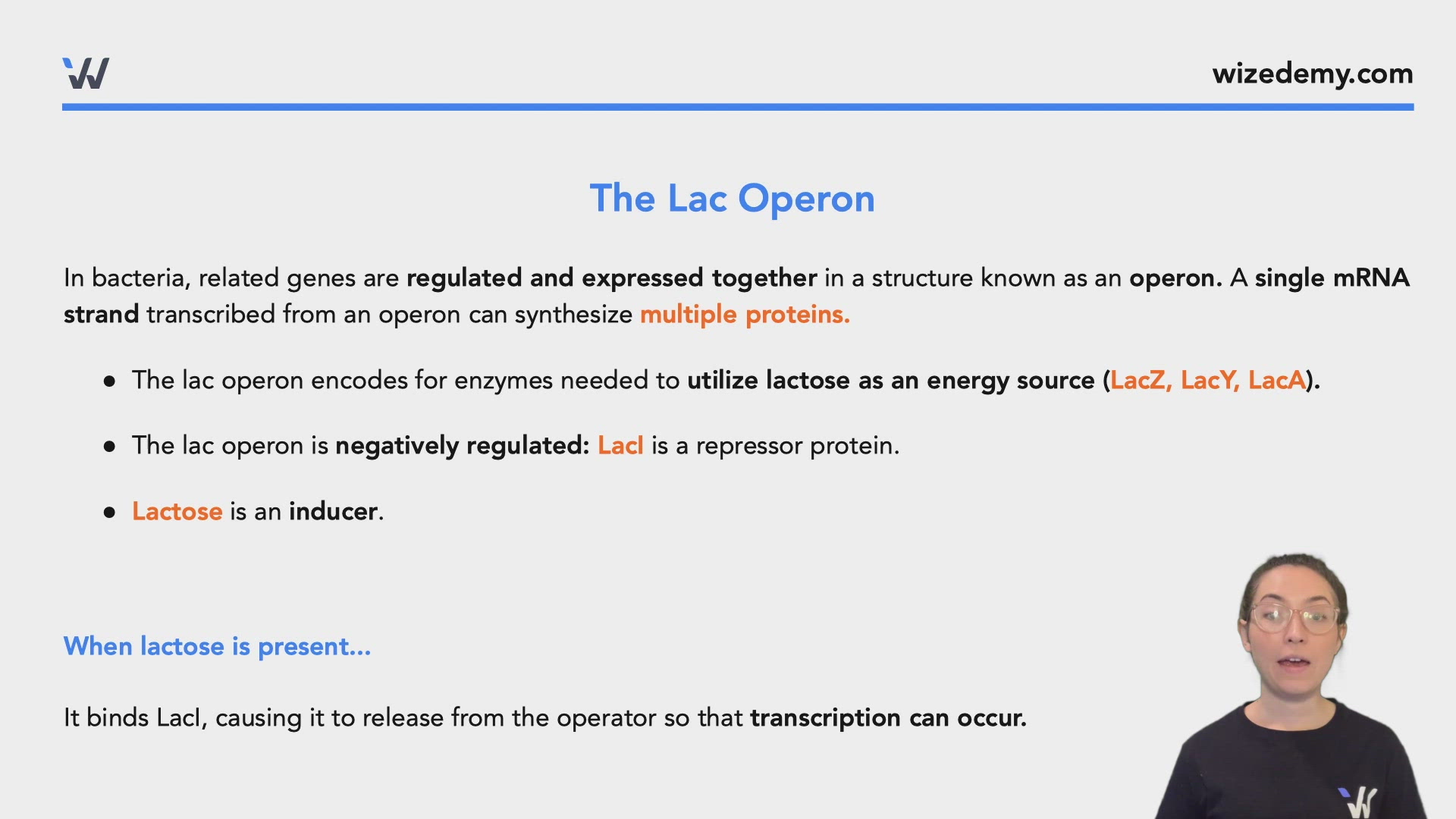
The Lac Operon
In bacteria, related genes are regulated and expressed together in a structure known as an operon. A single mRNA strand transcribed from an operon can synthesize multiple proteins.
- The lac operon encodes for enzymes needed to utilize lactose as an energy source (LacZ, LacY, LacA).
- The lac operon is negatively regulated: LacI is a repressor protein.
- Lactose is an inducer.
When lactose is present...
It binds LacI, causing it to release from the operator so that transcription can occur.
When lactose is absent...
Repressor LacI stays bound to the operator and blocks RNA polymerase so there is no transcription of the operon.

Wize Tip
This system ensures that the bacterium is not wasting energy transcribing and translating the operon when the enzymes for lactose utilization are not needed.
Practice: Lac Repressor
The lac repressor is a:
Practice: Lactose Operon Molecules
In the lactose operon, what do you call the molecule that binds to lacI thereby allowing transcription to occur?
Practice: Lactose Mutation
You are working with the bacterium E. coli in the lab. You find that your strain is suddenly unable to use lactose. Upon further examination, you find the presence of LacI protein, but no LacZ, LacY, or LacA. What is a possible explanation for this?
i. A mutation in lacI resulted in a LacI protein that is unable to bind lactose and therefore blocks transcription.
ii. A mutation in the operator that no longer allows for binding of LacI.
iii. A mutation in lacI resulted in a LacI protein that is unable to bind lactose and therefore cannot bind the initiator.
iv. A mutation in lacI resulted in a LacI protein that can no longer bind DNA.
v. A mutation in the operon promoter.