Wize University Biology Textbook > Gene Expression & Regulation
Prokaryotic Operons: Tryptophan (trp) Operon
Popular Courses
MCAT
General Course
Biology
General Course
General Biology
University Study Guides
BIOLOGY 1002B
Western University
BIOL 107
University of Alberta
DAT
General Course
Grade 12 Biology
Canada High School
General Biology
University Study Guides
BIOL 130
University of Waterloo
SC/BIOL 1000 3.00
York University
BLG 143
Toronto Metropolitan University
BIOLOGY 2581A/B
Western University
BIOL 112
McGill University
BIOL 1010
Dalhousie University
BIOL-1101
University of Windsor
BIO230H1
University of Toronto
BIOL 1201
Western University
MBG*2040
University of Guelph
BIOL 1P91
Brock University
BS 161
Michigan State University

0:00 / 0:00
The Tryptophan (Trp) Operon
Tryptophan is an amino acid involved in an operon in some bacteria.
- The goal of this operon is to produce tryptophan when it is low in the cell.
- Tryptophan metabolism is under the control of a single promoter.
- Genes encoded in the trp operon are involved in trp biosynthesis.
- TrpR is a repressor protein; it binds to the operator (O).
- Trp is a co-repressor.
- The structural (trpA - E) genes are proteins required for production of trp.

If tryptophan is present…
- High Trp concentrations binds the allosteric site of the trp repressor and activates it.
- Activation of the trp repressor blocks transcription of the operon, thus no biosynthesis enzymes and no tryptophan.
If tryptophan is absent….
- Low Trp concentrations inactivates the trp repressor.
- Inactive Trp repressor allows the transcription of the operon, thus increasing expression of trp biosynthesis enzymes and tryptophan can be produced.

0:00 / 0:00
Trp Operon Attenuation
- Trp operon expression is dependent on BOTH the concentration of Trp in the cytosol and the number of charged tRNA (tRNA actually carrying a Trp amino acid).
- Attenuation is regulated by the trpL sequence, called the leader transcript.

If high number of charged tRNA (thus high Trp concentration)….
- Leader sequence contains 2 Trp codons in a row.
- If there is lots of Trp-tRNA’s then the ribosome can translate it quickly.
- This blocks the growing mRNA from forming the 2-3 stem loop structure as the ribosome is physically on top of the sequence 2.
- Blocking the 2-3 loop allows the 3-4 sequence loop to form, the 3-4 stem loop is a transcription termination sequence.
If low number of charged tRNA (thus low Trp concentration)…
- Ribosome stalls at leader sequence 1 as it waits for Trp-tRNAs to enter the A site for the 2 adjacent Trp codons.
- Stalling of the ribosome allows leader sequence 2 to form a hairpin loop with leader sequence 3.
- The 2-3 loop doesn’t allow the 3-4 loop to form, thus there is no transcription termination sequence.
- No transcription termination sequence = transcription of the trp operon.
The Trp Operon Summary

Example: Importance of Leader Sequence
Describe the importance of the leader sequence in the Trp operon.
Leader seq. contains 4 sequences that can form H-bonds in RNA form.
If high Trp = sequence 2 is blocked by ribosomes allowing 3-4 termination seq.
If allow Trp+ ribosomes pause at seq. I allowing 2-3 to form which blocks formation of the termination seq.
Example: Negative Regulation
The bacterial Trp operon encodes genes involved in synthesizing the amino acid tryptophan. It is regulated through feedback inhibition where Trp regulatory protein is a repressor and tryptophan is a co-repressor molecule. The system is shown below:
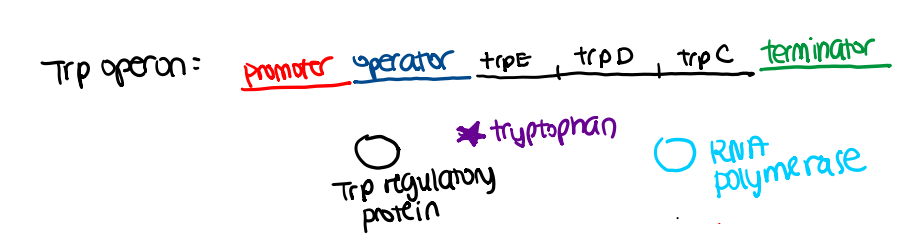
Predict the level of tryptophan synthesis in the following scenarios and draw out how the operon would look in each of these conditions:
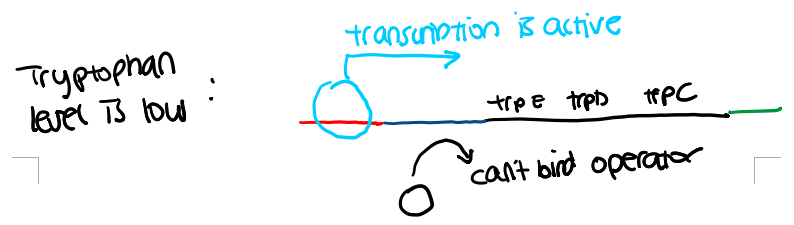
1. Tryptophan levels are low
Tryptophan normally binds to the regulatory protein causing a conformational change so that it can bind to DNA (specifically the operator). Without tryptophan or when there is very little tryptophan in the cell, the regulatory protein is not bound to the tryptophan and cannot bind to the operator. RNA polymerase, however, is bound to the promoter as it normally has a high affinity for the Trp operon promoter. Since there is nothing blocking its way, it will actively transcribe the tryptophan synthesis genes.
2. Tryptophan levels are high
When tryptophan is present in high amounts, it will start to bind the regulatory protein causing a conformational change that triggers its binding to the operator. The operator region is downstream of the promoter. RNA polymerase is still going to bind the promoter because it has a high affinity for it but it will not be able to move downwards towards the gene due to the blockage that the regulatory protein causes. Therefore, transcription would not occur.

Practice: RNA in Trp Operon
Consider the Trp operon. Which of the following are encoded in the DNA of the trp operon AND are transcribed by the cell into RNA?
Practice: Trp Operon Basics
Which of the following is true about the trp operon?