Wize University Biology Textbook > Gene Expression & Regulation
Introduction to Regulation of Gene Expression
Popular Courses
MCAT
General Course
Biology
General Course
General Biology
University Study Guides
BIOLOGY 1002B
Western University
BIOL 107
University of Alberta
BIOL 102
Queen's University
BIOL 112
University of British Columbia
Grade 12 Biology
Canada High School
DAT
General Course
General Biology
University Study Guides
SC/BIOL 1000 3.00
York University
BIOL 200
University of British Columbia
BLG 143
Toronto Metropolitan University
BIOLOGY 2581A/B
Western University
BIOL 112
McGill University
BIOL 1010
Dalhousie University
BIOL-1101
University of Windsor
BIO230H1
University of Toronto
BIOL 1201
Western University
MBG*2040
University of Guelph

0:00 / 0:00
Introduction to Regulation of Gene Expression
Gene expression can be regulated at multiple levels including at epigenetic, transcriptional, post-transcriptional, translational, and post-translational levels.
- All genes are not expressed at the same time. Organisms regulate gene expression in order to conserve energy and resources when certain gene products are not required.
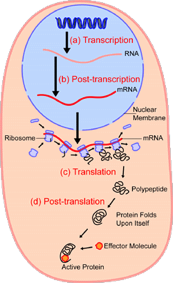
- Epigenetic and transcriptional regulation involves whether a gene (DNA) gets to be transcribed into RNA. These include:
- Whether the gene is physically accessible (epigenetic).
- Presence of special molecules called transcription factors to recruit RNA polymerase (transcriptional).
- RNA splicing and control of RNA stability (transcriptional).
- Translational regulation involves controlling mRNA translation into proteins.
- Post-translational regulation involves modification of the expressed protein, modulating its activity.
- Some genes are expressed continuously, and these are called constitutively expressed genes.
- This does not mean, however, that they are not regulated.
- Even though a gene may be expressed all the time, the expression levels can be regulated through promoter strength (transcriptional regulation) and the mRNA half-life (translational regulation).
- A strong promoter has a sequence closes to the consensus sequence and is therefore bound more often and more strongly by RNA polymerase, leading to more transcripts.
Wize Tip
Eukaryotes and prokaryotes can have all 3 levels of gene regulation. Prokaryotes are usually better understood and therefore covered in a lot of detail in courses.
0:00 / 0:00
Prokaryotic Levels of Regulation
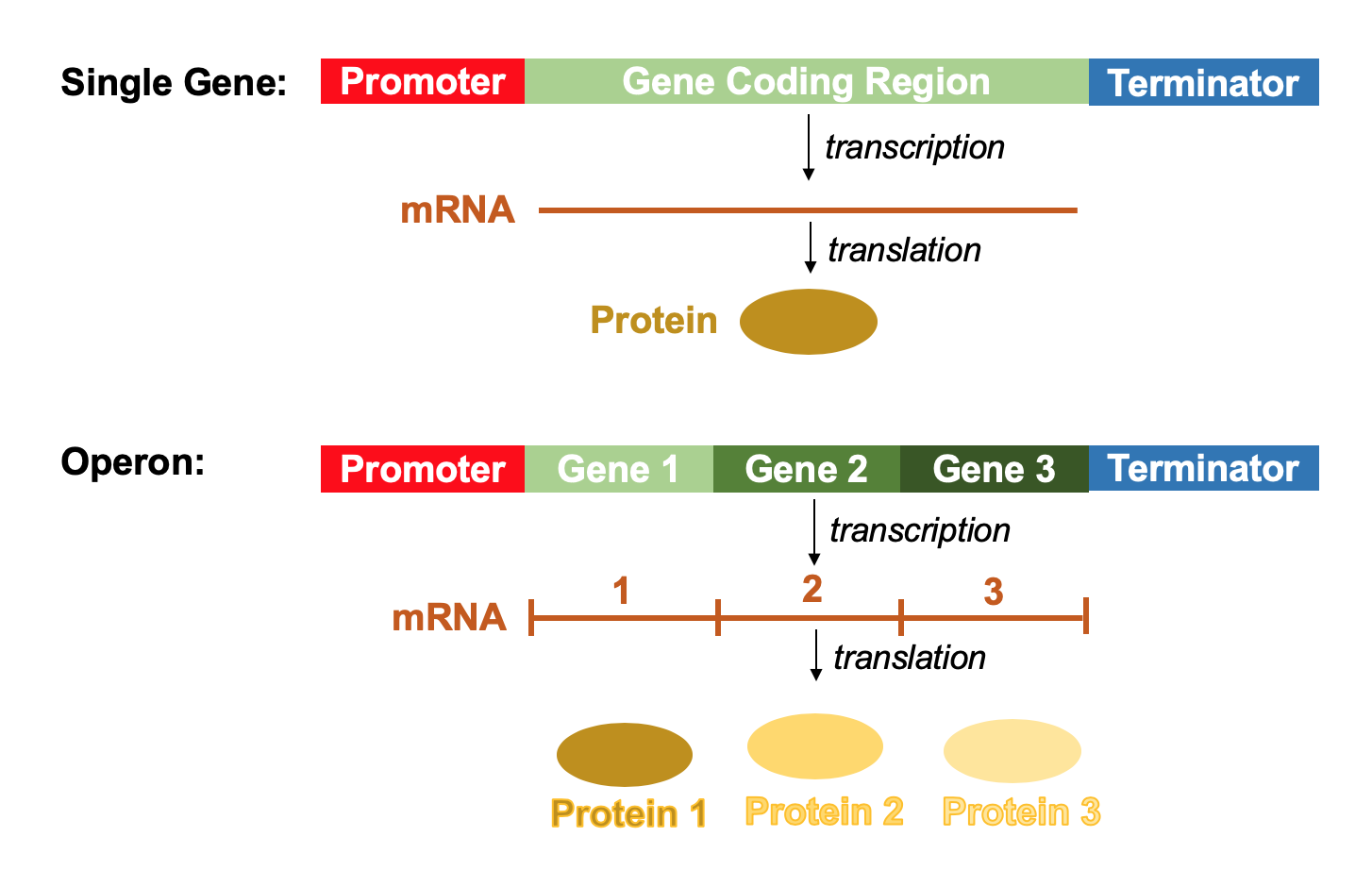
How a bacteria's genes are regulated depend on the type of gene in question. Unlike eukaryotes, bacteria can have a single gene between a promoter and a terminator or multiple genes in tandem (operons), which can make expression and regulation more complex.
Single Protein Genes
- One promoter, coding region and terminator.
- Encodes for one protein.
OR
Operons: Multi-Protein Gene
- One promoter, several protein coding regions, one terminator.
- Encodes for multiple proteins.
- Several start and stop codons to define the beginning/end of each protein.
- Genes like these are calledpolycistronic.
Transcriptional Regulation
- A region called an operator is directly upstream or downstream of the promoter.
- Regulatory proteins bind to the operator to control when RNA polymerase binds to the promoter to activate transcription.

Translational Regulation
Regulation at the translational level means affecting mRNA before it gets translated into proteins. The mRNA can be:
- Degraded before it gets translated
- Have short RNAs bind to prevent ribosome from binding
Post-translation Regulation
Occurs after translation of mRNA into proteins.
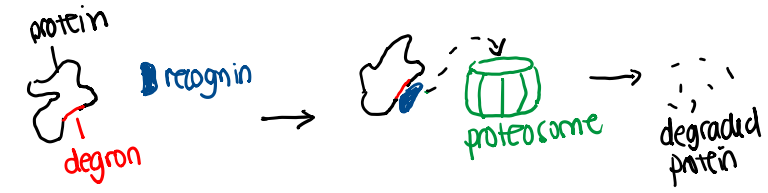
- Degradation of produced proteins to directly control their levels in the cell.
- A degron is a sequence on the protein that designates it for degradation.
- Recognin binds to the degron sequence and brings it to a proteosome (group of proteins that degrade other proteins).
Difference from Eukaryotes
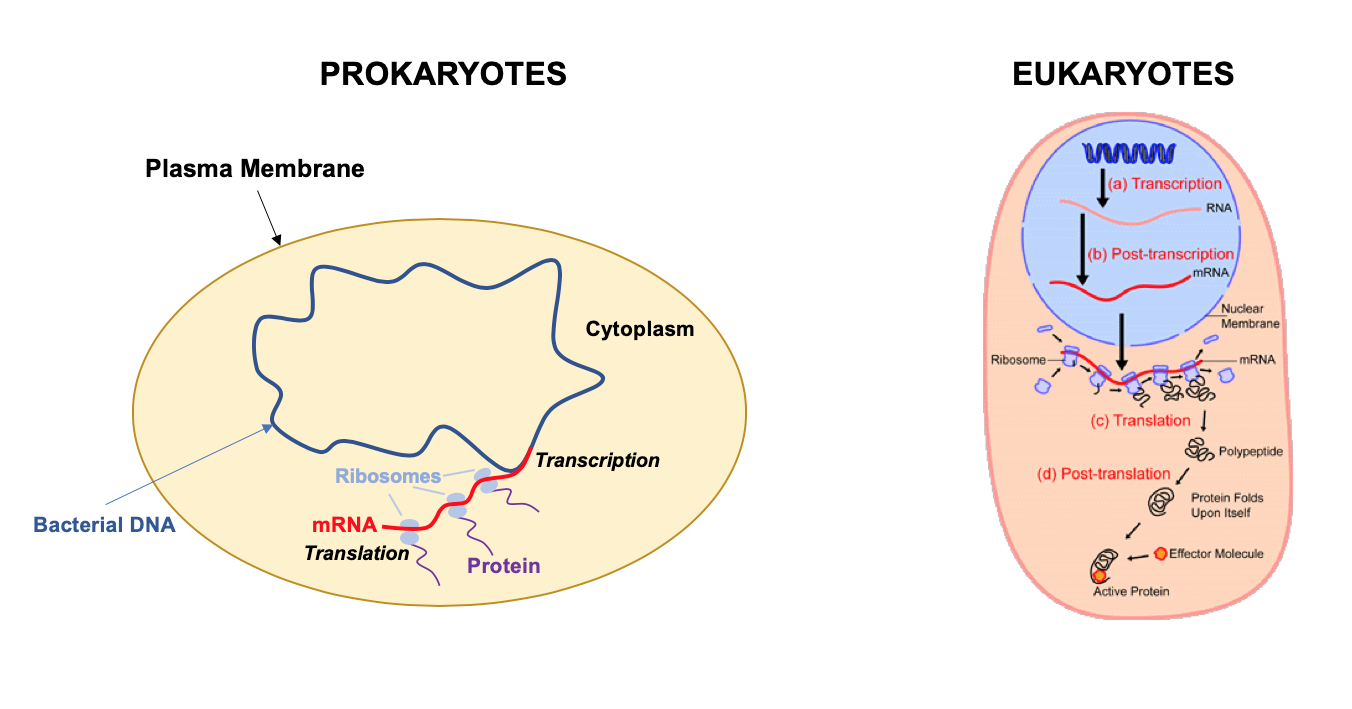
Because prokaryotes do not have a separate compartment for the nucleus, transcription and translation can occur simultaneously.
0:00 / 0:00
Prokaryotic Regulatory Proteins
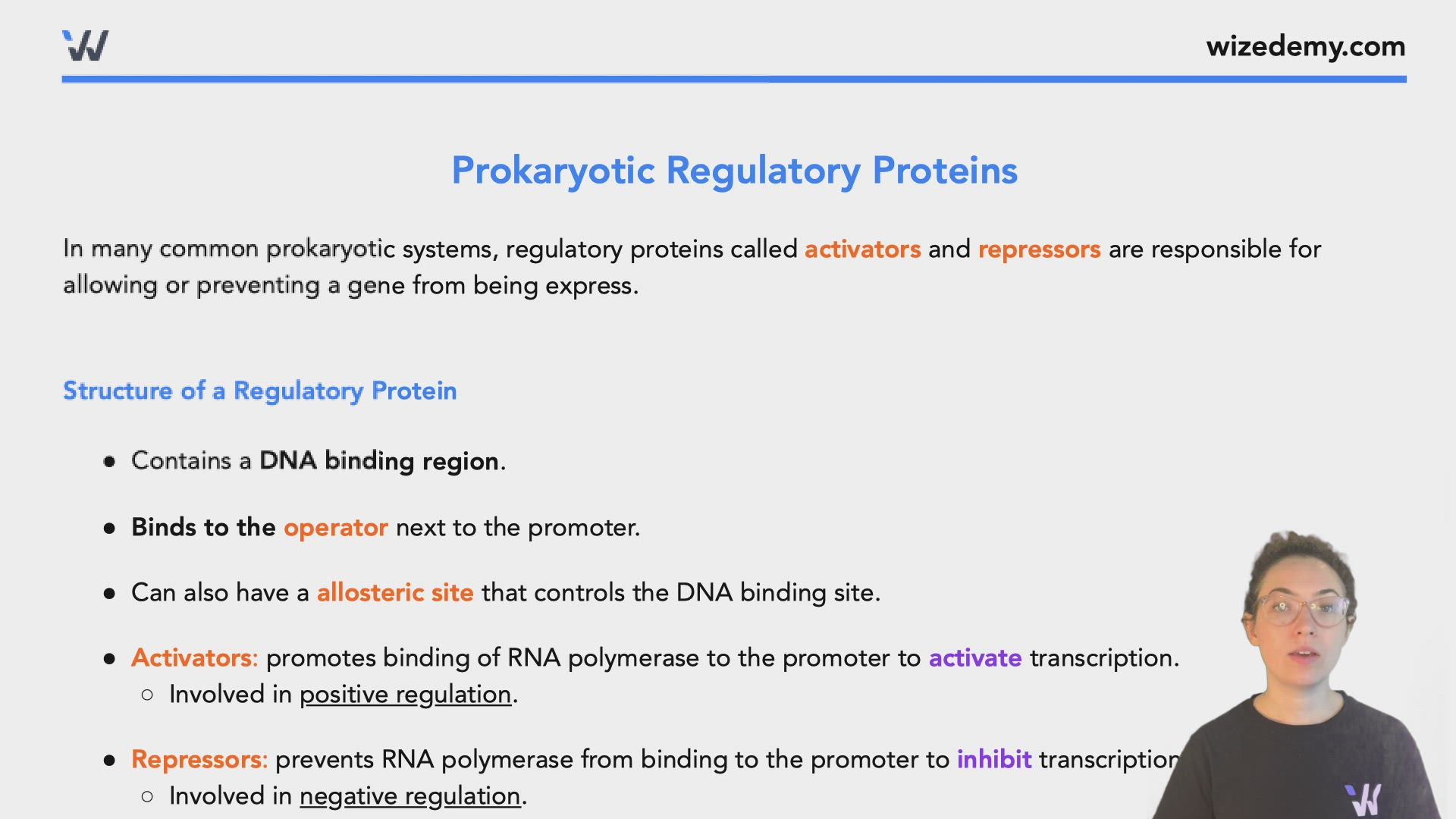
In many common prokaryotic systems, regulatory proteins called activators and repressors are responsible for allowing or preventing a gene from being expressed.
Structure of a Regulatory Protein
- Contains a DNA binding region.
- Binds to the operator next to the promoter.
- Can also have a allosteric site that controls the DNA binding site.
- Activators: promotes binding of RNA polymerase to the promoter to activate transcription.
- Involved in positive regulation.
- Repressors: prevents RNA polymerase from binding to the promoter to inhibit transcription.
- Involved in negative regulation.
- Activators and repressors can be influenced by small molecules.
- Inducers promote gene expression by inactivating repressors or activating activators.
- Inhibitors prevent gene expression by inhibiting activators.
- Co-repressors prevent gene expression by activating repressors.

0:00 / 0:00
Types of Transcriptional Regulation
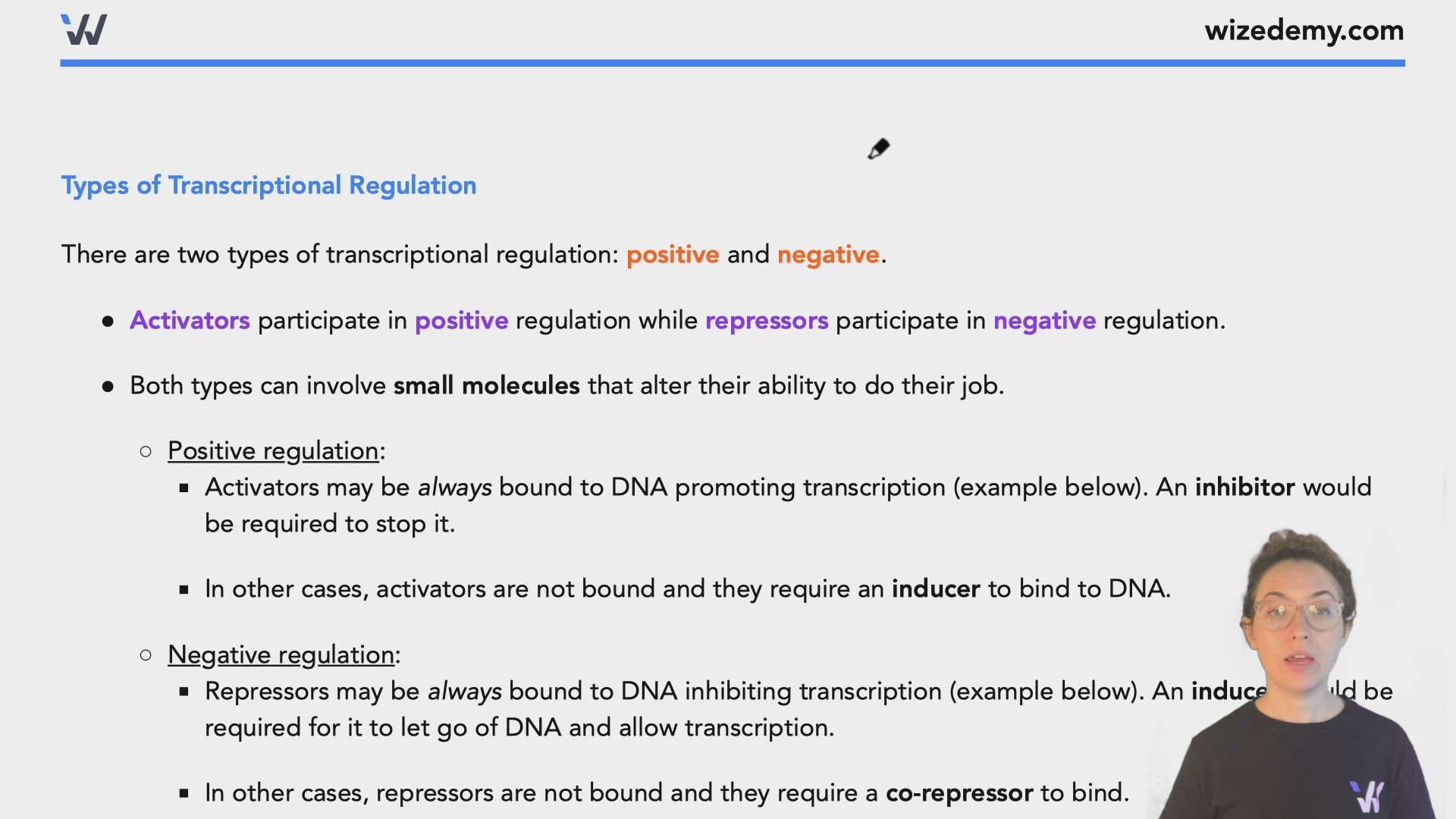
There are two types of transcriptional regulation: positive and negative.
- Activators participate in positive regulation while repressors participate in negative regulation.
- Both types can involve small molecules that alter their ability to do their job.
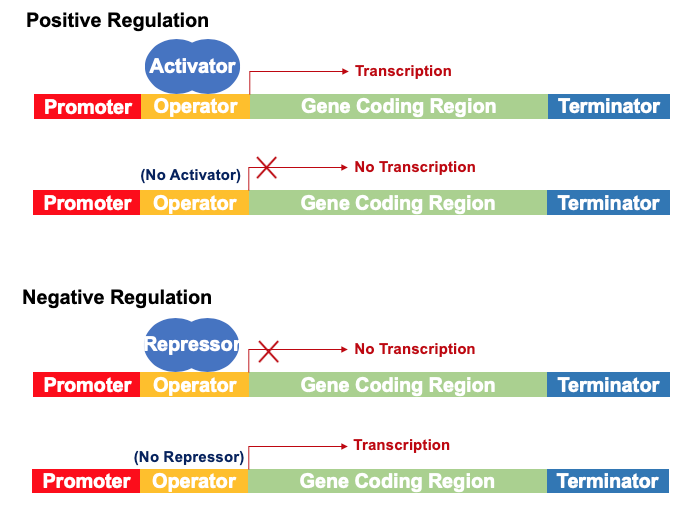
- Positive regulation:
- Activators may be always bound to DNA promoting transcription (example below). An inhibitor would be required to stop it.
- In other cases, activators are not bound and they require an inducer to bind to DNA.
- Negative regulation:
- Repressors may be always bound to DNA inhibiting transcription (example below). An inducer would be required for it to let go of DNA and allow transcription.
- In other cases, repressors are not bound and they require a co-repressor to bind.
Practice: Type of Small Molecule
A certain repressor protein is normally bound to a bacterial cell's DNA preventing transcription of a gene. A small molecule comes by and binds to the repressor protein, causing it to be displaced from DNA and allow transcription to occur. The repressor protein must have been bound to the _________ region and the small molecule is a ________.
Practice: Gene Expression & Regulation
Which of the following is incorrect?
Practice: Operon Structure
A single operon containing 5 genes has how many promoter regions?