Wize University Biology Textbook > Mendelian Genetics
History of Genetics and Laws of Probability
Popular Courses
MCAT
General Course
BIOLOGY 1001A
Western University
Biology
General Course
General Biology
University Study Guides
BIOL 102
Queen's University
Grade 12 Biology
Canada High School
High School Biology
US High School
DAT
General Course
BIO 1131
University of Ottawa
BIOL 121
University of British Columbia
BIOL*1090
University of Guelph
General Biology
University Study Guides
BIO120H1
University of Toronto
SC/BIOL 1000 3.00
York University
BIOL 311
University of Calgary
BIOL 184
University of Victoria
BLG 143
Toronto Metropolitan University
BIOLOGY 2581A/B
Western University
BIOL 112
McGill University
HMB265H1
University of Toronto

0:00 / 0:00
History of Mendelian Genetics
- Gregor Mendel (1822-1884) was a pioneer in the study of genetics.
- Laws of inheritance derived by hybridization experiments using garden peas.
- Hybridization is the interbreeding between two different varieties of an organism.
- Mendel followed a small number of easily recognizable traits.

- Mendel's strains were true breeding, meaning that the offspring's physical appearance is identical to that of the previous generation. Example: Plants with yellow seeds only produce plants with yellow seeds, plants with purple flowers only produce plants with purple flowers, etc.
Mendel's Objective
His approach was to cross true-breeding strains and cross their progeny to identify any statistical patterns in the frequency of the seven traits. Mendel's approaches differed from other scientist in three important ways:
- The use of true breeding strains rather than complicated and poorly characterized ones.
- A test cross occurs when you breed an organism with one that is homozygous recessive.
- Focusing on just one or a few traits at a time.
- The counting of progeny and looking for statistical patterns.
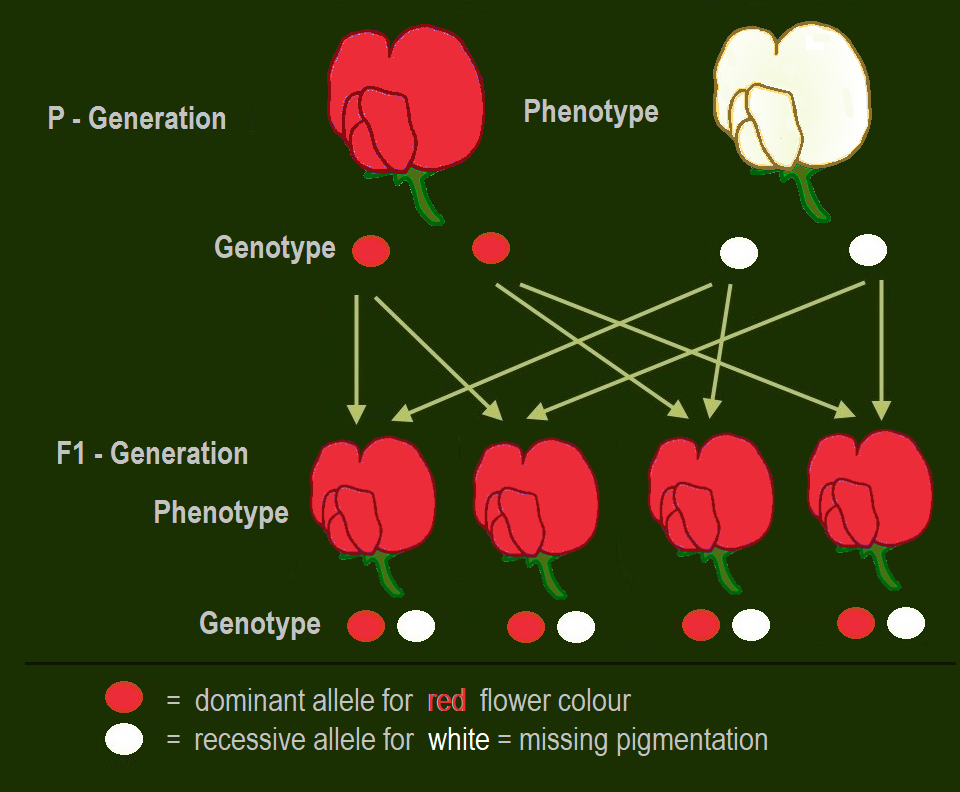
- P1 Generation: refers to the parental generation.
- F1 Generation: refers to the first offspring generation.

0:00 / 0:00
Basics of Probability for Genetics
Genetics can involve calculating a lot of probabilities. Following are a couple of rules that might help you along the way.
The Product Rule
For interdependent events X and Y, the probability P of them both occurring (X and Y) is the product of the two individual probabilities (PX x PY).
Example: What is the probability that you will get two heads consecutively when flipping a coin?
The probability of getting heads for a regular coin is 1/2 (equal to the probability of getting tails).
Two get two heads in a row, you need the first head (PH,1st = 1/2) and also another head (PH,2nd = 1/2).
Therefore: [ PH,1st x PH,2nd ] = [ 1/2 x 1/2 ] = 1/4
The Sum Rule
For mutually exclusive events X and Y, the probability P that at least one occurs (X or Y) is the sum of the two probabilities (PX + PY) that each individual event will occur.
Example: You're flipping two different coins (coin 1 and coin 2). What is the probability that you will get heads in one coin and tail in the other?
This can be achieved in two ways: coin 1 is heads and coin 2 is tails OR coin 1 is tails, and coin 2 is heads. These two events are mutually exclusive. So:
Probability heads coin 1 = PH1 = 1/2
Probability tails coin 2 = PT2 = 1/2
Similarly for the opposite scenario.
Therefore: [ PH1 x PT2 ] + [ PH2 x PT1 ] = [ 1/2 x 1/2 ] + [ 1/2 x 1/2 ] = 1/2
0:00 / 0:00
Product Rule in Genetics
In a cross between two flowers of the same genotype AaBb, where gene A encodes for one characteristic and gene B for another. Capital letter (A or B) represents the dominant allele, such that AA or Aa will produce the same effect. Calculate the probability of having aabb offspring. (Note: the probability of getting aa is 1/4 and the probability of getting bb is also 1/4).
If you know about Punnett square already you should be able to calculate that Aa x Aa = 1 AA, 2 Aa and 1 aa, so overall aa = 1/4 of the possibilities. This is the exact same for the B gene.
Therefore, in order to get both: Paa x Pbb = 1/4 x 1/4 = 1/16
0:00 / 0:00
Example: Sum Rule in Genetics
Both parents have a "Bb" genotype. What is the probability of the offspring having the dominant phenotype?
Offspring showing the dominant phenotype could be BB OR Bb, so we need to use the sum rule. What are the possible ways we could get offspring with the dominant phenotype?
1. Mother contributes B allele and father contributes b allele (offspring are Bb), OR
2. Mother contributes b allele and father contributes B allele (offspring are bB), OR
3. Both mother and father contribute B allele (offspring are BB).
These three events are mutually exclusive, because only one fertilization even can occur at a time. The probability of each of the above events is 1/4 (we can determine this using the product rule). To determine the probability of the offspring with the dominant phenotype, we add the three individual probabilities together:
(1/4) + (1/4) + (1/4) = 3/4
Practice: Probability in Genetics
Both parents have the genotype Bb. What is the probability of offspring showing the recessive phenotype?