Wize University Biology Textbook > Mendelian Genetics
Forked-Line and Probability Methods
Popular Courses
MCAT
General Course
Biology
General Course
General Biology
University Study Guides
DAT
General Course
High School Biology
US High School
BIO 1131
University of Ottawa
BIO120H1
University of Toronto
General Biology
University Study Guides
SC/BIOL 1000 3.00
York University
BIOL 311
University of Calgary
BLG 143
Toronto Metropolitan University
BIOLOGY 2581A/B
Western University
HMB265H1
University of Toronto
BIOL-1101
University of Windsor
BIOL 1201
Western University
MBG*2040
University of Guelph
BIOL 1P91
Brock University
BIOL 1020
University of Manitoba
BIOL 331
University of Calgary
BIOA01H3
University of Toronto
0:00 / 0:00
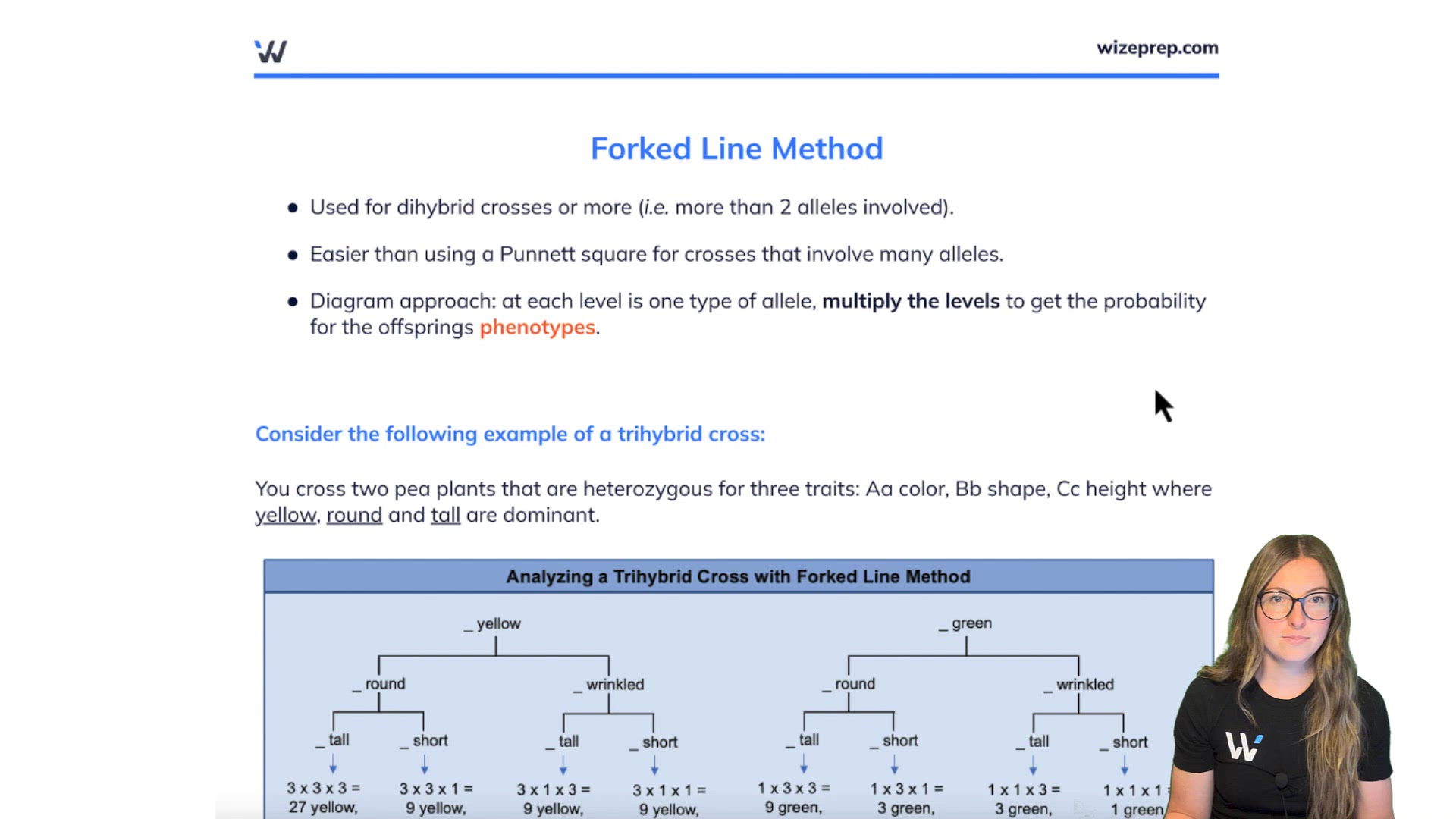
Forked Line Method
- Used for dihybrid crosses or more (i.e. more than 2 alleles involved).
- Easier than using a Punnett square for crosses that involve many alleles.
- Diagram approach: at each level is one type of allele, multiply the levels to get the probability for the offsprings phenotypes.
Consider the following example of a trihybrid cross:
You cross two pea plants that are heterozygous for three traits: Aa color, Bb shape, Cc height where yellow, round and tall are dominant.

How this forked line diagram was made:
- Start off with the probability ratio for color where you if cross two heterozygous yellow peas (Aa x Aa), you get a 3:1 yellow to green pea ratio.
- Next level you put the ratio for shape but this time you divided the two color groups.
- Next level you divide each individual shape group into the heights.
- Note: because you are looking at crossing two heterozygous genotypes, the ratio is always 3:1 dominant to recessive. You can verify this with a simple Punnett square
- Multiply the levels leading down to the combination of traits (e.g. a yellow, round, tall = 3 x 3 x 3 = 27).
- The number of offsprings makes up the phenotypic ratio (27:9:9:9:3:3:3:1).
- You can also determine the probability of that phenotype by taking the number of offsprings and dividing by the total (eg. 27/64 = 42%.

0:00 / 0:00
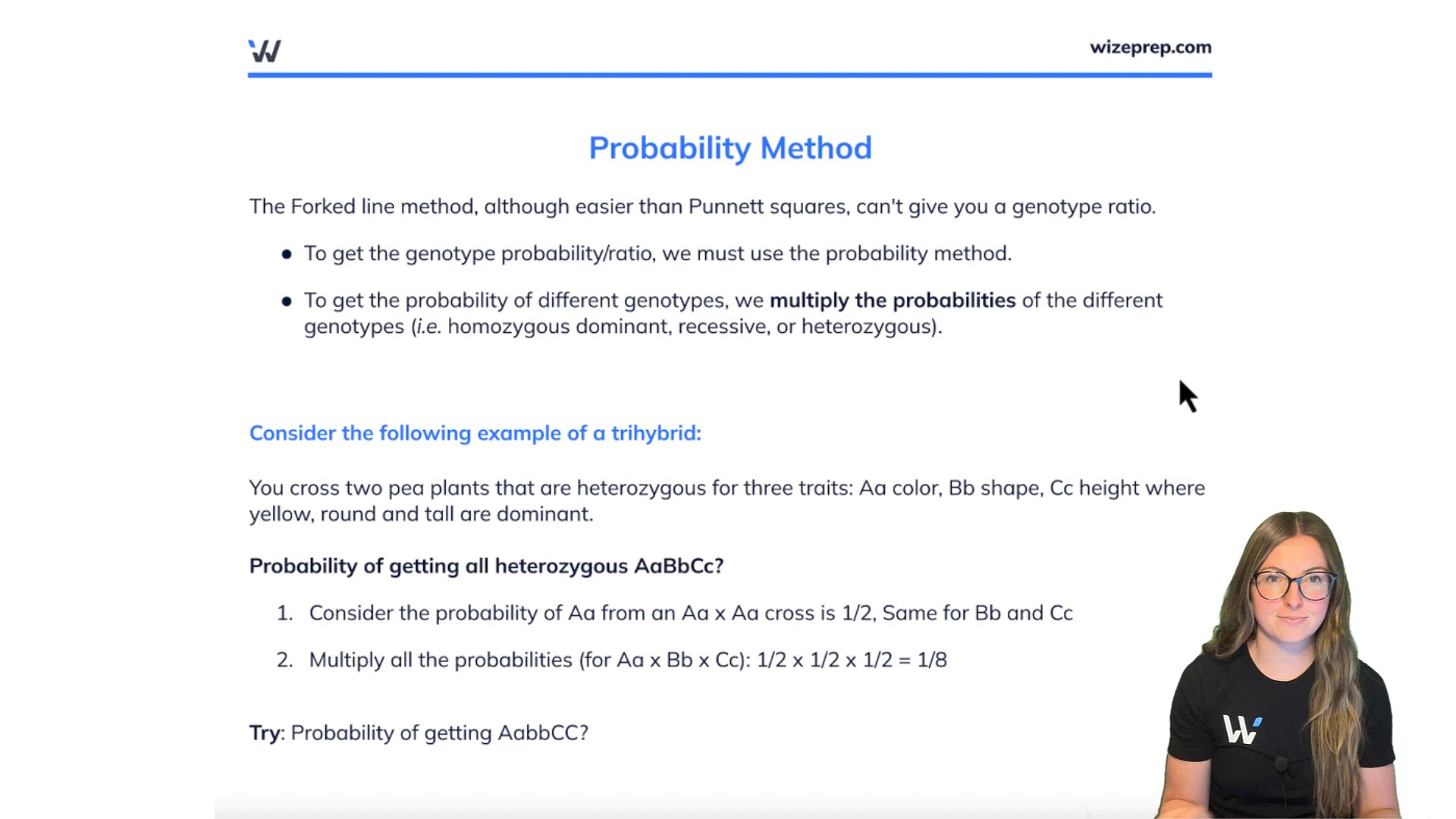
Probability Method
The Forked line method, although easier than Punnett squares, can't give you a genotype ratio.
- To get the genotype probability/ratio, we must use the probability method.
- To get the probability of different genotypes, we multiply the probabilities of the different genotypes (i.e. homozygous dominant, recessive, or heterozygous).
Consider the following example of a trihybrid:
You cross two pea plants that are heterozygous for three traits: Aa color, Bb shape, Cc height where yellow, round and tall are dominant.
Probability of getting all heterozygous AaBbCc?
- Consider the probability of Aa from an Aa x Aa cross is 1/2, Same for Bb and Cc
- Multiply all the probabilities (for Aa x Bb x Cc): 1/2 x 1/2 x 1/2 = 1/8
Try: Probability of getting AabbCC?
1/2 (Aa) x 1/4 (bb) x 1/4 (CC) = 1/32
Practice: Forked Line Method
What is the probability (%) of getting a small, pop-eyed, yellow goldfish when you cross a large, pop-eyed, orange (AaBbCc) goldfish with a small, normal eyed, yellow (aabbcc) goldfish?
A,a is for body size
B,b for eye shape
C,c for color
Practice: Probability Method
Calculate the probability (%) of producing AABbCcdd from the following cross:
AaBBccDd x AabbCcDd