Wize University Biology Textbook > Mendelian Genetics
Laws of Inheritance [Mendel's Laws]
Popular Courses
MCAT
General Course
BIOLOGY 1001A
Western University
Biology
General Course
General Biology
University Study Guides
BIOL 102
Queen's University
Grade 12 Biology
Canada High School
DAT
General Course
High School Biology
US High School
BIO 1131
University of Ottawa
BIOL 121
University of British Columbia
BIOL*1090
University of Guelph
BIO120H1
University of Toronto
General Biology
University Study Guides
SC/BIOL 1000 3.00
York University
BIOL 311
University of Calgary
BIOL 184
University of Victoria
BLG 143
Toronto Metropolitan University
BIOLOGY 2581A/B
Western University
BIOL 112
McGill University
HMB265H1
University of Toronto

0:00 / 0:00
Mendel's Law of Segregation
Mendel's First Law, the Law of Segregation states that gametes receive only one allele of each gene.
- Mendel's most important discovery was that the F1 progeny from parental strains with different traits were not true-breeders.
- True-breeding organisms are those that always pass down their phenotypic traits to its offspring.
- F2 Generation comes from the F1 generation self-fertilizing.
- Mendel found that the recessive trait reappeared in the F2 generation.
- The recessive trait always consistently appeared at a dominant:recessive ratio close to 3:1.

The Principle of Segregation
- Each cell in a pea plant contains two alleles of each gene (one from mom, one from dad) except for in reproductive cells, which contain only one allele.
- In true-breeding parental strains, the two alleles are identical. These plants are said to be homozygous.
- Each gamete (reproductive cell) contains just one allele of each gene.
- When gametes are formed, the two alleles of a gene segregate – half of the gametes get one allele, while the other half get the other allele. This is the principle of segregation.
- In homozygous plants, all the gametes will have the same allele.

- A zygote is formed after fertilization, and it is comprised of the union of two gametes – one from each parent.
- When the two gametes that formed the zygote carried different alleles for a gene, the resulting zygote is a hybrid containing two different alleles and is said to be heterozygous.
- These progeny then form gametes, and the alleles again segregate.

- The zygote (F1) will all be yellow, since this is the dominant allele.
- Self-fertilizing the F1 generation gives rise to F2. The resulting progeny of the F2 generation can be determined using a Punnett square.
- Note that the yellow seeds in the F2 generation have the same phenotype but different genotypes (can be AA or Aa at a ratio of 1AA:2Aa).
- Plants with the AA or Aa genotypes can be distinguished based on the seeds they produce when self-fertilized.
- Plants with the AA genotype produce only yellow seeds, while those with the Aa genotype produce seeds with a ratio of 3:1 (yellow:green).

Wize Concept
The Law of Segregation was determined from this. It states that alleles must segregate equally into gametes such that the progeny (F2) have an equal likelihood of obtaining one of the two alleles.
This law is the reason we can use the Punnet square to predict accurately the offspring of parents with known genotypes.
- A testcross can also be used to test segregation:
- Cross the F1 progeny with the true-breeding recessive strain instead of allowing them to self-fertilize.
- The recessive trait will only be observed if the F1 strain is heterozygous.

Watch Out!
Not all traits follow the Medelian rules of dominance:
- Incomplete dominance: the phenotype of the heterozygote is somewhere in-between the homozygote phenotypes
- Codominance: when both traits are expressed.
0:00 / 0:00
Mendel's Law of Independent Assortment
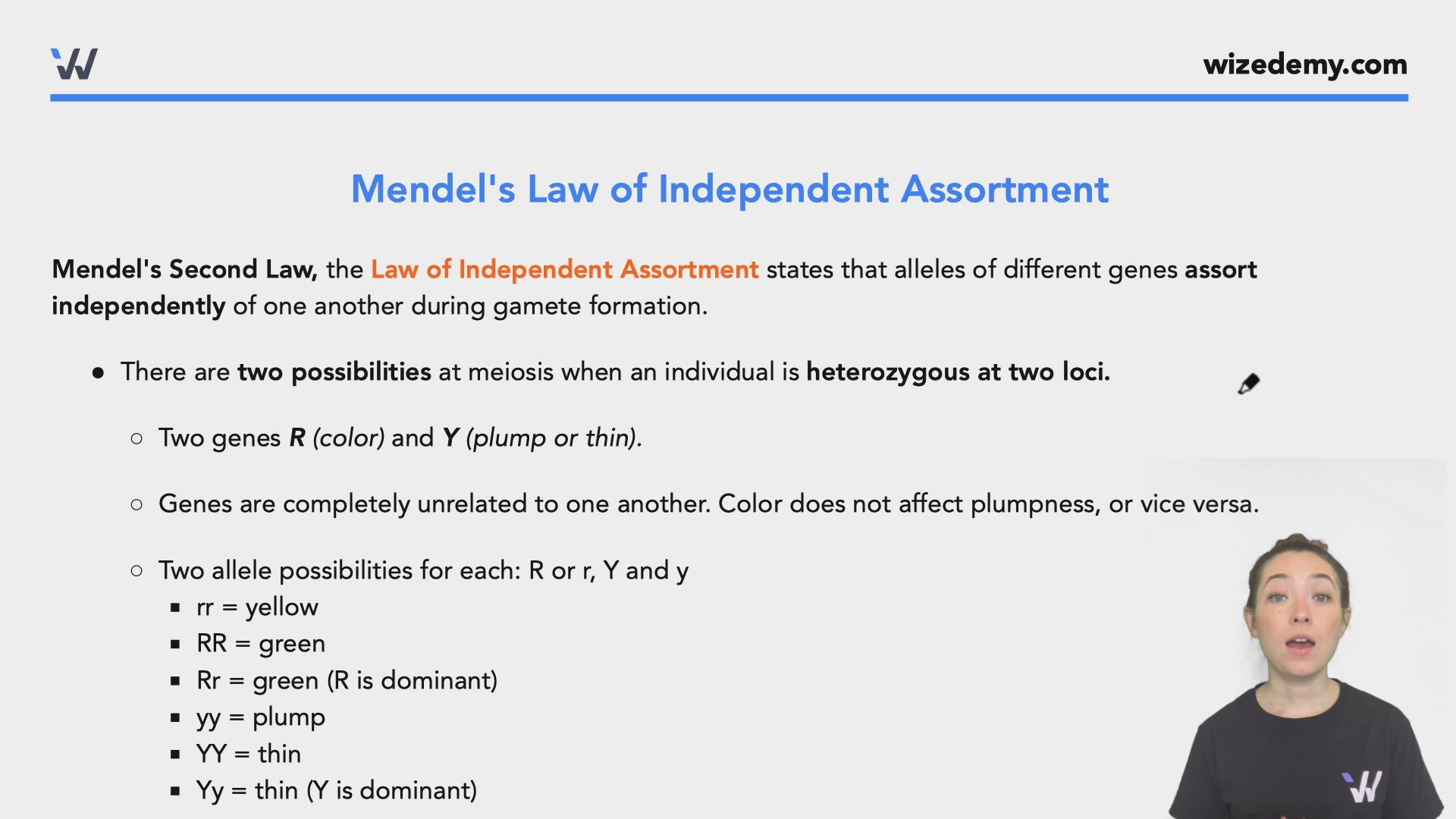
Mendel's Second Law, the Law of Independent Assortment states that alleles of different genes assort independently of one another during gamete formation.
- There are two possibilities at meiosis when an individual is heterozygous at two loci.
- Two genes R (color) and Y (plump or thin).
- Genes are completely unrelated to one another. Color does not affect plumpness, or vice versa.
- Two allele possibilities for each: R or r, Y and y
- rr = yellow
- RR = green
- Rr = green (R is dominant)
- yy = plump
- YY = thin
- Yy = thin (Y is dominant)
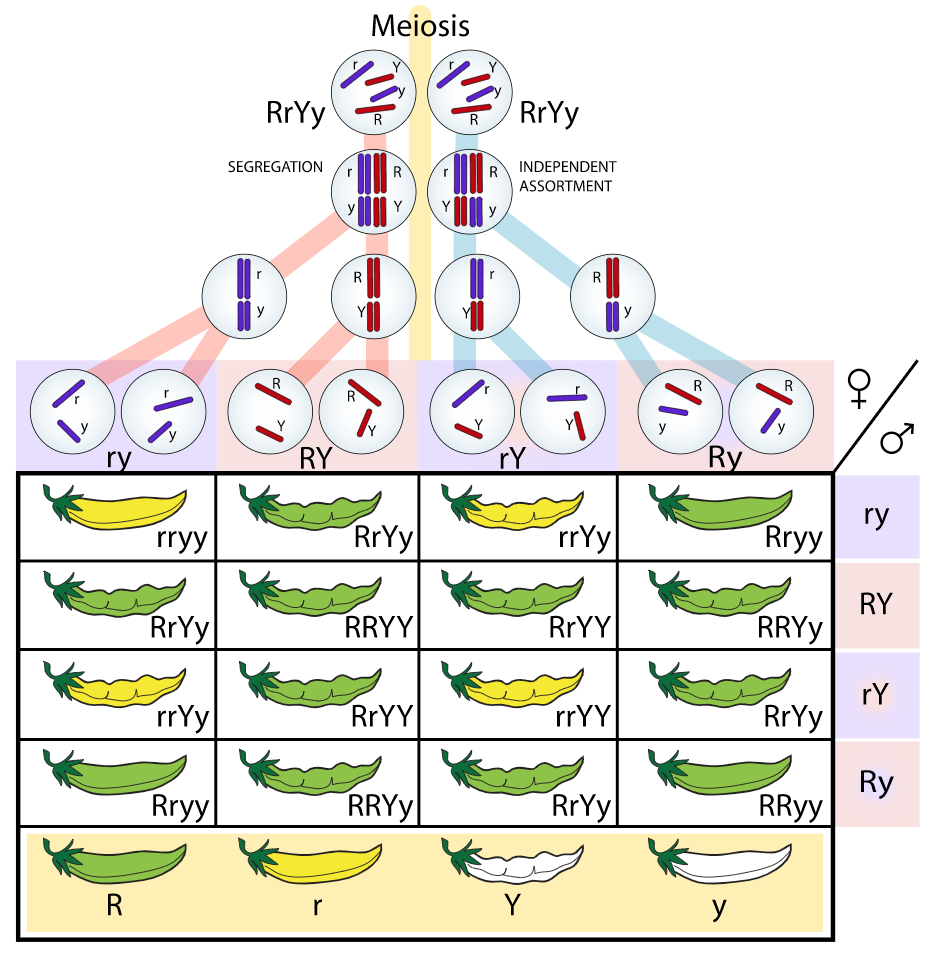
- Mendel found support for this law by performing dihybrid crosses.
- In the F1 generation all individuals are heterozygous at both alleles (RrYy).
- When you cross these F1 individuals, all trait combinations are possible in the F2 because of the law of independent assortment.
- States that a gamete into which an r allele sorted would be equally likely to contain either a Y allele or a y allele.
- Thus, there are four equally likely gametes that can be formed when the YyRr heterozygote is self-crossed: YR, Yr, yR, and yr.
What would happen if the Law of Independent Assortment was not true?
- Maybe R always goes with Y, which means that r always goes with y.
- Only possible gametes would be RY and ry.
- Which means that progeny would all be heterozygous for both genes: RrYy = green and thin.
Mendel observed that all possible combinations exist, confirming the Law of Independent Assortment. What are the phenotypes and their ratios in this dihybrid cross?
9:3:3:1
Green and thin : yellow and thin : green and plump : yellow and plump
0:00 / 0:00
Punnett Square Rules
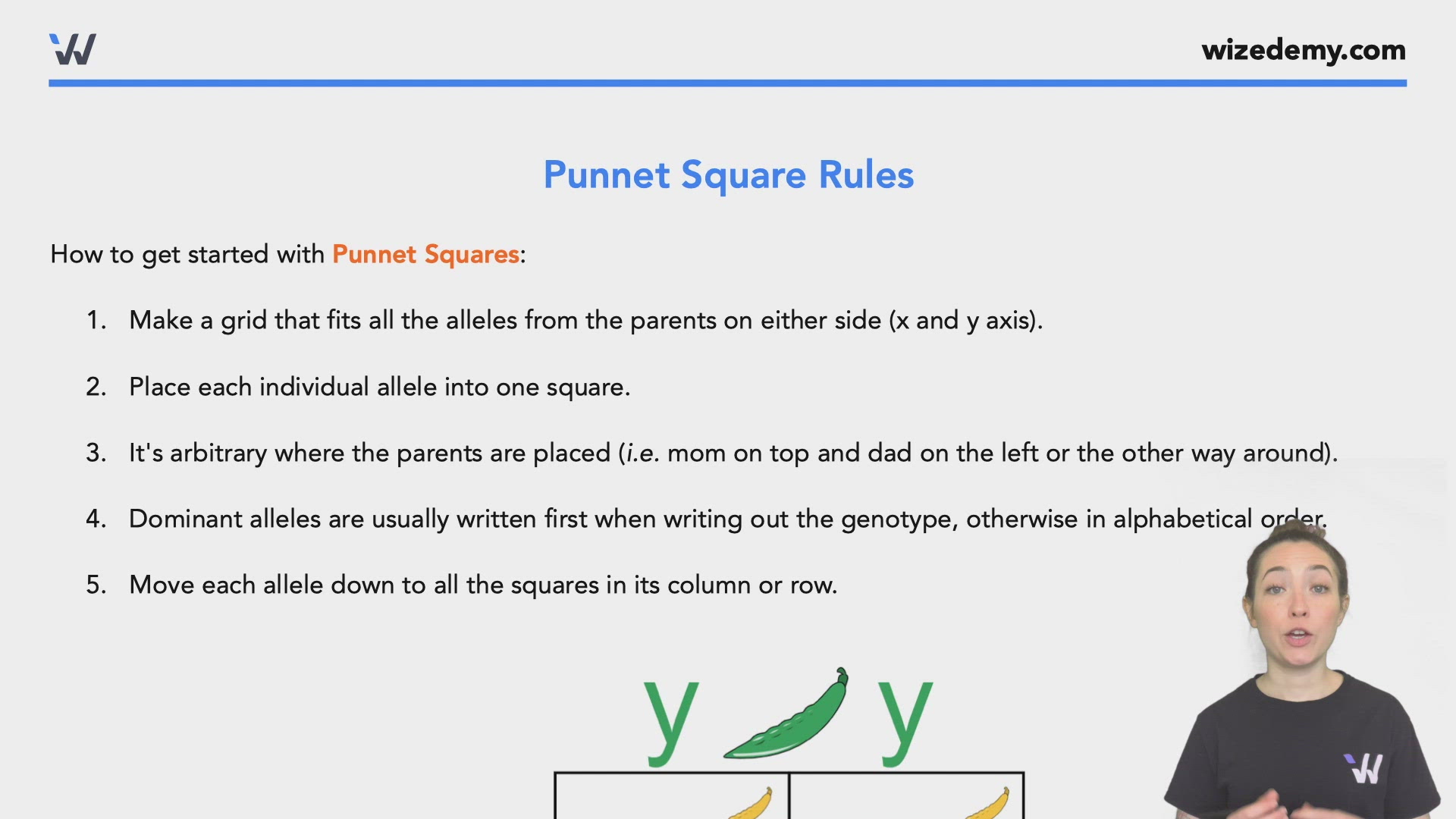
How to get started with Punnett Squares:
- Make a grid that fits all the alleles from the parents on either side (x and y axis).
- Place each individual allele into one square.
- It's arbitrary where the parents are placed (i.e. mom on top and dad on the left or the other way around).
- Dominant alleles are usually written first when writing out the genotype, otherwise in alphabetical order.
- Move each allele down to all the squares in its column or row.
Punnet Squares to Determine Offspring Probability
Based on the Punnet square shown above, determine the ratio of yellow to green beans.
1:1 because you have 2/4 genotypes that result in yellow and 2/4 that result in green
Therefore, 2:2 = 1:1 ratio of phenotypes
Ratios for genotype is also 1:1 (Yy:yy)
0:00 / 0:00
Example: Punnett Square
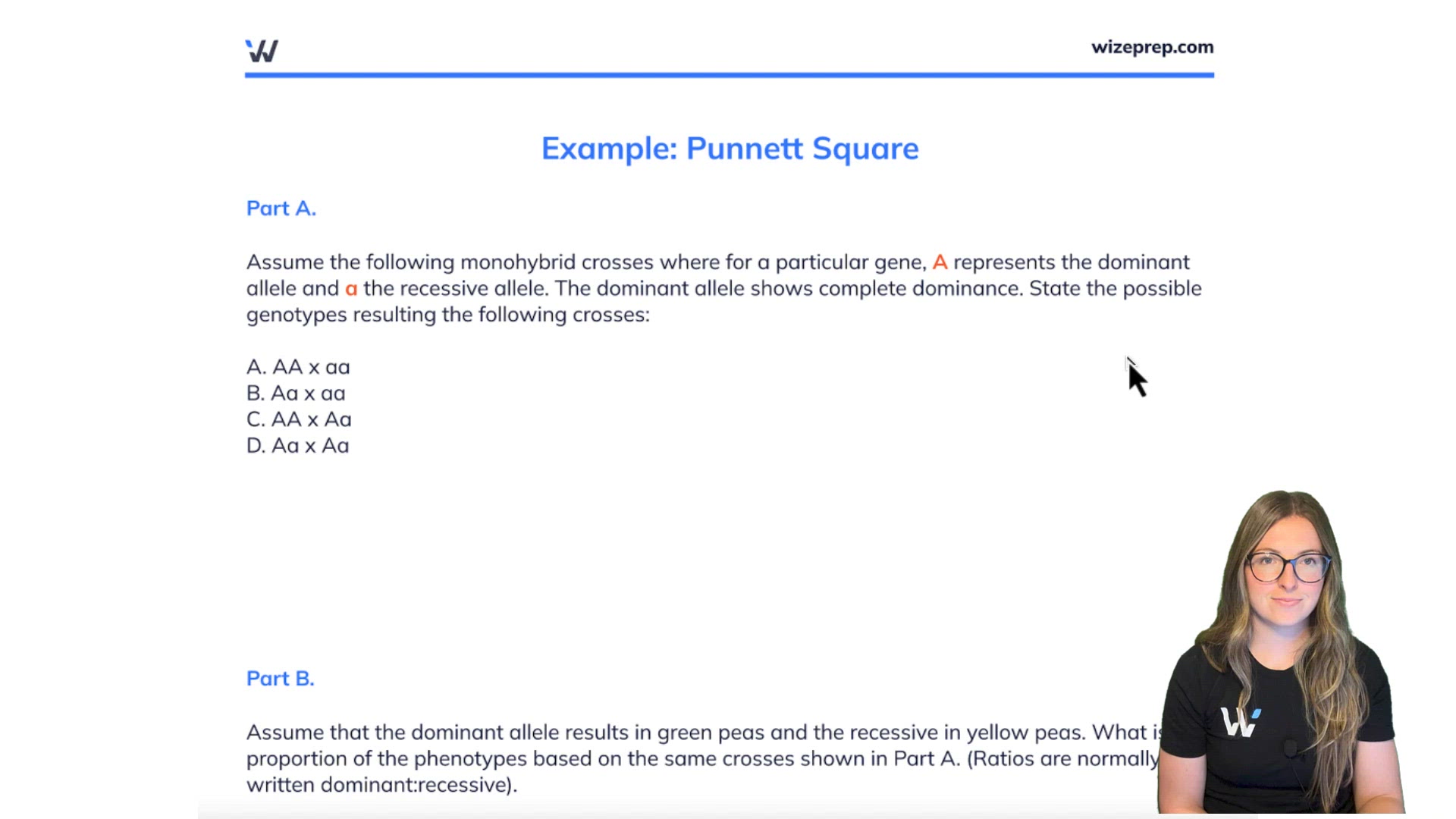
Part A.
Assume the following monohybrid crosses where for a particular gene, A represents the dominant allele and a the recessive allele. The dominant allele shows complete dominance. State the possible genotypes resulting the following crosses:
A. AA x aa
B. Aa x aa
C. AA x Aa
D. Aa x Aa
A. Aa
B. Aa, aa
C. AA, Aa
D. AA, aa, Aa
Part B.
Assume that the dominant allele results in green peas and the recessive in yellow peas. What is the proportion of the phenotypes based on the same crosses shown in Part A. (Ratios are normally written dominant:recessive).
A. 1:0
B. 1:1
C. 1:0
D. 3:1
0:00 / 0:00
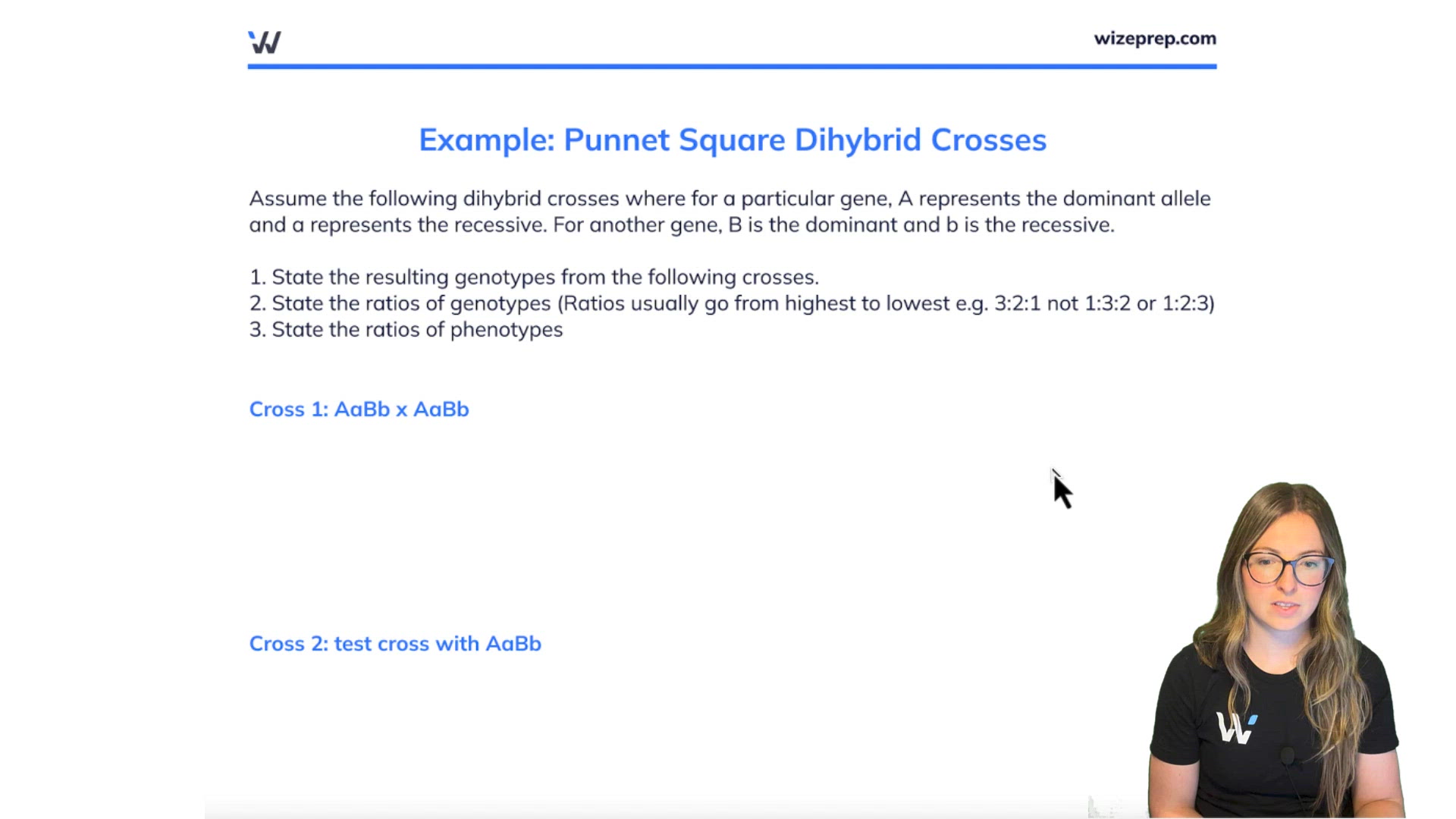
Example: Punnet Square Dihybrid Crosses
Assume the following dihybrid crosses where for a particular gene, A represents the dominant allele and a represents the recessive. For another gene, B is the dominant and b is the recessive.
1. State the resulting genotypes from the following crosses.
2. State the ratios of genotypes (Ratios usually go from highest to lowest e.g. 3:2:1 not 1:3:2 or 1:2:3)
3. State the ratios of phenotypes
Cross 1: AaBb x AaBb
1. AABB, AABb, AAbb, AaBB, AaBb, Aabb, aaBB, aaBb, aabb
2. 4:2:2:2:2:1:1:1:1 (AaBb:AaBB:Aabb:AABb:aaBb:AABB:aabb:aaBB:AAbb)
3. 9:3:3:1 (both dominant features:only A dominant:only B dominant:both recessive)
Cross 2: test cross with AaBb
1. AaBb, Aabb, aaBb, aabb
2. 1:1:1:1
3. 1:1:1:1
Practice: Percentage of Cross Results
A true-breeding hamster with long fur and brown patches was crossed with a true-breeding hamster with short fur and no patches. The F1 all had long fur and no patches. An F1 was crossed with hamsters with short fur and brown patches.
The pair produced 10 baby hamsters. What percentage do you expect to see for each genotype and phenotype in the 10 babies? Write a percentage number between 0 and 100.
Practice: Determining Generational Genotypes
Consider a cross between two true-breeding zebrafish strains. The female parent has stripes (dominant) and a short tail fin and the male is spotted with a long tail (dominant) fin. All F1 progeny are striped with long tail fins.
Use S and s to represent the body patterning alleles and T and t to represent the tail fin alleles. Let S is stripes and s is spots, while T is long tail and t is short tail.
a) What are the genotypes of the parents?
b) What gametes can they produce?
c) What is the genotype of the F1 generation?
d) What type of dominance is this?
Practice: Dihybrid Testcross
Consider a cross between two true-breeding zebrafish strains. The female parent has stripes (dominant) and a short tail fin and the male is spotted with a long tail (dominant) fin. All F1 progeny are striped with long tail fins.
Use S and s to represent the body patterning alleles and T and t to represent the tail fin alleles. Let S is stripes and s is spots, while T is long tail and t is short tail.
You perform a testcross using a female zebra with SsTt genotype. What are the genotypes and phenotypes produced?
Practice: Dominant and Incomplete Dominant
Hypothetically, roses contain 3 alleles that encode for flower color where two alleles are dominant, and when together exhibit incomplete dominance. Note: they are still diploid so only two alleles combined per organism. Allele A encodes for red, allele B for white, allele i for blue (recessive, so ii = blue); when AB combine they produce pink flowers. You perform the following crosses:
1. Test cross with pink roses
2. Cross F1 red with F1 white
3. Test cross with F2 white roses
Answer the following question the next 3 questions.
What was the genotypes of the first cross?
Inheritance Terminology
Locus: the physical location of a gene on a chromosome. (plural: loci)
Alleles: these are the different versions of a single gene or locus. In diploid organisms, each individual will inherit 2 alleles of every gene, one from mother and one from father. Common short-hand for alleles:
- B and b
- B and B'
- B1 and B2
Trait – each variant for a character (example purple or white)
- Alleles for a given gene affect the same character but can specify different traits.
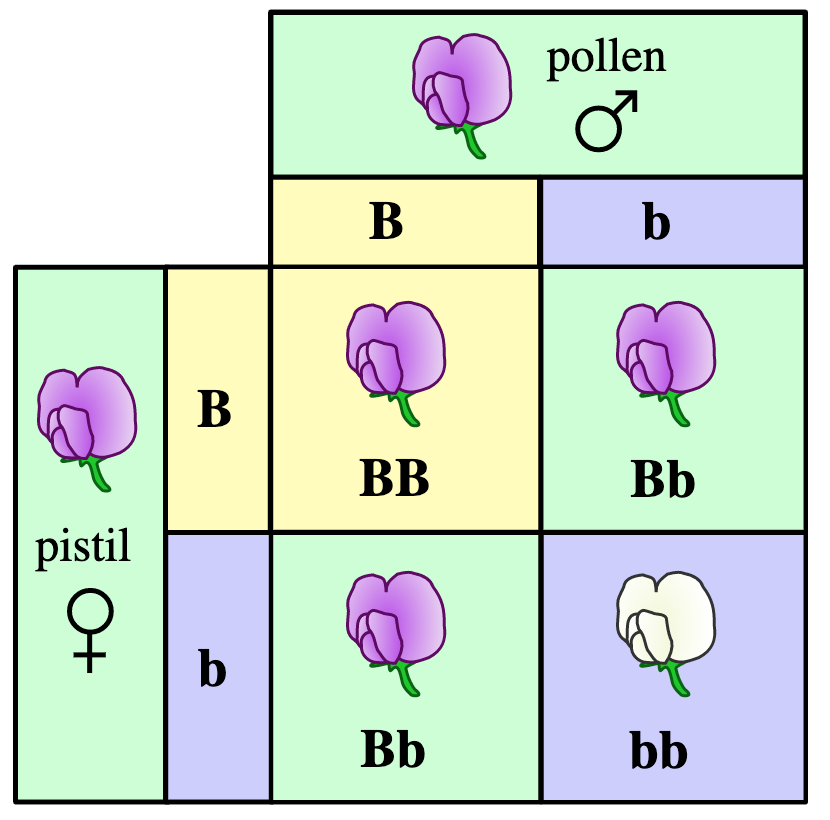
Genotype – the specific alleles in an individual, i.e. the genetic makeup
Example: BB, Bb, and bb are three different genotypes
Phenotype – the physical appearance of an individual
Example: purple and white are two different phenotypes for the flower color character
The genotype helps determine the phenotype.
Example: BB and Bb result in purple flowers while bb results in white flowers
Transmission of alleles – depends on events in meiosis and fertilization
- Mendel’s Law of Segregation – two alleles for a heritable character segregate (separate from each other) during gamete formation and end up in different gametes.
- Members of an allelic pair segregate during meiosis I and come together at fertilization; each gamete carries one allele of each allelic pair.
Mendel’s Model Quick Summary:
In mendelian inheritance:
1. Each gene controls one character.
2. Each gene has two alleles, these two alleles account for variations in inherited characters.
3. Dominant alleles determine an organisms appearance while recessive alleles have no noticeable effect if the two alleles at a locus differ.
4. Segregation of the two alleles for a heritable character occurs during gamete formation
5. The alleles or two different genes are inherited independently (independent assortment)
Important Notes on Genetics:
- Alleles usually remain unchanged, although rarely they can be mutated.
- A character can be affected by many genes and also the environment (i.e. one allele pair doesn’t always define the trait of a character, sometimes multiple genes are required to fully determine a characteristic).
- Gene expression of the genes of the genome are what cause the resultant phenotype.
- In a real-world population (mating random) pairs of genotypes mate with frequencies that depend on their proportions in the population