Wize University Biology Textbook > Invertebrates (Part 1: Non-Molting)
Mollusca (Snails, Clams and Squid)
Popular Courses
Biology
General Course
General Biology
University Study Guides
DAT
General Course
Grade 11 Biology
Ontario High School
Grade 11 Biology
Canada High School
General Biology
University Study Guides
BIOL 108
University of Alberta
Biology 20
Alberta High School
BIOL 111
McGill University
BIOL 1201
Western University
Life Sciences 11
British Columbia High School
BIOL 1P91
Brock University
BLG 144
Toronto Metropolitan University
BIOL 1020
University of Manitoba
BIOL 331
University of Calgary
BIOA01H3
University of Toronto
BISC 102
Simon Fraser University
BI110
Wilfrid Laurier University
BIO220H1
University of Toronto
BIOL 201
University of Alberta

0:00 / 0:00
Phylum Mollusca (Snails, Clams, and Squids)
This is an incredibly diverse group, some of which are incredibly intelligent. Octopus can learn how to solve puzzles by watching other individuals!
- Includes snails, clams, squids, etc.
- Mostly marine, some freshwater and terrestrial
- Have calcareous shells for protection
- Many have lost these shells secondarily
Characteristics

- Mantle: secretes shell
- Ventral foot: large muscular foot used for movement
- Organs: jumbled visceral mass above foot
- Radula: mouthparts used for scraping
- Gills: used for gas exchange or feeding Example: bivalves (clams) use gills to filter water for food
- Open circulatory system
- Reduced Coelom
- Lack segmentation
- Trochophores (free swimming larvae)

Class Gastropoda
- Snails
- Movement
- Glide along with muscular contractions of the large foot
- Most have single, coiled, tubular shell
- Except slugs which have no shell
- Those with shells undergo torsion
- Anus is twisted to the front (above the head)
- Mostly marine but many freshwater and terrestrial
- Trochophore larvae
- Gas exchange via lungs
- Grazers
- Nudibranchs: marine gastropods with no shell
- Lots of color
- Defense using nematocysts stolen from cnidarian prey

Class Bivalvia
- Clams, oysters, scallops
- Humans use them for
- Food
- Jewelry
- Pearls
- Some are invasive pests
- Mostly marine
- Two hinged shells ("bivalve")
- Feeding
- Filter water through gills
- Lack radula
- Lack head
- Some are sessile others are sedentary Example: Scallops can move by "clapping" their shells
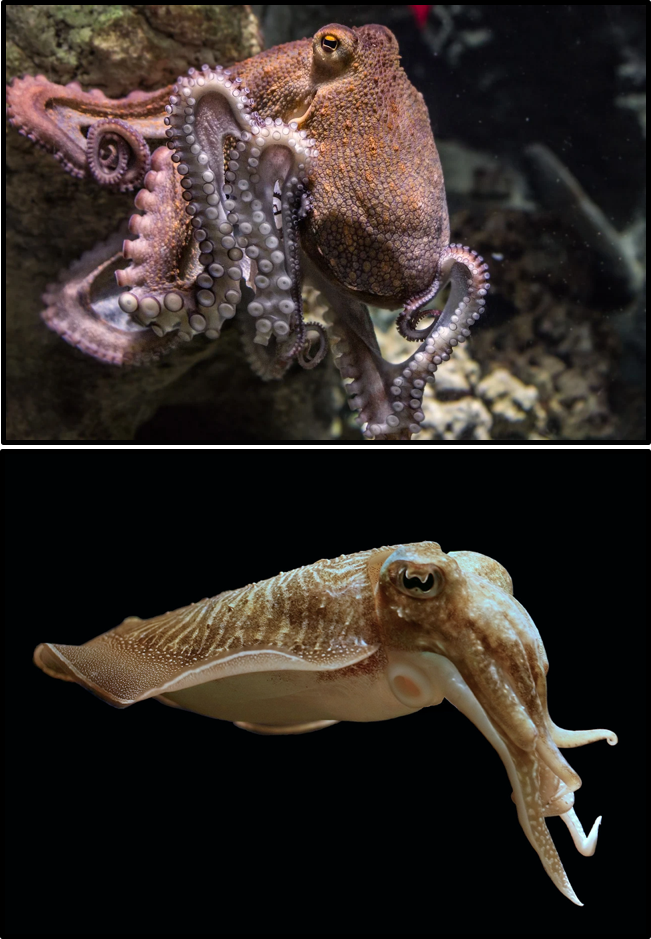
Class Cephalopoda
- Squids, cuttlefish, octopuses
- Large bodies
- Low diversity
- Have long tentacles around mouth
- Tentacles have suckers and hooks
- All are predatory
- Radula is modified into a biting beak
- Some have poison
- Lack external shell
- Except nautiluses and extinct ammonites
- Some have Internal shell remnants Example: Cuttlefish bone
- Siphon
- Made from a tube of mantle
- Used for jet propulsion
- Closed circulatory system
- Only mulloscs with it
- Support active lifestyle
- Reproduction
- Attach egg cases to substrates
- Maternal Care
- Lack trochophore larvae
- Direct-developing juveniles
- Excellent vision
- Complex behavior
- Communicate with color and posture
- Very intelligent!
Practice: Mollusca
Which of the following structures do mollusks have? (select all that apply)
Practice: Mollusca
What type of mollusk has the following features?
1.) Jet propulsion
2.) Tentacles
3.) Maternal Care