Wize University Biology Textbook > Animal Physiology
Osmoregulation
Popular Courses
Biology
General Course
General Biology
University Study Guides
Grade 12 Biology
Canada High School
DAT
General Course
High School Biology
US High School
Grade 11 Biology
Ontario High School
Grade 11 Biology
Canada High School
BIOL 103
Queen's University
BIO120H1
University of Toronto
General Biology
University Study Guides
Biology 20
Alberta High School
BIOL*1070
University of Guelph
BIOL 186
University of Victoria
BIOL 1201
Western University
BISC 101
Simon Fraser University
Life Sciences 11
British Columbia High School
BIOL 1011
Dalhousie University
BIOL 1P91
Brock University
BIOLOGY 2601A/B
Western University
BIOL 1020
University of Manitoba

0:00 / 0:00
Osmoregulation
It is necessary to keep the concentration of water and solutes constant in animal bodies
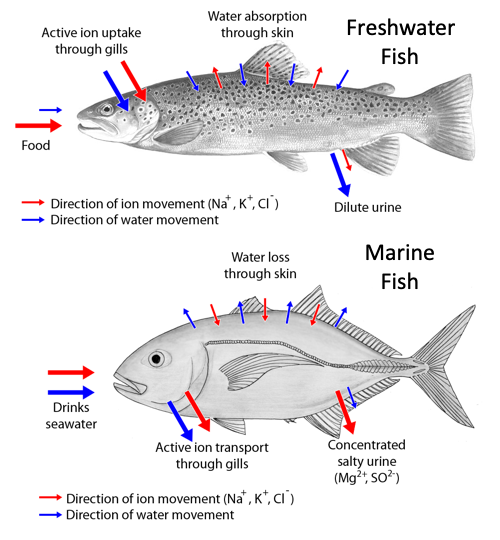
- Osmoregulation: controlling the solute and water concentration in bodies
- Osmolarity: the concentration of solutes in a solution
- Excretion: getting rid of toxic waste (nitrogen)
- Animals fall into two catergories
- Osmoregulator: controls internal solute concentrations
- Most vertebrates
- Osmoconformer: does not control solutes, body is the same as the environment
- Most invertebrates
Controlling Osmotic Balance
- Stenohaline: Can not tolerate large shifts in outside osmolarity
- Euryhaline: can tolerate large shifts in outside osmolarity
- Transport epithelium: layers of specialized cells that regulate solute movements
- Tight junctions: prevent fluid leaks between transport epithelial cells
- Transport into tubular networks (countercurrent exchanges)
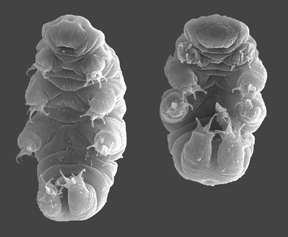
- Anhydrobiosis: ability to survive in a dormant state when environment dries up - Example: Tardigrades (water bears) can even survive in space

Osmotic Balance on Land
- Adaptations to reduce desiccation
- Desiccation: water lost to the environment Examples: Body coverings, nocturnal activity
- Kidneys
- Organs that are essential to mammalian water-balance and osmoregulation
- Reduce water-loss
- Excrete nitrogenous waste
What type of osmoregulation best describes vertebrates?

Mark Yourself Question
- Grab a piece of paper and try this problem yourself.
- When you're done, check the "I have answered this question" box below.
- View the solution and report whether you got it right or wrong.
Describe a scenario where anhydrobiosis would be beneficial.