Wize University Chemistry Textbook > Lewis Structures & Resonance Structures
How to Draw Lewis Structures
Popular Courses
MCAT
General Course
Grade 12 Chemistry
Ontario High School
Grade 12 Chemistry
Canada High School
CHEM 1301A/B
Western University
CHEM 201
University of Calgary
General Chemistry
University Study Guides
AP Chemistry Exam Prep Course
AP Exam Prep
CHEM 1A03
McMaster University
CHEM 101
University of Alberta
CHEM 112
Queen's University
CHEM 121
University of British Columbia
High School Chemistry
US High School
CHM 1311
University of Ottawa
CHEM 1AA3
McMaster University
Chemistry
General Course
DAT
General Course
General Chemistry
University Study Guides
CHEM 103
University of Alberta
CHEM 1E03
McMaster University
CHEM 110
McGill University

0:00 / 0:00
Drawing Lewis Structures
Drawing the "best" Lewis structure for a molecule is a great skill to have for your chemistry class! This concept will come in handy in the upcoming chapters as well. We will follow the steps below each time.
Wize Tip
Steps for Drawing Lewis Structures:
1) Calculate the total number of valence electrons for the molecule.
2) Write out all atoms, with the least electronegative atom in the middle (but H is never in the middle)
3) Connect all atoms with single bonds.
4) Put lone pairs on atoms, except H, until you run out of electrons. Put extra lone pairs on the central atom.
5) Shift lone pairs to make double or triple bonds to satisfy the Octet Rule and get the best formal charges.
Octet Rule: atoms need to have 8 electrons in the valence shell
Examples: C, N, O, F all need 8 electrons in their valence shell to have the "best" Lewis structure
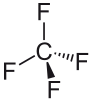
Example: CF4 → the C atom has 8 valence electrons and each F atom has 8 valence electrons in the Lewis Structure
Exceptions to the Octet Rule
Some elements are octet deficient (require less than 8 electrons in their valence shell)
Examples:
H and He can only have 2 electrons

Be can only have 4 electrons
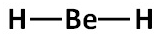
In group 13, Al and B can only have 6 electrons

Some elements have an expanded octet (can have more than 8 electrons in their valence shell)
Examples:
Non-metals in period 3 and onwards can have expanded octet.
P can have 10 electrons
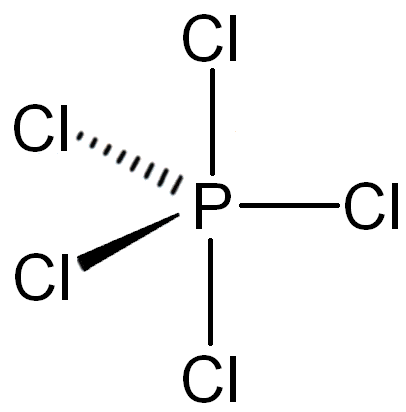
S can have 12 electrons

Some molecules like radicals have an odd number of electrons (these are rare!)
Example: NO
First let’s count the number of valence electrons (VE) in both atoms.
- N →5 VEs
- O → 6 VEs
- So in total there are 11 VEs which is an odd number. We would be left with a molecule that looks like this:

Note: There is an unpaired electron on the N. This is called a radical molecule and is highly reactive so it is very short-lived.
Formal Charges
The last thing we need to check to ensure we have the BEST Lewis Structure is to count formal charges.
Wize Concept
The best formal charge for an atom is zero.
If the formal charges for a molecule can't be 0 the best Lewis Structure for that molecule will have the lowest possible formal charges.
If formal charge is not zero, consider assigning negative formal charge to more electronegative elements and positive formal charges to less electronegative elements, if possible.
FC is the formal charge of an atom
VE are the valence electrons the atom has
Example:
OF2
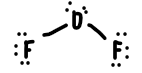
FC for F= 7 VE - 1 bond connected - 6 electrons on it
FC for F=7-1-6
FC for F=0
FC for O= 6 VE - 2 bonds connected - 4 electrons on it
FC for O= 6 - 2 - 4
FC for O=0
Therefore, we know this is the best possible Lewis structure!
0:00 / 0:00
Example: Lewis Structures
Draw Lewis structures of the following molecules.
a) PCl3

b) NH4+

c) SeF4

0:00 / 0:00
Example: Lewis Structure
Draw the Lewis Structure for SO42–
Determine the central atom. The central atom is usually the atom which has the lowest electronegativity. In this case it is S.
Count the total # of valence electrons.
6 (S) + [4 X 6 (O)] + 2= 32
Arrange the terminal atoms around the central atom.
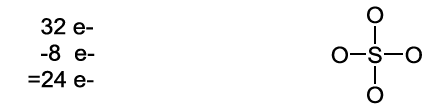
Use e- to fill octets of terminal atoms.

Evaluate and rearrange electrons to find the best structure.
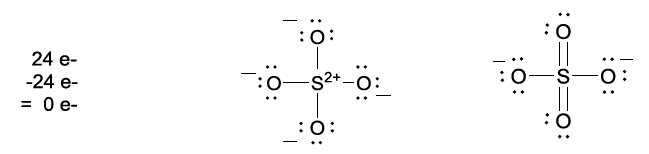
In our example all octets are satisfied but we have a 2+ on sulfur and negative charges on all oxygen atoms. To solve this we should move a l.p on oxygen (the negative element) to a double bond. Remember sulfur can expand its octet.
Practice: Formal Charges and Lewis Structures
Draw the Lewis structure of SO2Cl2 to answer the following questions.
Practice: Drawing Best Lewis Structures
Complete the “best” Lewis diagrams for the following species and use them to answer the next three questions
SeCl2
PO2+
AlI3
Which Lewis diagram has double bond(s)?