Wize University Chemistry Textbook > Intermolecular Forces and Physical Properties
Properties of Liquids
Popular Courses
MCAT
General Course
CHEM 1301A/B
Western University
CHEM 201
University of Calgary
General Chemistry
University Study Guides
CHEM 1A03
McMaster University
CHEM 101
University of Alberta
CHEM 112
Queen's University
CHEM 121
University of British Columbia
DAT
General Course
Chemistry
General Course
CHEM 103
University of Alberta
General Chemistry
University Study Guides
CHEM 110
McGill University
CHEM 101
University of Victoria
CHEM 120
University of Waterloo
CHY 102
Toronto Metropolitan University
CHEM 121
Simon Fraser University
CHEM 120
McGill University
SC/CHEM 1000 3.00
York University
APSC 132
Queen's University
0:00 / 0:00
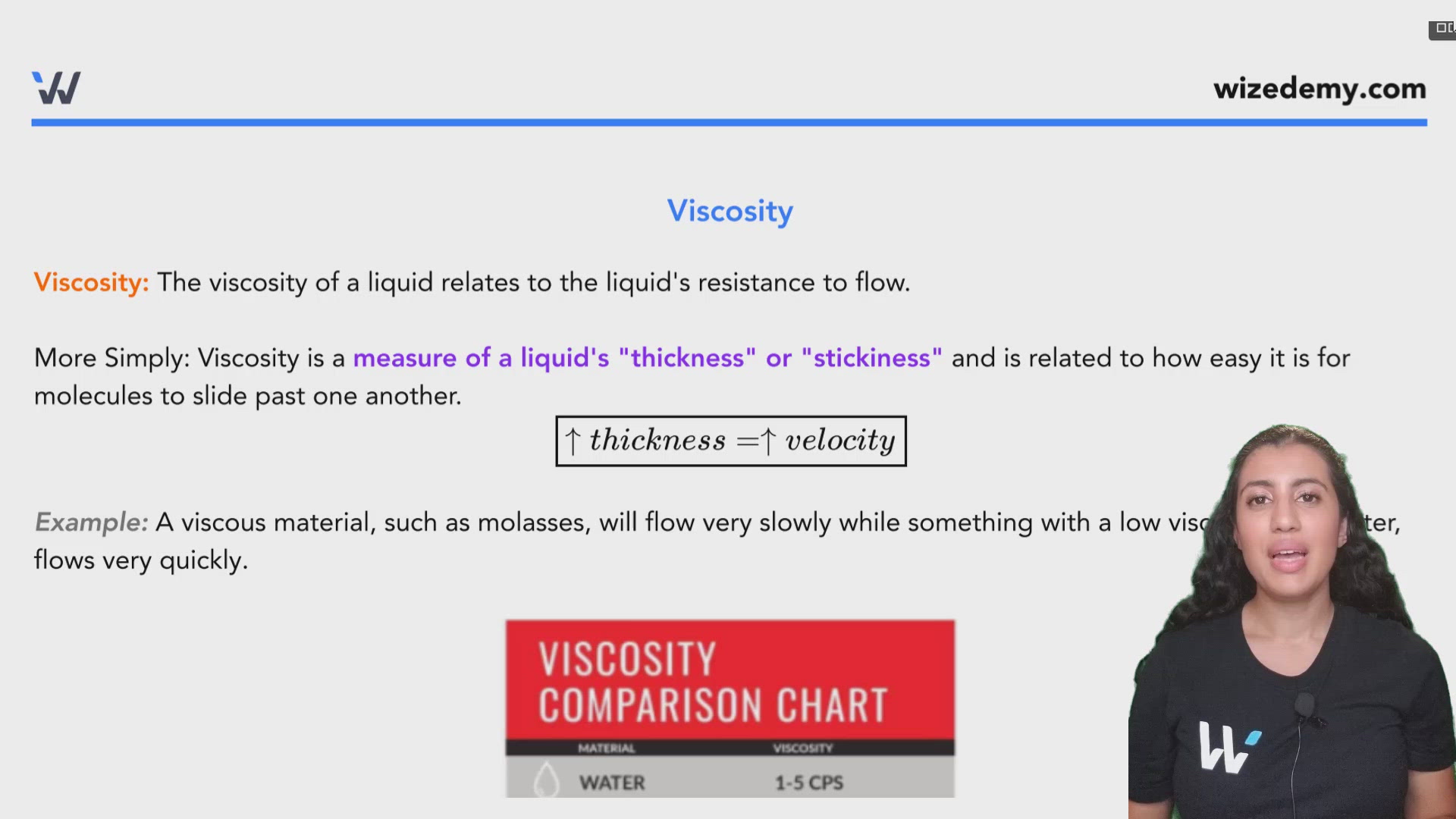
Viscosity
Viscosity: The viscosity of a liquid relates to the liquid's resistance to flow.
More Simply: Viscosity is a measure of a liquid's "thickness" or "stickiness" and is related to how easy it is for molecules to slide past one another.
Example: A viscous material, such as molasses, will flow very slowly while something with a low viscosity, like water, flows very quickly.
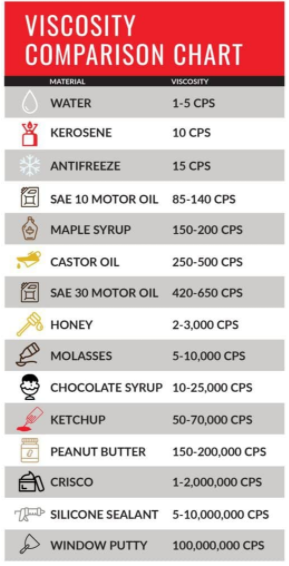
Factors that Influence Viscosity
1. Intermolecular Forces

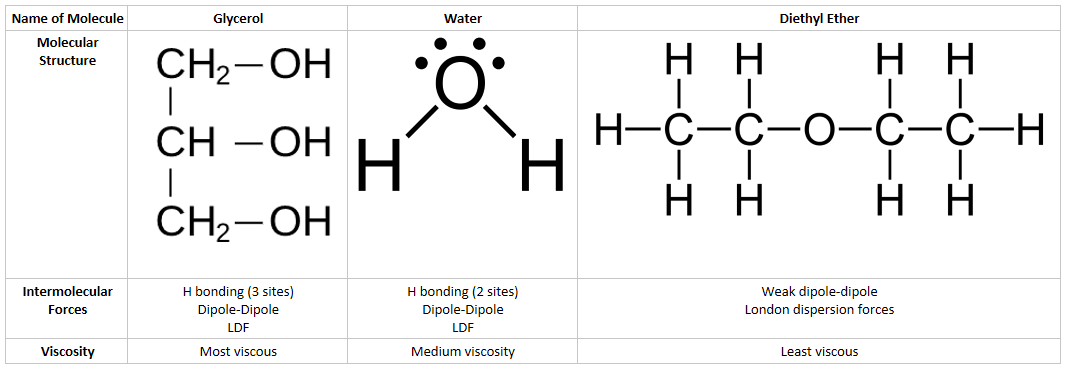
Wize Concept
The stronger the intermolecular forces between molecules in a liquid, the more resistant they are to separating and allowing molecules to slip by.
Therefore, stronger intermolecular forces leads to higher viscosity.
2. Molecular Weight
Earlier we learned that a molecule with a higher MW has stronger London dispersion forces. If two molecules only have LDF, the one with the higher MW will have stronger forces and be (more/less)
more
viscous.
3. Temperature effects
Increasing the temperature increases the molecular motion and breaks apart some of the attractive intermolecular interactions. Therefore, increasing the temperature makes the liquid (more/less)
less
viscous. 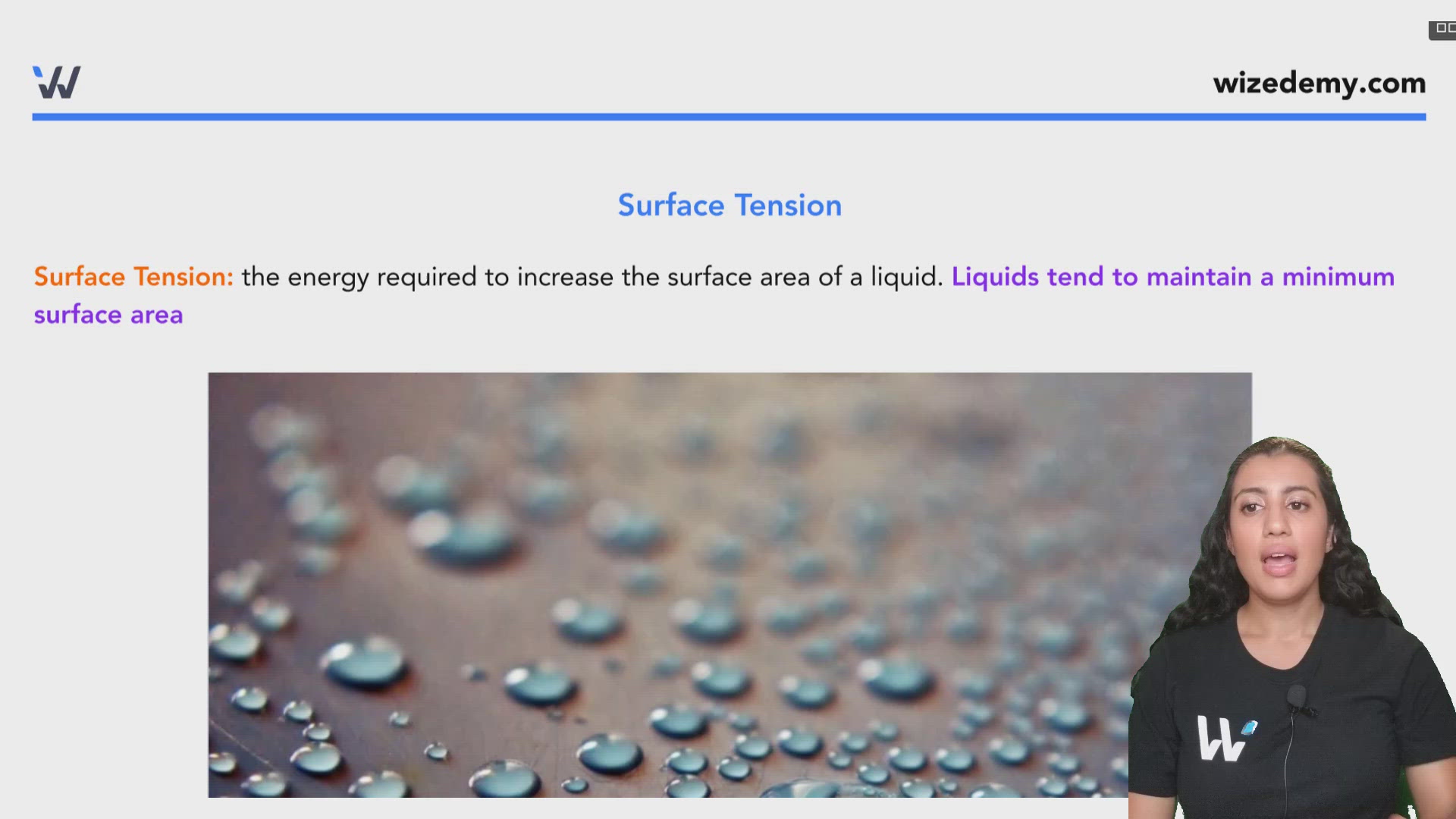
0:00 / 0:00
Surface Tension
Surface Tension: the energy required to increase the surface area of a liquid. Liquids tend to maintain a minimum surface area
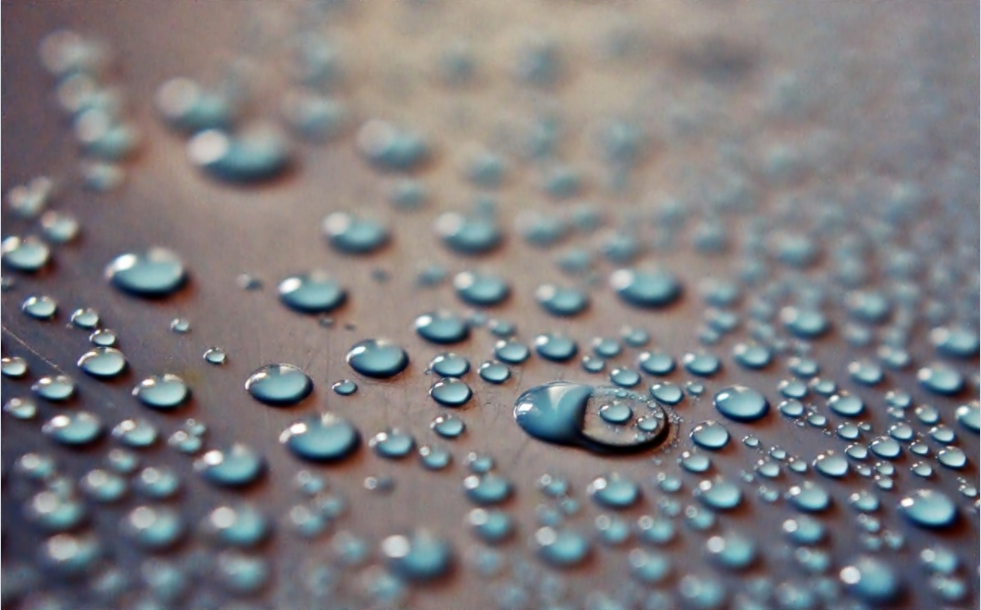
Surface tension is a result of the attraction of the surface molecules of a liquid to the interior molecules of a liquid. This attraction is depicted below and results in a force pushing the surface inwards.

Interior molecules: have a greater number of intermolecular attractions (as a result, these are more stable and lower in energy)
Surface molecules: have a fewer number of intermolecular attractions (as a result, these are less stable, and higher in energy)
In order to change the surface area of a liquid, work or energy is required.
More energy is required to move an interior molecule to the surface when molecules have stronger intermolecular forces (higher surface tensions).
The stronger the intermolecular forces, the higher the surface tension.
As temperature increases, the increased kinetic energy pulls some of the intermolecular forces apart. As a result, surface tension (increases/decreases)
decreases
.Surface tension involves cohesive forces, which are forces between like things (if the liquid is water, then there are cohesive interactions between surface water molecules and interior water molecules).
0:00 / 0:00
Capillary Action
Before we learn about capillary action, let's first consider a glass test tube with H2O in it vs Hg.
This is what we might expect the glass tube filled with H2O and Hg to look like:
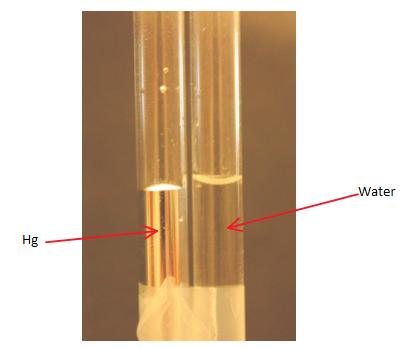
However, this is what the glass tubes would really look like:
Why is this the case?
- Glass is made of very polar (Si-O) bonds
- Water molecules have hydrogen bonding and are polar, while Hg(l) is non-polar
- The polar water molecules want to interact with the polar glass tube. As a result, the molecules are seen interacting with the glass container as much as possible → concave meniscus
- For water, the adhesive forces (between the glass and water molecules) are stronger than the cohesive forces (between water molecules)
- On the other hand, the non-polar Hg does not want to interact with the polar glass tube → convex meniscus
- For mercury, the cohesive forces (between mercury atoms) are stronger than the adhesive forces (between mercury and glass)
Wize Concept
Cohesive forces: forces between like molecules
Example: forces between water molecules or forces between mercury atoms
Adhesive forces: forces between unlike molecules
Example: forces between the glass container and liquid inside of it
Example: When we place water inside of a plastic container would we see a concave or convex meniscus?
Convex
Do cohesive or adhesive forces win?
Cohesive
Example: When we place hexane (a non-polar hydrocarbon) inside of a plastic container would we see a concave or convex meniscus?
Concave
Do cohesive or adhesive forces win?
Adhesive
Capillary Action
Capillary action refers to the movement of a liquid through a tube or absorbent material
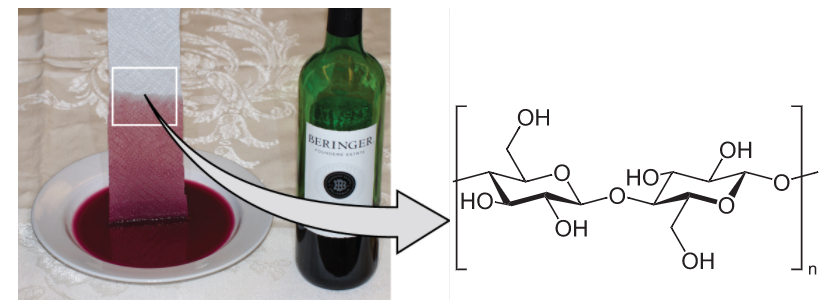
Example: Wine moving up a paper towel is an example of capillary action!
- The wine is made up of ethanol (with OH groups) and water (with OH groups) making it (polar/non-polar)polar.
- The paper towel is made up of cellulose which is the molecule shown on the right. It also has a lot of OH groups so it is (polar/non-polar)polar.
- The wine wants to interact with the paper towel since both are polar. As the paper towel binds to the molecules in wine, other molecules in wine will continue to move up the paper towel so they can bind as well.
Does capillary action demonstrate strong cohesive or adhesive forces?
Adhesive forces
0:00 / 0:00
Example: Surface Tension
When a window is dirty, rain water tends to form beads and obscure the view from inside, however once the window has been cleaned, the water does not bead but rather spreads out across the window and flows off. Explain the difference in the behavior of the water for the clean and dirty window.
When the window is dirty it is covered in a fine layer of organic matter (greasy material) which is non-polar and does not interact strongly with the liquid. This means that cohesion > adhesion and droplets will form.
On the other hand, when the window is clean, the glass has polar residues on the surface which can hydrogen bond with the water molecules. For a clean window cohesion < adhesion and the water spreads across the surface.
Example: Droplets
When liquid mercury (Hg) spills on a glass floor, it forms small Hg spherical droplets because:
1. The adhesive forces between Hg and glass are stronger than the Hg and cohesive forces.
2. The adhesive forces between Hg and glass are weaker than the Hg and cohesive forces.
3. The surface tension between Hg and glass is weaker than the adhesive forces.
4. The glass cohesive forces are weaker than the adhesive forces between Hg and glass.
5. The adhesive forces between Hg and glass are much stronger than the surface tension of the glass.
Answer: 2
The mercury is non-polar. It does not really want to interact with the polar glass floor.
The mercury would rather interact with itself.
Therefore it will form spherical droplets because the Hg cohesive forces are very strong (forces between Hg that hold it together), while the adhesive forces between Hg and the glass floor are very weak.
Practice: Physical Properties of Liquids
Consider two liquids: pentane, C5H12, and a light mineral oil, C12H26.
In the table below identify which liquid is being described. Enter pentane or mineral oil as your answer.
| A drop of hexane diffuses more rapidly through it | |
| When it is poured, it takes the shape of the container at a slower rate | |
| It has the lower boiling point | |
| Its surface is able to support a heavier object |
Practice: Physical Properties
Use the molecules below to answer the following questions:
CO2, Ne, CH3OH, KI
Place the following in order of increasing melting point: