Wize University Statics Textbook (Master) > Equilibrium of a Particle
Free-Body / Force-Body Diagrams (FBD)
Popular Courses
ENGG 130
University of Alberta
CIV100H1
University of Toronto
PCS 211
Toronto Metropolitan University
ENGG 202
University of Calgary
ENGSCI 1022A/B/Y
Western University
GNG 1105
University of Ottawa
PHYS 110
University of Victoria
ENGR 242
Concordia University
ENGR 141
University of Victoria
CE 221
Michigan State University
GENG-1110
University of Windsor
ESM 2104
Virginia Tech
APS160H1
University of Toronto
0:00 / 0:00
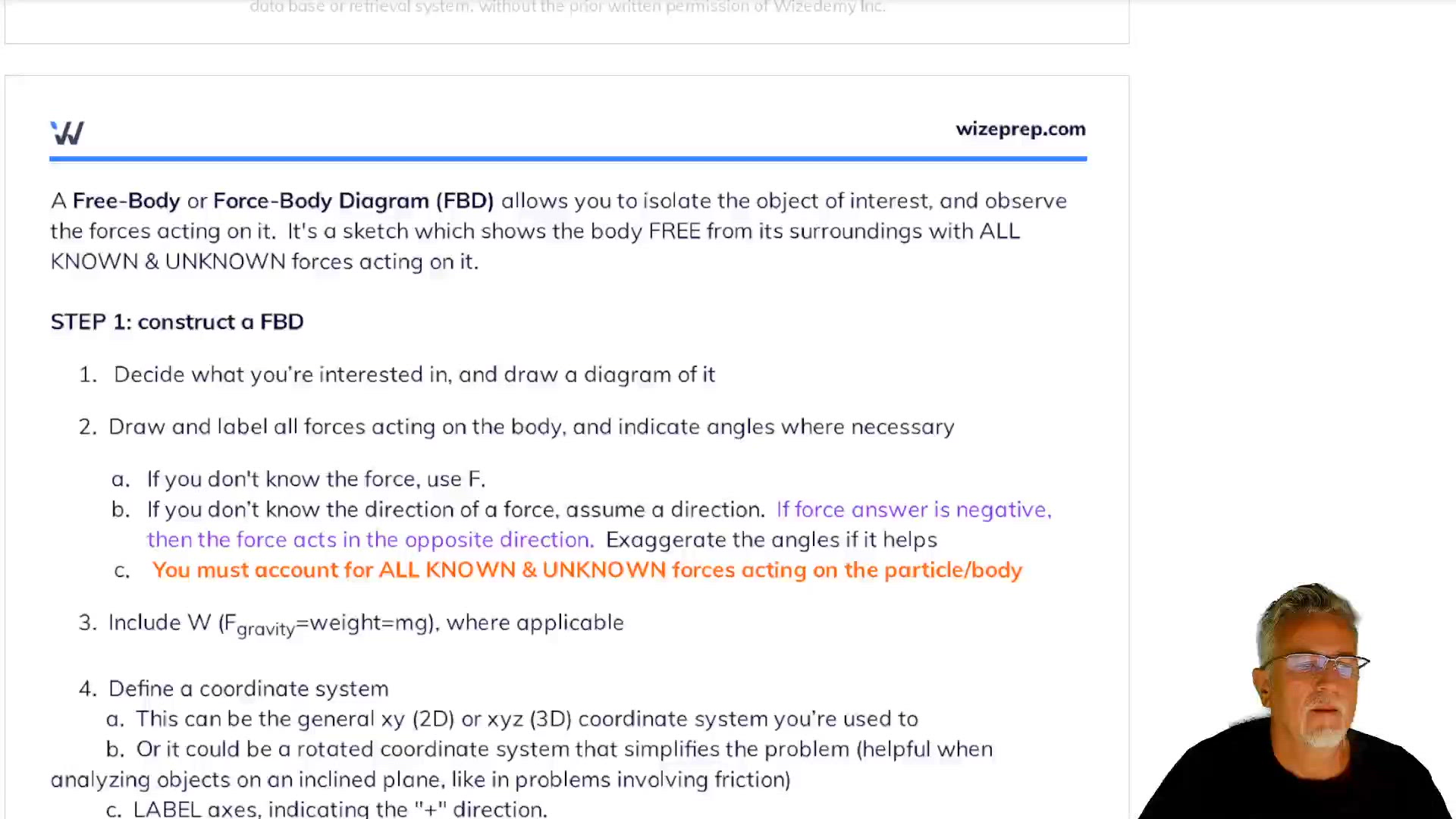
A Free-Body or Force-Body Diagram (FBD) allows you to isolate the object of interest, and observe the forces acting on it. It's a sketch which shows the body FREE from its surroundings with ALL KNOWN & UNKNOWN forces acting on it.
STEP 1: construct a FBD
- Decide what you’re interested in, and draw a diagram of it
2. Draw and label all forces acting on the body, and indicate angles where necessary
- If you don't know the force, use F.
- If you don’t know the direction of a force, assume a direction. If force answer is negative, then the force acts in the opposite direction. Exaggerate the angles if it helps
- You must account for ALL KNOWN & UNKNOWN forces acting on the particle/body
3. Include W (Fgravity=weight=mg), where applicable
4. Define a coordinate system
a. This can be the general xy (2D) or xyz (3D) coordinate system you’re used to
b. Or it could be a rotated coordinate system that simplifies the problem (helpful when analyzing objects on an inclined plane, like in problems involving friction)
c. LABEL axes, indicating the "+" direction.
***Drawing a FBD is required for every question (where applicable)***
(besides being required, IT IS A GOOD PLACE TO START!!!!)
STEP 2: choose equations
The next step would be to sum forces to be equal to a resultant force. If the system is at equilibrium, then the resultant force is zero.
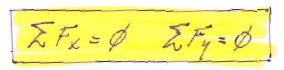
When setting up equations, remember:
Where to get that many equations:
- Begin by using equations of equilibrium (sum F's in x, y, and z (if 3D))
- (in the next section we will add sum M's about the x, y, and z axes (in 3D) to this list
- Use spring equations where applicable
- Use geometric equation if necessary


0:00 / 0:00
You learned how to draw a FBD for particles, and now it’s more important to know how to draw FBDs for bodies. The steps are essentially the same, but remember to account for moments, and include a coordinate system if one isn't provided for you.
0:00 / 0:00
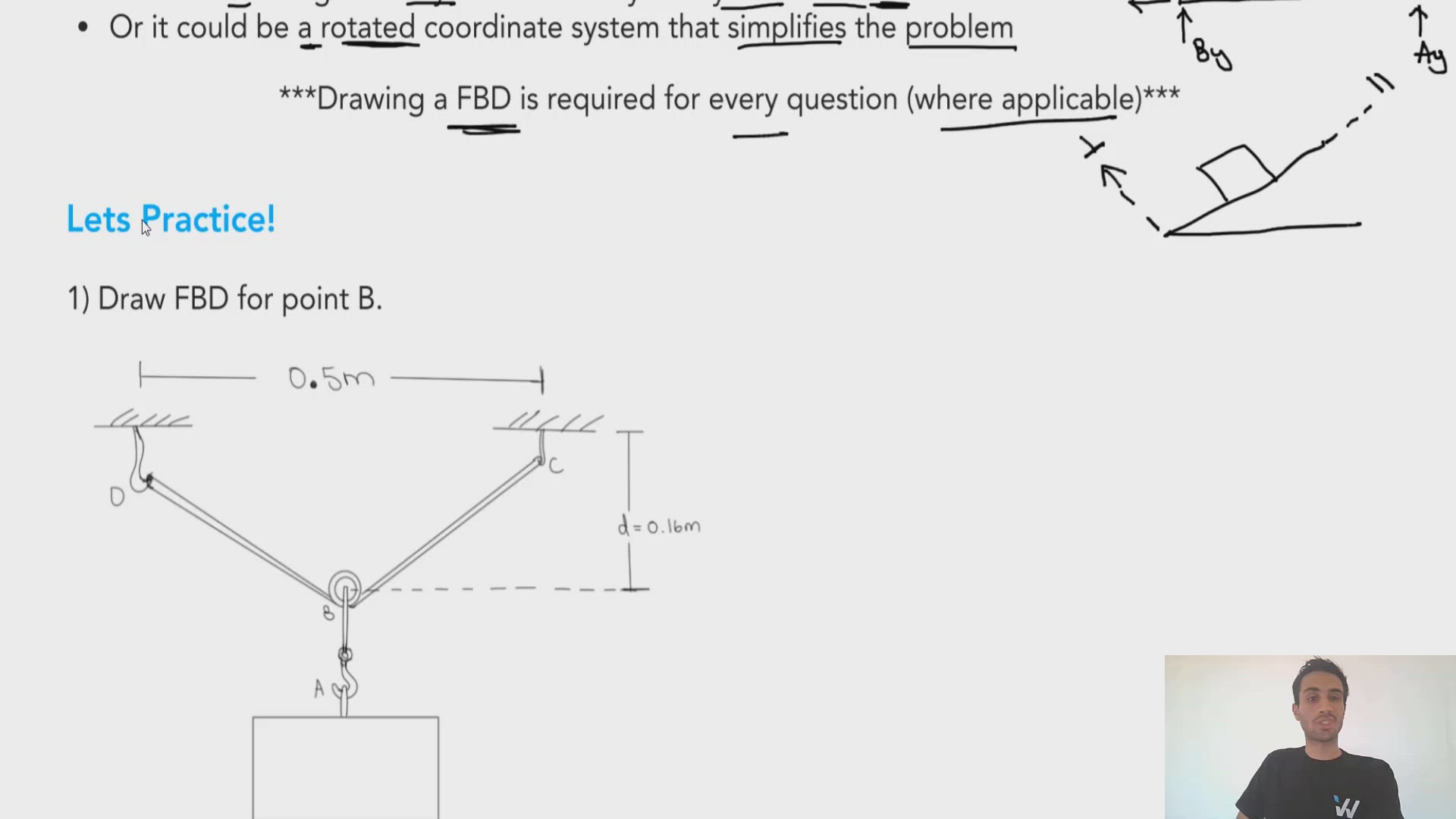
Lets Practice!
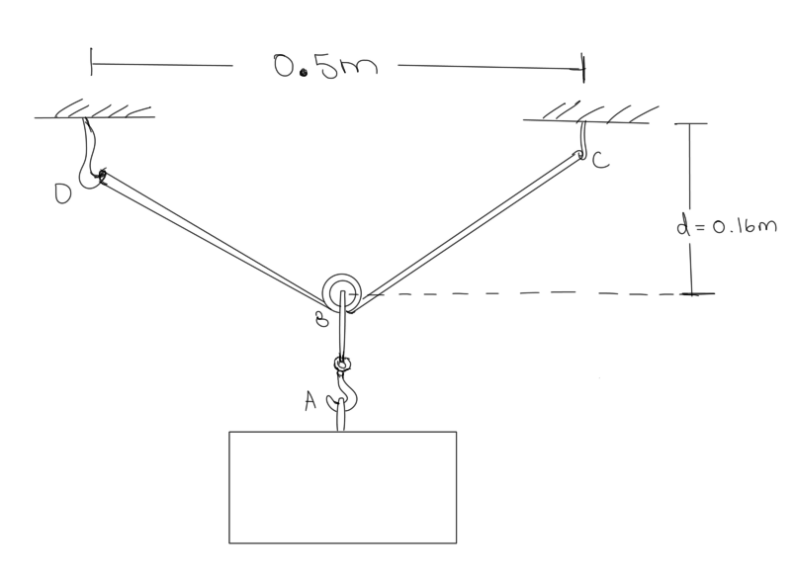
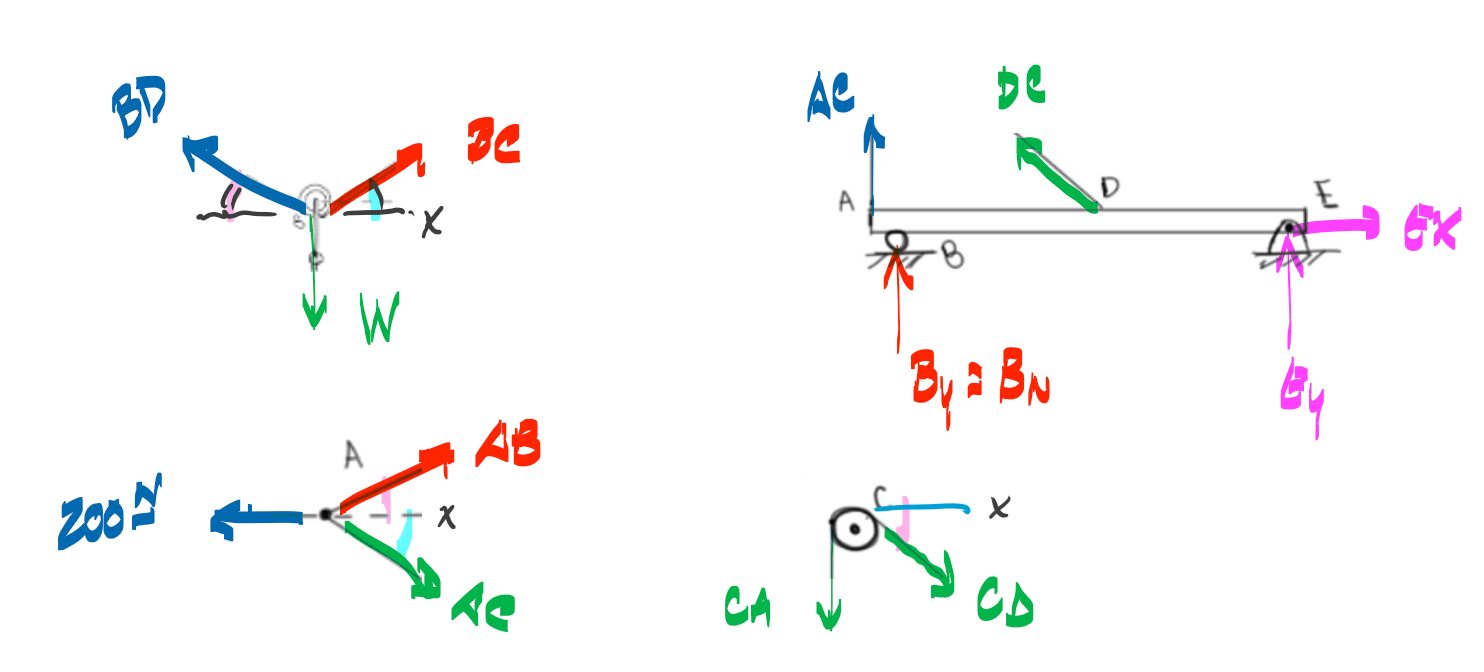
1) Draw FBD for point B.
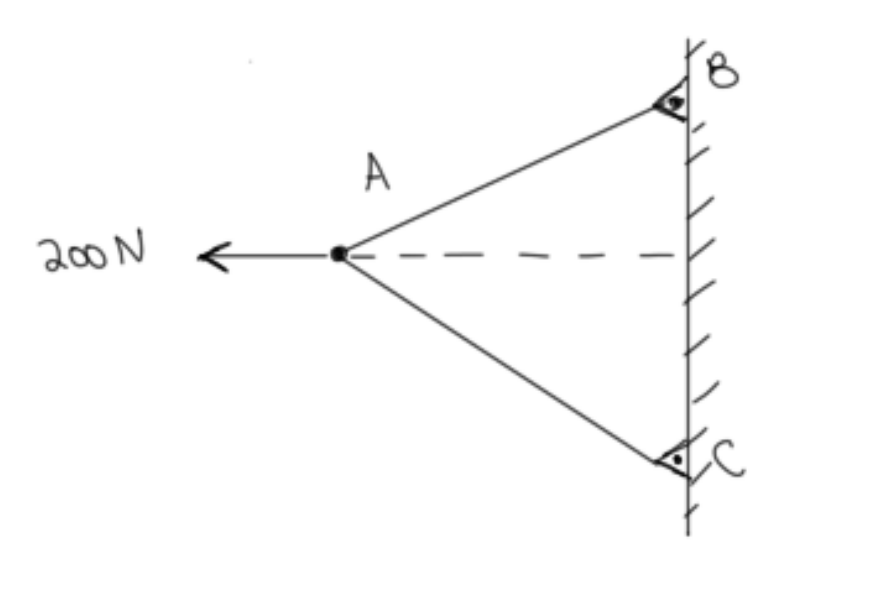
2) Draw FBD for Point A.
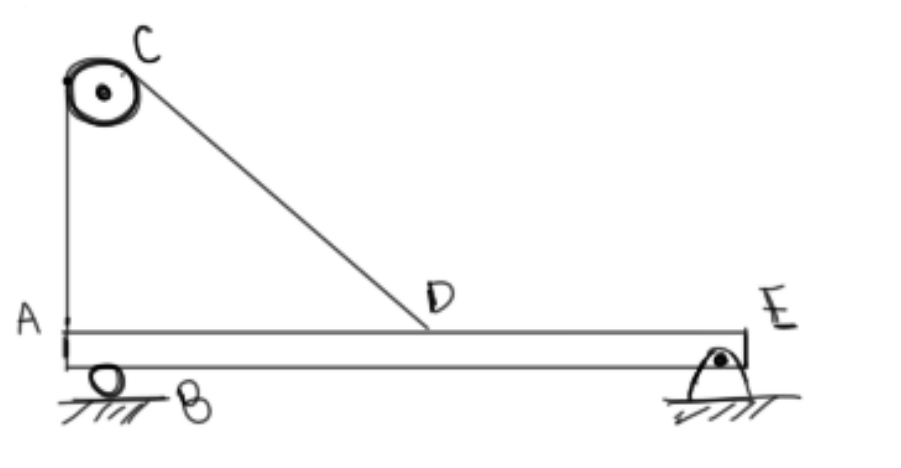
3)
-Draw FBD for the beam.
-Draw FBD for the pulley system isolated (point C).
A good guideline to setting up equations is
To get that many equations:
- Begin by using equations of equilibrium
- Use spring equations where applicable
- Use geometric equation if necessary
-------------------------------------------------------------------
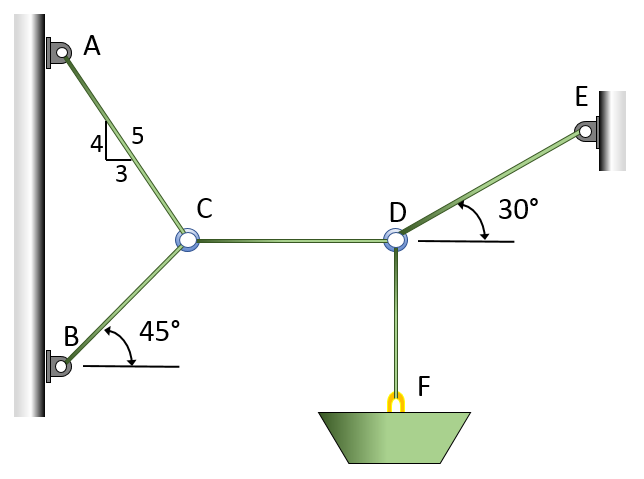
The lamp weights 57 N. Determine the tension in each of AB and AC needed to carry the lamp.
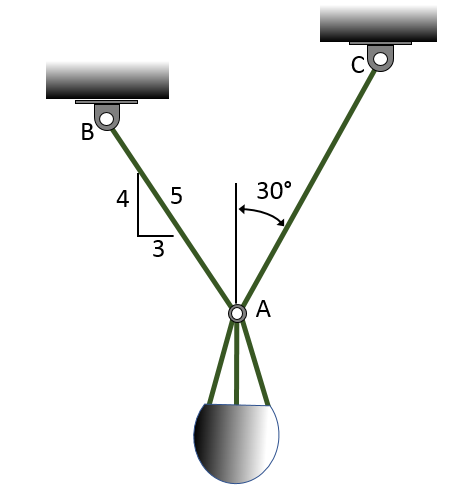
Tension of AB is ___ newtons.
Determine the maximum allowable weight for the lamp at F if each of the cables can only handle a load of 50 N.