Wize University Statics Textbook (Master) > Equilibrium of a Particle
(2D) Pulleys, Ropes, Cables, Springs
Ropes, Cables, and Springs (2D Equilibrium)
Pulleys (2D Equilibrium)
Example 1: Ropes and Cables (2D)
Practice 1: Ropes and Cables (2D)
Example 2: Part 1 - Pulleys (2D) - IMPORTANT!
Example 2: Part 2 - Pulleys (2D) - IMPORTANT!
Practice 2: Pulleys (2D) - IMPORTANT!
Example Question 1: Cables and Springs
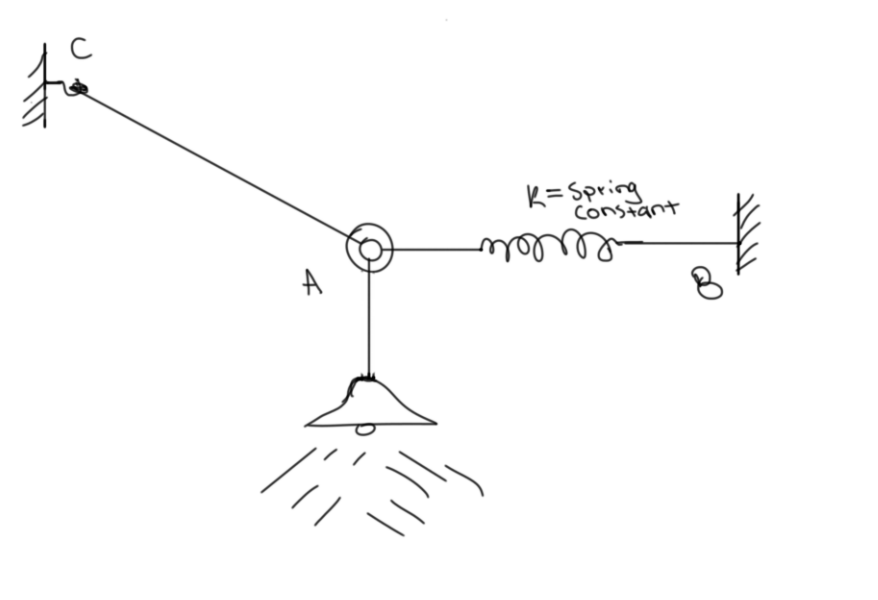
Example Question 2: Cables and Hanging Weights
Example Question 3: Two Cables
Popular Courses
ENGG 130
University of Alberta
CIV100H1
University of Toronto
PCS 211
Toronto Metropolitan University
ENGG 202
University of Calgary
ENGSCI 1022A/B/Y
Western University
GNG 1105
University of Ottawa
PHYS 110
University of Victoria
ENGR 242
Concordia University
ENGR 141
University of Victoria
CE 221
Michigan State University
GENG-1110
University of Windsor
ESM 2104
Virginia Tech
APS160H1
University of Toronto
0:00 / 0:00
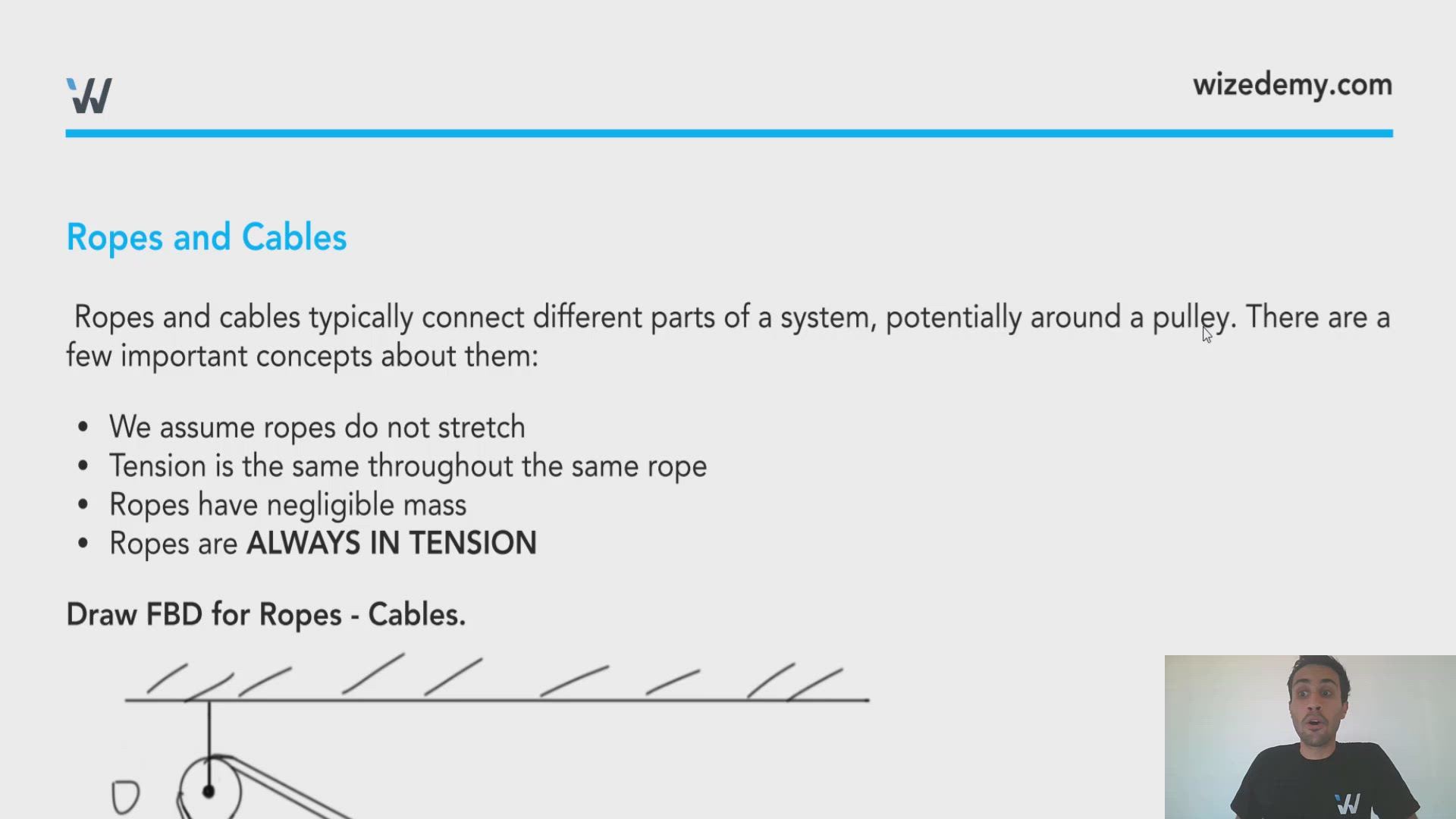
Ropes and Cables
Ropes and cables typically connect different parts of a system, potentially around a pulley. There are a few important concepts about them:
- We assume ropes do not stretch
- Tension is the same throughout the same rope
- Ropes have negligible mass
- Ropes are ALWAYS IN TENSION
Draw FBD for Ropes - Cables.
Springs
Springs are also commonly seen in this course. You need to know the following about springs:
- Springs are assumed to obey Hooke’s law
- The force in the spring is proportional to the stretch in the spring from its equilibrium position
- Springs can be in tension or compression.
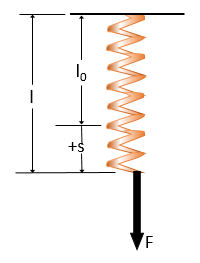
Spring in Action.
0:00 / 0:00
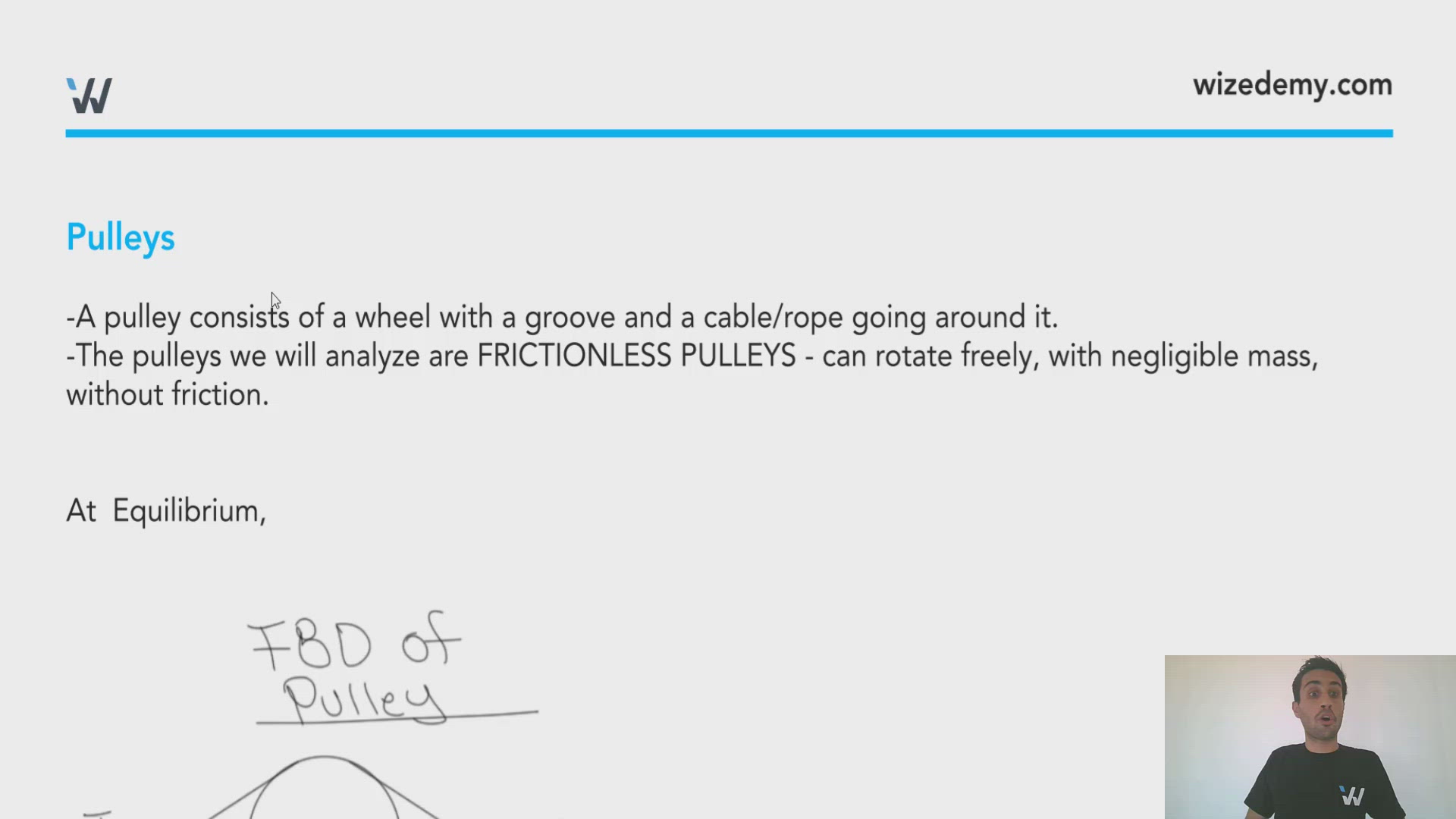
Pulleys
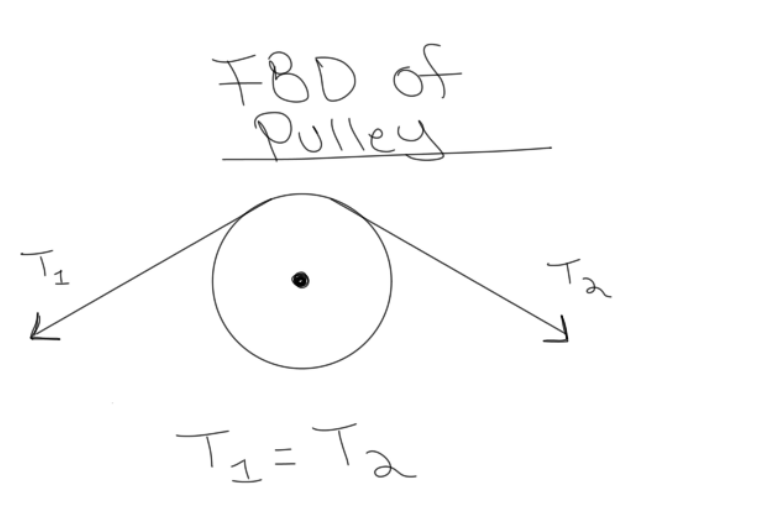
-A pulley consists of a wheel with a groove and a cable/rope going around it.
-The pulleys we will analyze are FRICTIONLESS PULLEYS - can rotate freely, with negligible mass, without friction.
At Equilibrium,
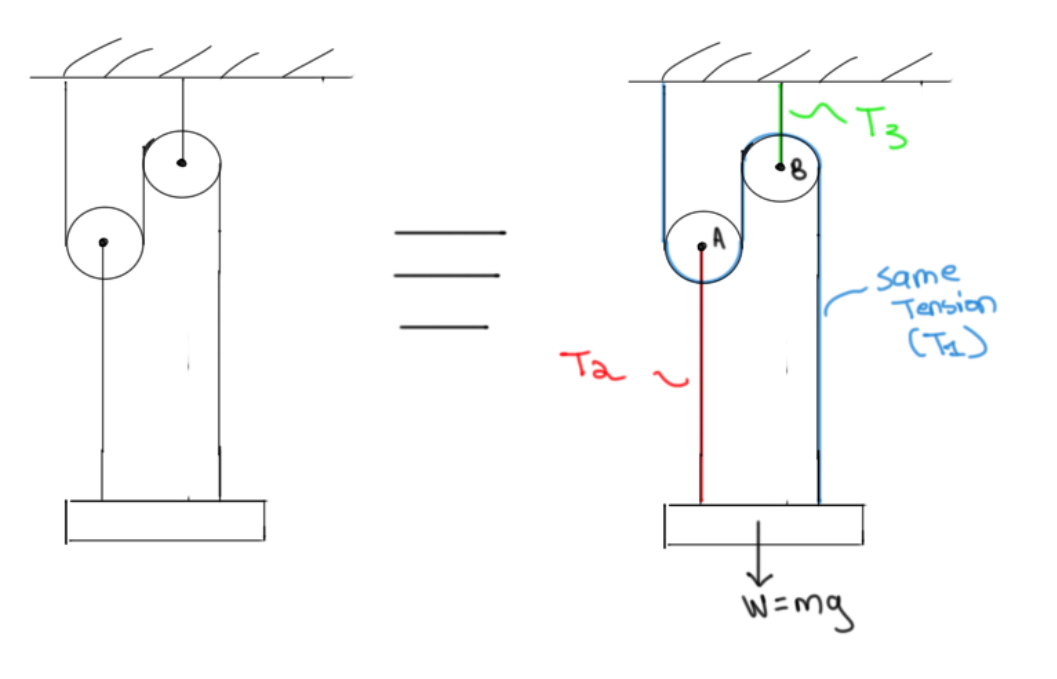
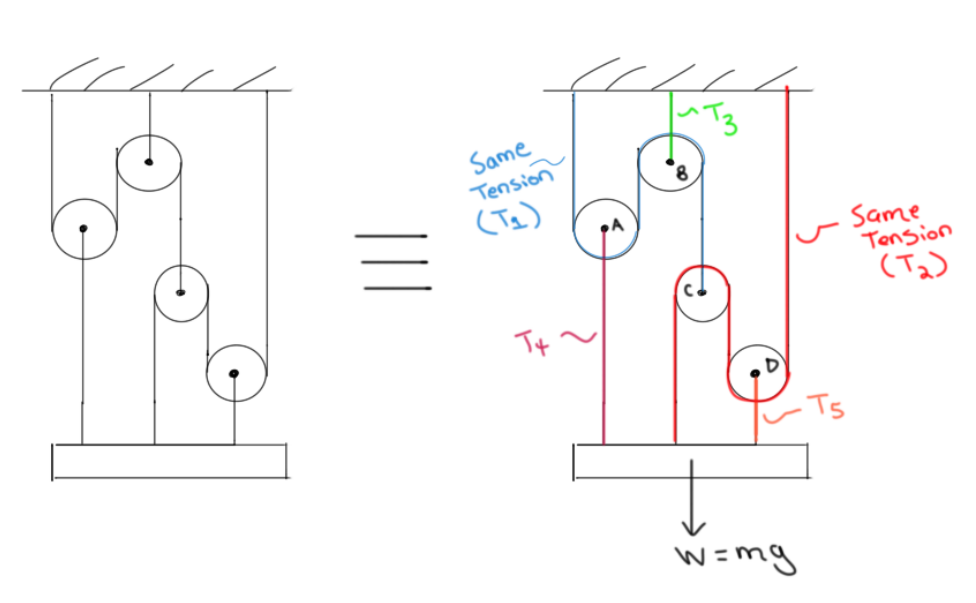
Examples
0:00 / 0:00
Example
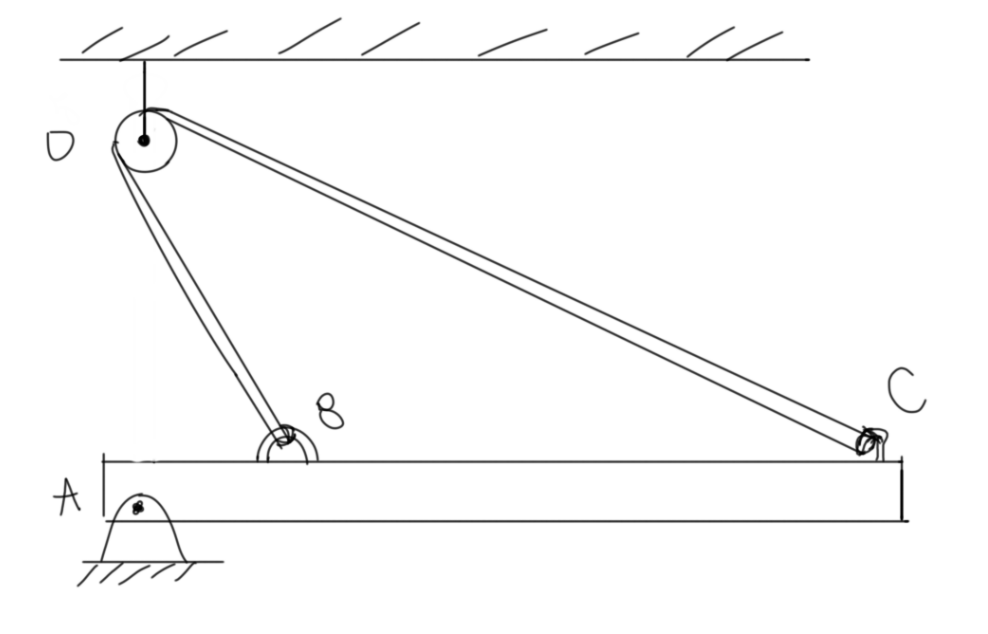
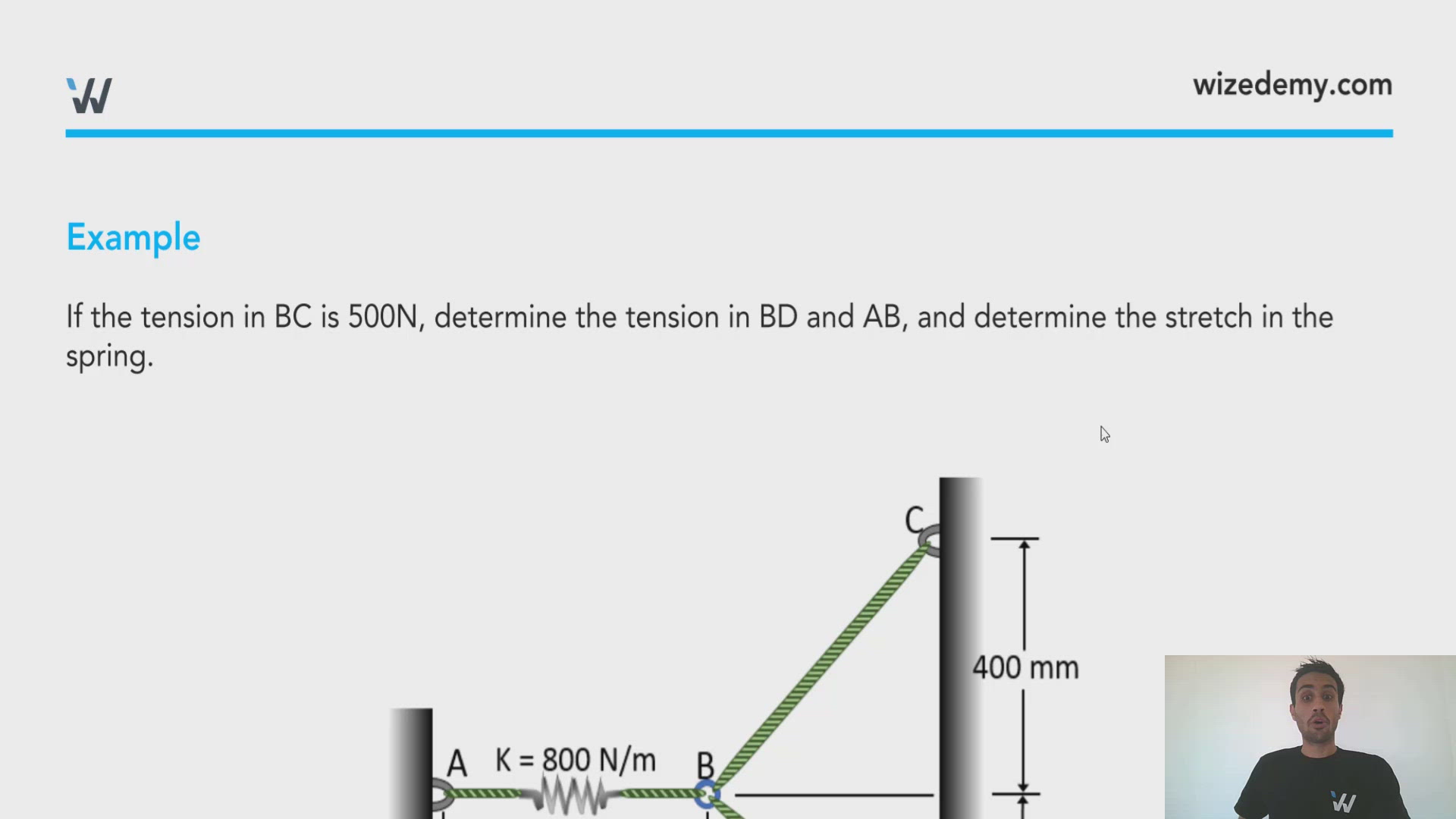
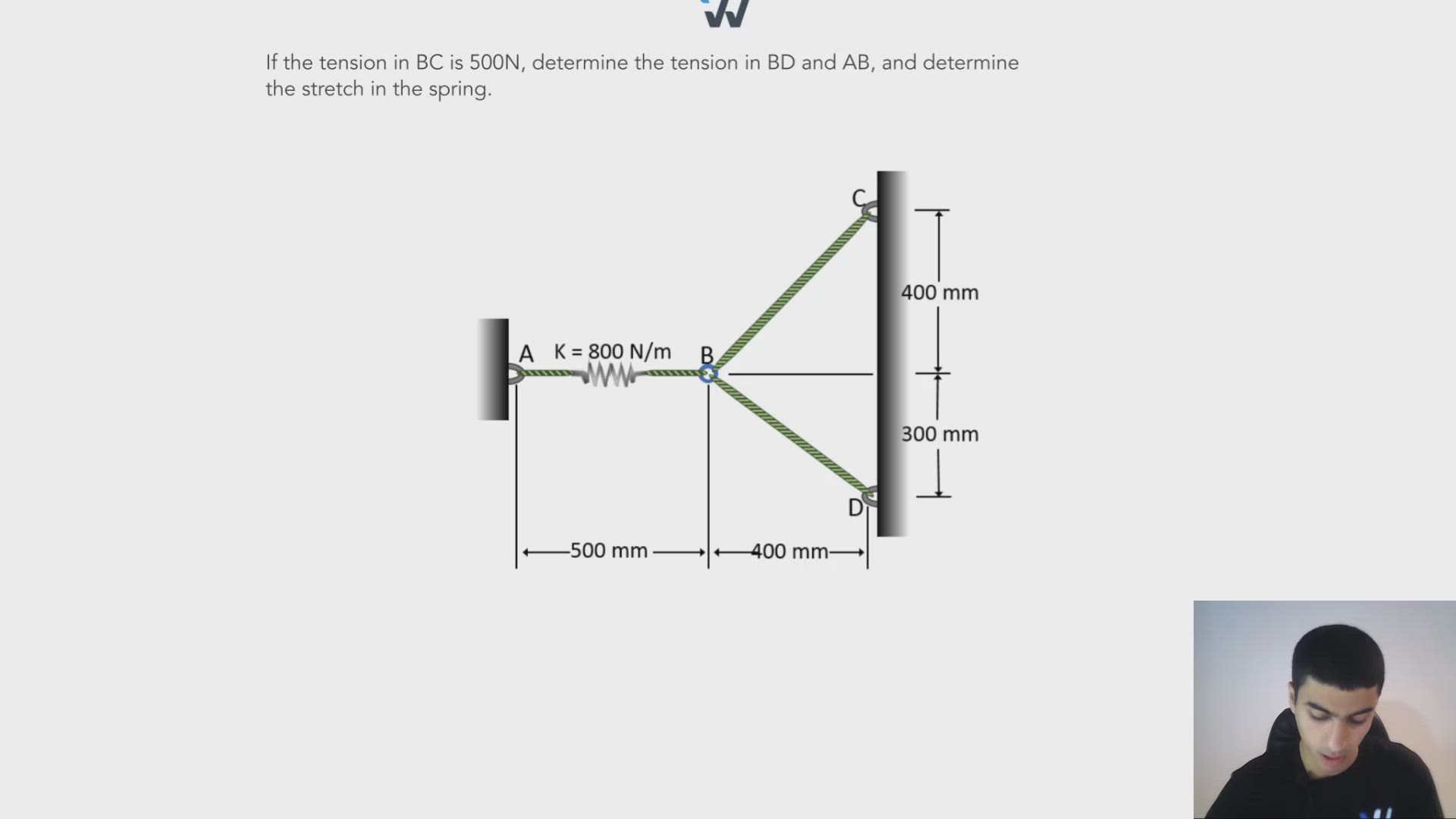
If the tension in BC is 500N, determine the tension in BD and AB, and determine the stretch in the spring.
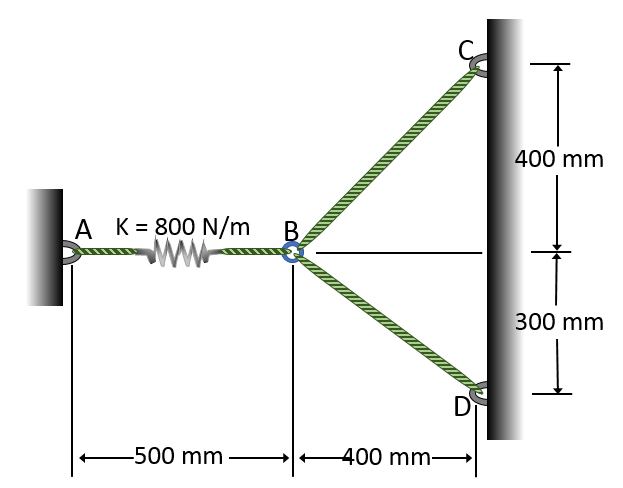
Solution:
1) Draw Free Body Diagram
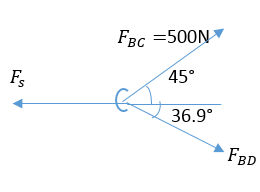
2) Apply Equation of Equilibrium
3) Solve for
Practice
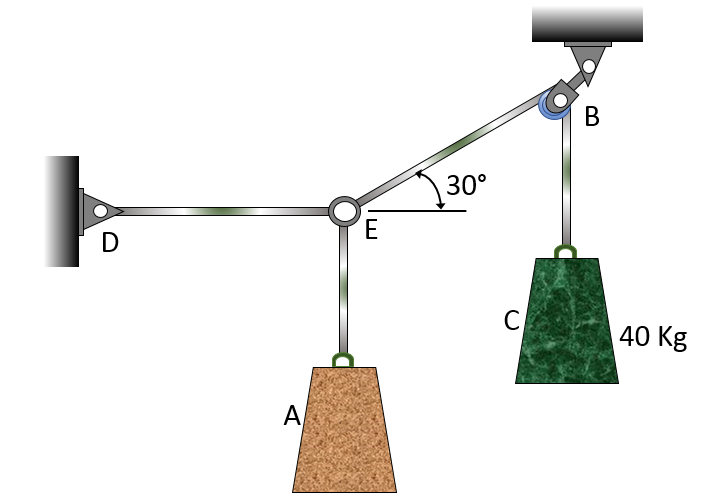
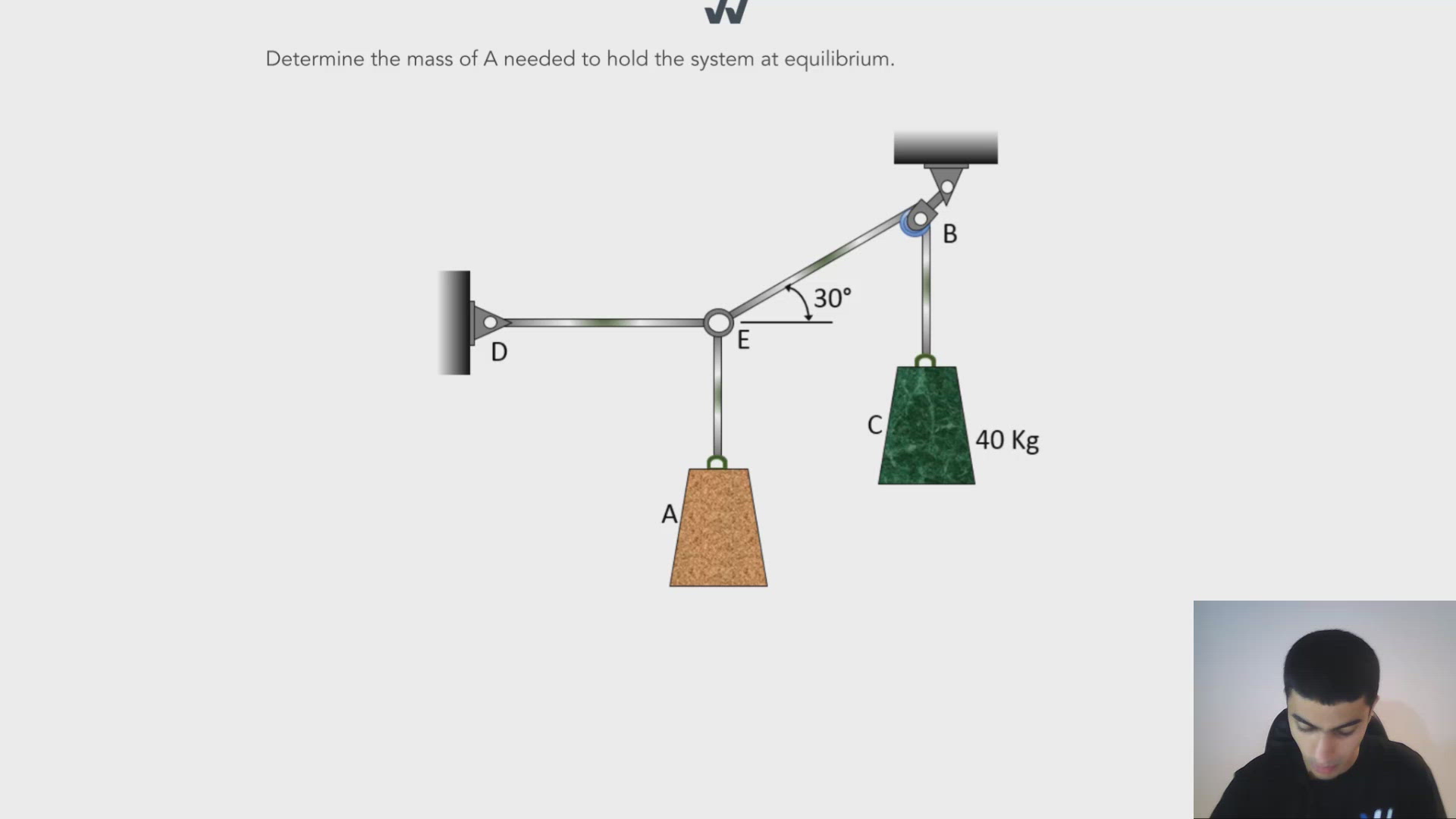
Determine the mass of A needed to hold the system at equilibrium.
0:00 / 0:00
Example
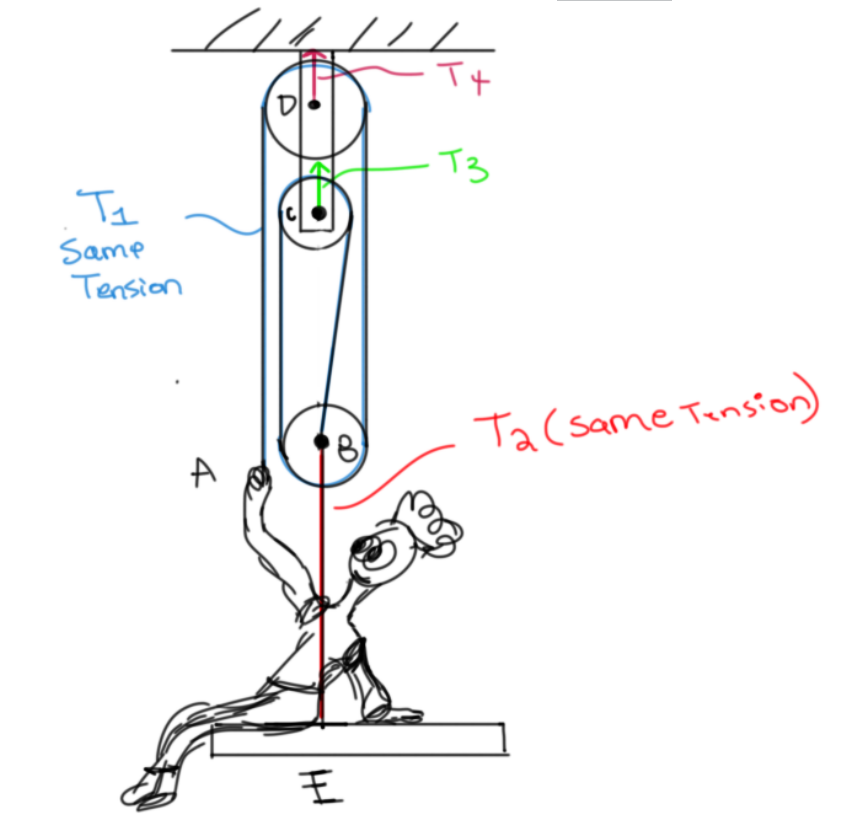
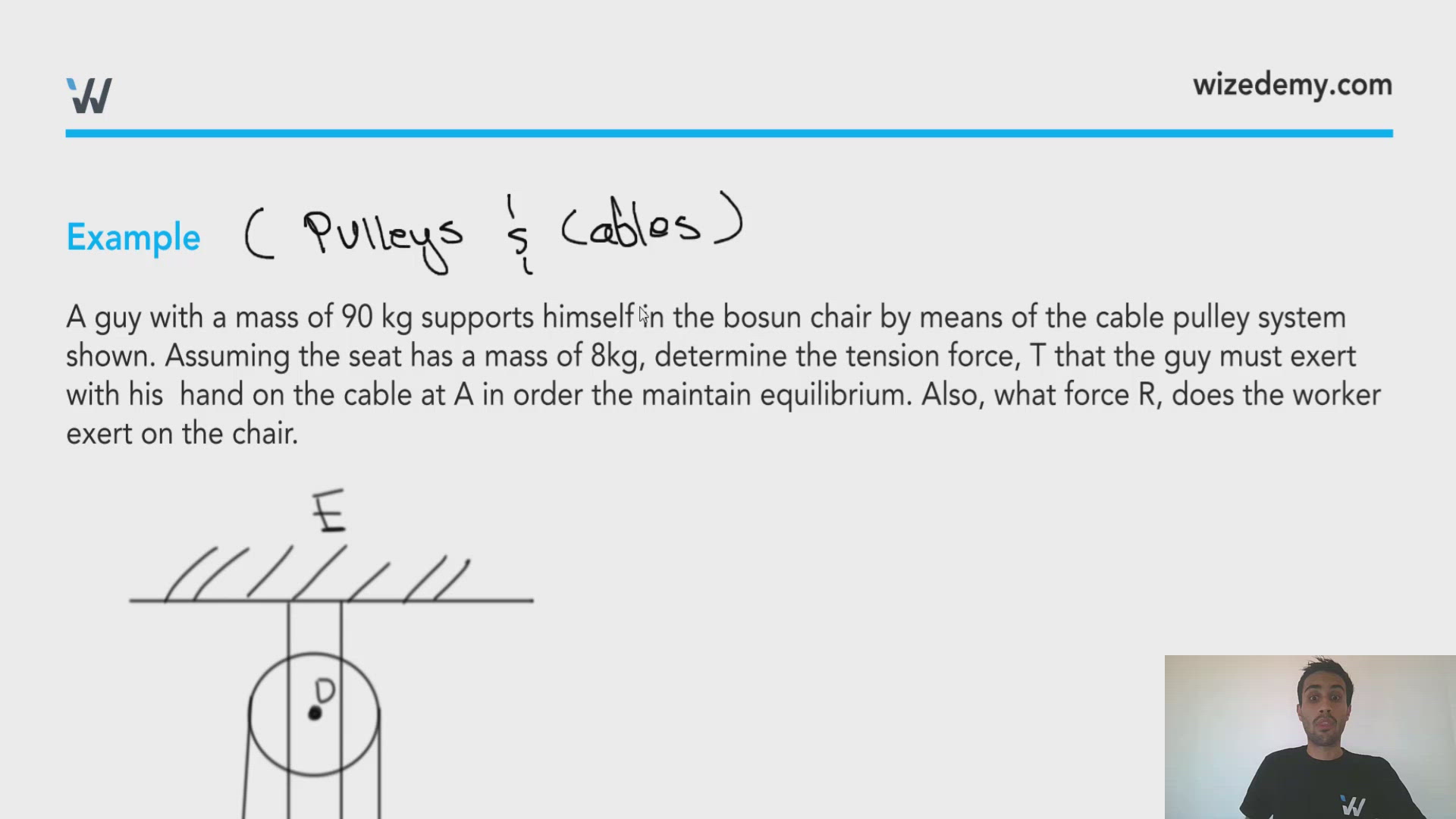
A guy with a mass of 90 kg supports himself in the bosun chair by means of the cable pulley system shown. Assuming the seat has a mass of 8kg, determine the tension force, T that the guy must exert with his hand on the cable at A in order the maintain equilibrium. Also, what force R, does the worker exert on the chair.

1) Label and determine where the tension is the same.

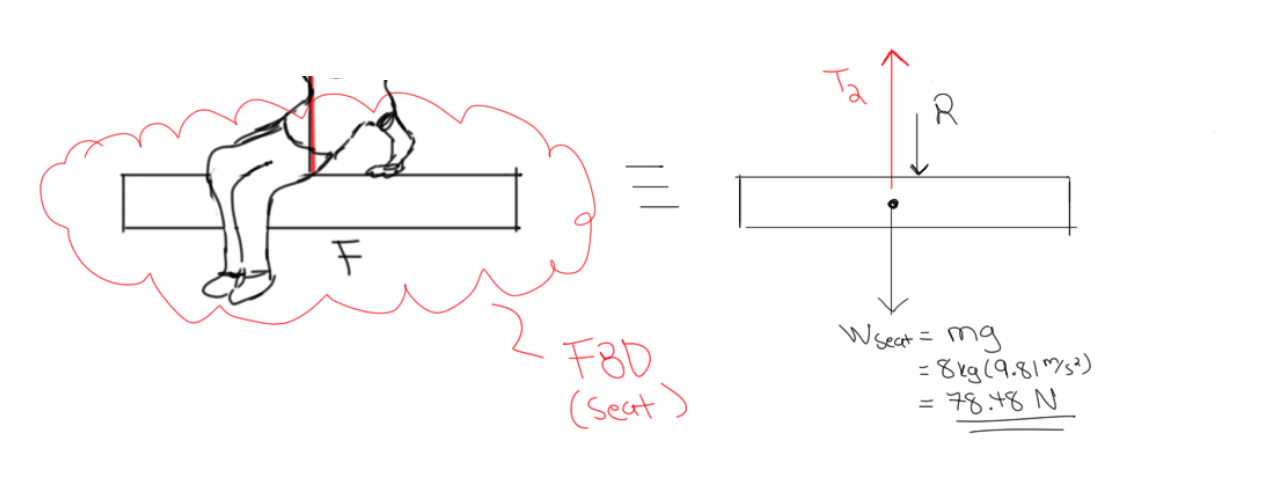
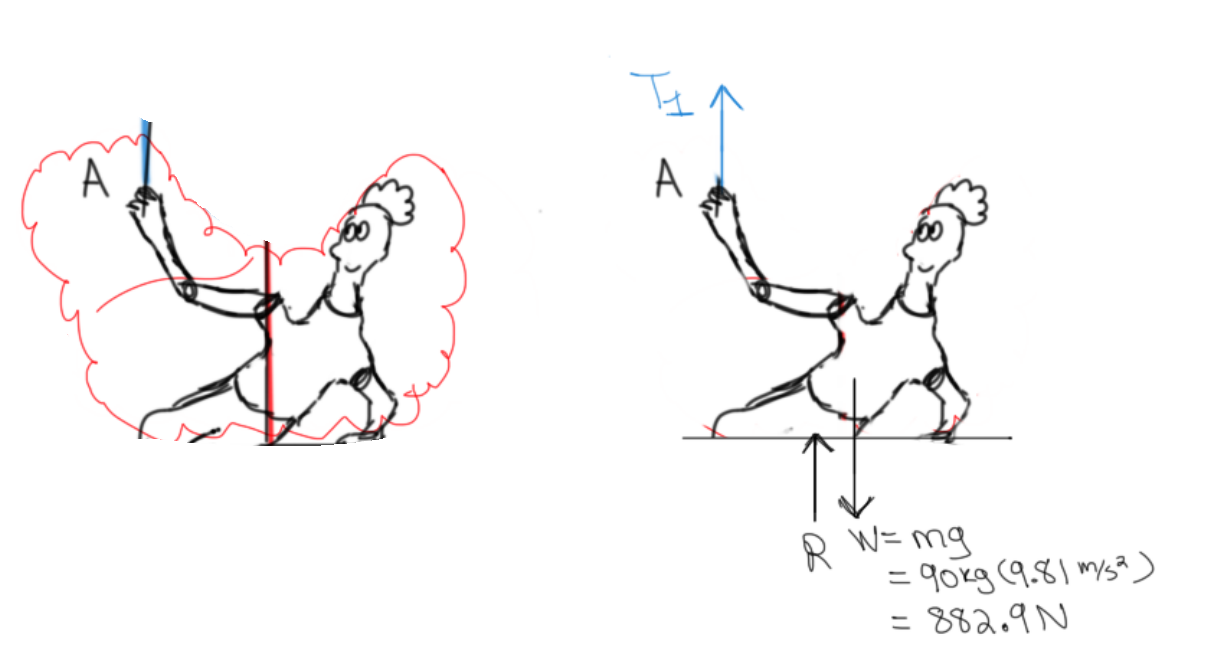
2) Begin drawing Free Body Diagrams (Assuming all cables are vertical)
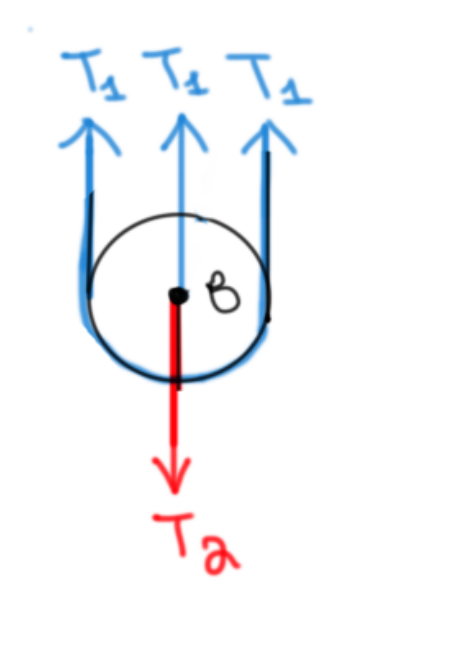
We realize the tension T1 is what we solving for in the first step and this would have to depend on T2, therefore it is necessary for us to get T2 in terms of T1 as shown below.
Draw FBDs from the bottom up, and apply equilibrium equation ,
FBD (SEAT)
FBD (GUY)
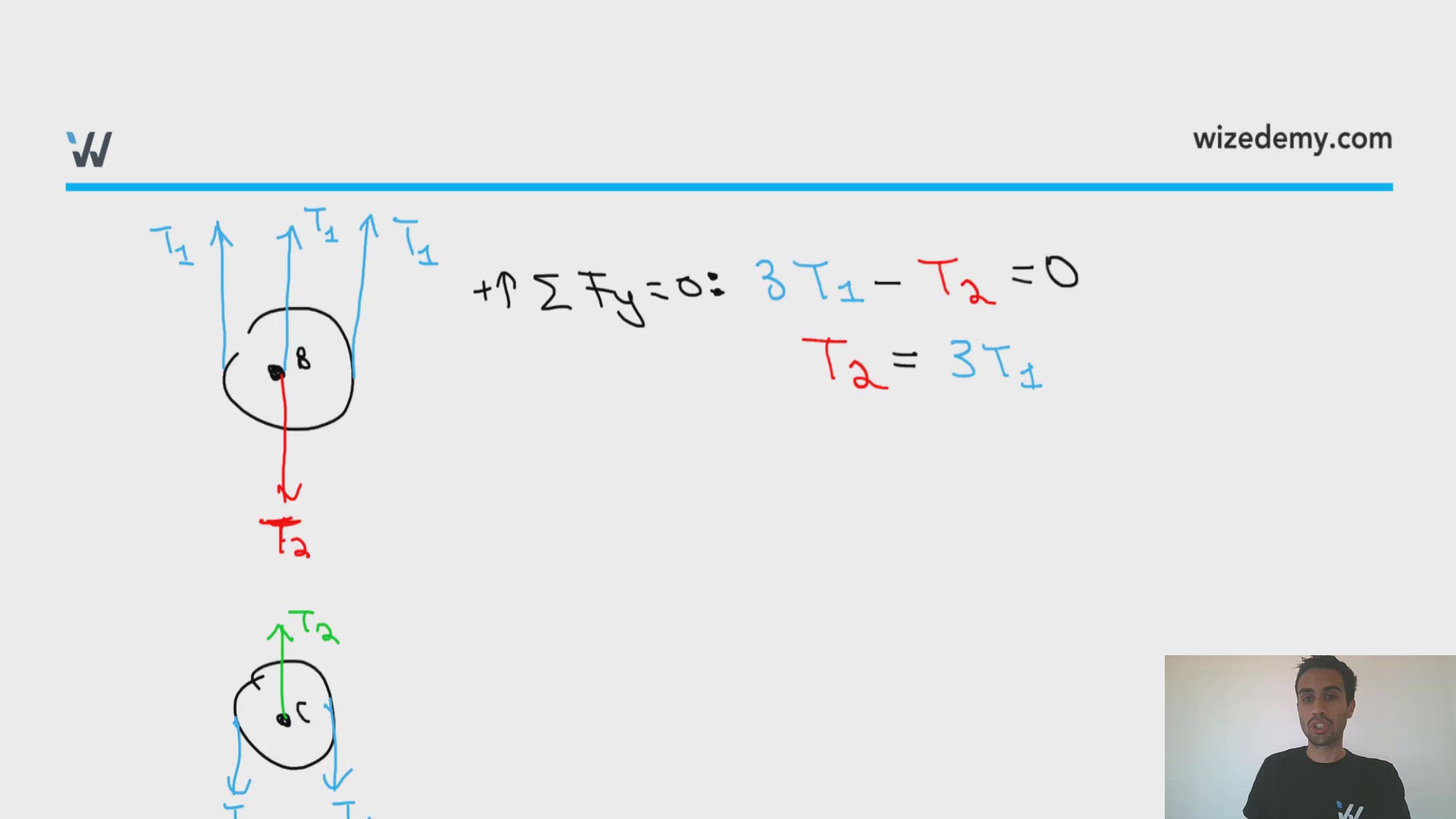
FBD (B)
Substitute from FBD(SEAT) into R for equation from FBD(GUY).
Therefore,
We can use Equation from FBD(B) which relates T2 to T1 and plug it in to the above equation.
Therefore,
Solve for T1,
Solving for R, from equation for FBD(GUY)
0:00 / 0:00
Example
A guy with a mass of 90 kg supports himself in the bosun chair by means of the cable pulley system shown. Assuming the seat has a mass of 8kg, determine the tension force, T that the guy must exert with his hand on the cable at A in order the maintain equilibrium. Also, what force R, does the worker exert on the chair.
1) Label and determine where the tension is the same.
2) Begin drawing Free Body Diagrams (Assuming all cables are vertical)
We realize the tension T1 is what we solving for in the first step and this would have to depend on T2, therefore it is necessary for us to get T2 in terms of T1 as shown below.
Draw FBDs from the bottom up, and apply equilibrium equation ,
FBD (SEAT)
FBD (GUY)
FBD (B)
Substitute from FBD(SEAT) into R for equation from FBD(GUY).
Therefore,
We can use Equation from FBD(B) which relates T2 to T1 and plug it in to the above equation.
Therefore,
Solve for T1,
Solving for R, from equation for FBD(GUY)
Practice
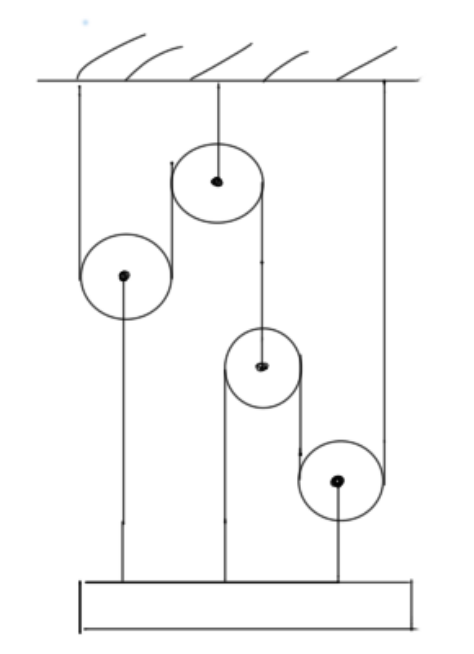
For the following pulley system if the maximum tension in each cable is 1500 N, determine the maximum weight of the platform under the following condition.
0:00 / 0:00
If the tension in BC is 500N, determine the tension in BD and AB, and determine
the stretch in the spring.
Solution:
0:00 / 0:00
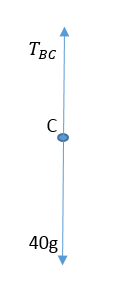
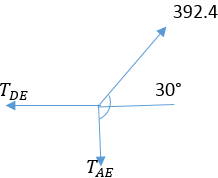
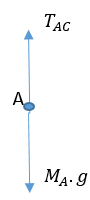
Determine the mass of A needed to hold the system at equilibrium.
Solution:
0:00 / 0:00
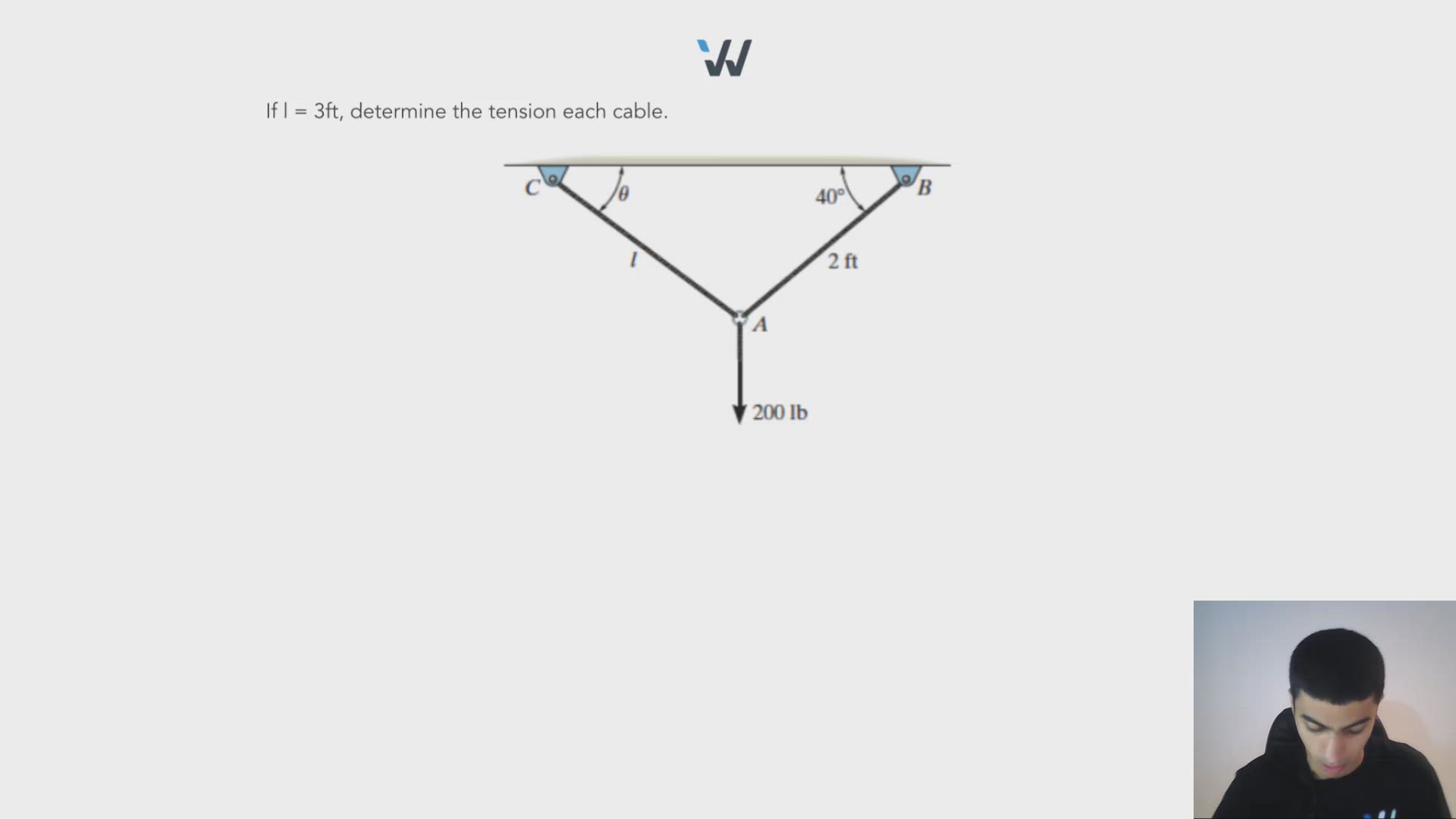
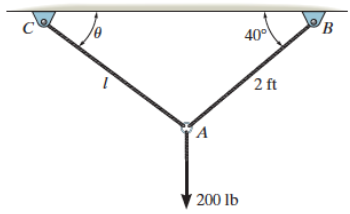
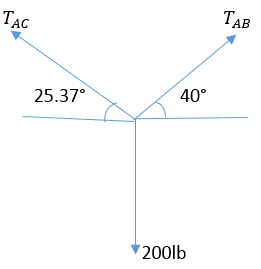
If l = 3ft, determine the tension each cable.
Solution:
Sub into (1)