Popular Courses
ENGG 130
University of Alberta
CIV100H1
University of Toronto
PCS 211
Toronto Metropolitan University
ENGG 202
University of Calgary
ENGSCI 1022A/B/Y
Western University
GNG 1105
University of Ottawa
PHYS 110
University of Victoria
ENGR 242
Concordia University
ENGR 141
University of Victoria
CE 221
Michigan State University
GENG-1110
University of Windsor
ESM 2104
Virginia Tech
APS160H1
University of Toronto
0:00 / 0:00
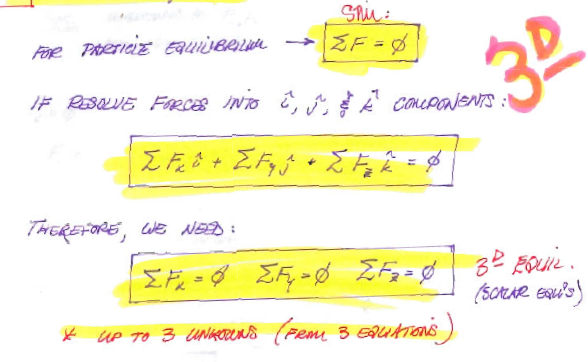
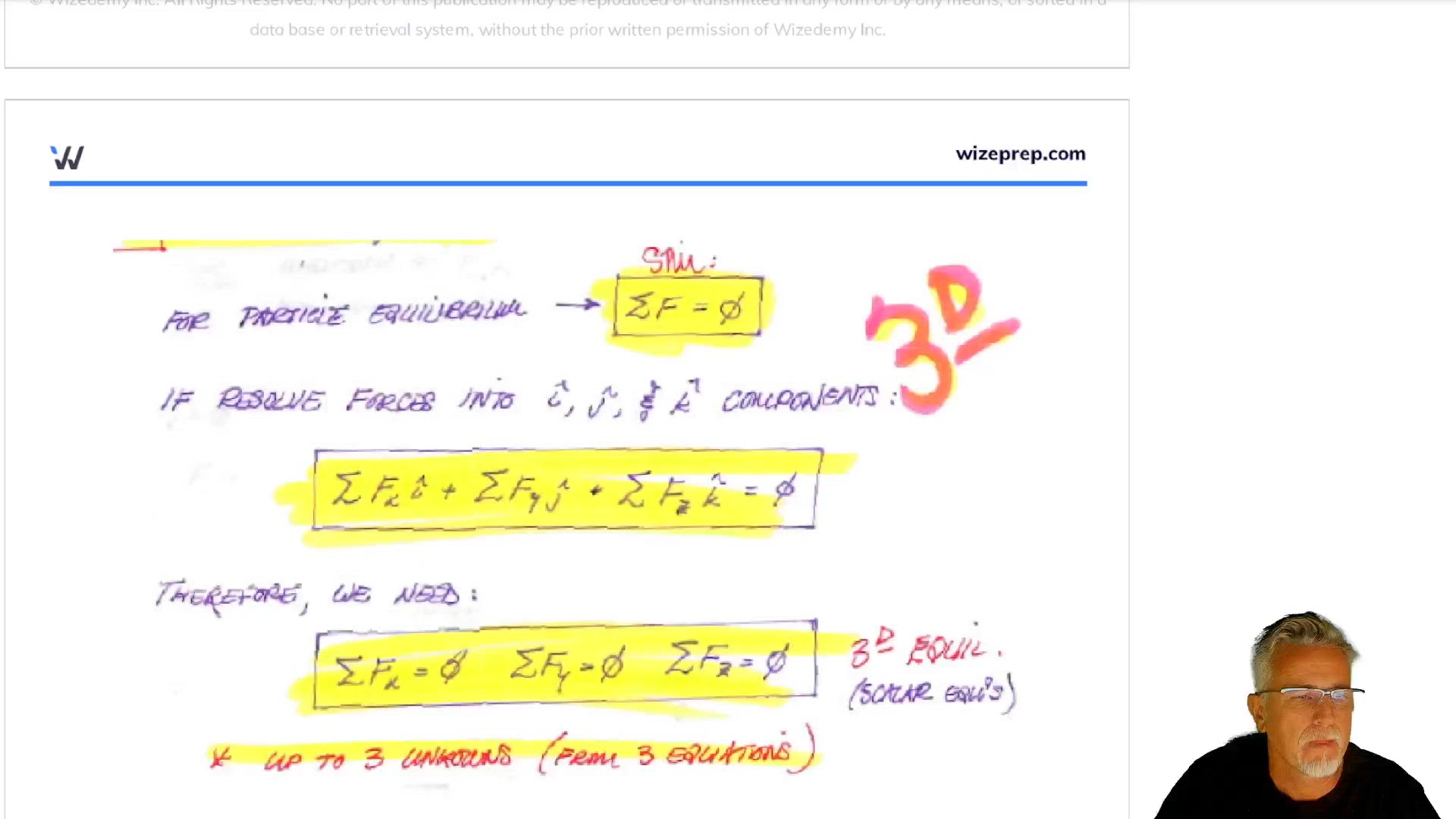
PROCEDURE: SAME AS FOR 2D > Sum F's = 0 (in x, y, and z (if 3D))
HELPFUL HINTS: IF 3D Geometry is difficult >
- express each FORCE in Cartesian Vector Form (i, j, k)
- substitute these vectors into SUM F = 0
- set i, j, k components = 0
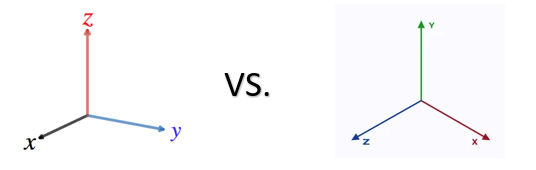
- BE CAREFUL TO CHECK AXES orientation before writing vectors in CVF !!!!!!!!
Determine the magnitudes of F1, F2, and F3 for equilibrium of the particle.
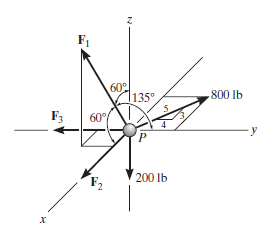
1) write each vector in CV Form:
F1 = F1cos60°i + F1cos135°j + F1cos60°
F2 = F1i
F3 = -F3j
F200 = -200k
F800 = -800(3/5)i + 800(4/5)j
= -480i + 640j
2) equilibrium requires that sum x's=0, sum y's=0, and sum z's=0
x: F1cos60° + F1 -480 = 0
y: F1cos135° -F3 + 640 = 0
z: F1cos60° - 200 = 0
3) solve for each:
F1=400 lb
F2=280 lb
F3=357 lb

Mark Yourself Question
- Grab a piece of paper and try this problem yourself.
- When you're done, check the "I have answered this question" box below.
- View the solution and report whether you got it right or wrong.
Determine the force in each cable if F = 500 lb.