0:00 / 0:00
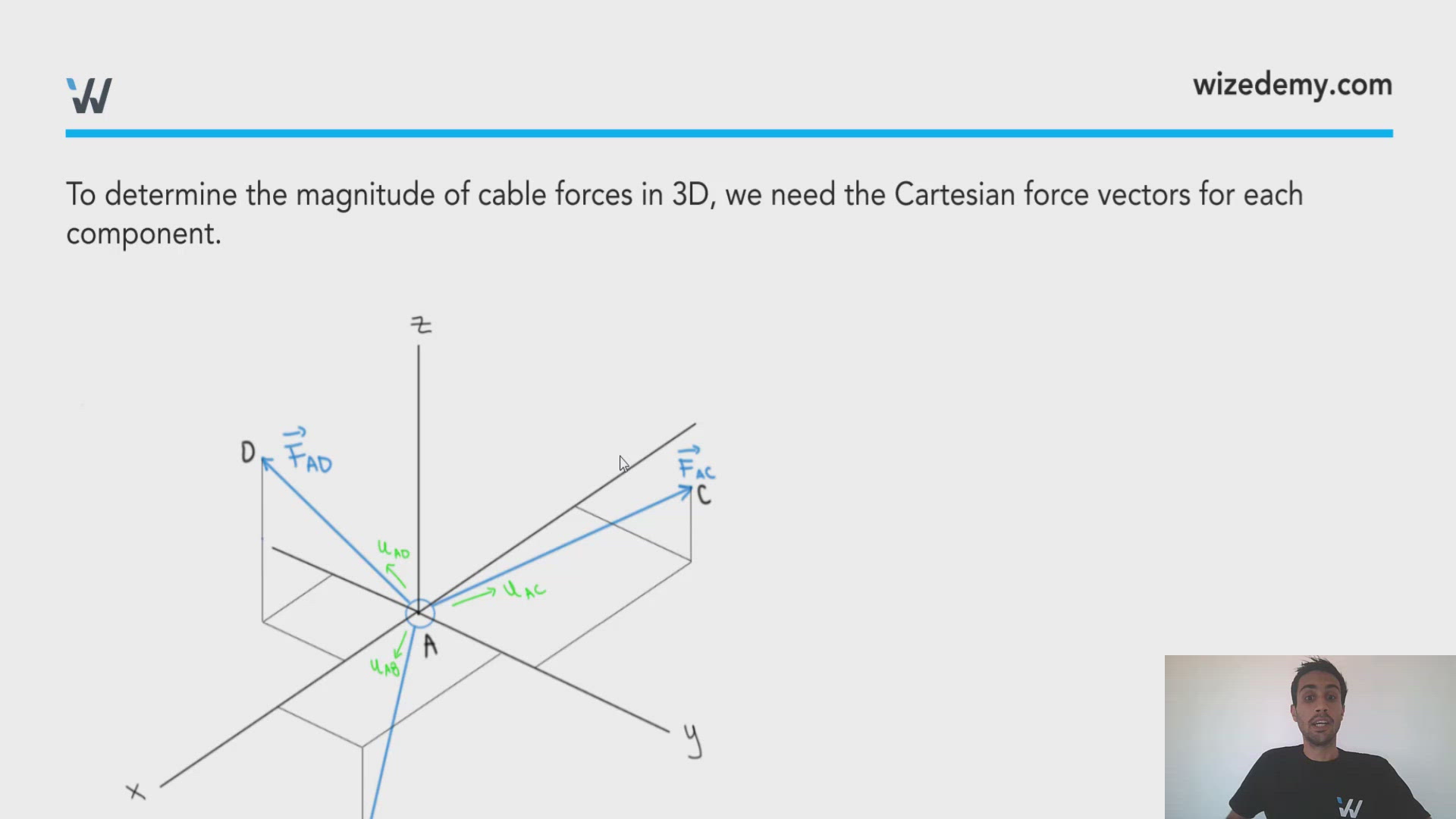
To determine the magnitude of cable forces in 3D, we need the Cartesian force vectors for each component.


FAB=FABuAB=FAB(rABrAB)\overrightarrow{F_{AB}}=\left|F_{AB}\right|u_{AB}=\left|F_{AB}\right|\left(\frac{r_{AB}}{\left|r_{AB}\right|}\right)

FAC=FACuAC=FAC(rACrAC)\overrightarrow{F_{AC}}=\left|F_{AC}\right|u_{AC}=\left|F_{AC}\right|\left(\frac{r_{AC}}{\left|r_{AC}\right|}\right)

FAD=FADuAD=FAD(rADrAD)\overrightarrow{F_{AD}}=\left|F_{AD}\right|u_{AD}=\left|F_{AD}\right|\left(\frac{r_{AD}}{\left|r_{AD}\right|}\right)

After determining the Cartesian vectors in their respective i, j, and k components substitute these,

ΣF=0\Sigma\mathbf{F}=\mathbf{0} (For particle equilibrium)

Apply Equations of equilibrium in 3D,
ΣFx=0ΣFy=0ΣFz=0\begin{array}{l}{\Sigma F_{x}=0} \\ {\Sigma F_{y}=0} \\ {\Sigma F_{z}=0}\end{array}


0:00 / 0:00

Example

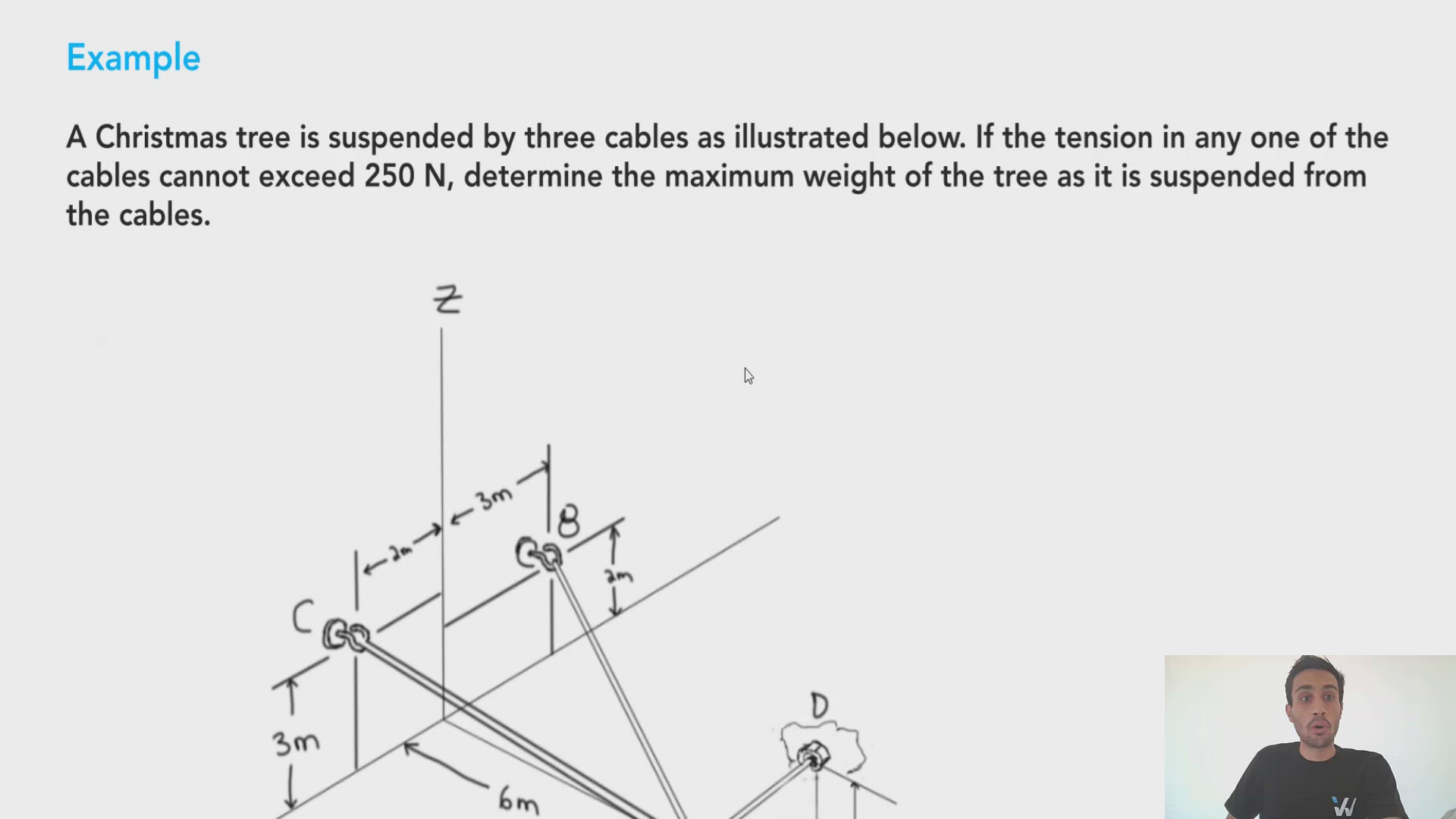
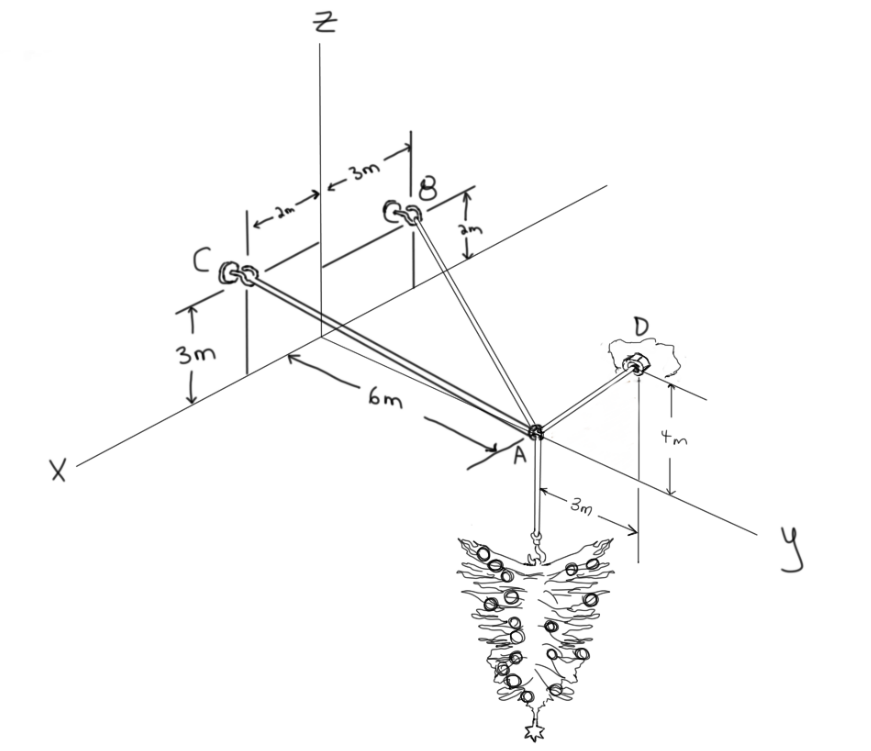
A Christmas tree is suspended by three cables as illustrated below. If the tension in any one of the cables cannot exceed 250 N, determine the maximum weight of the tree as it is suspended from the cables.
Solution:

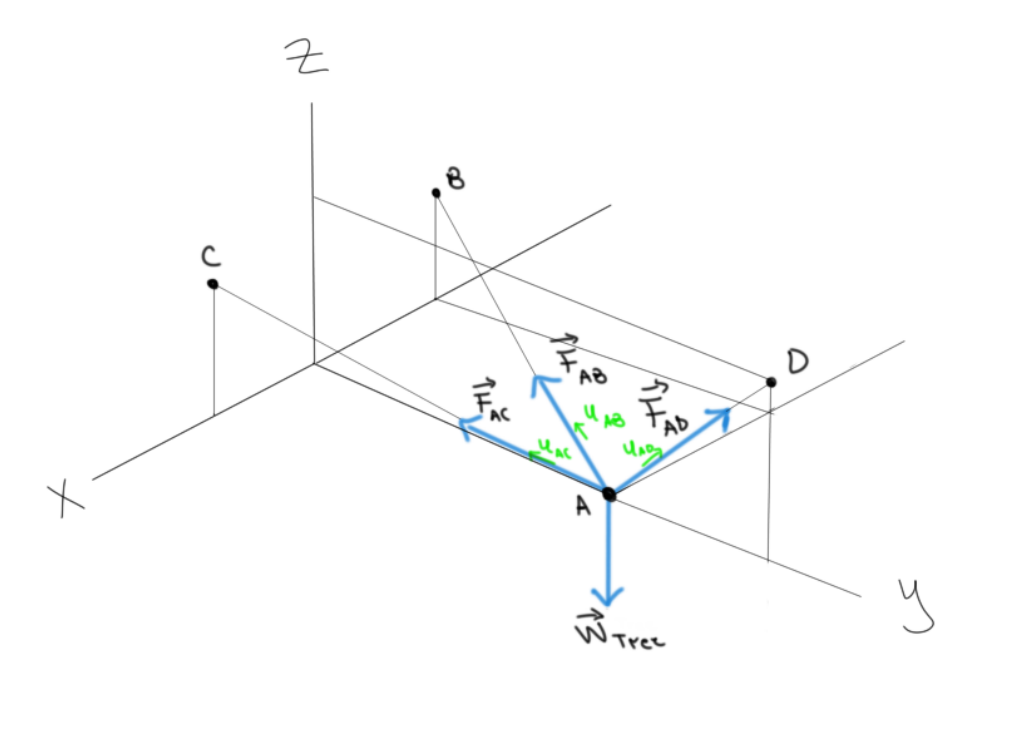
Free Body Diagram
1) We will first need the Cartesian force vector,

FAB=FABuABFAC=FACuACFAD=FADuADWtree=Wtreek\begin{array}{l}{\overrightarrow{F_{A B}}=\left|F_{A B}\right| u_{A B}} \\ {\overrightarrow{F_{A C}}=\left|F_{A C}\right| u_{A C}} \\ {\overrightarrow{F_{A D}}=\left|F_{A D}\right| u_{A D}} \\ {\overrightarrow{W_{t r e e}}=-\left|W_{t r e e}\right| k}\end{array}

Unit Vectors include,
uAB=(rABrAB)uAC=(rACrAC)uAD=(rADrAD)\begin{aligned} u_{A B} &=\left(\frac{r_{A B}}{\left|r_{A B}\right|}\right) \\ u_{A C} &=\left(\frac{r_{A C}}{\left|r_{A C}\right|}\right) \\ u_{A D} &=\left(\frac{r_{A D}}{\left|r_{A D}\right|}\right) \end{aligned}

To determine position vectors, we need coordinate points A, B, C, and D. Therefore,

A(0,6,0)B(3,0,2)C(2,0,3)D(0,9,4)\begin{array}{l}{A(0,6,0)} \\ {B(-3,0,2)} \\ {C(2,0,3)} \\ {D(0,9,4)}\end{array}

Position vectors,

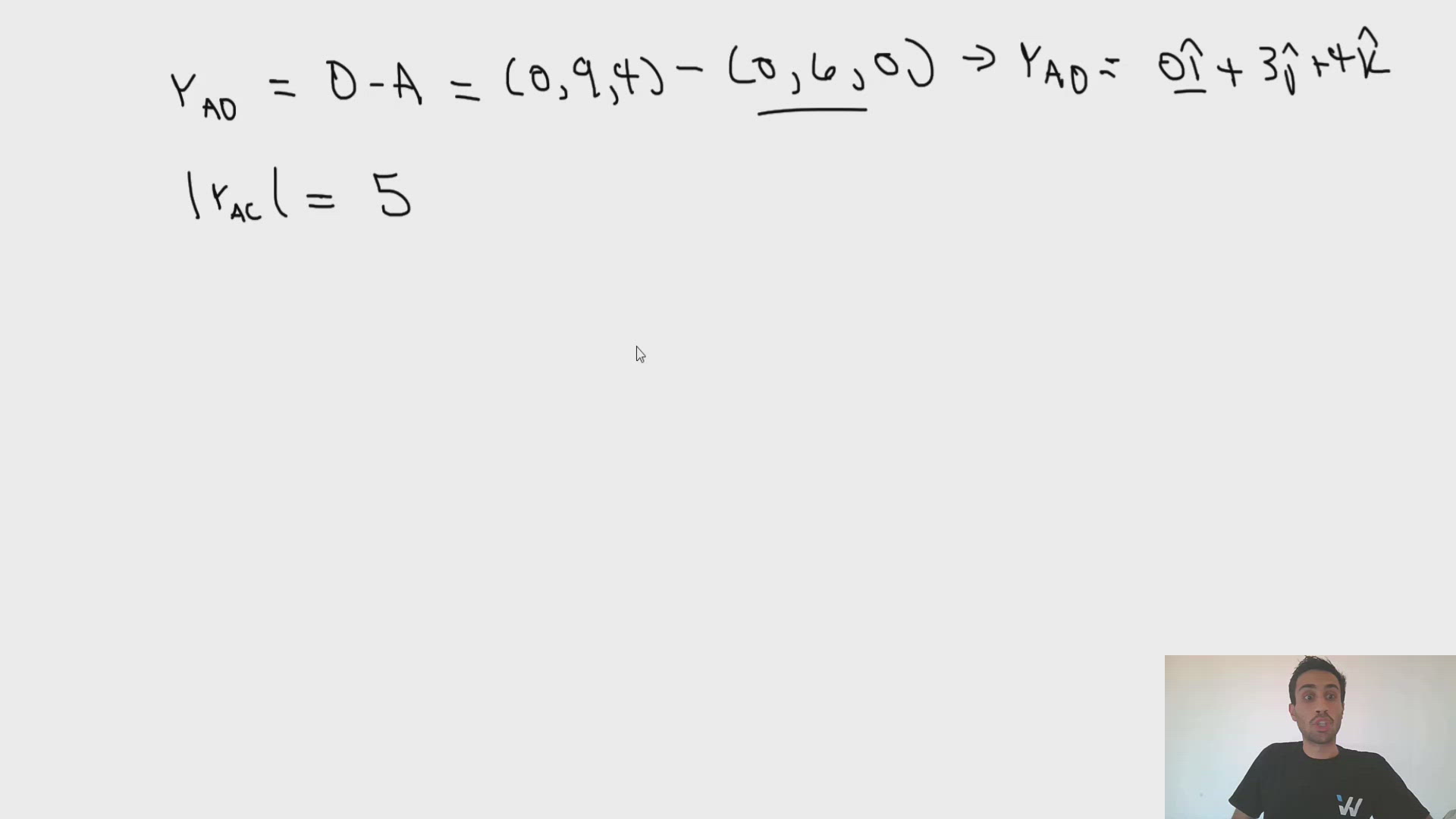
rAB=BA=(3,0,2)(0,6,0)rAB=3i6j+2krAB=(3)2+(6)2+(2)2=7rAC=CA=(2,0,3)(0,6,0)rAC=2i6j+3krAC=(2)2+(6)2+(3)2=7rAD=DA=(0,9,4)(0,6,0)rAD=0i+3j+4krAD=(0)2+(3)2+(4)2=5\begin{array}{ll}{r_{A B}=B-A=(-3,0,2)-(0,6,0) \rightarrow r_{A B}=-3 i-6 j+2 k} & {\left|r_{A B}\right|=\sqrt{(3)^{2}+(6)^{2}+(2)^{2}}=7} \\ {r_{A C}=C-A=(2,0,3)-(0,6,0) \rightarrow r_{A C}=2 i-6 j+3 k} & {\left|r_{A C}\right|=\sqrt{(2)^{2}+(6)^{2}+(3)^{2}}=7} \\ {r_{A D}=D-A=(0,9,4)-(0,6,0) \rightarrow r_{A D}=0 i+3 j+4 k} & {\left|r_{A D}\right|=\sqrt{(0)^{2}+(3)^{2}+(4)^{2}}=5}\end{array}

If we plug position vectors and their magnitudes into the top equations for Cartesian vectors, we get,

FAB=FAB[rABrAB]=FAB[3i6j+2k7]=0.4286FABi0.8571FABj+0.2857FABkFAC=FAC[rACrAC]=FAC[2i6j+3k7]=0.2857FACi0.8571FACj+0.4286FACkFAD=FAD[rADrAD]=FAD[0i+3j+4k5]=0.60FADj+0.80FADkWtree=Wtreek\begin{array}{l}{\overrightarrow{F_{A B}}=\left|F_{A B}\right|\left[\frac{r_{A B}}{\left|r_{A B}\right|}\right]=\left|F_{A B}\right|\left[\frac{-3 i-6 j+2 k}{7}\right]=-0.4286 F_{A B} i-0.8571 F_{A B} j+0.2857 F_{A B} k} \\ {\overrightarrow{F_{A C}}=\left|F_{A C}\right|\left[\frac{r_{A C}}{ | r_{A C}}\right]=\left|F_{A C}\right|\left[\frac{2 i-6 j+3 k}{7}\right]=0.2857 F_{A C} i-0.8571 F_{A C} j+0.4286 F_{A C} k} \\ {\overrightarrow{F_{A D}}=\left|F_{A D}\right|\left[\frac{r_{A D}}{\left|r_{A D}\right|}\right]=\left|F_{A D}\right|\left[\frac{0 i+3 j+4 k}{5}\right]=0.60 F_{A D} j+0.80 F_{A D} k} \\ {\overrightarrow{W_{t r e e}}=-W_{t r e e} k}\end{array}

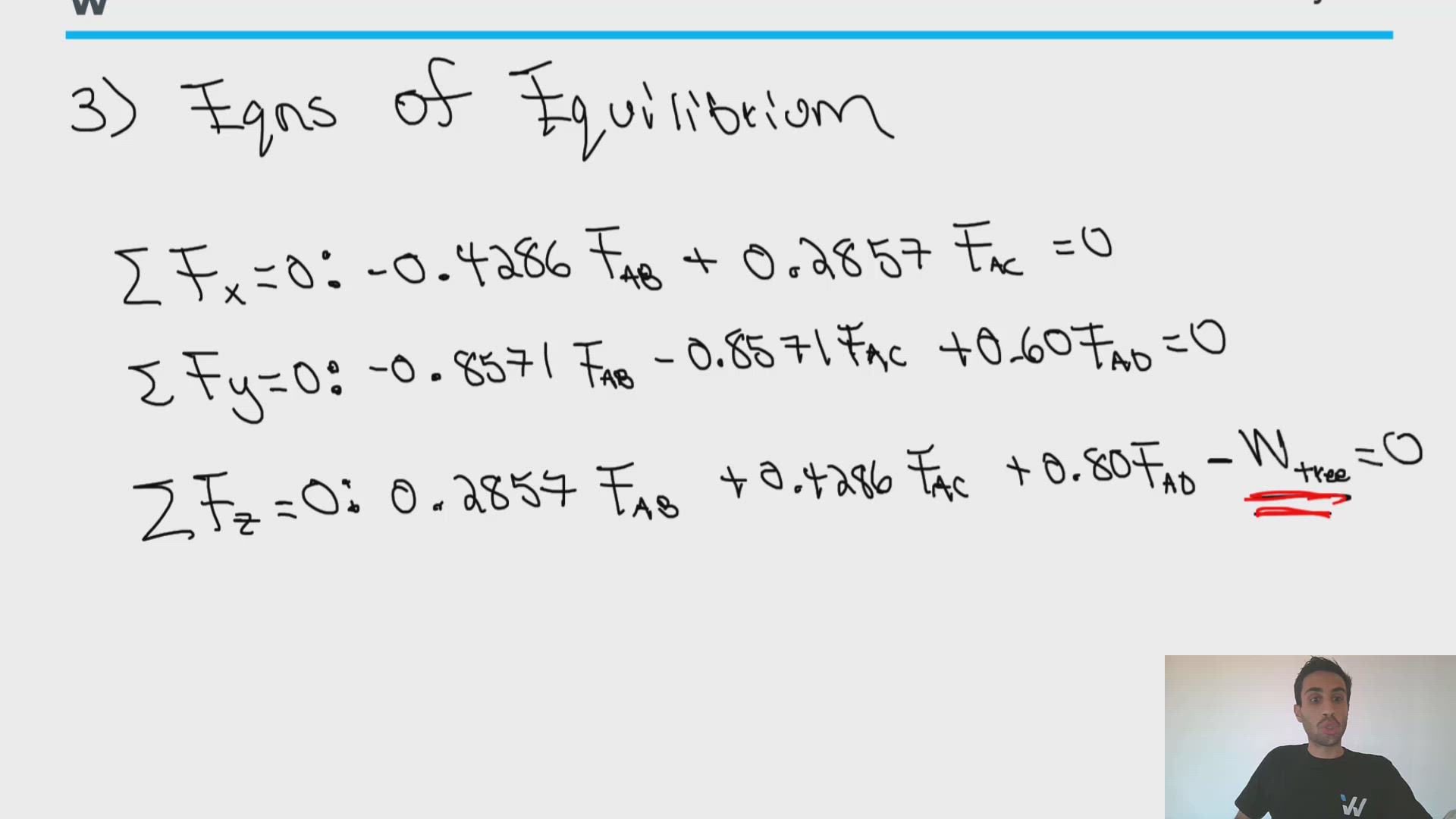
2) Applying Equation of Equilibrium in 3D, and the separate-combine the i components for Fx, j components for Fy, and k components for Fz, we get,

ΣFx=0:0.4286FAB+0.2857FAC=0      (1)\Sigma F_{x}=0 :-0.4286 F_{A B}+0.2857 F_{A C}=0 \ \ \ \ \ \ (1)
ΣFy=0:0.8571FAB0.8571FAC+0.60FAD=0      (2)\Sigma F_{y}=0 :-0.8571 F_{A B}-0.8571 F_{A C}+0.60 F_{A D}=0\ \ \ \ \ \ (2)
ΣFz=0:0.2857FAB+0.4286FAC+0.80FADWtree=0      (3)\Sigma F_{z}=0 : 0.2857 F_{A B}+0.4286 F_{A C}+0.80 F_{A D}-W_{tree}=0 \ \ \ \ \ \ (3)
3) Assume that AD has the maximum tension first, therefore, FAD=250 NF_{AD}=250\ N

If FAD=250 NF_{AD}=250\ Nthen,

Using Eq. (2) from above plug in FADF_{AD},

0.8571FAB0.8571FAC+0.60FAD=00.8571FAB0.8571FAC+0.60(250N)=00.8571FAB0.8571FAC=150N0.8571FAB=150N+0.8571FAC=150N+0.8571FACFAB=150N+0.8571FAC0.8571FAB=175.008FAC\begin{array}{l}{-0.8571 F_{A B}-0.8571 F_{A C}+0.60 F_{A D}=0} \\ {-0.8571 F_{A B}-0.8571 F_{A C}+0.60(250 N)=0} \\ {-0.8571 F_{A B}-0.8571 F_{A C}=-150 N} \\ {-0.8571 F_{A B}=-150 N+0.8571 F_{A C}=-150 N+0.8571 F_{A C}} \\ {F_{A B}=\frac{-150 N+0.8571 F_{A C}}{-0.8571}} \\ {F_{A B}=175.008-F_{A C}}\end{array}
We have an equation for FABF_{AB} substitute this into Eq. (1) above and solve for FACF_{AC},

0.4286FAB+0.2857FAC=00.4286(175.008FAC)+0.2857FAC=00.714FAC=75.012FAC=105N<250N(OK!)\begin{array}{l}{-0.4286 F_{A B}+0.2857 F_{A C}=0} \\ {-0.4286\left(175.008-F_{A C}\right)+0.2857 F_{A C}=0} \\ {0.714 F_{A C}=75.012} \\ {F_{A C}=105 N<250 N(O K !)}\end{array}

We have FACF_{AC} plug this back into Eq. (1) and solve for FABF_{AB},

0.4286FAB+0.2857FAC=00.4286FAB+0.2857(105N)=0FAB=70N<250N(OK!)\begin{array}{l}{-0.4286 F_{A B}+0.2857 F_{A C}=0} \\ {-0.4286 F_{A B}+0.2857(105 N)=0} \\ {F_{A B}=70 N<250 N(O K !)}\end{array}

Now we have,

FAB=70N,FAC=105N, and FAD=250N, all conditions satified our above assumption is correct!F_{A B}=70 N, F_{A C}=105 N, \text { and } F_{A D}=250 \mathrm{N}, \text { all conditions satified our above assumption is correct!}

Plug in these values into Eq. (3) above and solve for WtreeW_{tree},

0.2857(70N)+0.4286(105N)+0.80(250N)Wtree=0Wtree=265N\begin{array}{l}{0.2857(70 N)+0.4286(105 N)+0.80(250 N)-W_{tree}=0} \\ {W_{tree}=265 N}\end{array}


0:00 / 0:00

Example

A Christmas tree is suspended by three cables as illustrated below. If the tension in any one of the cables cannot exceed 250 N, determine the maximum weight of the tree as it is suspended from the cables.

Solution:

Free Body Diagram

1) We will first need the Cartesian force vector,

FAB=FABuABFAC=FACuACFAD=FADuADWtree=Wtreek\begin{array}{l}{\overrightarrow{F_{A B}}=\left|F_{A B}\right| u_{A B}} \\ {\overrightarrow{F_{A C}}=\left|F_{A C}\right| u_{A C}} \\ {\overrightarrow{F_{A D}}=\left|F_{A D}\right| u_{A D}} \\ {\overrightarrow{W_{t r e e}}=-\left|W_{t r e e}\right| k}\end{array}

Unit Vectors include,
uAB=(rABrAB)uAC=(rACrAC)uAD=(rADrAD)\begin{aligned} u_{A B} &=\left(\frac{r_{A B}}{\left|r_{A B}\right|}\right) \\ u_{A C} &=\left(\frac{r_{A C}}{\left|r_{A C}\right|}\right) \\ u_{A D} &=\left(\frac{r_{A D}}{\left|r_{A D}\right|}\right) \end{aligned}

To determine position vectors, we need coordinate points A, B, C, and D. Therefore,

A(0,6,0)B(3,0,2)C(2,0,3)D(0,9,4)\begin{array}{l}{A(0,6,0)} \\ {B(-3,0,2)} \\ {C(2,0,3)} \\ {D(0,9,4)}\end{array}

Position vectors,

rAB=BA=(3,0,2)(0,6,0)rAB=3i6j+2krAB=(3)2+(6)2+(2)2=7rAC=CA=(2,0,3)(0,6,0)rAC=2i6j+3krAC=(2)2+(6)2+(3)2=7rAD=DA=(0,9,4)(0,6,0)rAD=0i+3j+4krAD=(0)2+(3)2+(4)2=5\begin{array}{ll}{r_{A B}=B-A=(-3,0,2)-(0,6,0) \rightarrow r_{A B}=-3 i-6 j+2 k} & {\left|r_{A B}\right|=\sqrt{(3)^{2}+(6)^{2}+(2)^{2}}=7} \\ {r_{A C}=C-A=(2,0,3)-(0,6,0) \rightarrow r_{A C}=2 i-6 j+3 k} & {\left|r_{A C}\right|=\sqrt{(2)^{2}+(6)^{2}+(3)^{2}}=7} \\ {r_{A D}=D-A=(0,9,4)-(0,6,0) \rightarrow r_{A D}=0 i+3 j+4 k} & {\left|r_{A D}\right|=\sqrt{(0)^{2}+(3)^{2}+(4)^{2}}=5}\end{array}

If we plug position vectors and their magnitudes into the top equations for Cartesian vectors, we get,

FAB=FAB[rABrAB]=FAB[3i6j+2k7]=0.4286FABi0.8571FABj+0.2857FABkFAC=FAC[rACrAC]=FAC[2i6j+3k7]=0.2857FACi0.8571FACj+0.4286FACkFAD=FAD[rADrAD]=FAD[0i+3j+4k5]=0.60FADj+0.80FADkWtree=Wtreek\begin{array}{l}{\overrightarrow{F_{A B}}=\left|F_{A B}\right|\left[\frac{r_{A B}}{\left|r_{A B}\right|}\right]=\left|F_{A B}\right|\left[\frac{-3 i-6 j+2 k}{7}\right]=-0.4286 F_{A B} i-0.8571 F_{A B} j+0.2857 F_{A B} k} \\ {\overrightarrow{F_{A C}}=\left|F_{A C}\right|\left[\frac{r_{A C}}{ | r_{A C}}\right]=\left|F_{A C}\right|\left[\frac{2 i-6 j+3 k}{7}\right]=0.2857 F_{A C} i-0.8571 F_{A C} j+0.4286 F_{A C} k} \\ {\overrightarrow{F_{A D}}=\left|F_{A D}\right|\left[\frac{r_{A D}}{\left|r_{A D}\right|}\right]=\left|F_{A D}\right|\left[\frac{0 i+3 j+4 k}{5}\right]=0.60 F_{A D} j+0.80 F_{A D} k} \\ {\overrightarrow{W_{t r e e}}=-W_{t r e e} k}\end{array}

2) Applying Equation of Equilibrium in 3D, and the separate-combine the i components for Fx, j components for Fy, and k components for Fz, we get,

ΣFx=0:0.4286FAB+0.2857FAC=0      (1)\Sigma F_{x}=0 :-0.4286 F_{A B}+0.2857 F_{A C}=0 \ \ \ \ \ \ (1)
ΣFy=0:0.8571FAB0.8571FAC+0.60FAD=0      (2)\Sigma F_{y}=0 :-0.8571 F_{A B}-0.8571 F_{A C}+0.60 F_{A D}=0\ \ \ \ \ \ (2)
ΣFz=0:0.2857FAB+0.4286FAC+0.80FADWtree=0      (3)\Sigma F_{z}=0 : 0.2857 F_{A B}+0.4286 F_{A C}+0.80 F_{A D}-W_{tree}=0 \ \ \ \ \ \ (3)
3) Assume that AD has the maximum tension first, therefore, FAD=250 NF_{AD}=250\ N

If FAD=250 NF_{AD}=250\ Nthen,

Using Eq. (2) from above plug in FADF_{AD},

0.8571FAB0.8571FAC+0.60FAD=00.8571FAB0.8571FAC+0.60(250N)=00.8571FAB0.8571FAC=150N0.8571FAB=150N+0.8571FAC=150N+0.8571FACFAB=150N+0.8571FAC0.8571FAB=175.008FAC\begin{array}{l}{-0.8571 F_{A B}-0.8571 F_{A C}+0.60 F_{A D}=0} \\ {-0.8571 F_{A B}-0.8571 F_{A C}+0.60(250 N)=0} \\ {-0.8571 F_{A B}-0.8571 F_{A C}=-150 N} \\ {-0.8571 F_{A B}=-150 N+0.8571 F_{A C}=-150 N+0.8571 F_{A C}} \\ {F_{A B}=\frac{-150 N+0.8571 F_{A C}}{-0.8571}} \\ {F_{A B}=175.008-F_{A C}}\end{array}
We have an equation for FABF_{AB} substitute this into Eq. (1) above and solve for FACF_{AC},

0.4286FAB+0.2857FAC=00.4286(175.008FAC)+0.2857FAC=00.714FAC=75.012FAC=105N<250N(OK!)\begin{array}{l}{-0.4286 F_{A B}+0.2857 F_{A C}=0} \\ {-0.4286\left(175.008-F_{A C}\right)+0.2857 F_{A C}=0} \\ {0.714 F_{A C}=75.012} \\ {F_{A C}=105 N<250 N(O K !)}\end{array}

We have FACF_{AC} plug this back into Eq. (1) and solve for FABF_{AB},

0.4286FAB+0.2857FAC=00.4286FAB+0.2857(105N)=0FAB=70N<250N(OK!)\begin{array}{l}{-0.4286 F_{A B}+0.2857 F_{A C}=0} \\ {-0.4286 F_{A B}+0.2857(105 N)=0} \\ {F_{A B}=70 N<250 N(O K !)}\end{array}

Now we have,

FAB=70N,FAC=105N, and FAD=250N, all conditions satified our above assumption is correct!F_{A B}=70 N, F_{A C}=105 N, \text { and } F_{A D}=250 \mathrm{N}, \text { all conditions satified our above assumption is correct!}

Plug in these values into Eq. (3) above and solve for WtreeW_{tree},

0.2857(70N)+0.4286(105N)+0.80(250N)Wtree=0Wtree=265N\begin{array}{l}{0.2857(70 N)+0.4286(105 N)+0.80(250 N)-W_{tree}=0} \\ {W_{tree}=265 N}\end{array}


0:00 / 0:00

Example

A Christmas tree is suspended by three cables as illustrated below. If the tension in any one of the cables cannot exceed 250 N, determine the maximum weight of the tree as it is suspended from the cables.

Solution:

Free Body Diagram

1) We will first need the Cartesian force vector,

FAB=FABuABFAC=FACuACFAD=FADuADWtree=Wtreek\begin{array}{l}{\overrightarrow{F_{A B}}=\left|F_{A B}\right| u_{A B}} \\ {\overrightarrow{F_{A C}}=\left|F_{A C}\right| u_{A C}} \\ {\overrightarrow{F_{A D}}=\left|F_{A D}\right| u_{A D}} \\ {\overrightarrow{W_{t r e e}}=-\left|W_{t r e e}\right| k}\end{array}

Unit Vectors include,
uAB=(rABrAB)uAC=(rACrAC)uAD=(rADrAD)\begin{aligned} u_{A B} &=\left(\frac{r_{A B}}{\left|r_{A B}\right|}\right) \\ u_{A C} &=\left(\frac{r_{A C}}{\left|r_{A C}\right|}\right) \\ u_{A D} &=\left(\frac{r_{A D}}{\left|r_{A D}\right|}\right) \end{aligned}

To determine position vectors, we need coordinate points A, B, C, and D. Therefore,

A(0,6,0)B(3,0,2)C(2,0,3)D(0,9,4)\begin{array}{l}{A(0,6,0)} \\ {B(-3,0,2)} \\ {C(2,0,3)} \\ {D(0,9,4)}\end{array}

Position vectors,

rAB=BA=(3,0,2)(0,6,0)rAB=3i6j+2krAB=(3)2+(6)2+(2)2=7rAC=CA=(2,0,3)(0,6,0)rAC=2i6j+3krAC=(2)2+(6)2+(3)2=7rAD=DA=(0,9,4)(0,6,0)rAD=0i+3j+4krAD=(0)2+(3)2+(4)2=5\begin{array}{ll}{r_{A B}=B-A=(-3,0,2)-(0,6,0) \rightarrow r_{A B}=-3 i-6 j+2 k} & {\left|r_{A B}\right|=\sqrt{(3)^{2}+(6)^{2}+(2)^{2}}=7} \\ {r_{A C}=C-A=(2,0,3)-(0,6,0) \rightarrow r_{A C}=2 i-6 j+3 k} & {\left|r_{A C}\right|=\sqrt{(2)^{2}+(6)^{2}+(3)^{2}}=7} \\ {r_{A D}=D-A=(0,9,4)-(0,6,0) \rightarrow r_{A D}=0 i+3 j+4 k} & {\left|r_{A D}\right|=\sqrt{(0)^{2}+(3)^{2}+(4)^{2}}=5}\end{array}

If we plug position vectors and their magnitudes into the top equations for Cartesian vectors, we get,

FAB=FAB[rABrAB]=FAB[3i6j+2k7]=0.4286FABi0.8571FABj+0.2857FABkFAC=FAC[rACrAC]=FAC[2i6j+3k7]=0.2857FACi0.8571FACj+0.4286FACkFAD=FAD[rADrAD]=FAD[0i+3j+4k5]=0.60FADj+0.80FADkWtree=Wtreek\begin{array}{l}{\overrightarrow{F_{A B}}=\left|F_{A B}\right|\left[\frac{r_{A B}}{\left|r_{A B}\right|}\right]=\left|F_{A B}\right|\left[\frac{-3 i-6 j+2 k}{7}\right]=-0.4286 F_{A B} i-0.8571 F_{A B} j+0.2857 F_{A B} k} \\ {\overrightarrow{F_{A C}}=\left|F_{A C}\right|\left[\frac{r_{A C}}{ | r_{A C}}\right]=\left|F_{A C}\right|\left[\frac{2 i-6 j+3 k}{7}\right]=0.2857 F_{A C} i-0.8571 F_{A C} j+0.4286 F_{A C} k} \\ {\overrightarrow{F_{A D}}=\left|F_{A D}\right|\left[\frac{r_{A D}}{\left|r_{A D}\right|}\right]=\left|F_{A D}\right|\left[\frac{0 i+3 j+4 k}{5}\right]=0.60 F_{A D} j+0.80 F_{A D} k} \\ {\overrightarrow{W_{t r e e}}=-W_{t r e e} k}\end{array}

2) Applying Equation of Equilibrium in 3D, and the separate-combine the i components for Fx, j components for Fy, and k components for Fz, we get,

ΣFx=0:0.4286FAB+0.2857FAC=0      (1)\Sigma F_{x}=0 :-0.4286 F_{A B}+0.2857 F_{A C}=0 \ \ \ \ \ \ (1)
ΣFy=0:0.8571FAB0.8571FAC+0.60FAD=0      (2)\Sigma F_{y}=0 :-0.8571 F_{A B}-0.8571 F_{A C}+0.60 F_{A D}=0\ \ \ \ \ \ (2)
ΣFz=0:0.2857FAB+0.4286FAC+0.80FADWtree=0      (3)\Sigma F_{z}=0 : 0.2857 F_{A B}+0.4286 F_{A C}+0.80 F_{A D}-W_{tree}=0 \ \ \ \ \ \ (3)
3) Assume that AD has the maximum tension first, therefore, FAD=250 NF_{AD}=250\ N

If FAD=250 NF_{AD}=250\ Nthen,

Using Eq. (2) from above plug in FADF_{AD},

0.8571FAB0.8571FAC+0.60FAD=00.8571FAB0.8571FAC+0.60(250N)=00.8571FAB0.8571FAC=150N0.8571FAB=150N+0.8571FAC=150N+0.8571FACFAB=150N+0.8571FAC0.8571FAB=175.008FAC\begin{array}{l}{-0.8571 F_{A B}-0.8571 F_{A C}+0.60 F_{A D}=0} \\ {-0.8571 F_{A B}-0.8571 F_{A C}+0.60(250 N)=0} \\ {-0.8571 F_{A B}-0.8571 F_{A C}=-150 N} \\ {-0.8571 F_{A B}=-150 N+0.8571 F_{A C}=-150 N+0.8571 F_{A C}} \\ {F_{A B}=\frac{-150 N+0.8571 F_{A C}}{-0.8571}} \\ {F_{A B}=175.008-F_{A C}}\end{array}
We have an equation for FABF_{AB} substitute this into Eq. (1) above and solve for FACF_{AC},

0.4286FAB+0.2857FAC=00.4286(175.008FAC)+0.2857FAC=00.714FAC=75.012FAC=105N<250N(OK!)\begin{array}{l}{-0.4286 F_{A B}+0.2857 F_{A C}=0} \\ {-0.4286\left(175.008-F_{A C}\right)+0.2857 F_{A C}=0} \\ {0.714 F_{A C}=75.012} \\ {F_{A C}=105 N<250 N(O K !)}\end{array}

We have FACF_{AC} plug this back into Eq. (1) and solve for FABF_{AB},

0.4286FAB+0.2857FAC=00.4286FAB+0.2857(105N)=0FAB=70N<250N(OK!)\begin{array}{l}{-0.4286 F_{A B}+0.2857 F_{A C}=0} \\ {-0.4286 F_{A B}+0.2857(105 N)=0} \\ {F_{A B}=70 N<250 N(O K !)}\end{array}

Now we have,

FAB=70N,FAC=105N, and FAD=250N, all conditions satified our above assumption is correct!F_{A B}=70 N, F_{A C}=105 N, \text { and } F_{A D}=250 \mathrm{N}, \text { all conditions satified our above assumption is correct!}

Plug in these values into Eq. (3) above and solve for WtreeW_{tree},

0.2857(70N)+0.4286(105N)+0.80(250N)Wtree=0Wtree=265N\begin{array}{l}{0.2857(70 N)+0.4286(105 N)+0.80(250 N)-W_{tree}=0} \\ {W_{tree}=265 N}\end{array}


Determine the tension in each of the cables supporting the phone tower under 7000 lb of compression.