Wize University Statics Textbook (Master) > Equilibrium of Rigid Body
3D Rigid Body Equilibrium
3D Rigid Body Equilibrium
3D Rigid Body - Support Reactions and FBDs
Example 1: 3D Rigid Body Equilibrium (IMPORTANT!) - Part 1
Example 1: 3D Rigid Body Equilibrium - Part 2
Example 1: 3D Rigid Body Equilibrium - Part 3
Example 2: 3D Rigid Body Equilibrium
Practice 1: 3D Rigid Body Equilibrium (IMPORTANT!)
Practice 2: 3D Rigid Body Equilibrium (IMPORTANT!)
Popular Courses
Find My Course
0:00 / 0:00
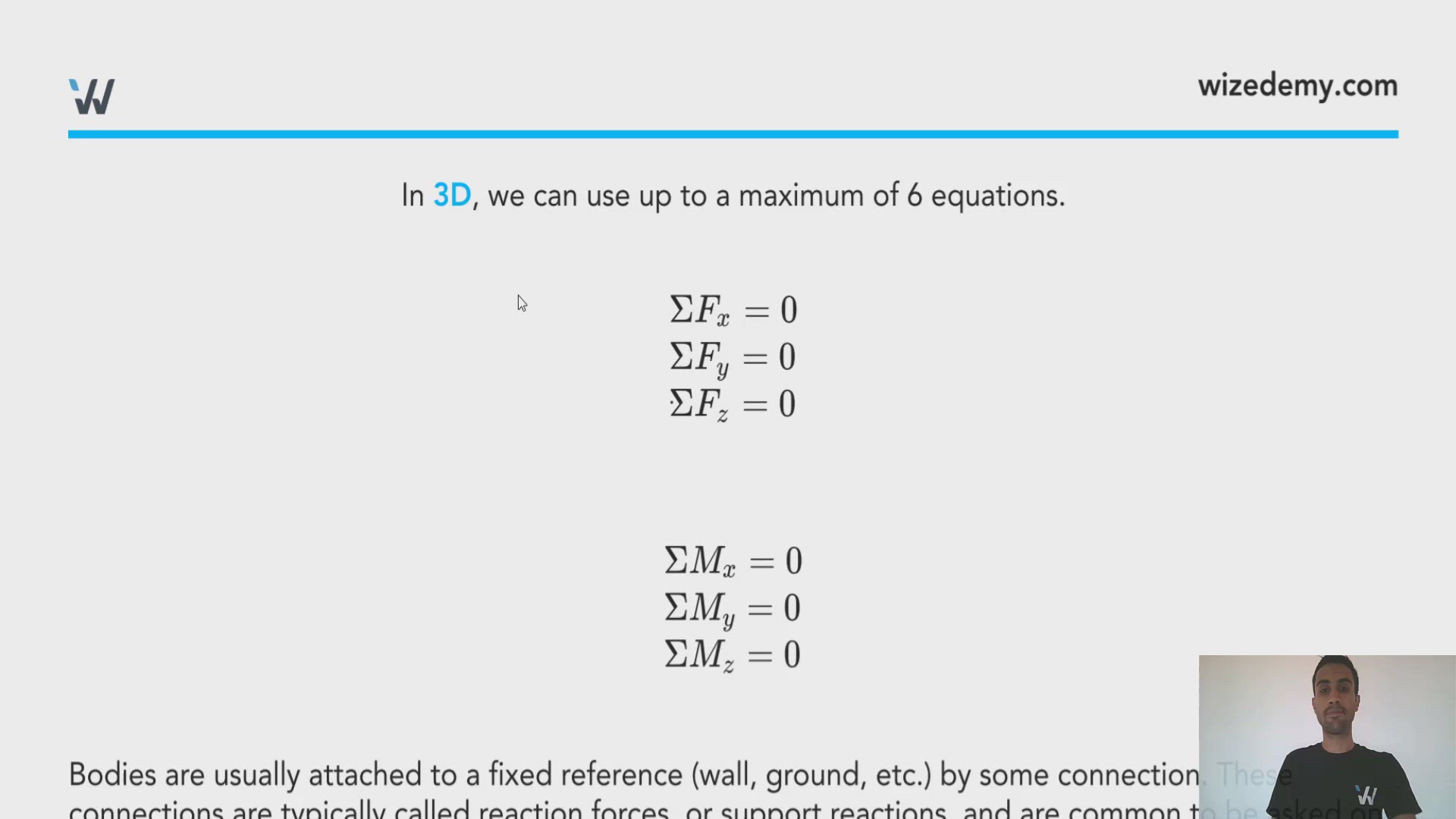
In 3D, we can use up to a maximum of 6 equations.
Bodies are usually attached to a fixed reference (wall, ground, etc.) by some connection. These connections are typically called reaction forces, or support reactions, and are common to be asked on a question. As you may notice, there are many types of support reactions.
Wize Concept
The key to knowing whether they provide a reaction or not is to ask yourself whether the 3D body would move in the x-direction, y-direction, z-direction and whether it would rotate about the x-axis, y-axis, and z-axis.
A brief review of these reactions follows:


As always, to solve a system of equations, you can have a maximum number of unknowns equal to the number of equations – up to 6 unknowns in 3D. Therefore, we sometimes simplify the unknown reaction forces to reduce the number of unknowns by:
Wize Tip
Choosing the direction of an axis for moment summation ( ),
such that it intersects the lines of action of as many unknown forces as possible. Realize that the moments of forces passing through points on this axis and the moments of forces which are parallel to the axis will then be zero.
0:00 / 0:00
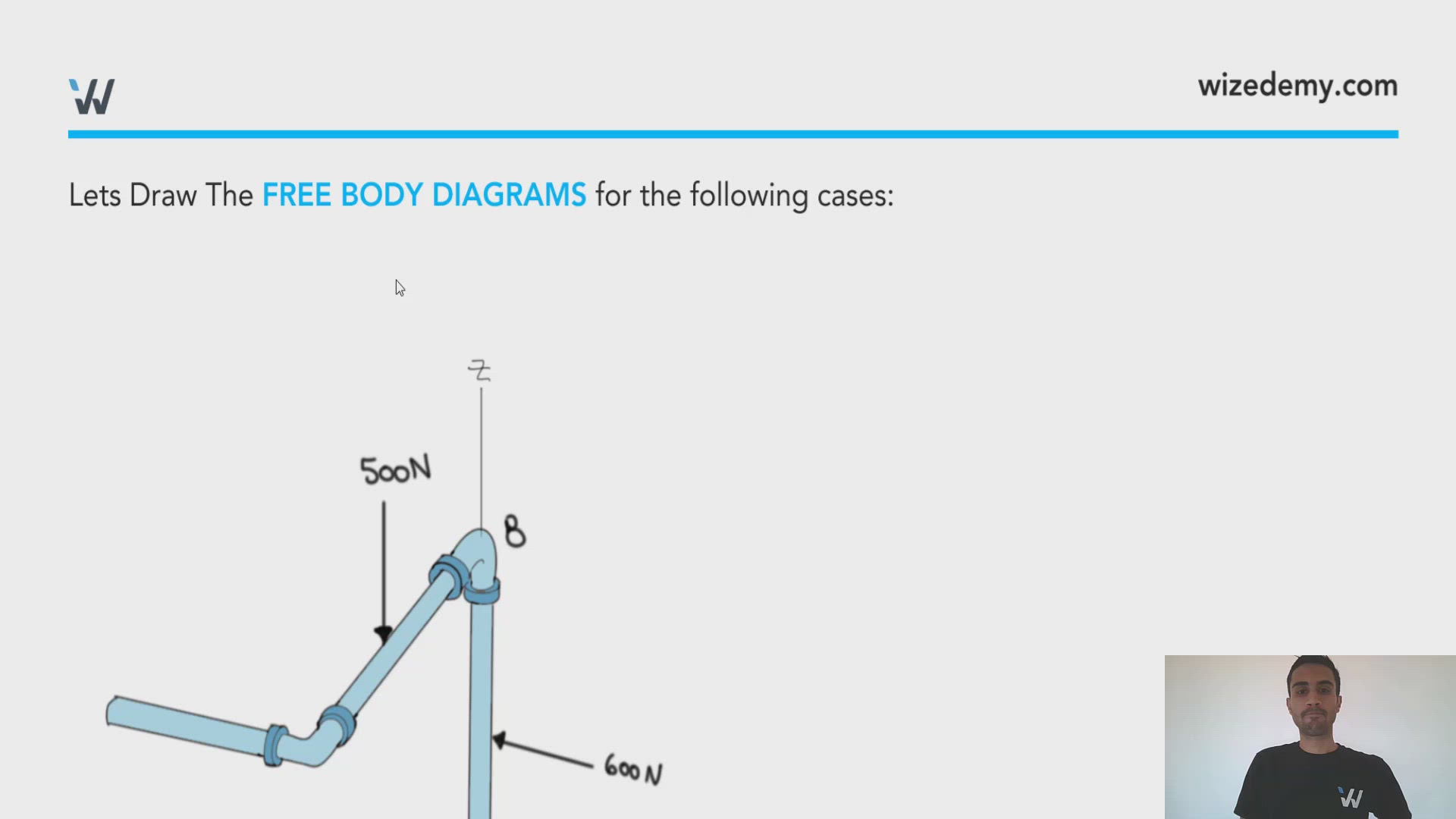
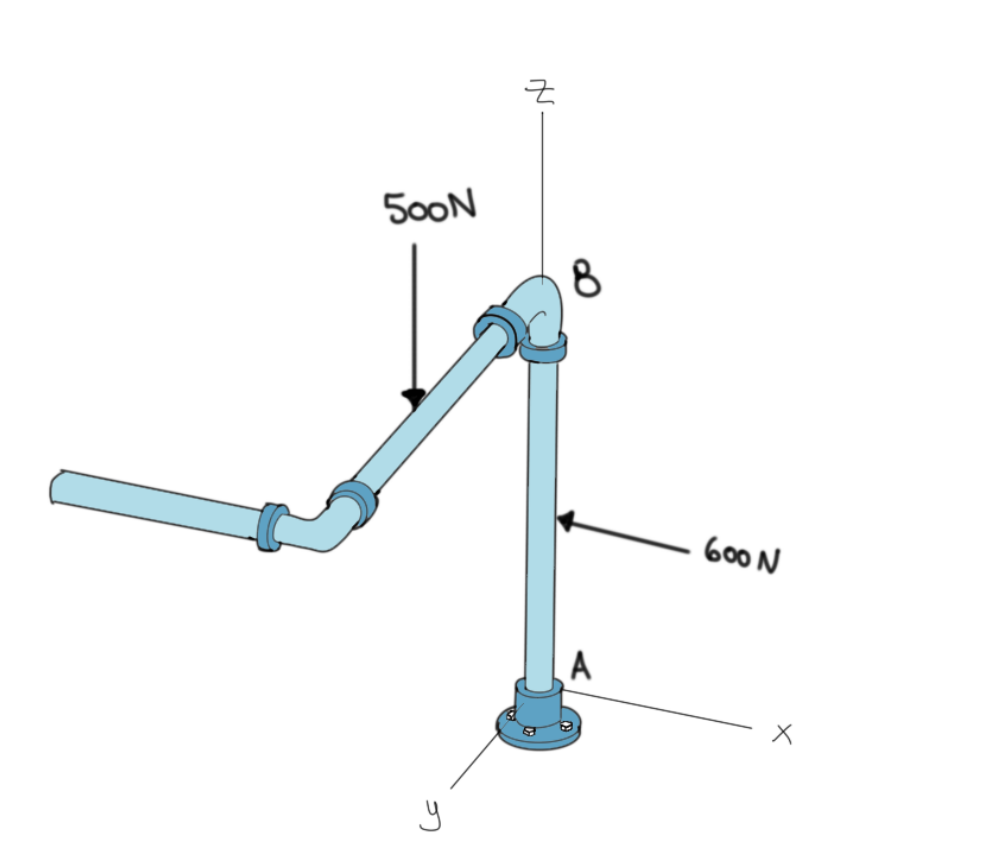
Lets Draw The FREE BODY DIAGRAMS for the following cases:

0:00 / 0:00
Example
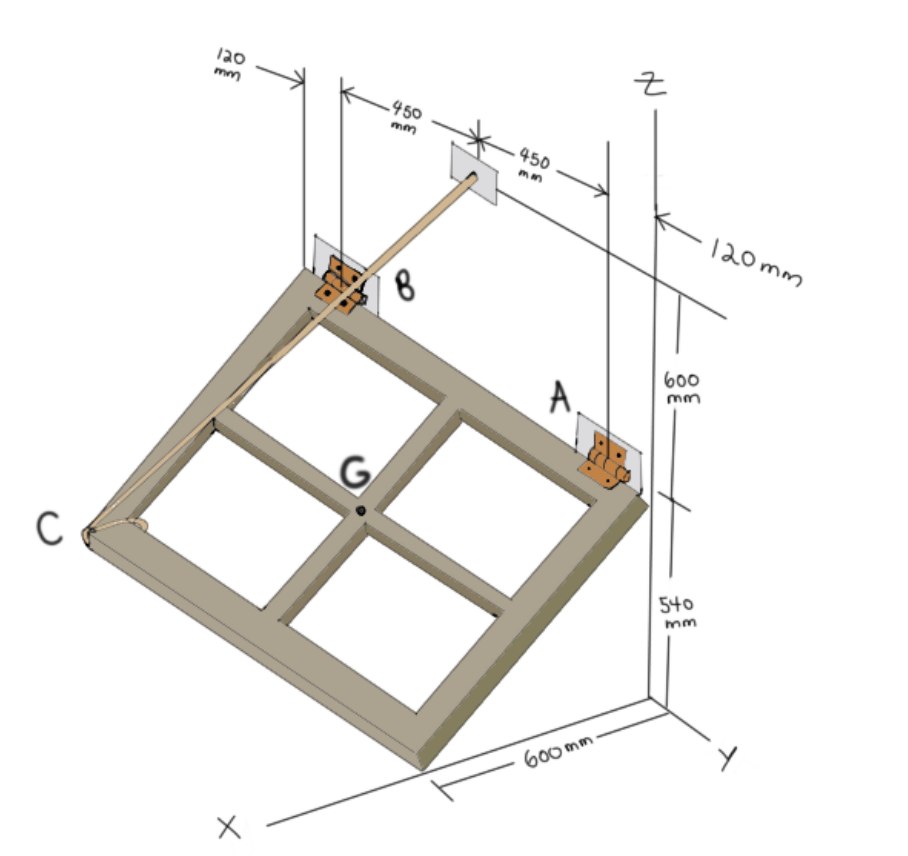
The mass for the window below is 20 kg and it acts at the geometric center of the window, at G. The window is attached at A and B by two hinges which can be idealized as ball and socket supports. Determine all the forces acting on the window when it is held open in the position shown by the rope attached at C. The hinge at B has been modified to allow for translation along its own axis of rotation.
Solution:
1) Draw Free Body Diagram, notice the hinge (ball and socket support) at B has been modified to allow for axial translation along the y-axis (axis of rotation for the hinge) so there is NO By reaction.

2) Determine all forces and moments in cartesian vector form
Cable force CD,
Weight,
Reaction forces,
3) Apply 3D Force Equations of Equilibrium and Equate i, j, and k components from the Forces above,
Notice we couldn’t solve for anything using the equations of equilibrium from above. We need to take the moment about a point where we can eliminate the most unknowns. This is point A!
4) Moment equation of equilibrium about point A,
We need the position vectors
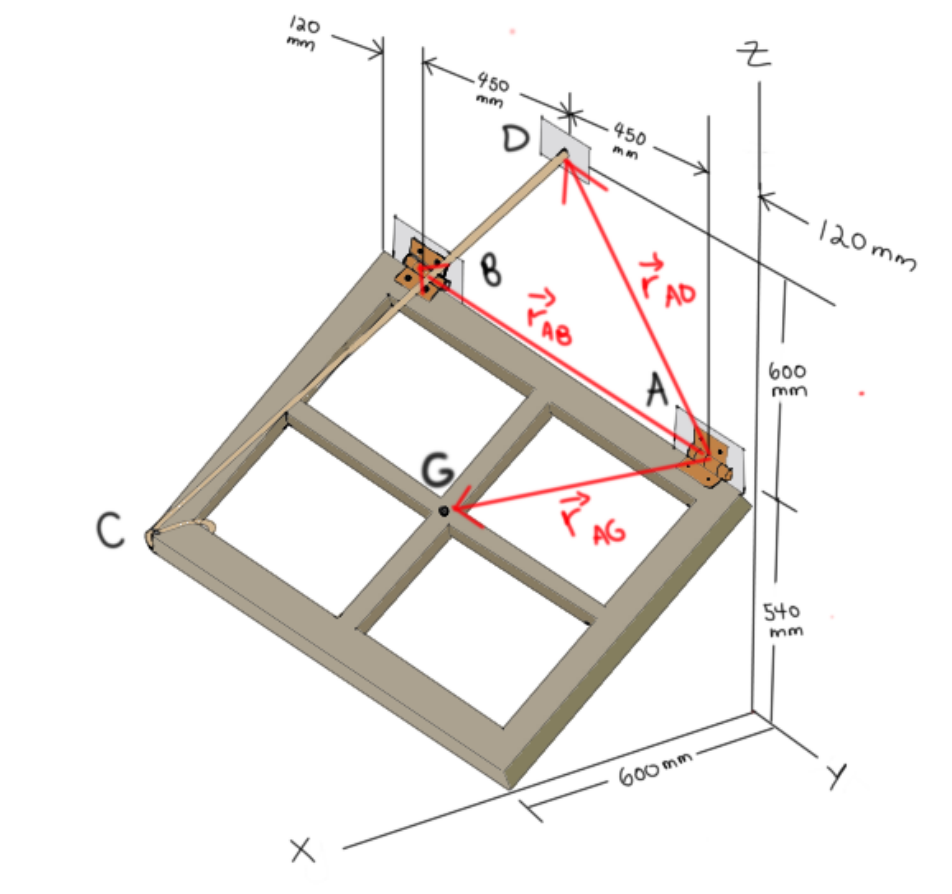
Therefore,
5) Equate i j and k Components,
6) We can find TCD using the equation (5),
Plug TCD into equation (6) and solve for Bx,
Plug TCD into equation (4) and solve for Bz,
7) Solve for the reactions at A, using our initial equilibrium equations (1), (2), (3)
0:00 / 0:00
Example
The mass for the window below is 20 kg and it acts at the geometric center of the window, at G. The window is attached at A and B by two hinges which can be idealized as ball and socket supports. Determine all the forces acting on the window when it is held open in the position shown by the rope attached at C. The hinge at B has been modified to allow for translation along its own axis of rotation.
Solution:
1) Draw Free Body Diagram
2) Determine all forces and moments in cartesian vector form
Cable force CD,
Weight,
Reaction forces,
3) Apply 3D Force Equations of Equilibrium and Equate i, j, and k components from the Forces above,
Notice we couldn’t solve for anything using the equations of equilibrium from above. We need to take the moment about a point where we can eliminate the most unknowns. This is point A!
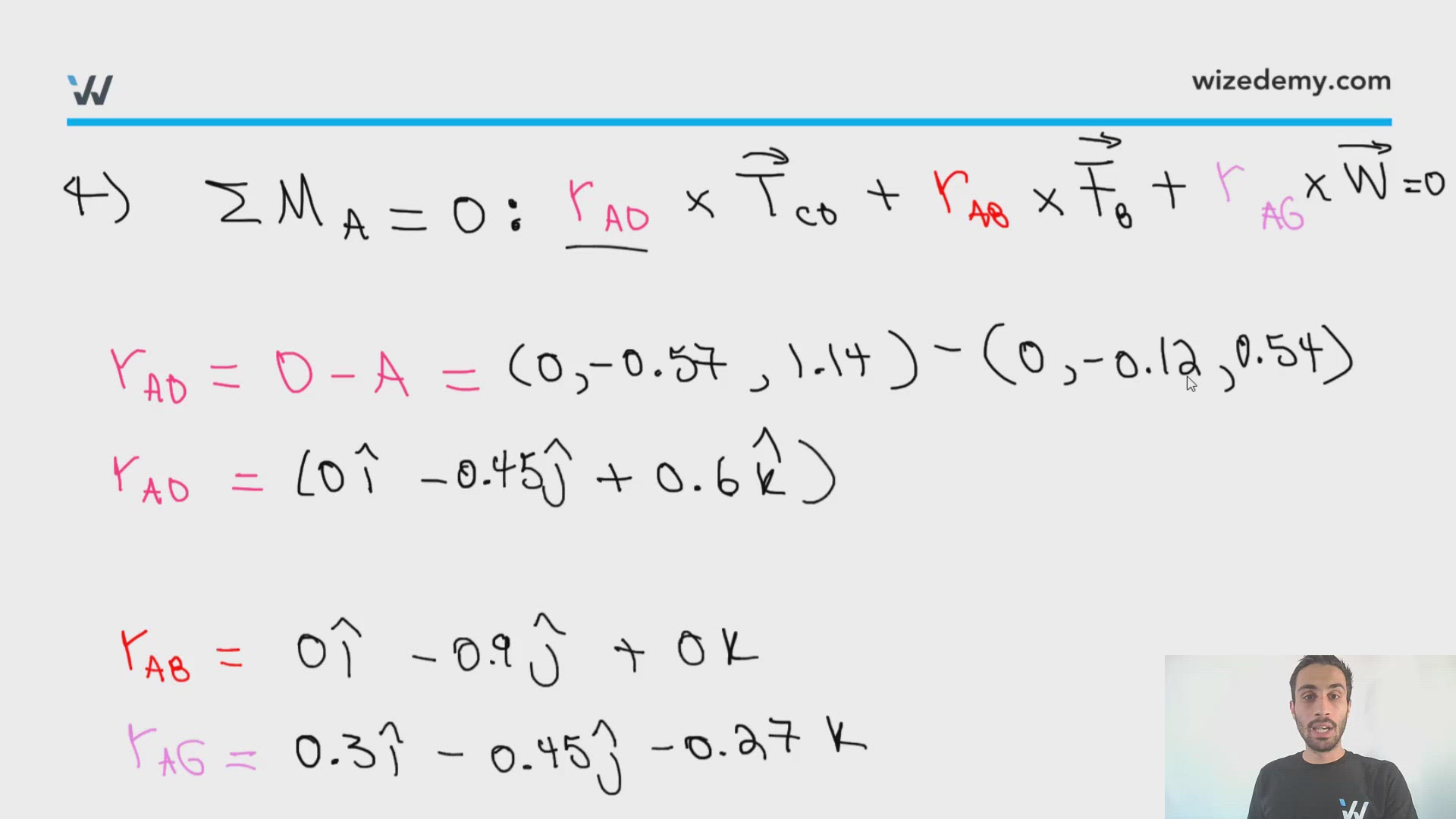
4) Moment equation of equilibrium about point A,
We need the position vectors
Therefore,
5) Equate i j and k Components,
6) We can find TCD using the equation (5),
Plug TCD into equation (6) and solve for Bx,
Plug TCD into equation (4) and solve for Bz,
7) Solve for the reactions at A, using our initial equilibrium equations (1), (2), (3)
0:00 / 0:00
Example
The mass for the window below is 20 kg and it acts at the geometric center of the window, at G. The window is attached at A and B by two hinges which can be idealized as ball and socket supports. Determine all the forces acting on the window when it is held open in the position shown by the rope attached at C. The hinge at B has been modified to allow for translation along its own axis of rotation.
Solution:
1) Draw Free Body Diagram
2) Determine all forces and moments in cartesian vector form
Cable force CD,
Weight,
Reaction forces,
3) Apply 3D Force Equations of Equilibrium and Equate i, j, and k components from the Forces above,
Notice we couldn’t solve for anything using the equations of equilibrium from above. We need to take the moment about a point where we can eliminate the most unknowns. This is point A!
4) Moment equation of equilibrium about point A,
We need the position vectors
Therefore,
5) Equate i j and k Components,
6) We can find TCD using the equation (5),
Plug TCD into equation (6) and solve for Bx,
Plug TCD into equation (4) and solve for Bz,
7) Solve for the reactions at A, using our initial equilibrium equations (1), (2), (3)
0:00 / 0:00
Disclaimer: At 16:15 of video it should read "Ay=-800N".
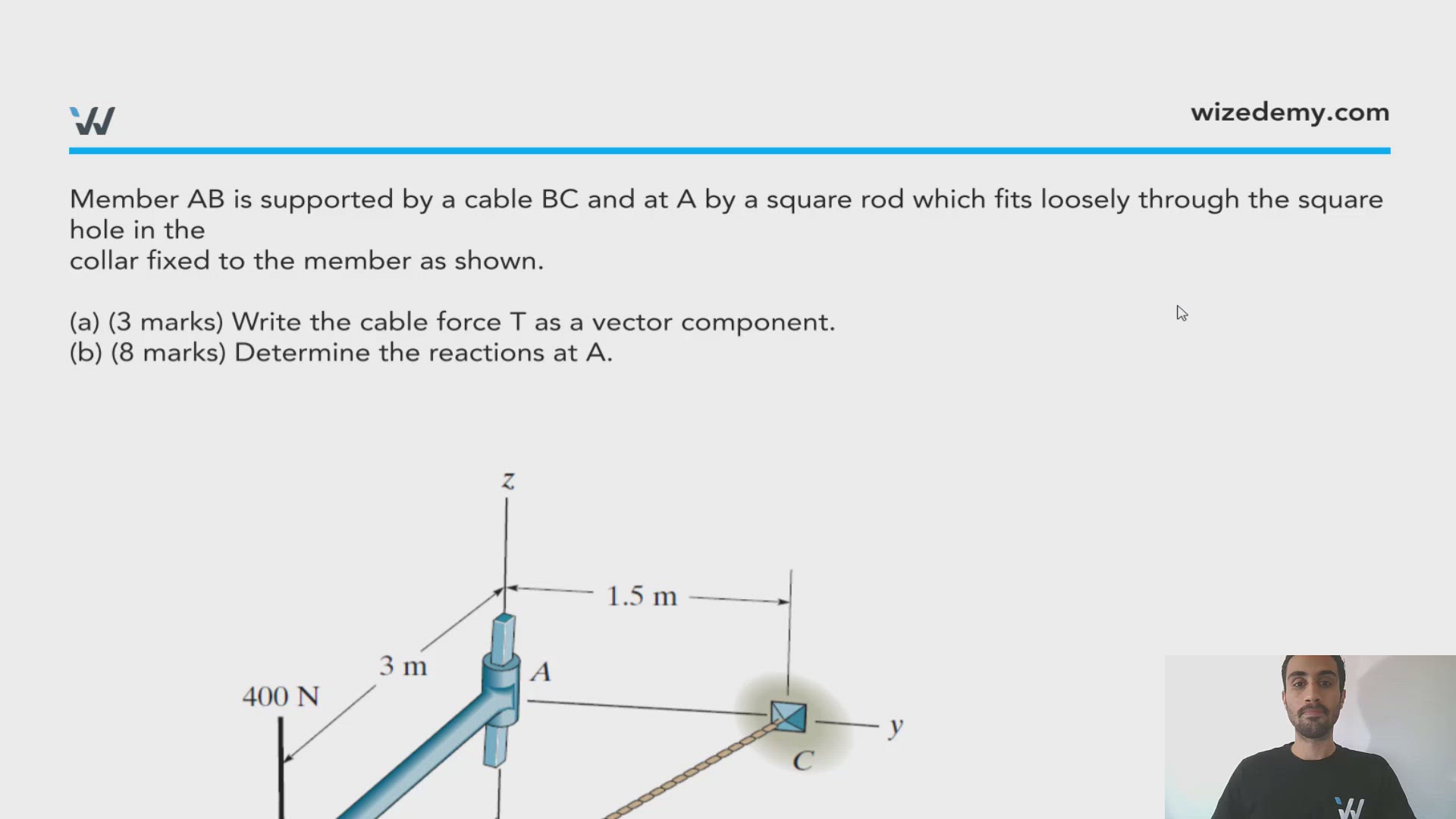
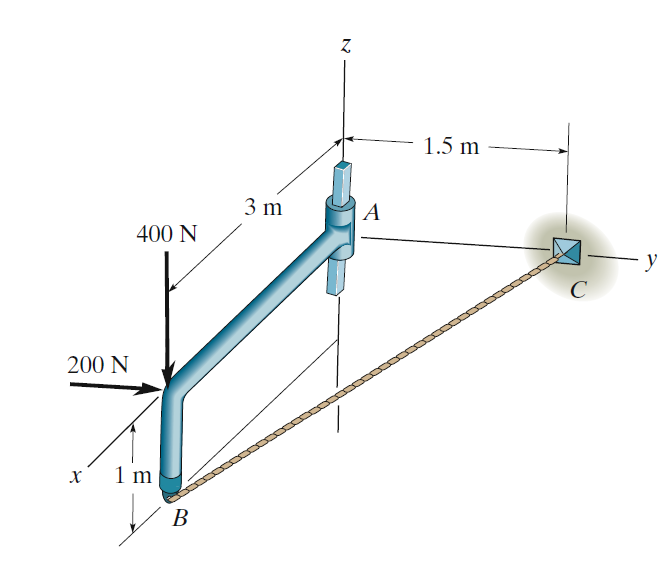
Member AB is supported by a cable BC and at A by a square rod which fits loosely through the square hole in the
collar fixed to the member as shown.
(a) (3 marks) Write the cable force T as a vector component.
(b) (8 marks) Determine the reactions at A.
Solution:
1) Draw Free Body Diagram.
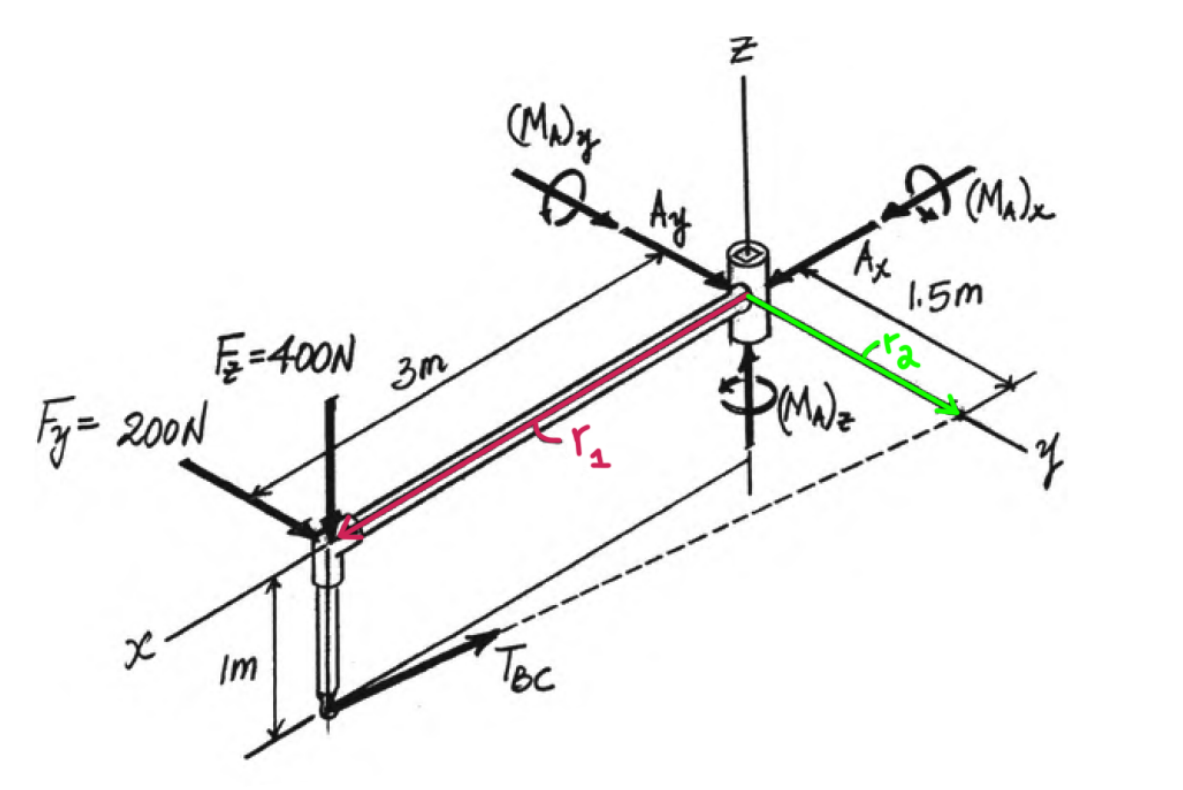
2) Determine all forces and moments in cartesian vector form
Cable force CD,
Applied forces,
Reaction forces,
Reaction moment,
3) Apply 3D Force Equations of Equilibrium and Equate i, j, and k components from the Forces above,
From Eqs (1) to (3), we get,
4) Moment equation of equilibrium about point A,
We need the position vectors
Therefore,
5) Equate i j and k Components,
Plug TBC=1400 N into equations (4), (5), and (6) and solve for the moment reactions,
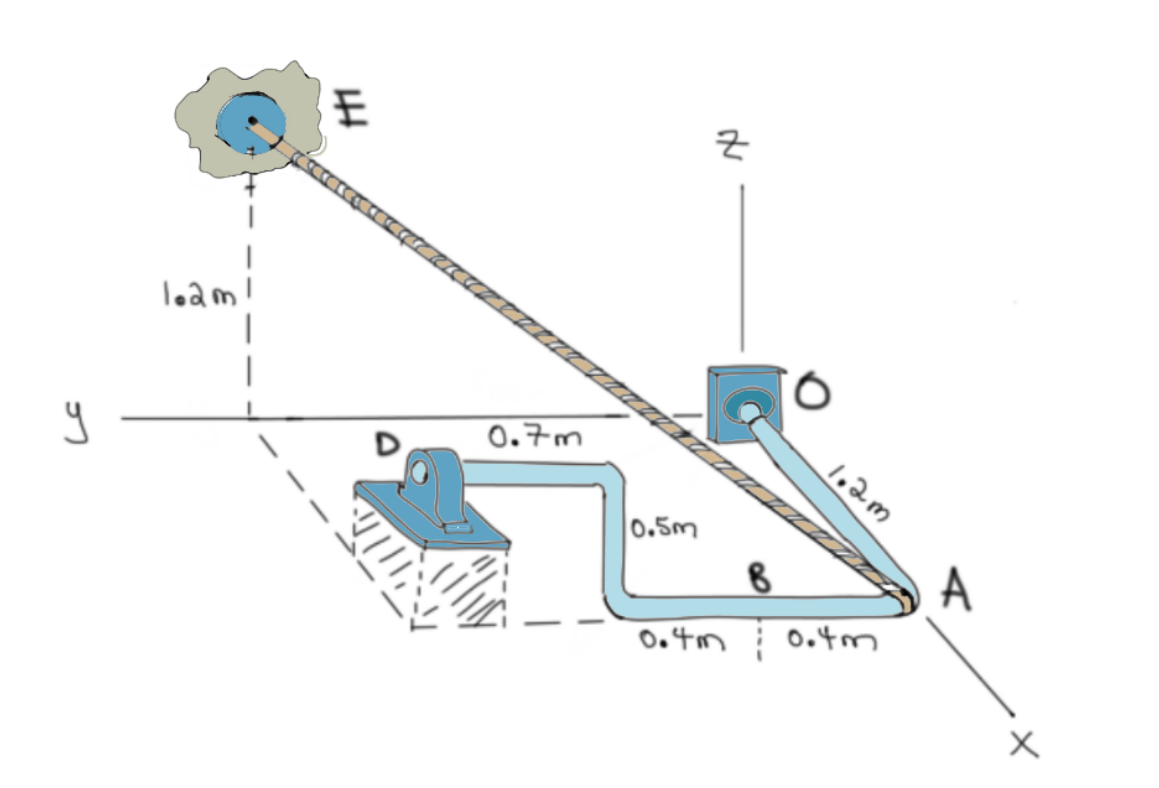
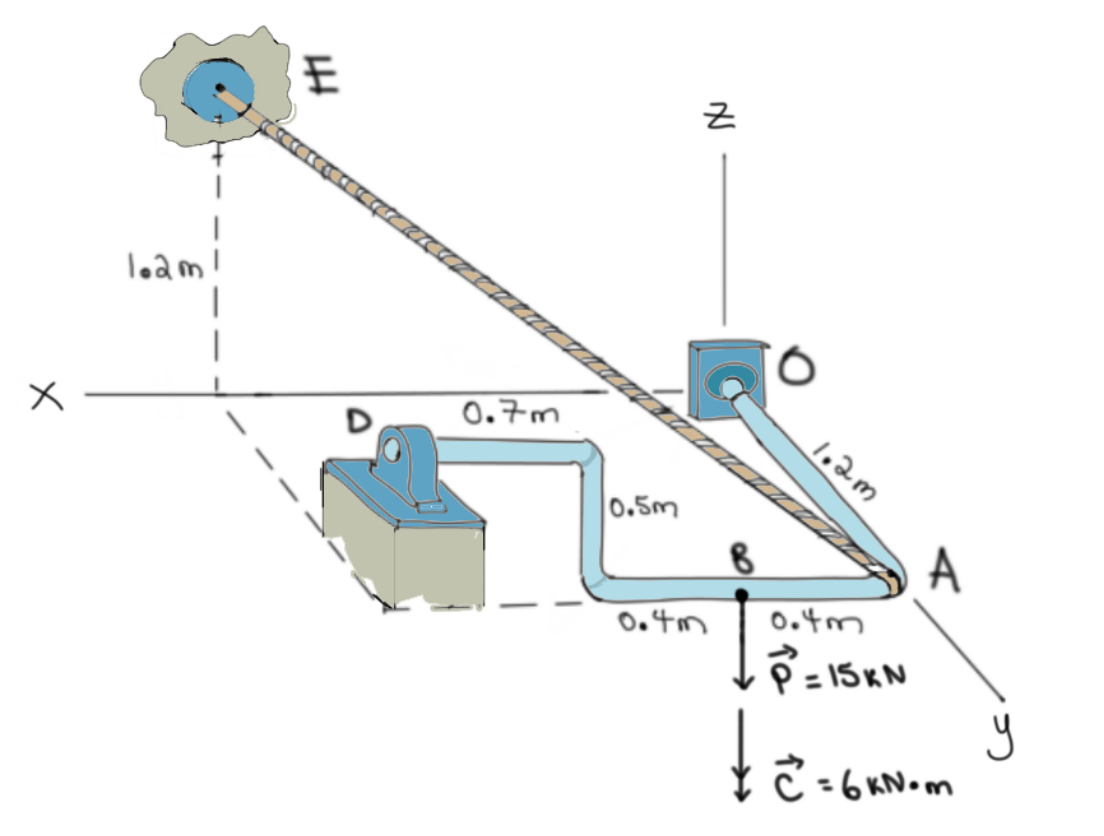
The bent bar illustrated has a negligible weight and is supported by a ball and socket joint at O, a cable connected between A and E, and a sliding bearing at D. The sliding bearing is allowed to slide freely in the x-direction. The bar is acted upon for a moment C and a force P, both are vectors parallel to the z-axis. Determine the magnitude of the total reaction force at D and the force in cable AE.
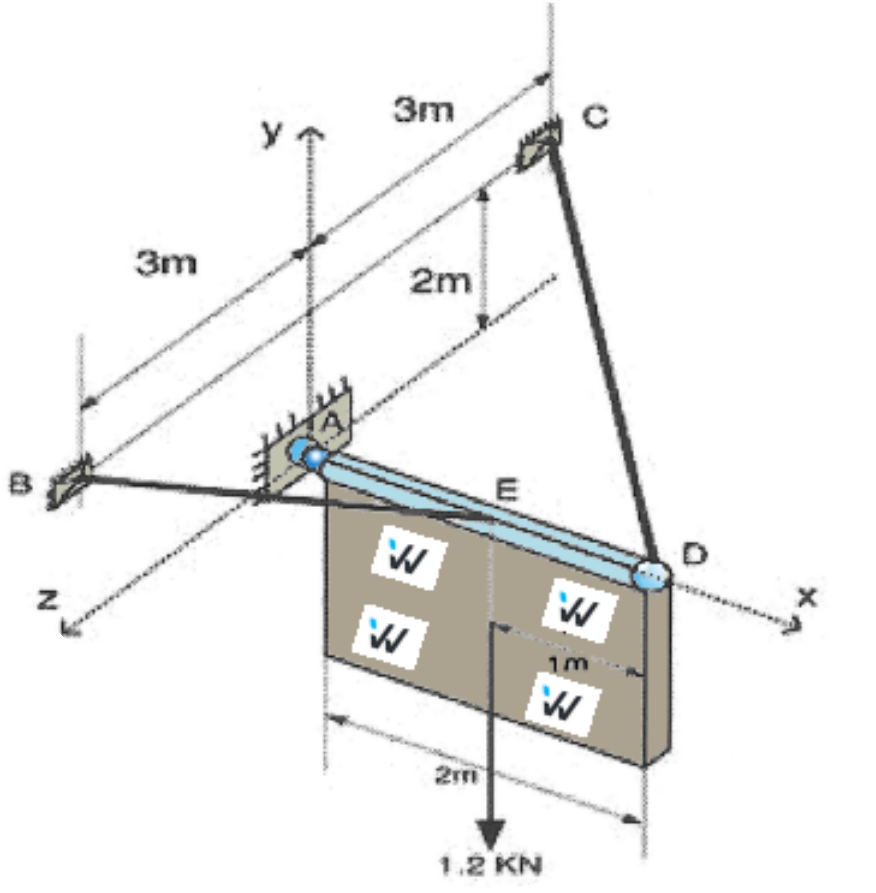
The structure AD has negligible weight and has a ball and socket joint at A. The structure AD supports a uniform rectangular sign. Determine the magnitude of the force in cables EB and DC and all the reaction forces at A.