Wize University Statics Textbook (Master) > Equilibrium of Rigid Body
3D Solution Method
0:00 / 0:00
3D equilibrium problems are slightly more difficult and less predictable, but the
general idea remains the same – begin by summing moments and try to solve as
many unknowns as possible. Remember that you can have a maximum of 6
unknowns. Some points to keep in mind:
- Always begin by drawing a FBD and labelling all important points and forces
- In 3D, you can sum moments about an axis, which gives one equation. If there is only 1 unknown in that equation, you can solve directly.
- Try to find a point where 3 unknown forces pass through. If the geometry of the problem is well defined (ie. you’re given all the distances you need), then it would be best to sum moments about that point which reduces your system from 6 equations to 3 equations.
- Sum forces in all 3 directions. At this point, you will have a system of equations to solve.
- Remember everything that you learned about moments, distance vectors,unit vectors, etc. is still needed to solve these problems, so be sure to go back and review that if necessary.
0:00 / 0:00
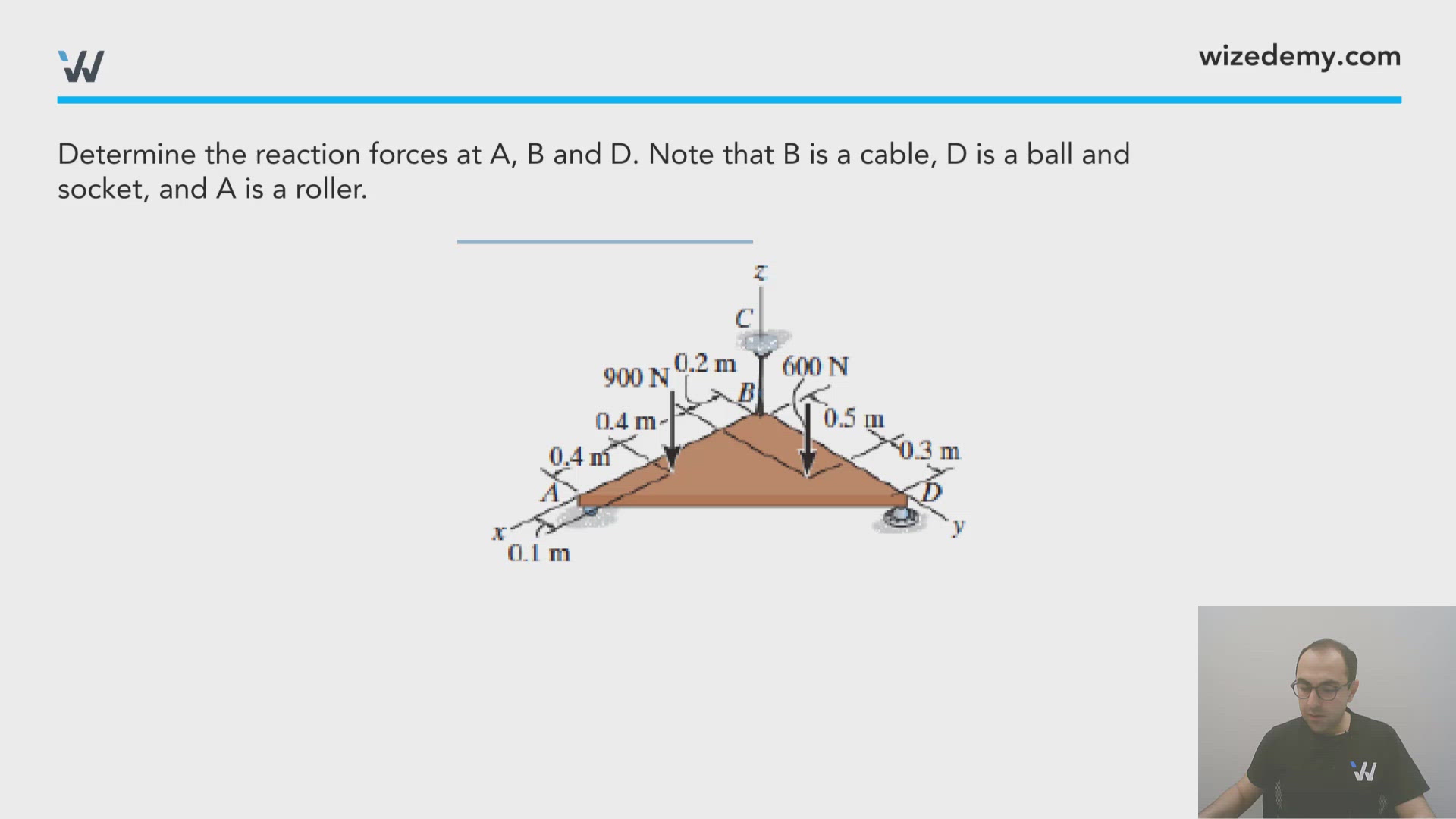
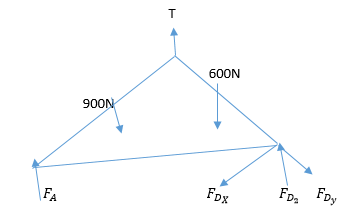
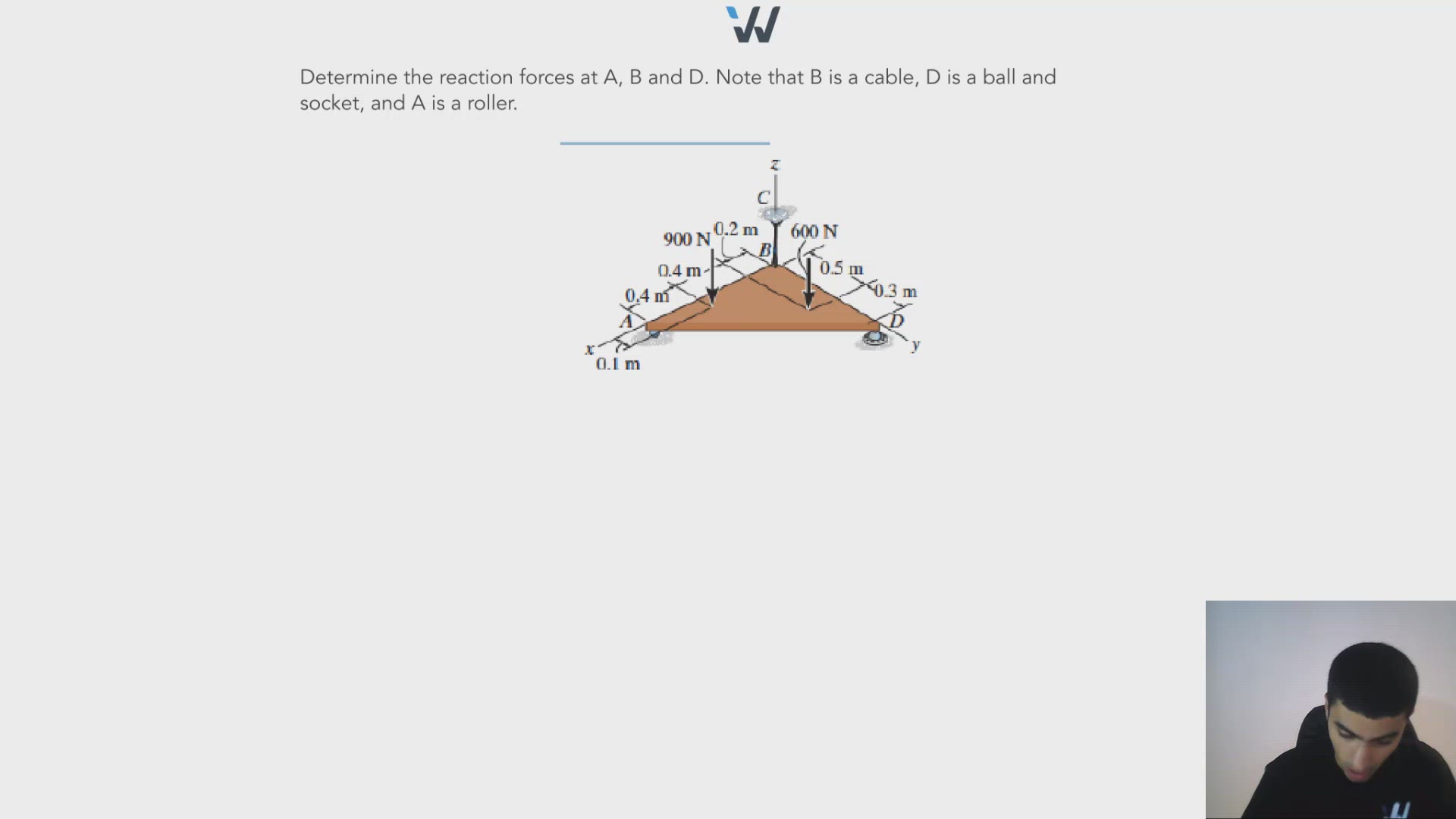
Determine the reaction forces at A, B and D. Note that B is a cable, D is a ball and
socket, and A is a roller.
0:00 / 0:00
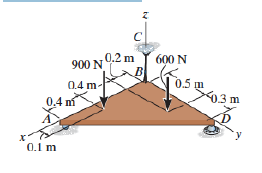
Determine the reaction forces at A, B and D. Note that B is a cable, D is a ball and
socket, and A is a roller.

Mark Yourself Question
- Grab a piece of paper and try this problem yourself.
- When you're done, check the "I have answered this question" box below.
- View the solution and report whether you got it right or wrong.
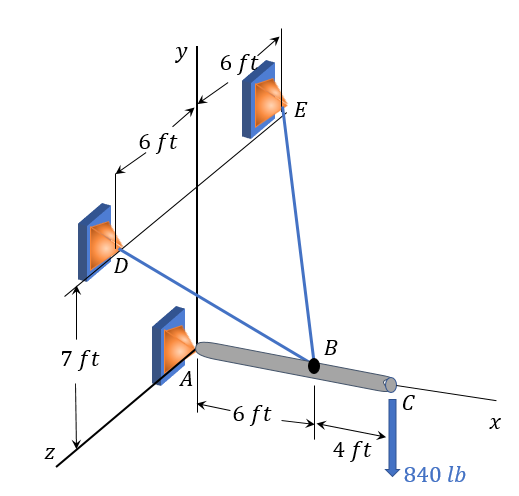
Determine the tension in each of the cables BD and BE, and the support reactions at the ball and socket joint at A.
Mark Yourself Question
- Grab a piece of paper and try this problem yourself.
- When you're done, check the "I have answered this question" box below.
- View the solution and report whether you got it right or wrong.
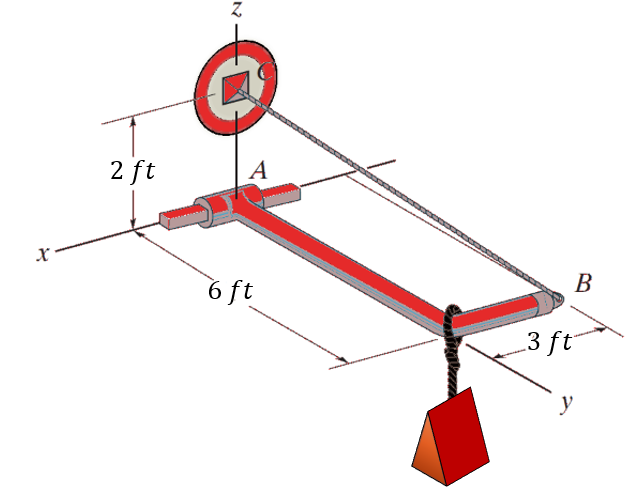
Determine the tension in cable BC, as well as the reactions at A needed to support the 400 lb load. Note: The collar at A has a square cross section.