Wize University Statics Textbook (Master) > Equilibrium of Rigid Body
2D Solution Method
Popular Courses
ENGG 130
University of Alberta
CIV100H1
University of Toronto
ENGG 202
University of Calgary
ENGSCI 1022A/B/Y
Western University
PHYS 110
University of Victoria
ENGR 242
Concordia University
ENGR 141
University of Victoria
CE 221
Michigan State University
GENG-1110
University of Windsor
ESM 2104
Virginia Tech
APS160H1
University of Toronto
0:00 / 0:00
There are several ways to solve 2D systems. Method 1 is geometrically rigorous, whereas method 2 is mathematically rigorous.
Method 1
In any 2D problems, 2 out of 3 unknown forces (generally) must pass through a single point. This point may be on or off the body. We will sum moments about that point to cancel two unknowns allowing us to solve for the third. The difficult arises from finding distance vectors to that point. The steps can be summarized as:
- Draw a FBD including the reaction forces
- Find a point where two unknown forces pass through
- Sum moments about that point – this will require some geometric manipulation to find distance vectors
- Solve the moment equation for the third unknown
- Sum forces (2 equations) to solve for the last 2 unknown forces
Method 2
This method works for all 2D problems, where we set up the equations and unknowns and solve simultaneous equations. The general procedure can be summarized as follows:
- Draw a FBD including the reaction forces
- Sum moments about any point on the body – choose a convenient point for distance vectors, and preferably one with an unknown passing through it
- Sum forces in x and y directions
- Solve the 3 equations from steps 2 and 3 simultaneously
Both methods will lead to an answer. Method 1 requires some thinking and is highly dependent on the geometry of the problem, whereas method 2 will always work but requires more mathematical steps
0:00 / 0:00
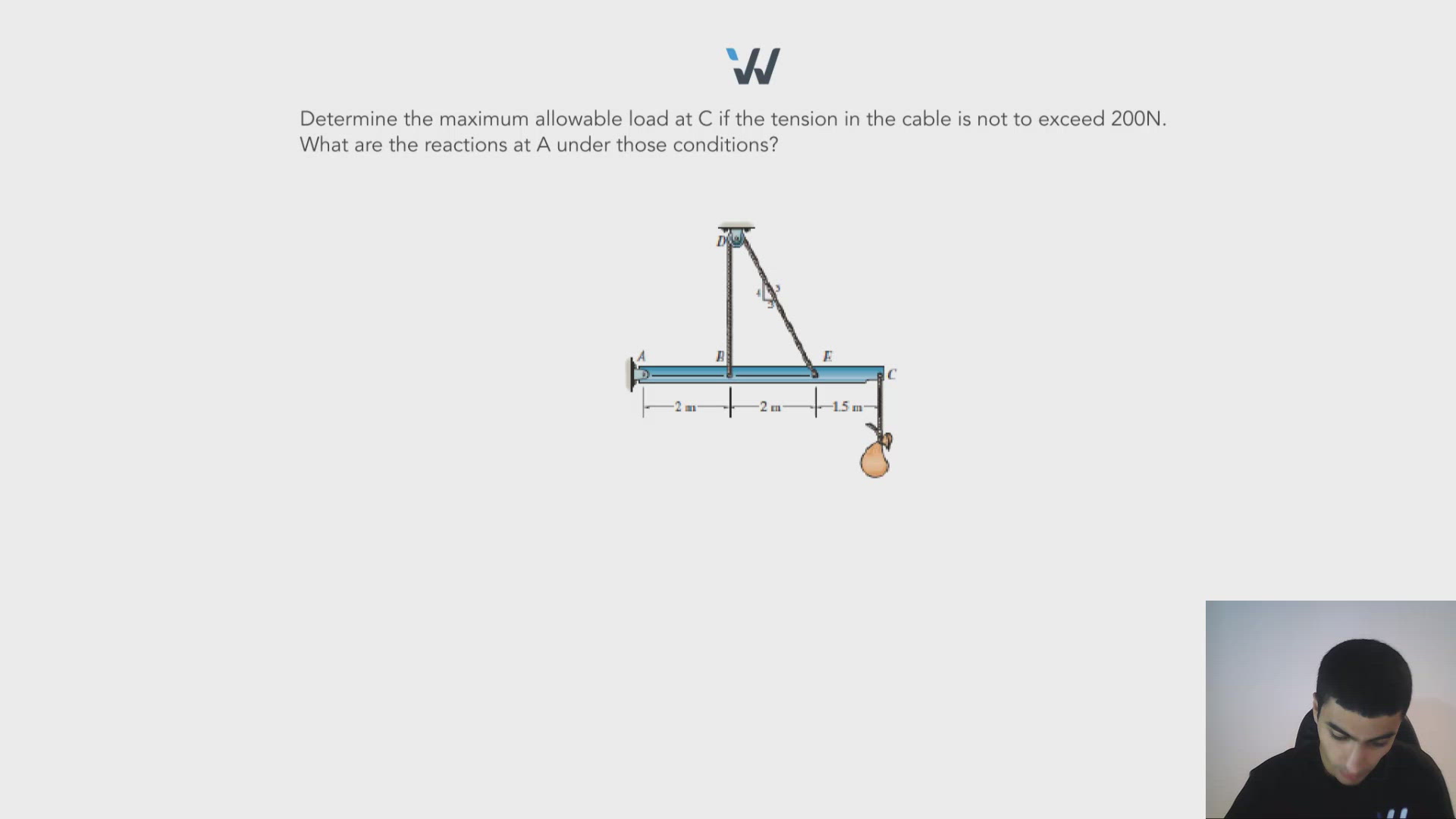
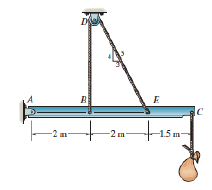
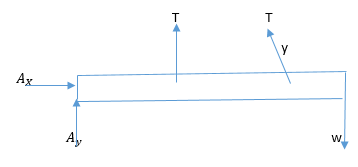
Determine the maximum allowable load at C if the tension in the cable is not to exceed 200N. What are the reactions at A under those conditions?

Mark Yourself Question
- Grab a piece of paper and try this problem yourself.
- When you're done, check the "I have answered this question" box below.
- View the solution and report whether you got it right or wrong.
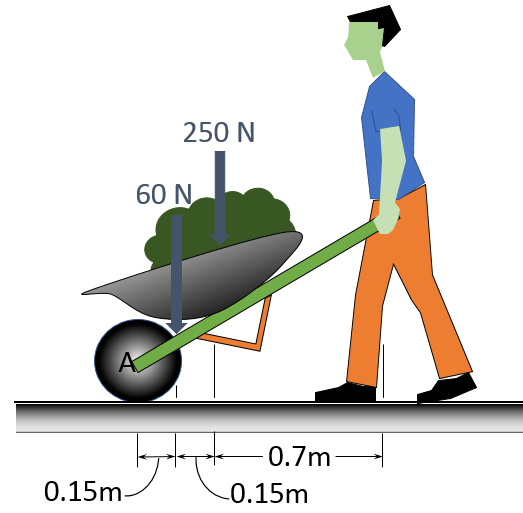
a) Determine the lifting force needed and the reaction at the wheel A to lift the wheel barrel.
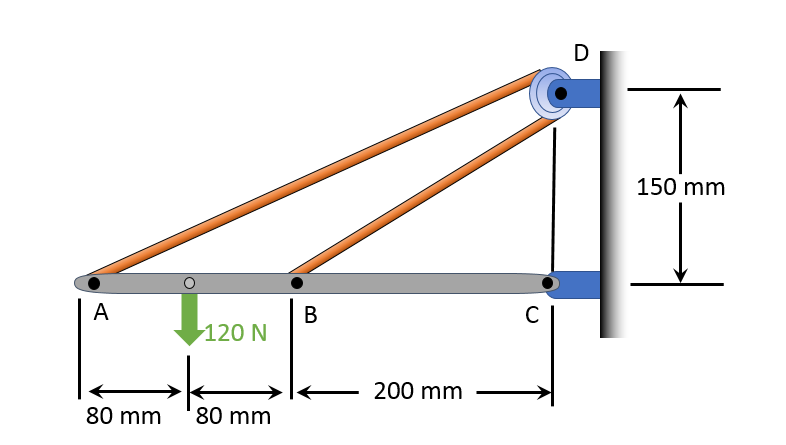
b) Determine the tension in the continuous cable ADB, and the reactions at the pin at C.
Mark Yourself Question
- Grab a piece of paper and try this problem yourself.
- When you're done, check the "I have answered this question" box below.
- View the solution and report whether you got it right or wrong.
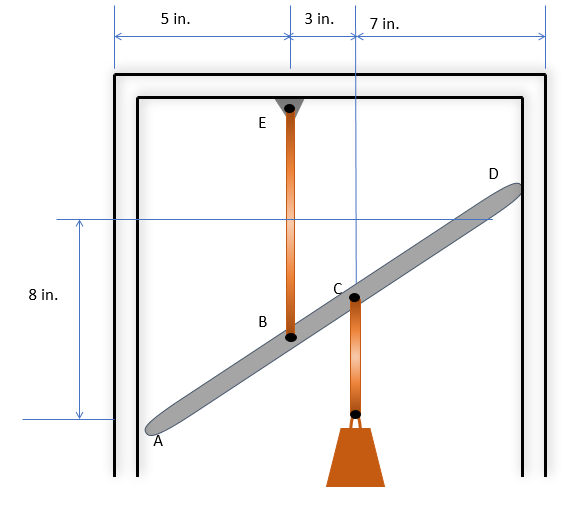
Determine the tension in cable BE as well as the normal reactions at A and D caused by attaching the 35 N load at C.
Quiz: 2D solution Method Quiz
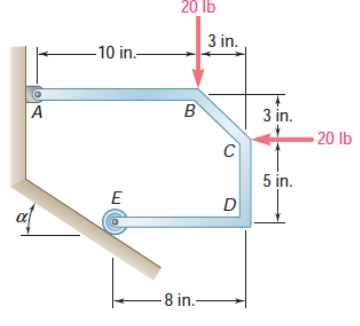
Determine the reaction forces at A and E.
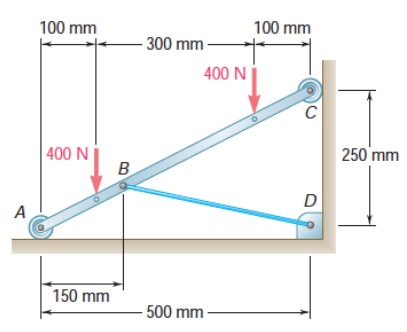
Determine the reaction forces at A and C, and the tension in the cable.
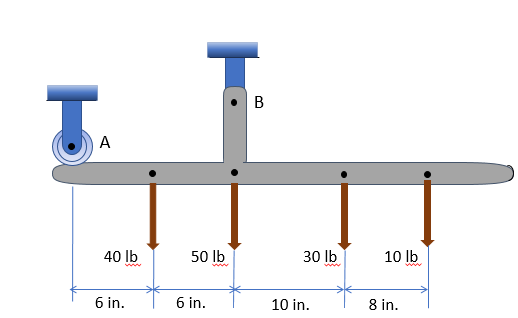
Determine the reaction forces at A and B.
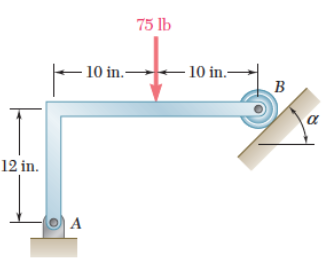
Determine the reaction forces at A and B. Take α =
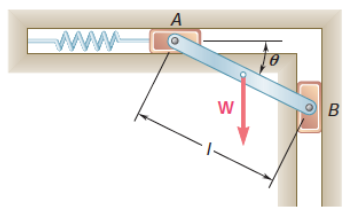
The spring is unstreched when θ = 0. If W = 10N, determine the value of θ. Take l = 1m, and k =100N/m.
The bar of negligible weight is supported by two springs at A and B and is initially horizontal before the load is applied. Once the 800N load is applied, the bar is pushed down, but remains horizontal. Determine the relationship between the two spring constants kA and kB.
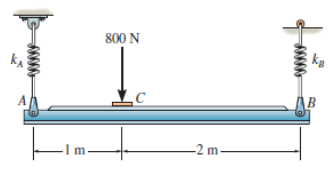
The relationship is: Enter the value of x
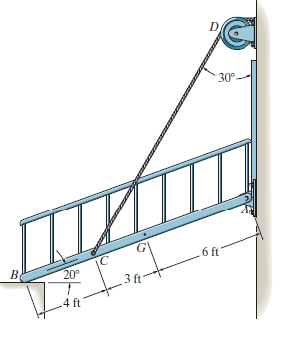
The following ramp has a weight of 20 kN acting at point G. Determine the minimum tension needed to start lifting the ramp.
Mark Yourself Question
- Grab a piece of paper and try this problem yourself.
- When you're done, check the "I have answered this question" box below.
- View the solution and report whether you got it right or wrong.
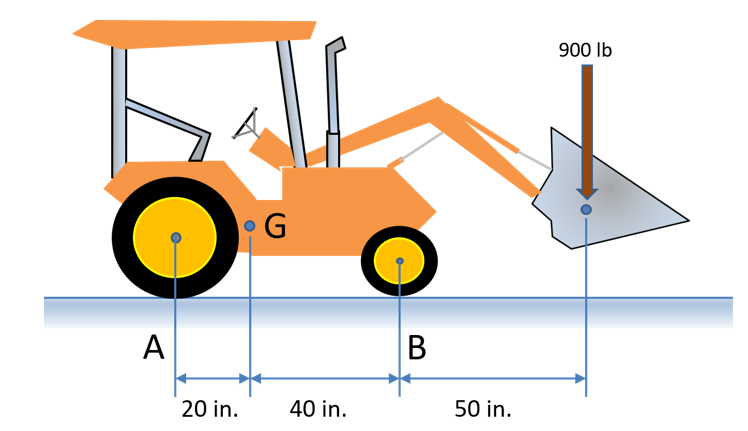
Determine the reaction at each wheel (remember that there is a total of 4 wheels). The weight acts at G and is 4000 lb.
Mark Yourself Question
- Grab a piece of paper and try this problem yourself.
- When you're done, check the "I have answered this question" box below.
- View the solution and report whether you got it right or wrong.
Determine the reactions at A,B and C when the 10lb force is applied to the bar.
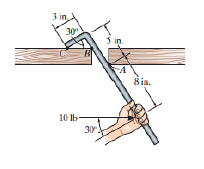
Enter your answer in absolute value in lb.
Mark Yourself Question
- Grab a piece of paper and try this problem yourself.
- When you're done, check the "I have answered this question" box below.
- View the solution and report whether you got it right or wrong.
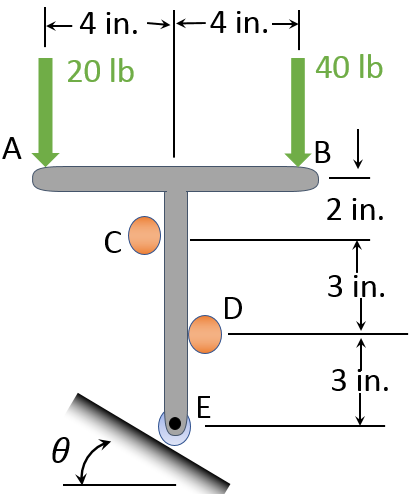
Determine the range of values of angles for which the bar will remain stable.
Quiz: 2D Solution Method (New)
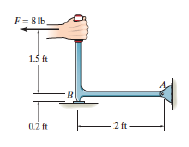
Determine the punching force at B under the given conditions. What are the
reactions at A in that set up?
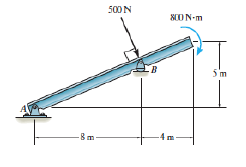
A is a pin while B is a rocker. Determine the reactions at A and B under the following loading.
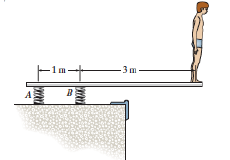
Each spring has a spring constant of 1000 N/mm. Determine the angle of the board
relative to the horizontal when a 500 N person is standing on the board.
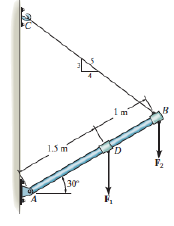
What is the maximum allowable load F1, if the maximum allowable tension in the
cable is 500 N, and F2 = 2F1? What are the reactions at A?
Determine the furthest distance x, which the 20kN box can be hung. The short
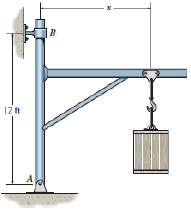
smooth collar at B can support a maximum load of 10kN.