Popular Courses
ENGG 130
University of Alberta
CIV100H1
University of Toronto
ENGG 202
University of Calgary
ENGSCI 1022A/B/Y
Western University
GNG 1105
University of Ottawa
ENGR 242
Concordia University
ENGR 141
University of Victoria
CE 221
Michigan State University
GENG-1110
University of Windsor
ESM 2104
Virginia Tech
APS160H1
University of Toronto
0:00 / 0:00
APPROACH #1 : Method of Joints (MOJ) - NEED TO KNOW F's in ALL THE MEMBERS
The method of joints analyzes the one joint (connection point) at a time. This method is useful when wanting to solve for the forces in ALL THE MEMBERS OR the forces in members near the edge OR for trusses with few total members. If asked about forces in members near the middle of the truss, then this method could take a really long time.
General steps:
- Solve the external reaction forces / find SUPPORT REACTIONS.
- Identify all zero force members, remove and REDRAW.
- Begin at a joint with a maximum of 2 UNKNOWN forces & at least 1 KNOWN force. Assume all unknown members are in tension.
- Sum F's (x & y) to solve for unknown forces in members.
- TENSION vs COMPRESSION: Positive values typically mean tension, negative means compression – clearly state your convention. Or..... thinks of TENSION as PULLING (on or away) from the joint, and COMPRESSION as PUSHING (on or into) the joint.
- As you know the forces in more members, move across to other joints and continue solving. Remember that you can only solve for 2 unknowns at a time
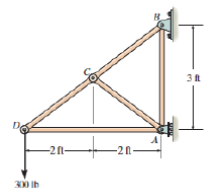
Determine the force in each member. Indicate whether the member is in tension or compression.
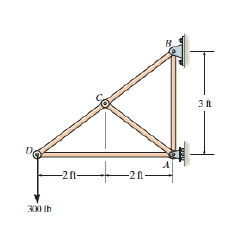
(so redraw truss WITHOUT AC)
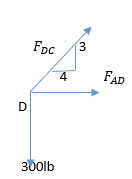
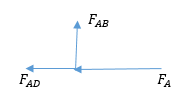
Determine the forces in all members of the truss. State whether each member is in tension or compression.
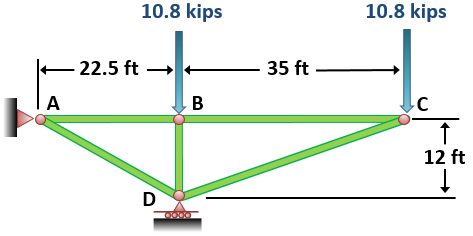

Mark Yourself Question
- Grab a piece of paper and try this problem yourself.
- When you're done, check the "I have answered this question" box below.
- View the solution and report whether you got it right or wrong.
Determine the tension in members: AB, AH, BH, HC, BC and HG. Indicate whether the member is in tension or compression.
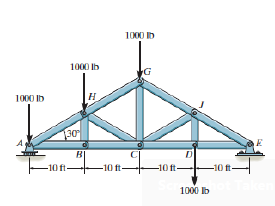
Mark Yourself Question
- Grab a piece of paper and try this problem yourself.
- When you're done, check the "I have answered this question" box below.
- View the solution and report whether you got it right or wrong.
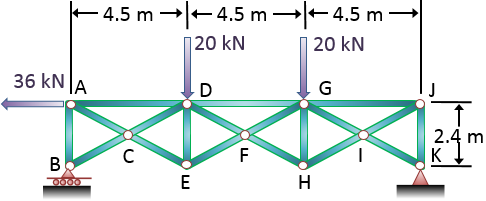
Determine the forces in each member of the following truss.