Wize University Dynamics Textbook (Master) > Work and Energy
Conservation of Energy for a Particle
0:00 / 0:00
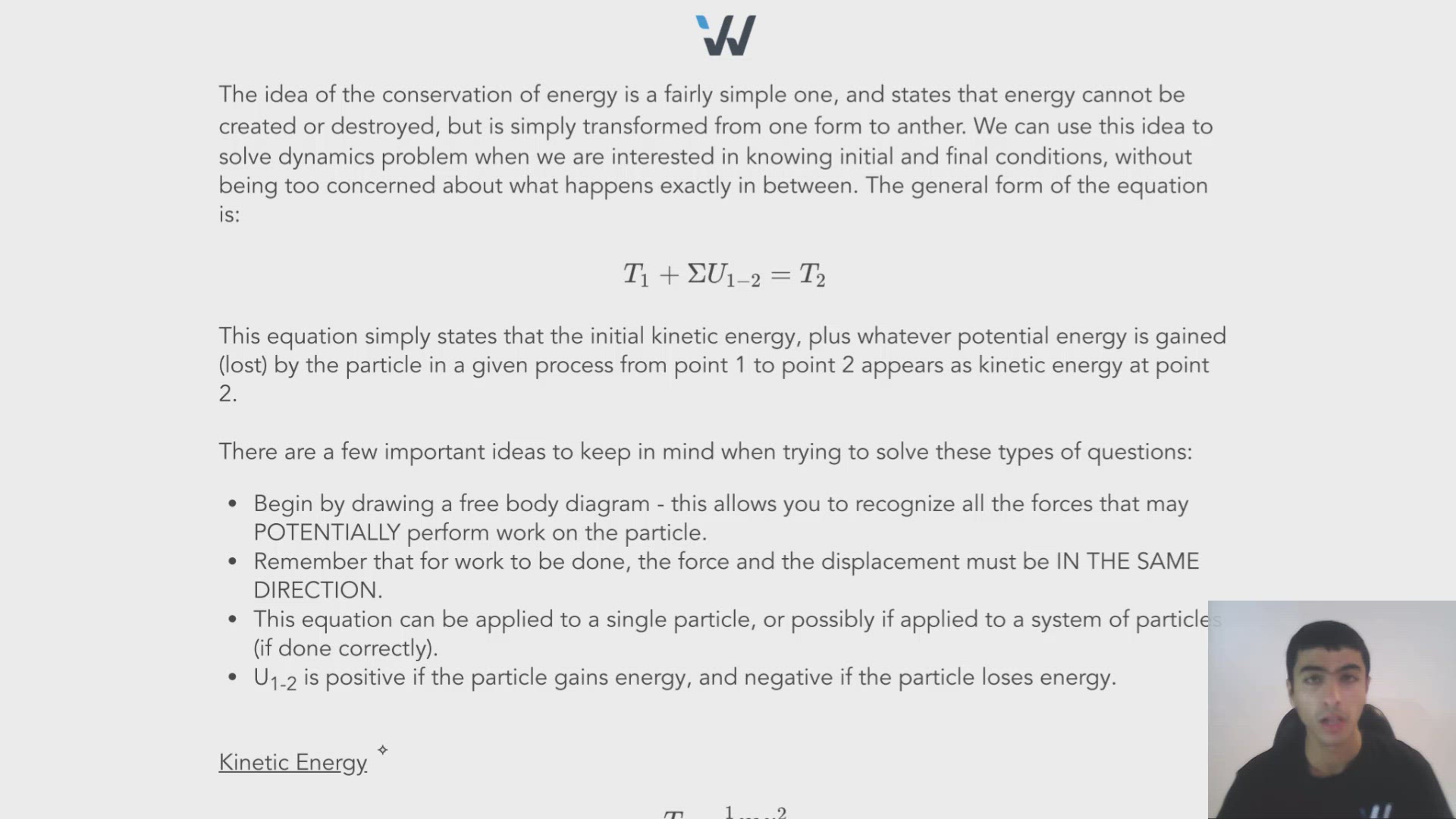
The idea of the conservation of energy is a fairly simple one, and states that energy cannot be created or destroyed, but is simply transformed from one form to anther. We can use this idea to solve dynamics problem when we are interested in knowing initial and final conditions, without being too concerned about what happens exactly in between. The general form of the equation is:
This equation simply states that the initial kinetic energy, plus whatever potential energy is gained (lost) by the particle in a given process from point 1 to point 2 appears as kinetic energy at point 2.
There are a few important ideas to keep in mind when trying to solve these types of questions:
- Begin by drawing a free body diagram - this allows you to recognize all the forces that may POTENTIALLY perform work on the particle.
- Remember that for work to be done, the force and the displacement must be IN THE SAME DIRECTION.
- This equation can be applied to a single particle, or possibly if applied to a system of particles (if done correctly).
- U1-2 is positive if the particle gains energy, and negative if the particle loses energy.
Kinetic Energy
Gravitational Potential Energy
Where g = 9.81 (positive), and Δy is positive if the particle gains elevation, or negative if the particle has travelled downwards.
Potential Energy in a Spring
Where k is the spring constant, and Δx is the stretch in the spring from its equilibrium position.
Work by a Force
Where the force and the position vector 'r' must be parallel to cause a change in the potential energy. Since the force of friction always opposes the direction of motion, it will result it a negative change in the energy of the system.
0:00 / 0:00
A 300 g ice puck is travelling on ice at some initial velocity vo, when it reaches the edge of the ice and comes off the ice and onto a snowy surface. The puck travels for 3 m before coming to a stop. The coefficient of kinetic friction with the ice and snow are 0.00 and 0.10 respectively.
a) What was the initial velocity of the puck?
b) If instead of hitting a snowy patch, the puck began travelling up a hill with a slope of 30°, how far will the puck travel on the hill?
m=0.3 kg
a) N=W=0.3(9.81)=2.943N
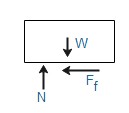
d = 3 m
b)
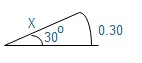
puck will travel 60 cm up the hill

Mark Yourself Question
- Grab a piece of paper and try this problem yourself.
- When you're done, check the "I have answered this question" box below.
- View the solution and report whether you got it right or wrong.
{1) The system below initially starts from rest, with a spring constant of 28 N/m. At t = 0, the 3 kg block is removed.
If the 2 kg block is not attached to the spring:
a) Determine how far up it travels?
b) What is the maximum velocity of the block?
c) How does your answer change if the block was attached to the spring?
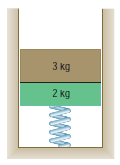
2) A 2 kg block rests on a spring as shown above, when a 3 kg block is dropped from a height of 3 m above it. Determine:
a) The maximum velocity of the 3 kg block
b) The maximum compression of the spring