Wize University Dynamics Textbook (Master) > Energy Methods for a Particle
End of Chapter Practice Questions
Popular Courses
Find My CourseEnd of Chapter Practice - Energy Methods
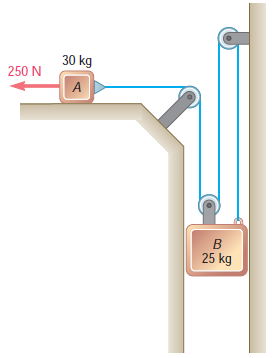
In the system shown below, block B is initially falling at a speed of 3 m/s when a 250 N force is applied to block A to stop the movement. Determine how much further block B will fall before coming to a stop.
End of Chapter Practice - Energy Methods for Rigid Bodies
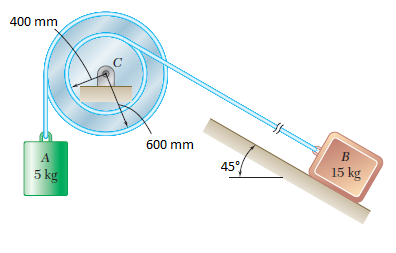
The system shown below is released from rest. What is the maximum value for the coefficient of static friction for motion to occur?
If the coefficient of static and kinetic frictions are 70% and 40% of what you found above, determine the velocity of both particles after block A has travelled 3 m.
After block A has travelled 3 m, the cable connected to block B is cut as shown. How far up will block A travel from that point?
Other information: the double pulley has two separate cables, a mass of 25 kg, and has a radius of gyration of 450 mm. The axle of the pulley is frictionless.