Wize University Introduction to Finance Textbook > CAPM
Shorting Stocks
Popular Courses
COMM 308
Concordia University
Intro to Finance
University Study Guides
Intro to Finance
University Study Guides
FINA 230
Concordia University
MGCR 341
McGill University
FIN 301
University of Alberta
FIN 300
Toronto Metropolitan University
COMM 121
Queen's University
FIN*2000
University of Guelph
FINC 341
Texas A&M University
COMM 2202
Dalhousie University
BU283
Wilfrid Laurier University
FIN 300
Arizona State University - Tempe
BUSFIN 3220
Ohio State University
SB/FINE 2000 3.00
York University
FIN 301
Pennsylvania State University
BUS-F 255
Indiana University - Bloomington
FIN 3403
University of Central Florida
FIN 3403
University of Florida
FIN 320
California State University - Fullerton
0:00 / 0:00
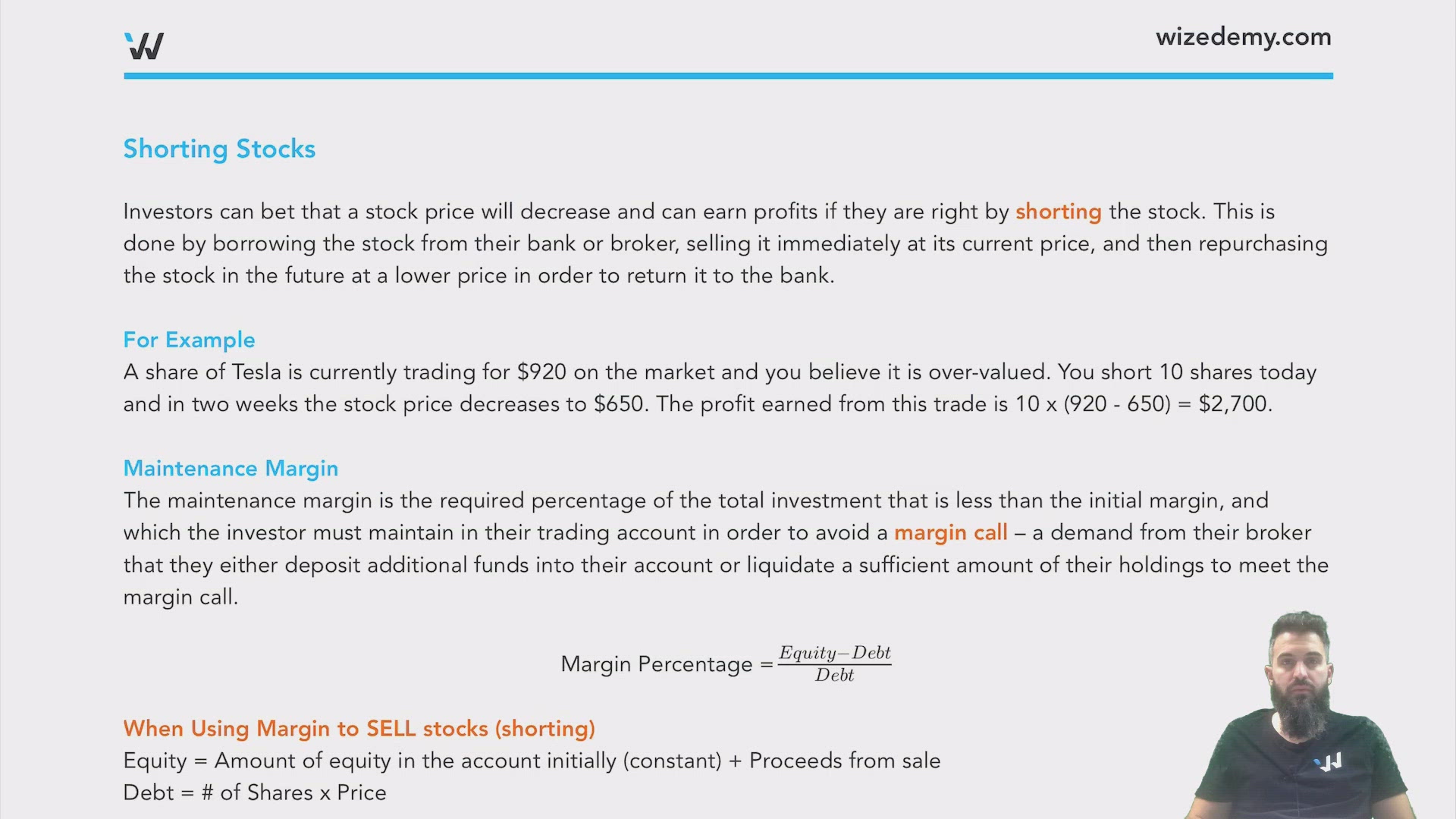
Shorting Stocks
Investors can bet that a stock price will decrease and can earn profits if they are right by shorting the stock. This is done by borrowing the stock from their bank or broker, selling it immediately at its current price, and then repurchasing the stock in the future at a lower price in order to return it to the bank.
For Example:
A share of Tesla is currently trading for $920 on the market and you believe it is over-valued. You short 10 shares today and in two weeks the stock price decreases to $650. The profit earned from this trade is 10 x (920 - 650) = $2,700.
Maintenance Margin
The maintenance margin is the required percentage of the total investment that is less than the initial margin, and which the investor must maintain in their trading account in order to avoid a margin call – a demand from their broker that they either deposit additional funds into their account or liquidate a sufficient amount of their holdings to meet the margin call.
Margin Percentage =
When Using Margin to SELL stocks (shorting)
Equity = Amount of equity in the account initially (constant) + Proceeds from sale
Debt = # of Shares x Price
For Example:
You wish to short 100 shares of ABC Inc which are currently trading for $10 each, you first need to borrow 100 shares from your broker and immediately sell them on the market. You have $800 cash in your account to start and now have an additional $1,000 from the sale of the borrowed stocks. Assuming your broker has a minimum maintenance margin of 40%.
If the stock price increases to $12 per share, your equity remains $1,800 but your debt is now $1,200 (100 shares x $12 per share).
If the stock price increases to $14 per share, your equity remains $1,800 but your debt is now $1,400 (100 shares x $14 per share).
Since the margin percentage has fallen below the broker's minimum of 40%, the investor will receive a margin call to either add money to the account to increase this back above the minimum or to repay some of what they owe.
0:00 / 0:00
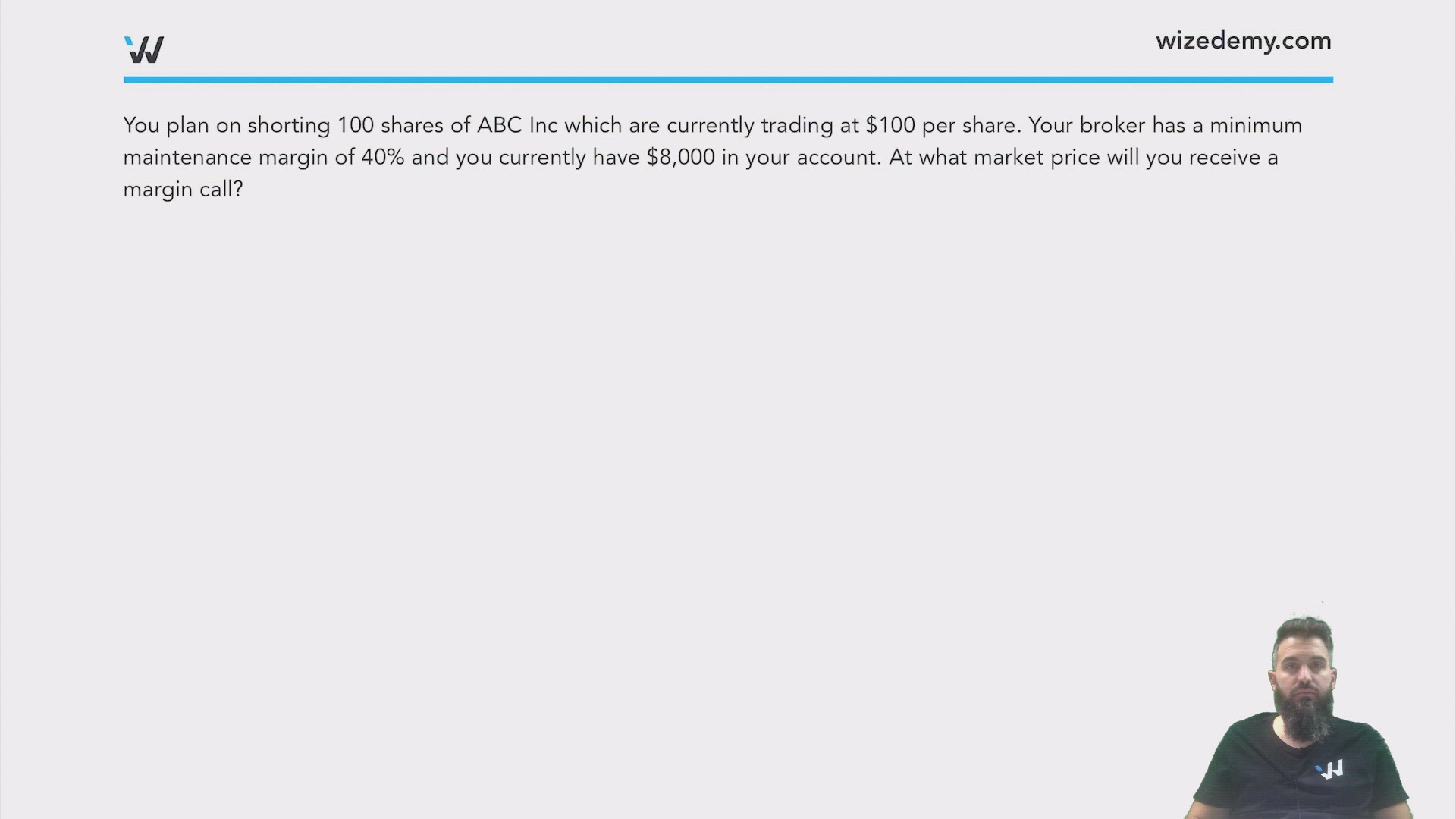
Example: Shorting Stocks
You plan on shorting 100 shares of ABC Inc which are currently trading at $100 per share. Your broker has a minimum maintenance margin of 40% and you currently have $8,000 in your account.
At what market price will you receive a margin call?
Practice: Shorting Stocks
Maria believes stock X is too overvalued and wishes to short the stock. Currently, Stock X is trading for $100 per share and Maria calls her broker to short 50 shares of the stock. The broker's minimum maintenance margin is 40% and Maria currently has $20,000 in her account.
At what price will she receive a margin call?