Wize University Introduction to Finance Textbook > CAPM
Capital Market Line (CML)
Popular Courses
COMM 308
Concordia University
Intro to Finance
University Study Guides
Intro to Finance
University Study Guides
FINA 230
Concordia University
MGCR 341
McGill University
FIN 301
University of Alberta
FIN 300
Toronto Metropolitan University
COMM 121
Queen's University
FIN*2000
University of Guelph
FINC 341
Texas A&M University
COMM 2202
Dalhousie University
BU283
Wilfrid Laurier University
FIN 300
Arizona State University - Tempe
BUSFIN 3220
Ohio State University
SB/FINE 2000 3.00
York University
FIN 301
Pennsylvania State University
BUS-F 255
Indiana University - Bloomington
FIN 3403
University of Central Florida
FIN 3403
University of Florida
FIN 320
California State University - Fullerton

0:00 / 0:00
Market Portfolio & Capital Market Line
The Market Portfolio
The market portfolio (M) is a theoretical bundle of investments that includes every type of asset available in the world financial market, with each asset weighted in proportion to its total presence in the market.
Capital Market Line (CML)
The Capital Market Line (CML) is a straight line that begins at the risk-free rate and ends at the highest possible expected return for any given risk level. The line shows the required expected return for every possible level of risk and the risk-return ratio (the slope) is determined by the market portfolio. The CML line tells us what portfolios investors will choose to hold efficient portfolios.
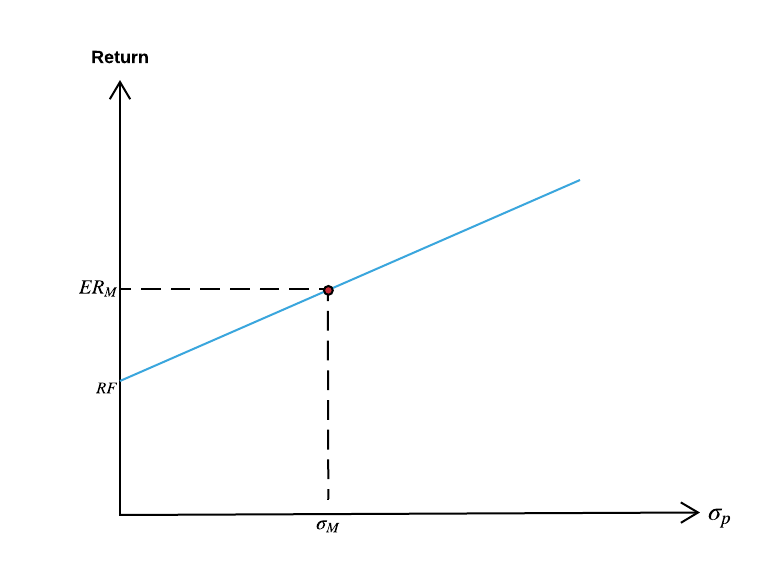
Required Rate of Return
Sharpe Ratio
The Sharpe ratio is the ratio of an investment risk-premium to its level of risk (standard deviation). The Sharpe ratio of the market is the slope of the CML line.

Pricing Investments
Every investment and every asset has a fair price or correct price, and this is determined by its risk-reward ratio. An asset is said to be fairly priced when its risk-reward ratio is equal to that of the market.
- If the investment is said to be under-valued or under-priced because it has a greater risk-return ratio than the market (above the line).
- If the investment is said to be over-valued or over-priced because it has a lower risk-return ratio than the market (below the line).
- If the investment is said to be at its correct price or efficient price because it has the same risk-return ratio as the market.
0:00 / 0:00
Example: The Market Portfolio and The Capital Market Line
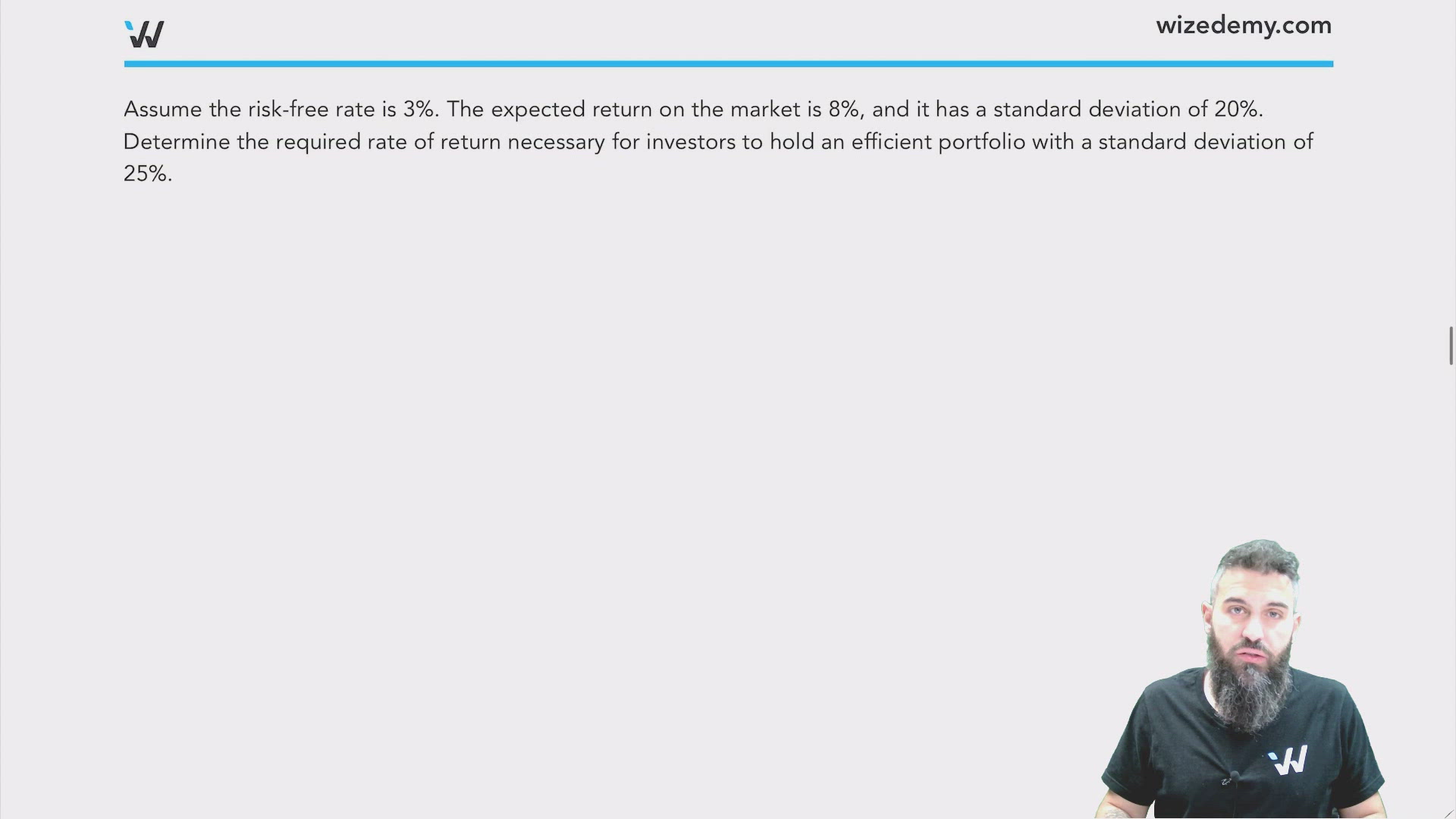
Assume the risk-free rate is 3%. The expected return on the market is 8%, and it has a standard deviation of 20%. Determine the required rate of return necessary for investors to hold an efficient portfolio with a standard deviation of 25%.
Practice: The Market Portfolio and The Capital Market Line
Portfolio A has an expected return of 9% and a standard deviation of 11%. The market's expected return is 12% with a standard deviation of 15%. Canadian T-Bills are yielding 3% per year.
What is the required rate of return for Portfolio A?
0:00 / 0:00
Example: The Market Portfolio and The Capital Market Line
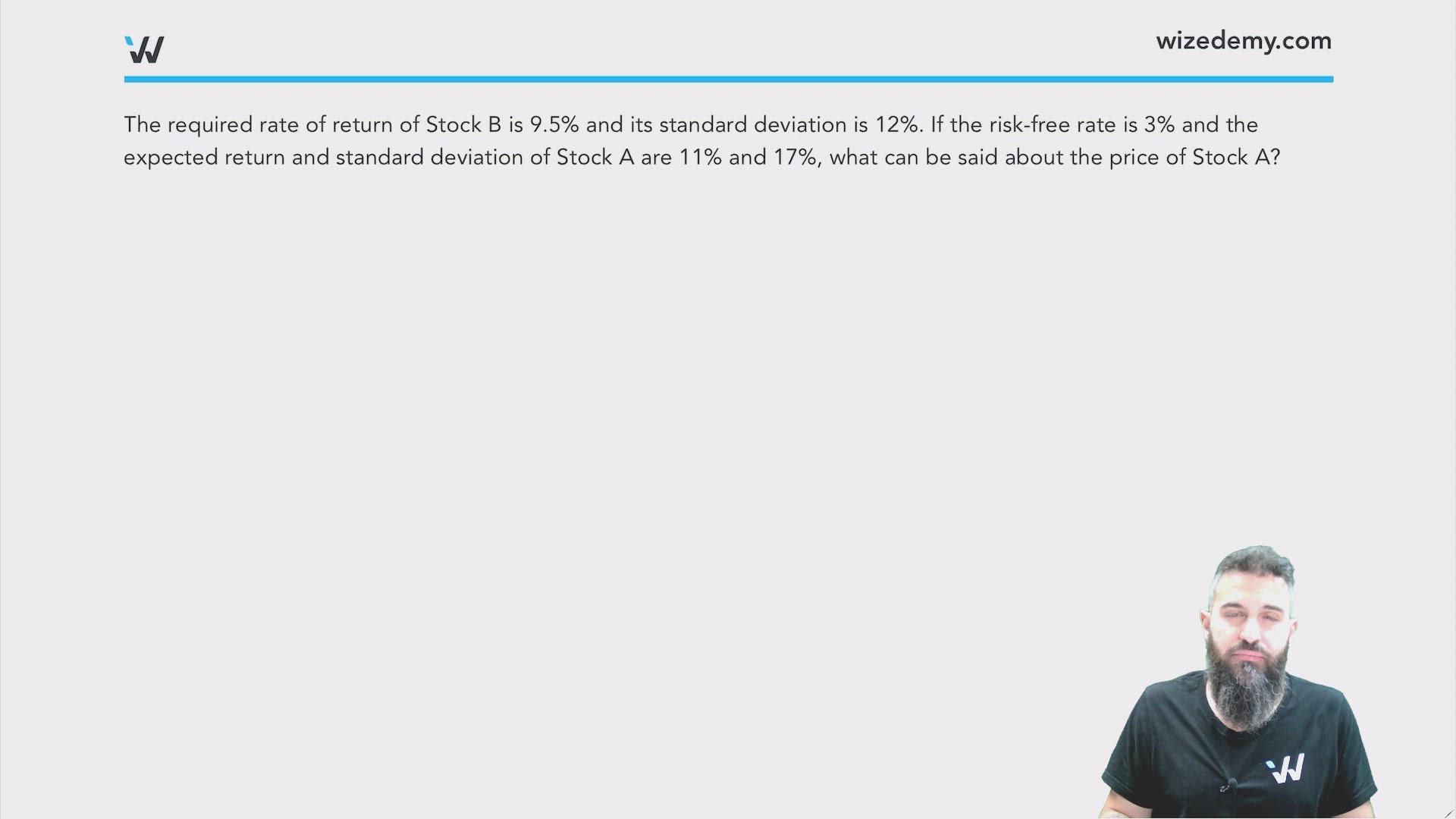
The required rate of return of Stock B is 9.5% and its standard deviation is 12%. If the risk-free rate is 3% and the expected return and standard deviation of Stock A are 11% and 17%, what can be said about the price of Stock A?
Practice: The Market Portfolio and The Capital Market Line
A portfolio with an expected return of 23% and standard deviation of 12.8% is being considered. The expected return of the market is 19.5%, and the standard deviation of the market is 7.4%. T-bills are yielding 3%.
What is the required rate of return of this portfolio? Round your answer to 2 decimal places
| Required rate of return | % |