Wize University Introduction to Finance Textbook > Time Value of Money
Amortized (Instalment) Loan
Popular Courses
COMM 308
Concordia University
Intro to Finance
University Study Guides
Intro to Finance
University Study Guides
FINA 200
Concordia University
FINA 230
Concordia University
MGCR 341
McGill University
FIN 301
University of Alberta
FIN 300
Toronto Metropolitan University
COMM 121
Queen's University
FIN*2000
University of Guelph
FINC 341
Texas A&M University
COMMERCE 2FA3
McMaster University
COMM 2202
Dalhousie University
BU283
Wilfrid Laurier University
FIN 300
Arizona State University - Tempe
BUSFIN 3220
Ohio State University
FIN 301
Pennsylvania State University
BUS-F 255
Indiana University - Bloomington
FIN 3403
University of Central Florida
FIN 3403
University of Florida
0:00 / 0:00
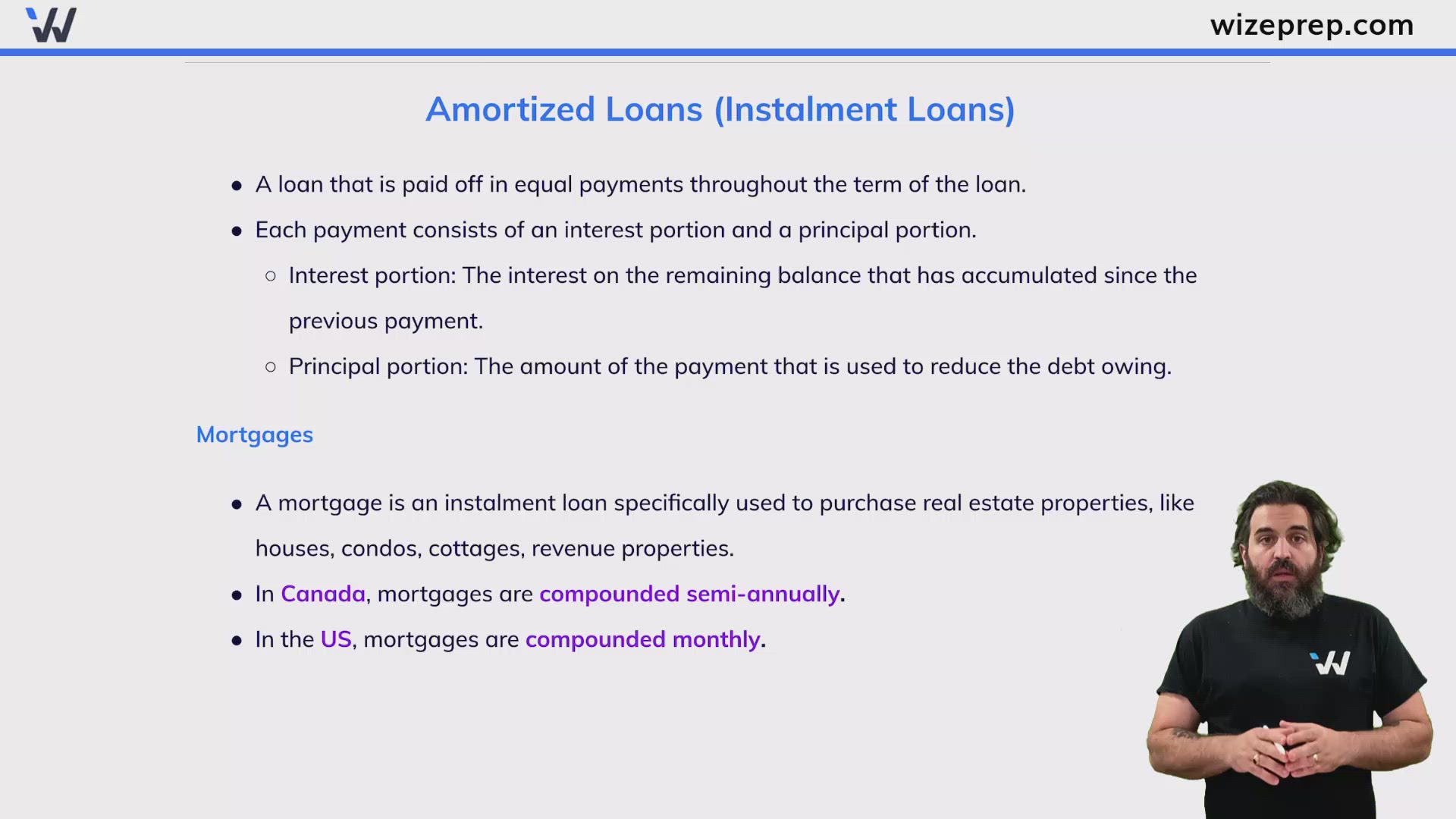
Amortized Loans (Instalment Loans)
- A loan that is paid off in equal payments throughout the term of the loan.
- Each payment consists of an interest portion and a principal portion.
- Interest portion: The interest on the remaining balance that has accumulated since the previous payment.
- Principal portion: The amount of the payment that is used to reduce the debt owing.
Mortgages
- A mortgage is an instalment loan specifically used to purchase real estate properties, like houses, condos, cottages, revenue properties.
- In Canada, mortgages are compounded semi-annually.
- In the US, mortgages are compounded monthly.
Interest and Principal
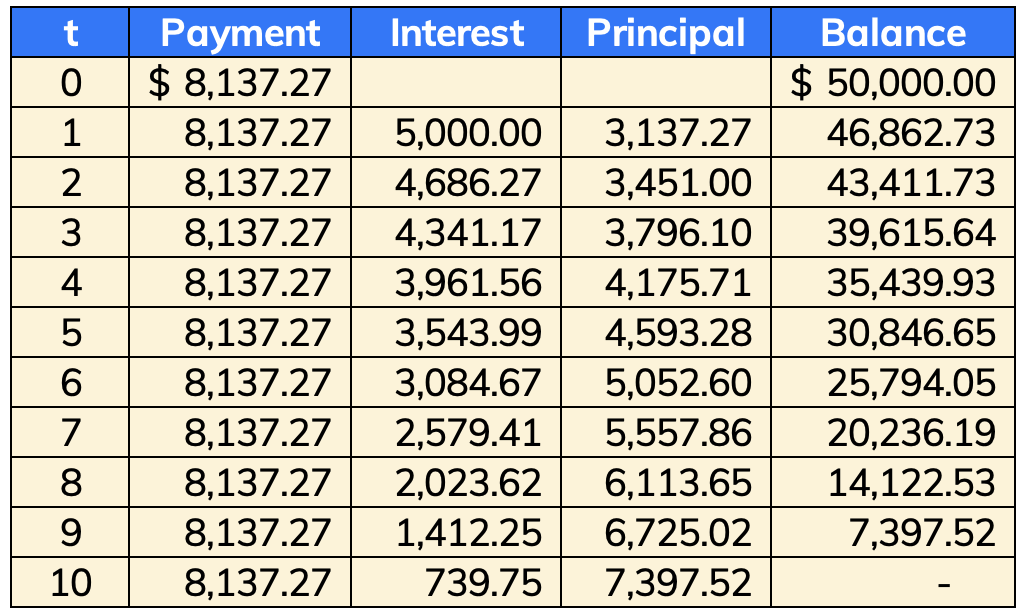
- The payment remains constant each period.
- The interest portion decreases with each payment because the remaining balance of the debt decreases.
- The principal portion increases with each payment because the payment is constant and interest decreases.
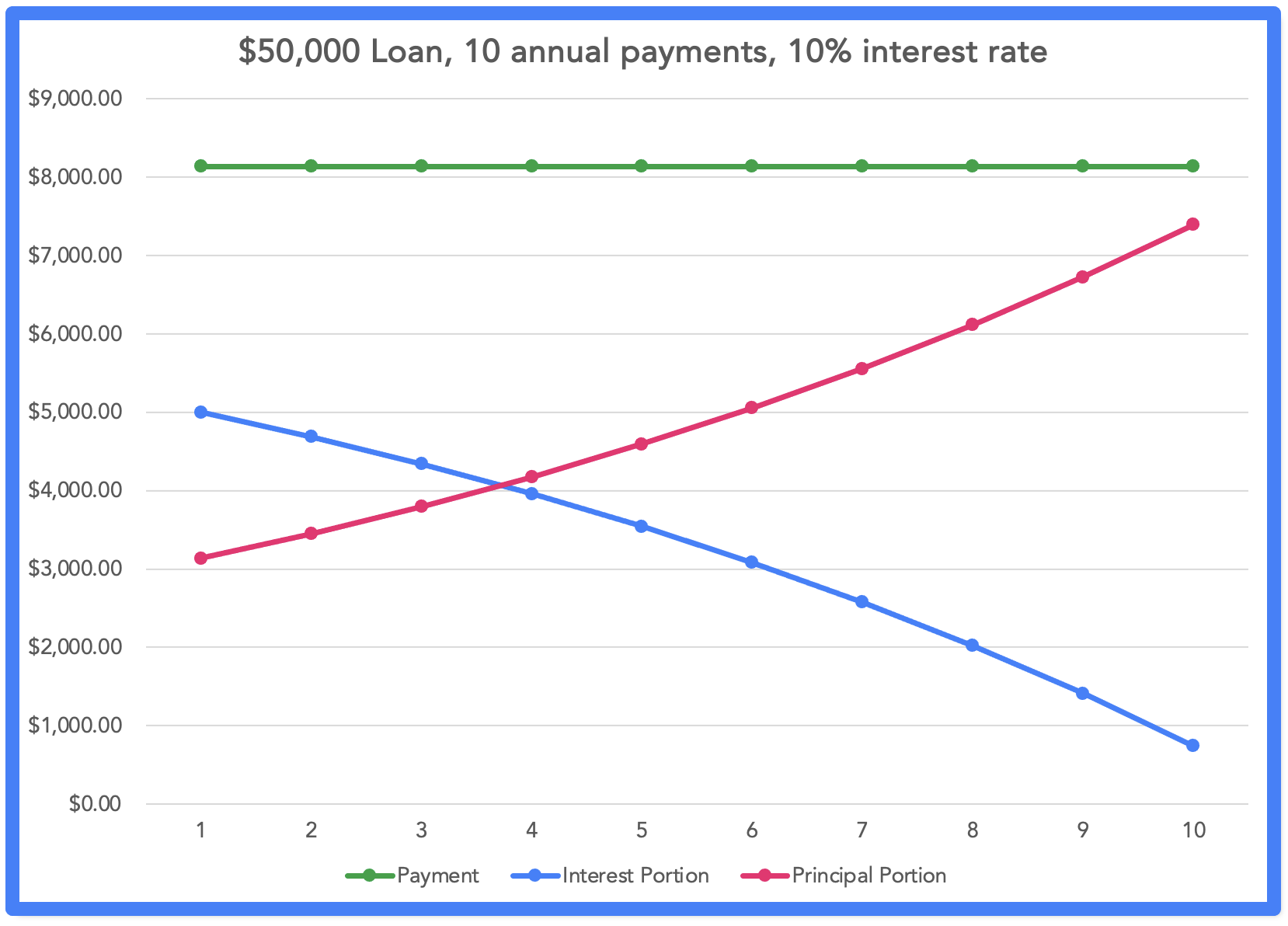
Amortization Schedule
0:00 / 0:00
Break-down of the Payment on an Instalment Loan
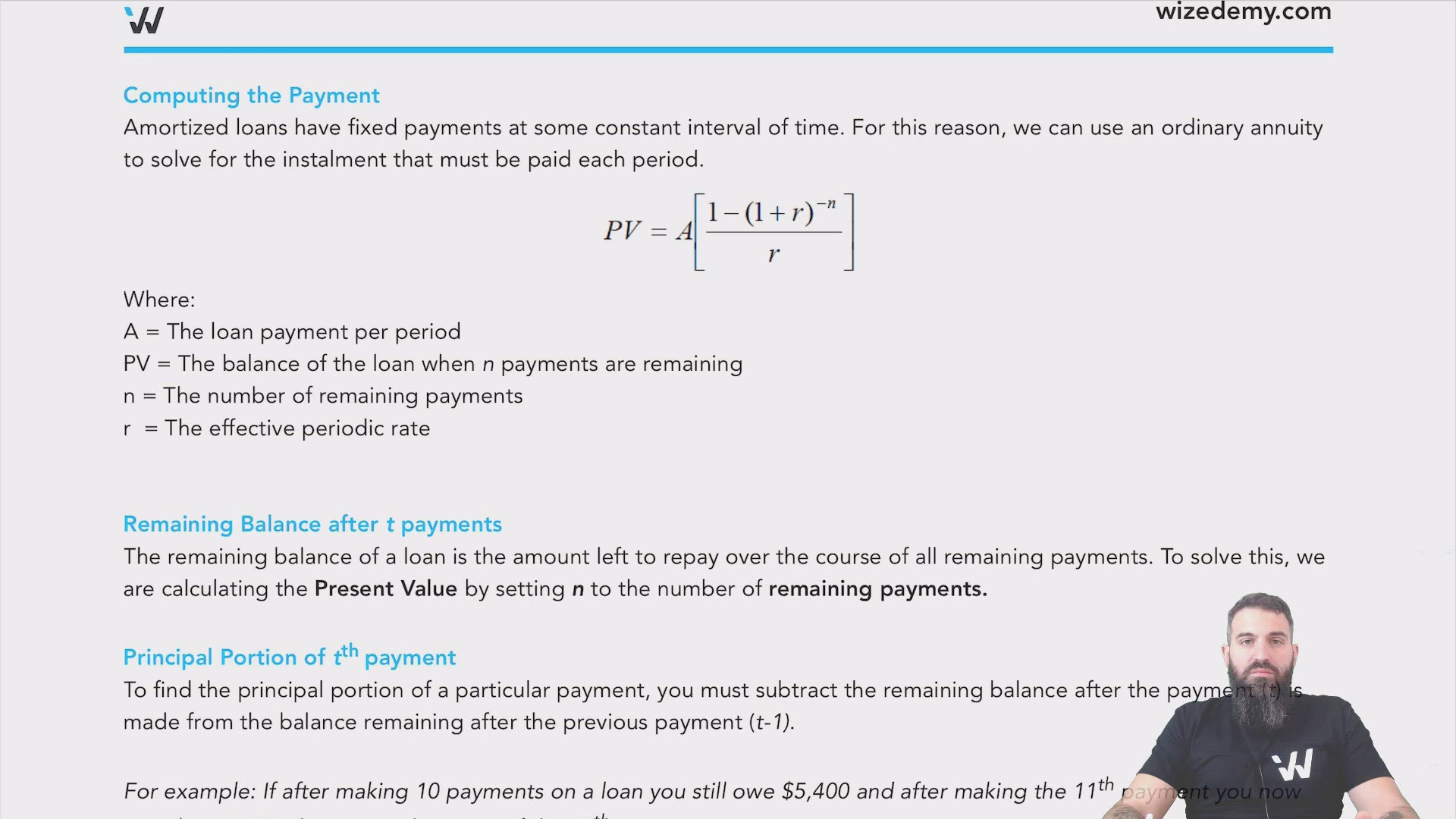
Amortized loans have fixed payments at some constant interval of time. For this reason, we can use an ordinary annuity to solve for the instalment that must be paid each period.
Calculating the Loan Payment
- The payment on an instalment loan is found using the ordinary annuity formula or a financial calculator.
- The effective rate used must match the frequency of the payment.
- For example, if a loan is paid monthly the rate must be an effective monthly rate.
Calculating the Interest Portion
- The interest portion of a loan payment is based on the remaining balance of the debt and the effective rate.
- It can be found by multiplying the balance by the effective rate, or by using your financial calculator's amortization function.

Calculating the Principal Portion
The principal portion is the difference between the loan payment and the interest portion.

Calculating the Remaining Balance
- The remaining balance is the amount that is still owed to the lender at a specific point in time.
- It is based on the effective rate, the number of remaining payments, and the payment.
- The balance is found using the present value of an annuity formula or a financial calculator, solving for the PV.
Using the Financial Calculator
- Financial calculators have an amortization function that can speed up finding these values
- Compute the payment on the loan, then in the amortization function enter the range of payments you wish to gather the information for.
- For example, if you'd like to know the interest portion of the 5th payment, simply enter into the calculator P1 = 5 and P2 = 5. The calculator understands this as a range.
0:00 / 0:00
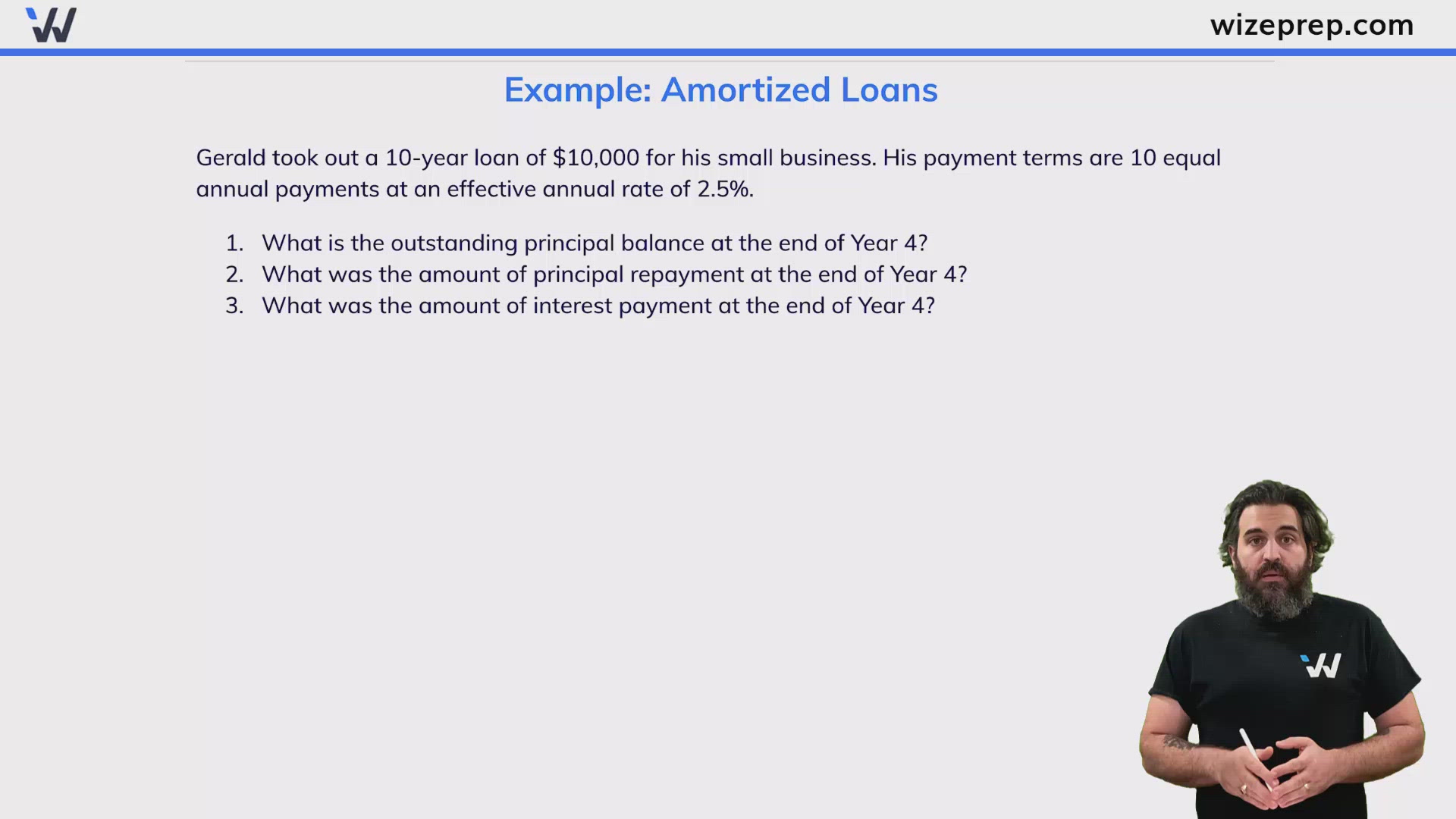
Example: Amortized Loans
Gerald took out a 10-year loan of $10,000 for his small business. His payment terms are 10 equal annual payments at an effective annual rate of 2.5%.
- What is the outstanding principal balance at the end of Year 4?
- What was the amount of principal repayment at the end of Year 4?
- What was the amount of interest payment at the end of Year 4?
Practice: Amortized Loan
You just borrowed $75,000 to renovate your apartment. The bank quoted a rate of 6.9% compounded monthly. You plan to make bi-weekly payments on the loan for 10 years to pay it off.
Round the effective rate to at least 6 decimal places and your final answers to 2 decimal places.
0:00 / 0:00
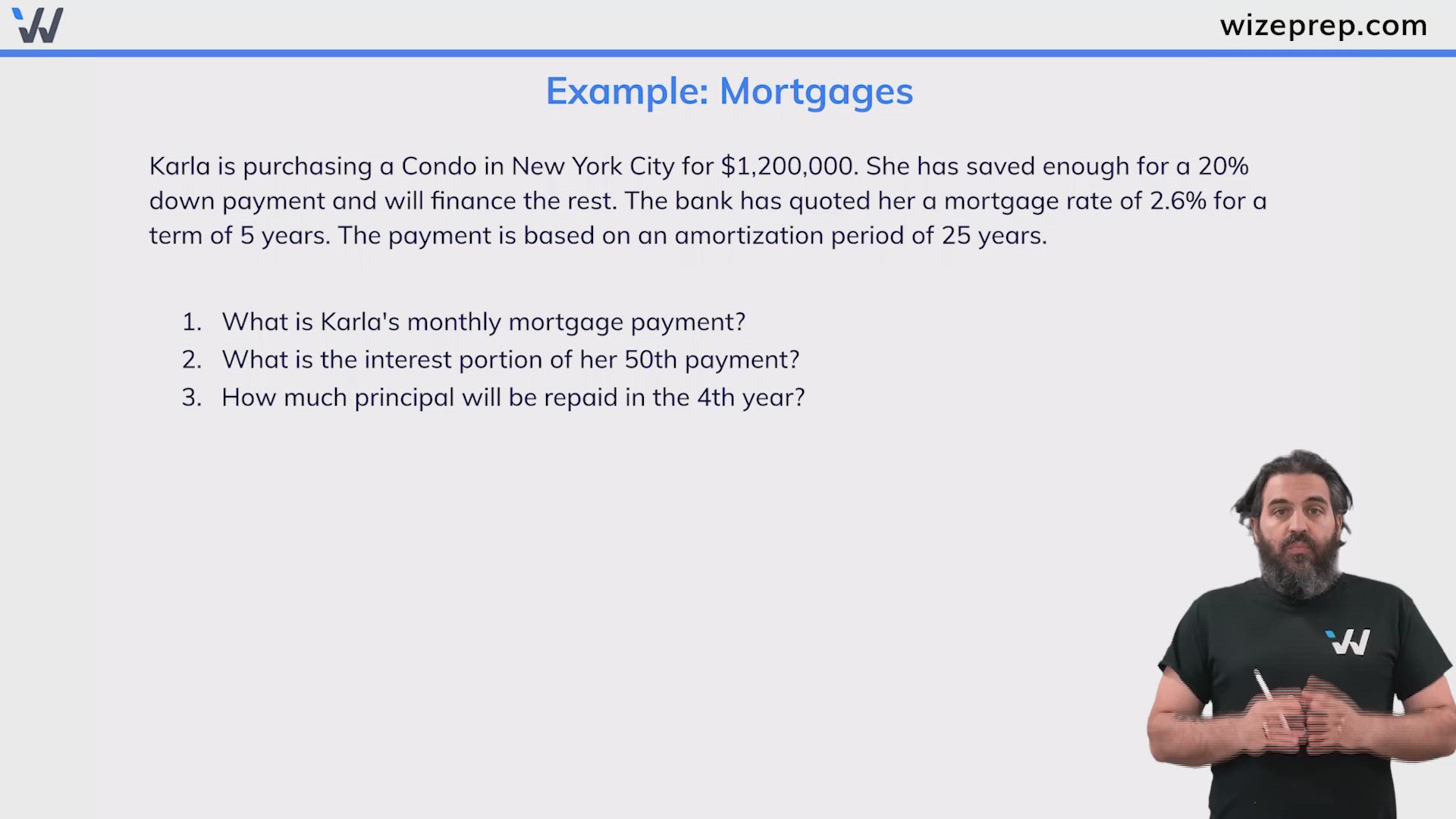
Example: Mortgages
Karla is purchasing a Condo in New York City for $1,200,000. She has saved enough for a 20% down payment and will finance the rest. The bank has quoted her a mortgage rate of 2.6% for a term of 5 years. The payment is based on an amortization period of 25 years.
- What is Karla's monthly mortgage payment?
- What is the interest portion of her 50th payment?
- How much principal will be repaid in the 4th year?
Practice: Mortgages
Steve is purchasing a cottage in Mont Tremblant, Canada. The price of the cottage is $1,000,000, and he has $250,000 in cash for a down payment. The term of the mortgage is 4 years, 2.99% interest. The amortization period is 30 years.
Round the effective rate to at least 6 decimal places and your final answers to 2 decimal places.
What is Steve's monthly mortgage payment?