Wize University Introduction to Finance Textbook > CAPM
Risk-Free Investing
Popular Courses
COMM 308
Concordia University
Intro to Finance
University Study Guides
Intro to Finance
University Study Guides
FINA 230
Concordia University
MGCR 341
McGill University
FIN 301
University of Alberta
FIN 300
Toronto Metropolitan University
COMM 121
Queen's University
FIN*2000
University of Guelph
FINC 341
Texas A&M University
COMM 2202
Dalhousie University
BU283
Wilfrid Laurier University
FIN 300
Arizona State University - Tempe
BUSFIN 3220
Ohio State University
SB/FINE 2000 3.00
York University
FIN 301
Pennsylvania State University
BUS-F 255
Indiana University - Bloomington
FIN 3403
University of Central Florida
FIN 3403
University of Florida
FIN 320
California State University - Fullerton
0:00 / 0:00
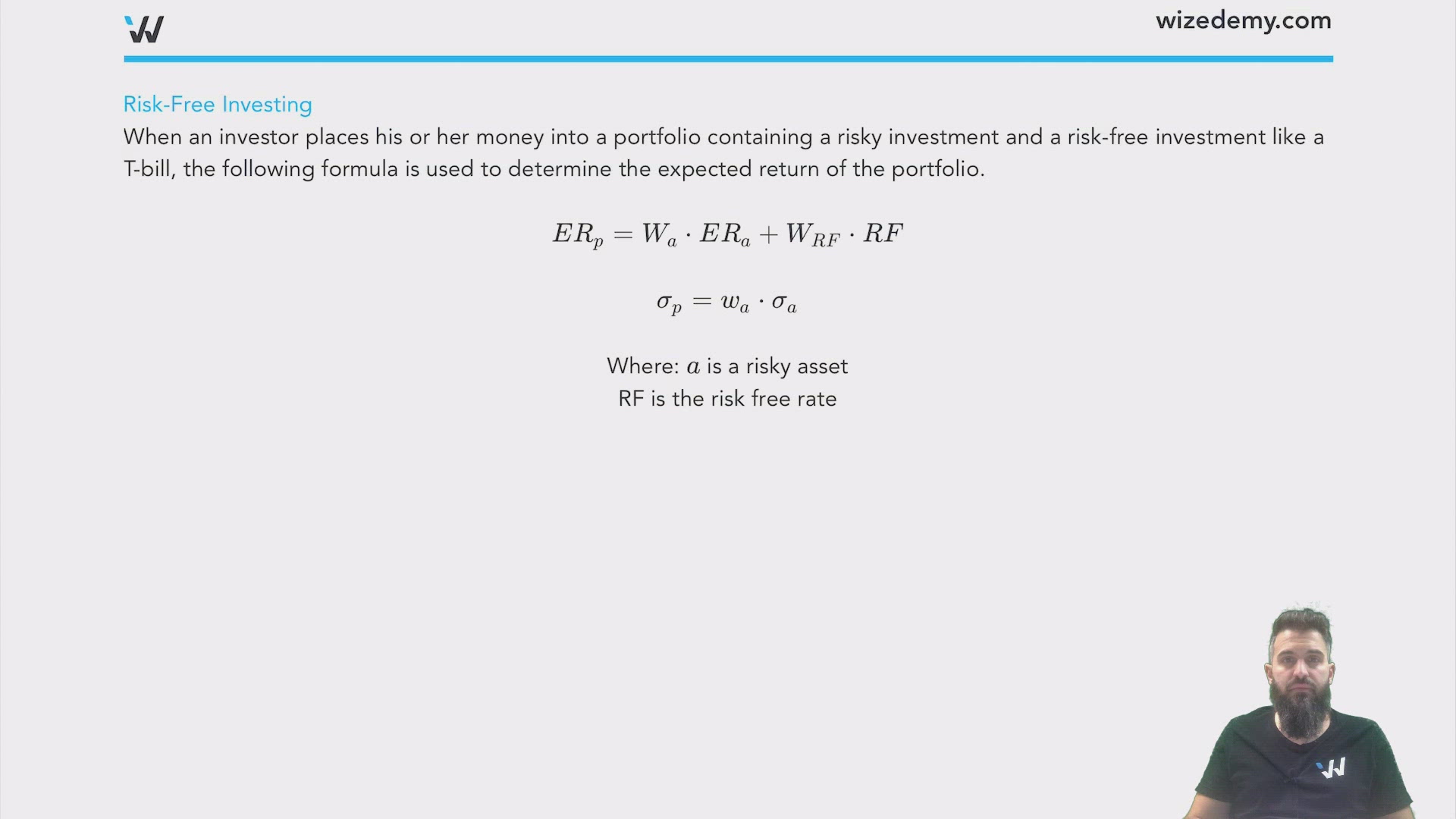
Risk-Free Investing
When an investor places his or her money into a portfolio containing a risky investment and a risk-free investment like a T-bill, the following formula is used to determine the expected return of the portfolio.


Formula Breakdown:
: a risky asset
RF: the risk-free rate
0:00 / 0:00
Example: Risk-Free Investing
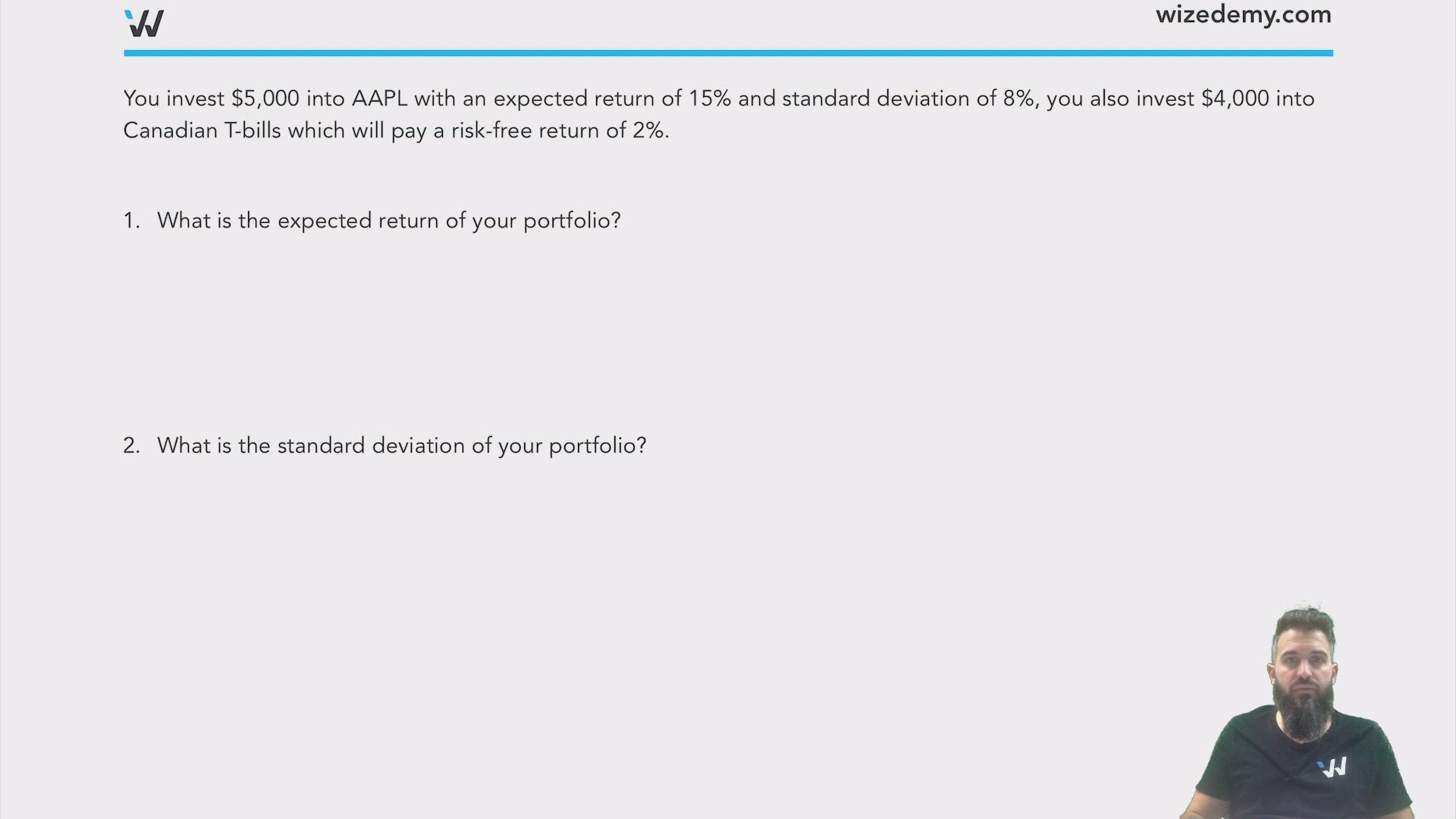
You invest $5,000 into AAPL with an expected return of 15% and standard deviation of 8%, you also invest $4,000 into Canadian T-bills which will pay a risk-free return of 2%.
- What is the expected return of your portfolio?
- What is the standard deviation of your portfolio?
Practice: Risk-Free Investing
You plan to invest part of your portfolio in stock of Netflix (NFLX) but want to limit your risk by also investing in T-bills. Knowing the expected return and standard deviation of NFLX are 25% and 19% respectively, what fraction of your money should you invest in T-bills so that your portfolio standard deviation is 7%?
Enter your answer in decimal format and rounded to 4 decimal places.