0:00 / 0:00

Cross Product

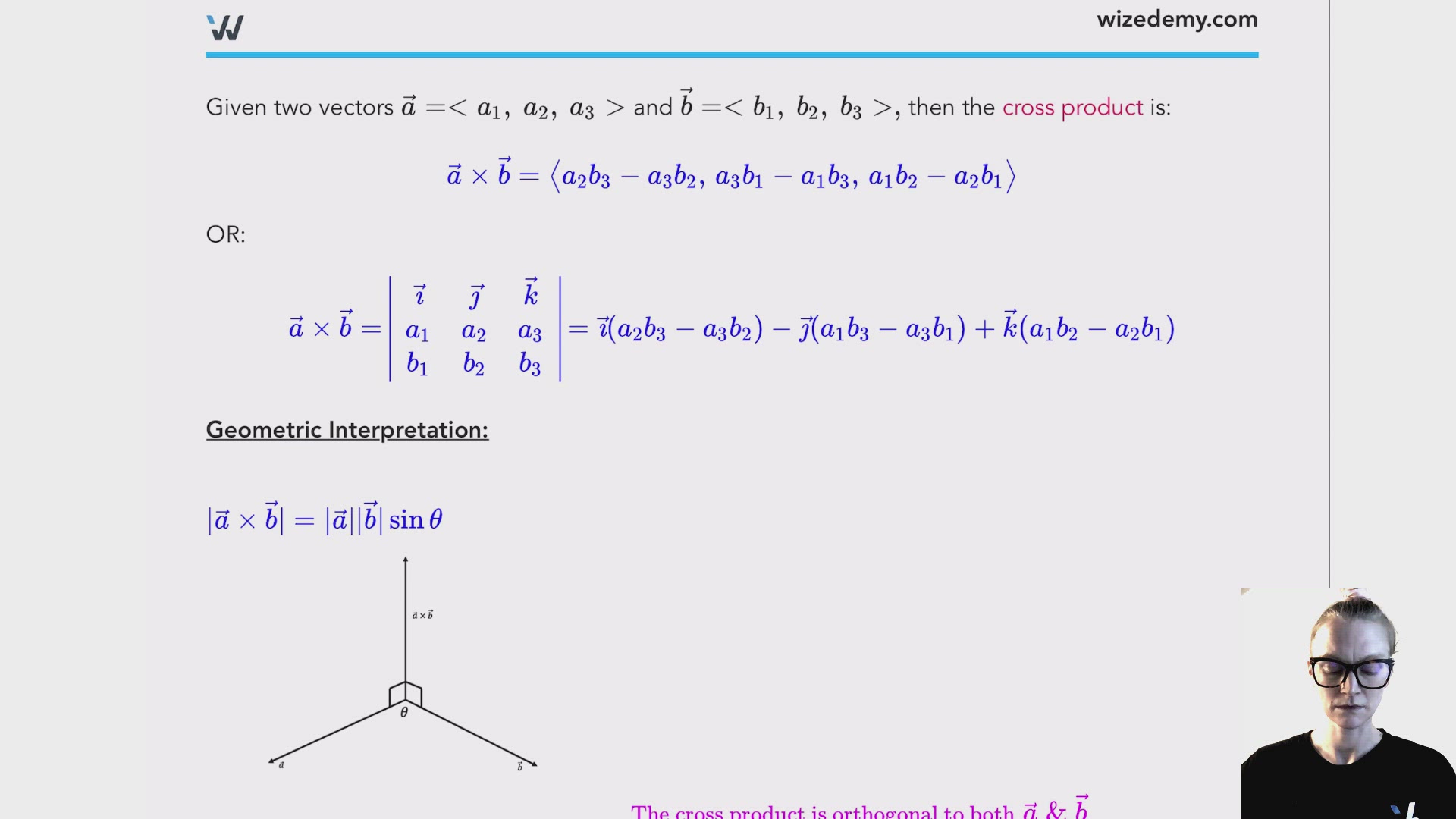
Given two vectors a⃗=<a1, a2, a3> \vec{a}=<a_1,~a_2,~a_3>~and b⃗=<b1, b2, b3>,\vec{b}=<b_1,~b_2,~b_3>, then the cross product is:
a⃗×b⃗=<a2b3−a3b2, a3b1−a1b3, a1b2−a2b1>\vec a\times\vec b=\rowvecth{a_2b_3 - a_3b_2}{a_3b_1-a_1b_3}{a_1b_2-a_2b_1}
OR:
a⃗×b⃗=ı⃗ȷ⃗k⃗a1a2a3b1b2b3=ı⃗(a2b3−a3b2)−ȷ⃗(a1b3−a3b1)+k⃗(a1b2−a2b1)\vec a\times\vec b=\begin{array}{|ccc|} \vec\imath &\vec\jmath&\vec k\\ a_1 & a_2 & a_3\\ b_1 & b_2 & b_3 \end{array}=\vec\imath(a_2b_3-a_3b_2)-\vec\jmath(a_1b_3-a_3b_1)+\vec k(a_1b_2-a_2b_1)

Geometric Interpretation:

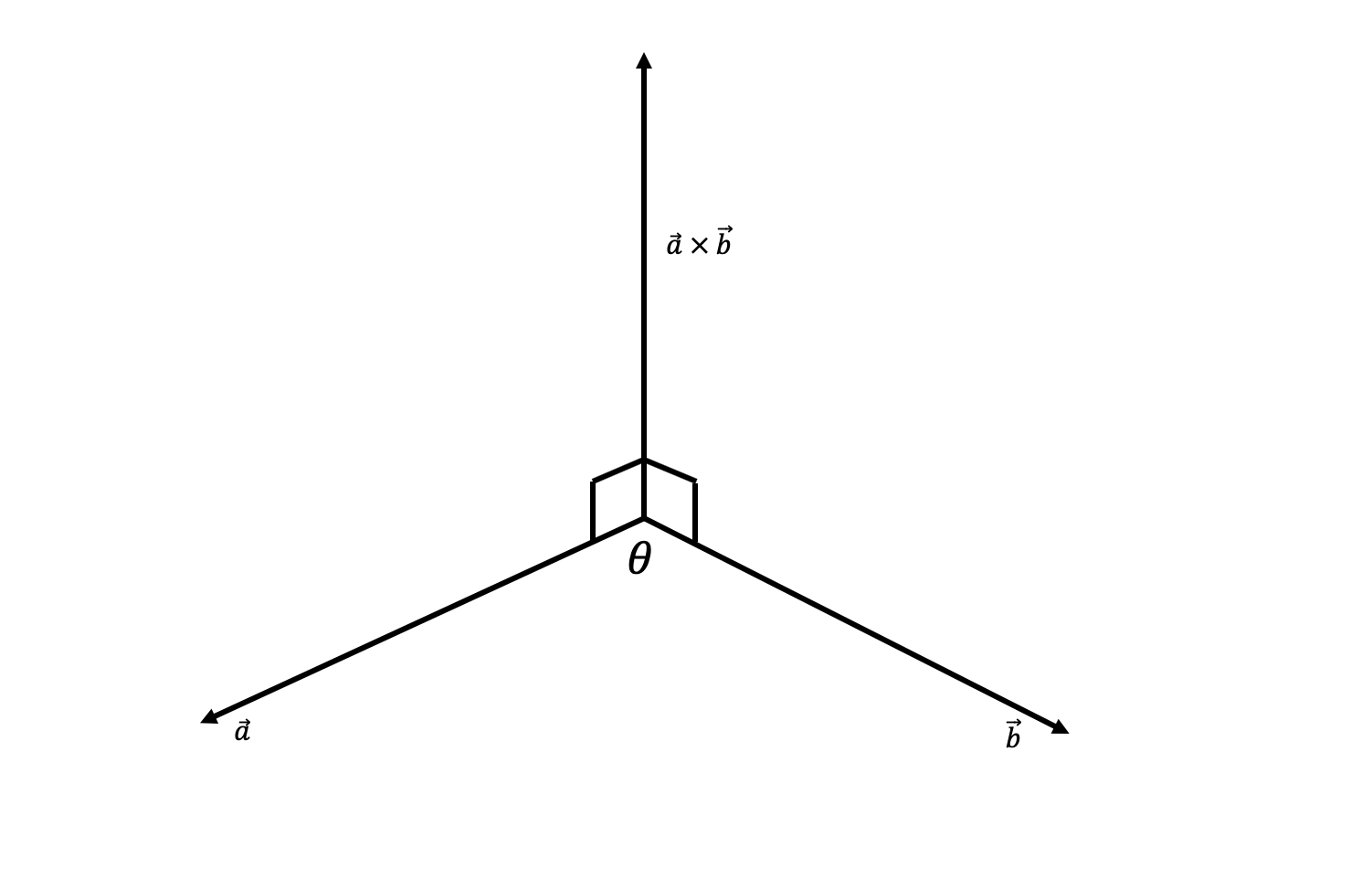
∣∣a⃗×b⃗∣∣=∣∣a⃗∣∣⋅∣∣b⃗∣∣sin⁡θ||\vec a\times\vec b||=||\vec a||\cdot||\vec b||\sin\theta
The cross product is orthogonal to both a⃗ & b⃗\color{magenta}\text{\footnotesize{The cross product is orthogonal to both}}~\vec{a}~\&~\vec{b}

Wize Concept
If a⃗×b⃗=0⃗, \vec{a}\times\vec{b}=\vec{0},~then a⃗ & b⃗ \vec{a}~\&~\vec{b}~will be parallel to each other

If a⃗×b⃗≠0⃗, \vec{a}\times\vec{b}\neq\vec{0},~then a⃗ × b⃗ \vec{a}~\times~\vec{b}~is orthogonal to both a⃗\vec{a} and b⃗\vec{b}


Given a parallelepiped (shown below), then:
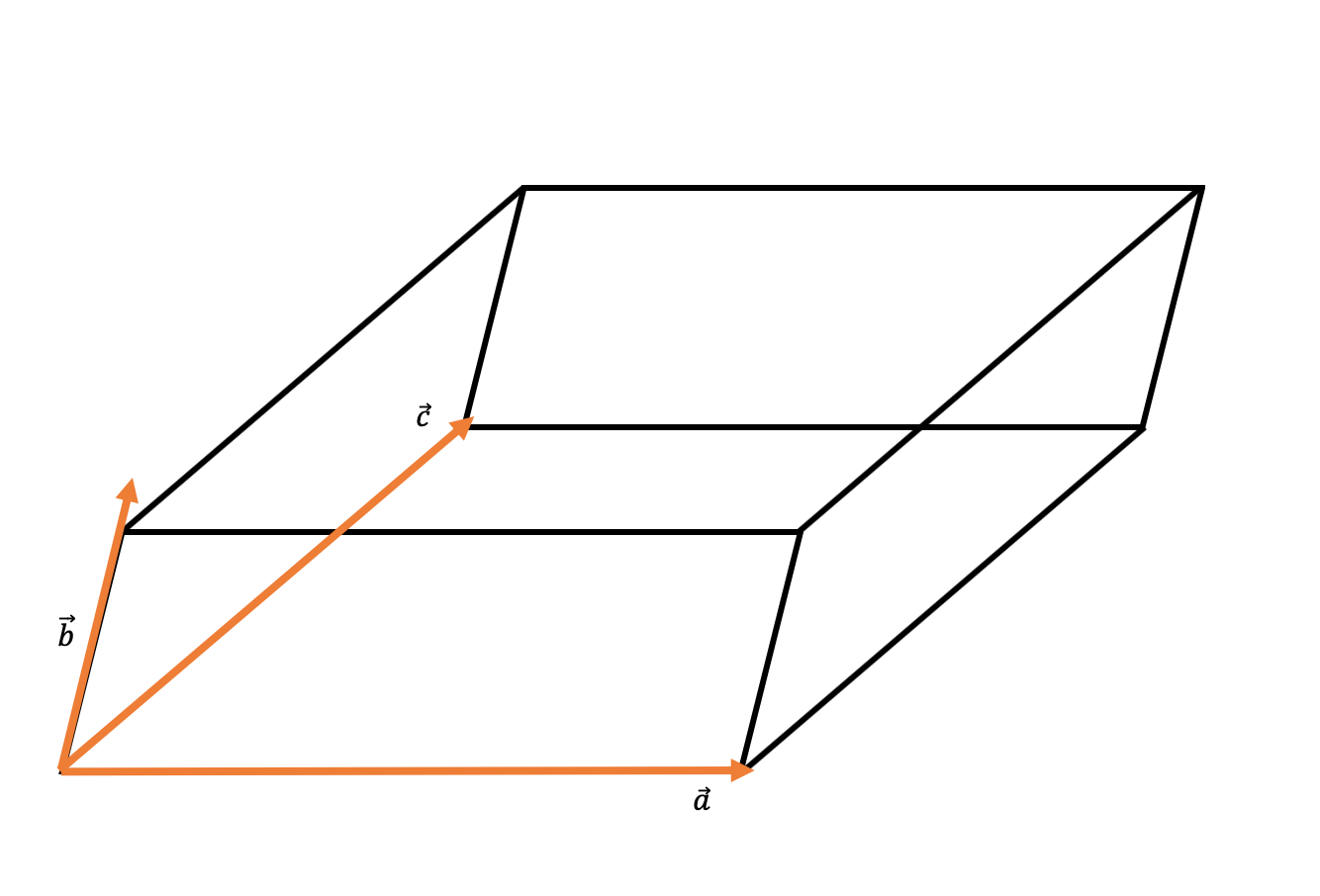
The area of a parallelogram formed by a⃗\vec a, b⃗\vec b is equal to:
A=∣a⃗×b⃗∣\color{blue}A=|\vec a\times\vec b|
The volume of a parallelepiped formed by a⃗, b⃗ \vec{a},~\vec{b}~is equal to:
V=∣a⃗⋅(b⃗×c⃗)∣\color{blue}V=|\vec{a}\cdot(\vec{b}\times\vec{c})|

Wize Tip
You can use the volume formula to determine if 3 vectors lie in the same plane or not. If V = 0, then they lie in the same plane.

0:00 / 0:00

Example

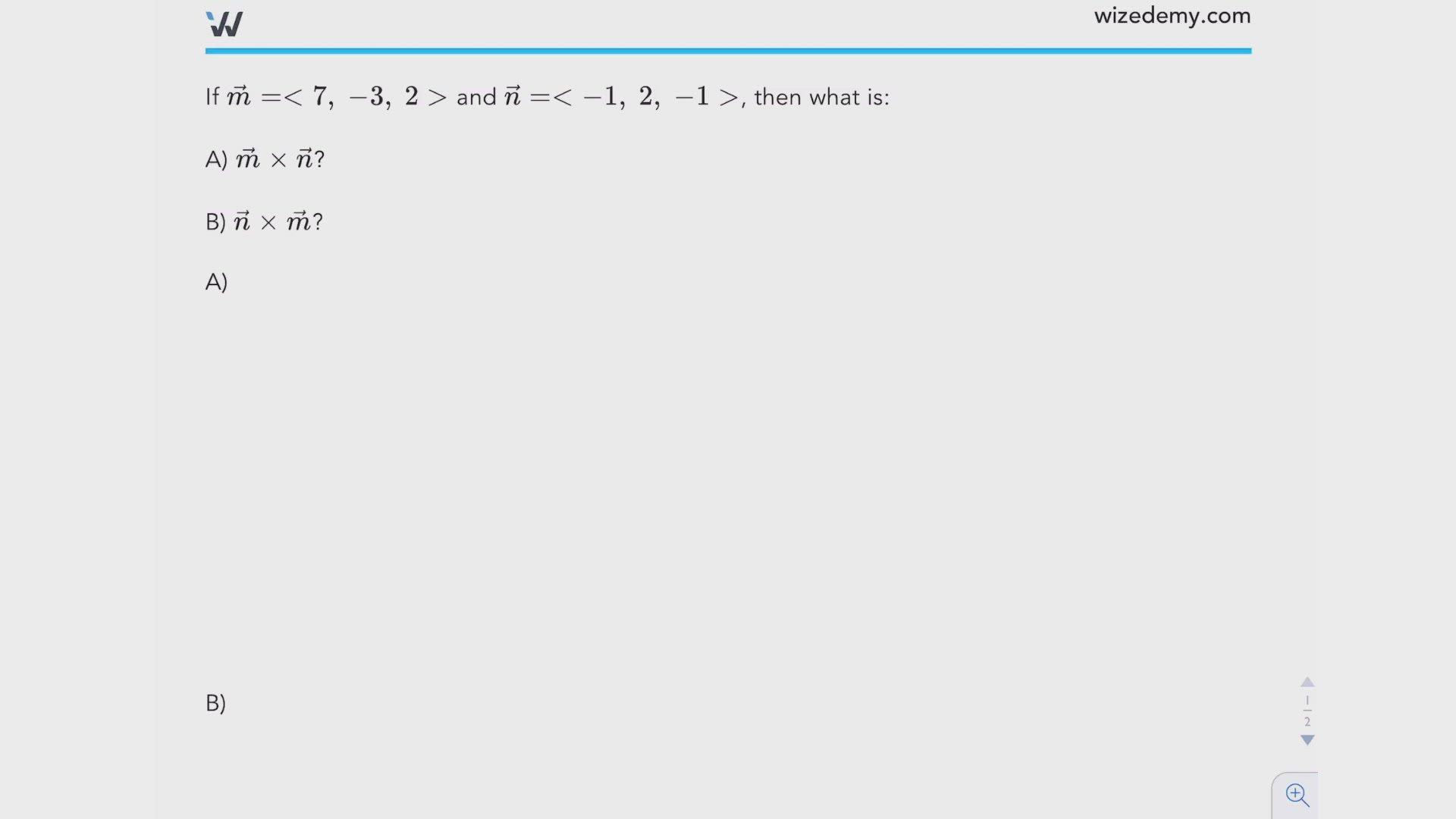
If m⃗=<7, −3, 2> \vec{m}=<7,~-3,~2>~and n⃗=<−1, 2, −1>\vec{n}=<-1,~2,~-1>, then what is:

A) m⃗×n⃗\vec{m}\times\vec{n}?

B) n⃗×m⃗\vec{n}\times\vec{m}?

A)
To find m⃗×n⃗\vec{m}\times\vec{n}, we can use the discriminant.
m⃗×n⃗=i⃗j⃗k⃗m1m2m3n1n2n3=i⃗j⃗k⃗7−32−12−1\vec{m}\times\vec{n}=\begin{array}{|ccc|} \vec{i} &\vec{j}&\vec{k}\\ m_1 & m_2 & m_3\\ n_1 & n_2 & n_3 \end{array}=\begin{array}{|ccc|} \vec{i} &\vec{j}&\vec{k}\\ 7 & -3 & 2\\ -1 & 2 & -1 \end{array}

m⃗×n⃗=i⃗(3−4)−j⃗(−7+2)+k⃗(14−3)m⃗×n⃗=−i⃗+5j⃗+11k⃗\begin{array}{rcl} \vec{m}\times\vec{n}&=&\vec{i}(3-4)-\vec{j}(-7+2)+\vec{k}(14-3)\\\\ \vec{m}\times\vec{n}&=&-\vec{i}+5\vec{j}+11\vec{k} \end{array}

B)
To find n⃗×m⃗\vec{n}\times\vec{m}, we can use the discriminant.
n⃗×m⃗=i⃗j⃗k⃗n1n2n3m1m2m3=i⃗j⃗k⃗−12−17−32\vec{n}\times\vec{m}=\begin{array}{|ccc|} \vec{i} &\vec{j}&\vec{k}\\ n_1 & n_2 & n_3\\ m_1 & m_2 & m_3 \end{array}=\begin{array}{|ccc|} \vec{i} &\vec{j}&\vec{k}\\ -1 & 2 & -1\\ 7 & -3 & 2 \end{array}

n⃗×n⃗=i⃗(4−3)−j⃗(−2+7)+k⃗(3−14)n⃗×m⃗=i⃗−5j⃗−11k⃗\begin{array}{rcl} \vec{n}\times\vec{n}&=&\vec{i}(4-3)-\vec{j}(-2+7)+\vec{k}(3-14) \\\\ \vec{n}\times\vec{m}&=&\vec{i}-5\vec{j}-11\vec{k} \end{array}

Note: m⃗×n⃗=−n⃗×m⃗\color{magenta}\text{Note:}~\vec{m}\times\vec{n}=-\vec{n}\times\vec{m}

Practice

Do the vectors u⃗= <3, −1, 4>, v⃗= <6, 0, 1>, and w⃗= <−1, 2, 5> \vec{u}=~<3,~-1,~4>,~\vec{v}=~<6,~0,~1>,~\text{and}~\vec{w}=~<-1,~2,~5>~lie in the same plane?

Practice

Let X=(0, 0, 0), Y=(1, 1, 0), & Z=(0, 1, 1).X=(0,~0,~0),~Y=(1,~1,~0),~\&~Z=(0,~1,~1).

What is the area of the triangle XYZ?