0:00 / 0:00

Equations of Lines

In R2\colorOne{\mathbb{R}^2}

  • Slope - Point Form:
  • y=m(xx1)+y1y=m(x-x_1)+y_1
  • m=slope\color{magenta}\text{m}=\text{slope}
  • Pt=(x1,y1)\color{magenta}\text{Pt}=(x_1,y_1)
  • Slope - Intercept Form:
  • y=mx+by=mx+b
  • m=slope\color{magenta}\text{m}=\text{slope}
  • b=y-intercept\color{magenta}\text{b}=\text{y-intercept}

We need the slope (m) and either the y - int. or a point to determine equation of line in R2\mathbb{R}^2.

In R3\colorOne{\mathbb{R}^3}

The line y=mx+by=mx+b represents a plane when z=0z=0 in R3\mathbb{R}^3.

In R3\mathbb{R}^3, to find the equation of the line, we need a point on the line but we also need a "slope" and the equation of the line will be as a vector function.

PAGE BREAK

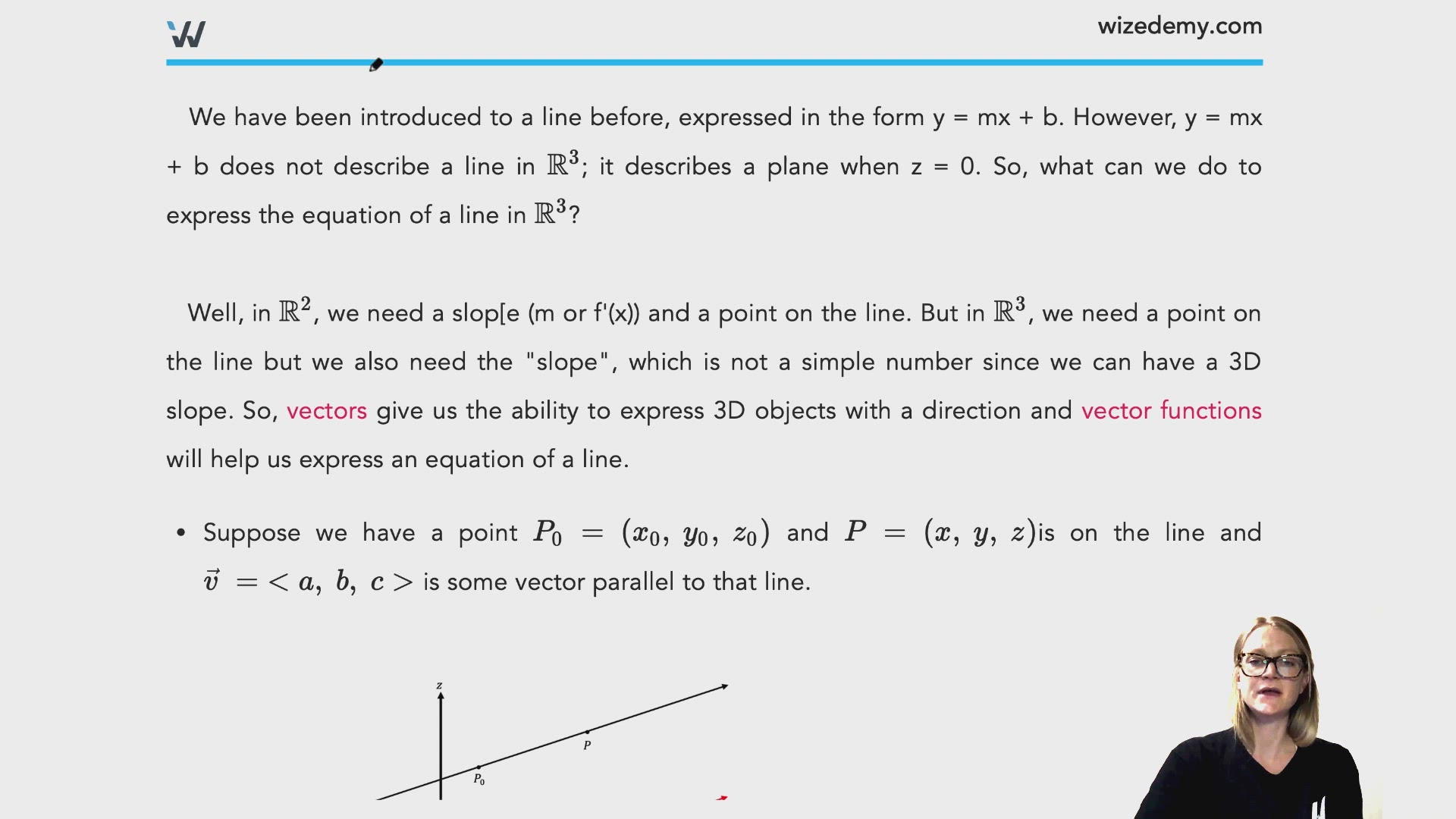
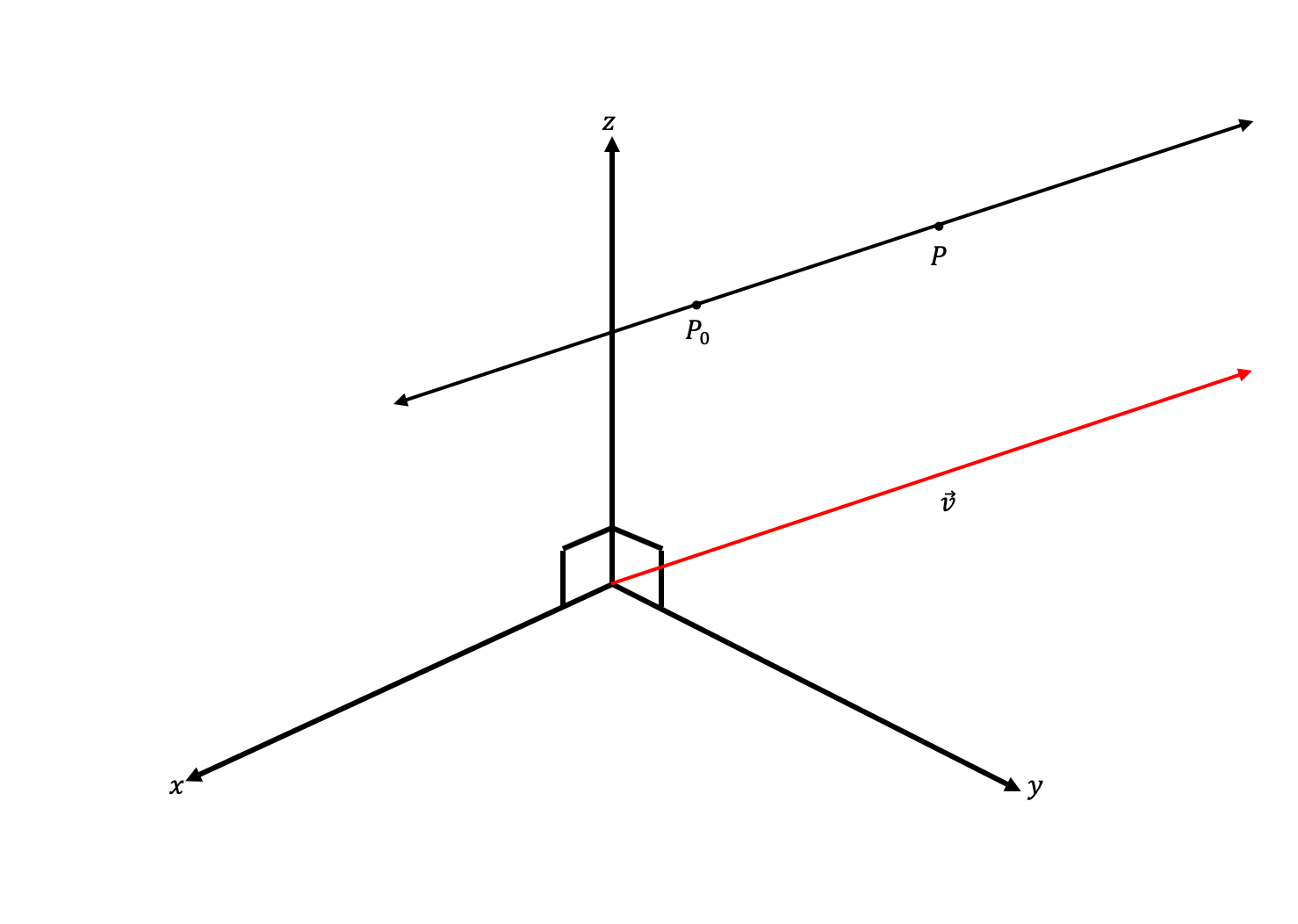
Suppose we have a point P0 = (x0, y0, z0)P_0~=~(x_0,~y_0,~z_0) and P = (x, y, z)P~=~(x,~y,~z) and they are both on the line and v = <a, b, c> \vec{v}~=~<a,~b,~c>~is some vector parallel to that line.

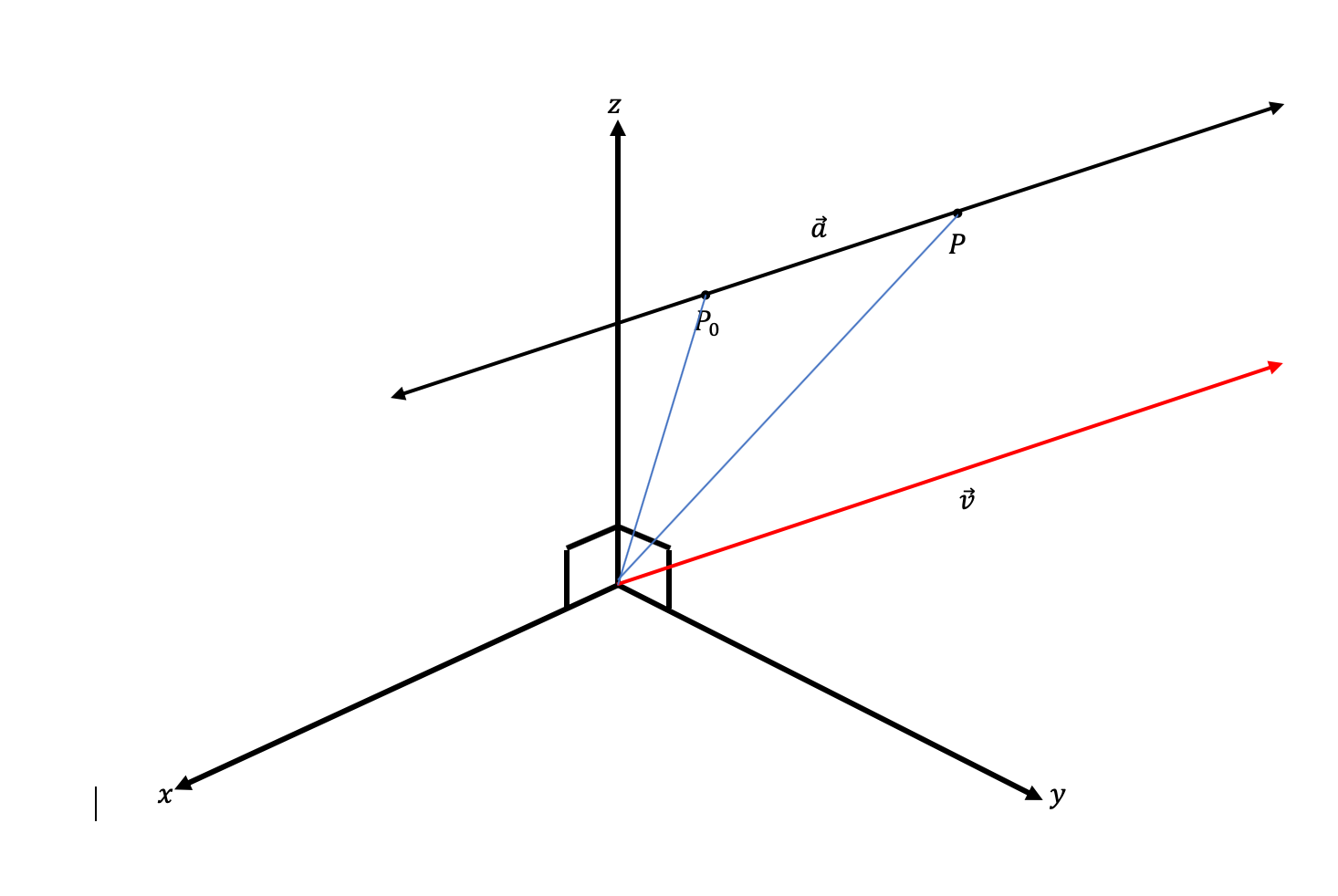
We can see that P0 & P P_0 ~\&~P~can be drawn as position vectors.
If both P0 & P \vec{P_0}~\&~\vec{P}~are position vectors, then we can find a vector a = P0P \vec{a}~=~\vec{P_0P}~ that is parallel to v \vec{v}~ (i.e. a = tv;  tR\vec{a}~=~t\vec{v}; ~~t\in\mathbb{R})
  • Let r0 = P0\vec{r_0}~=~\vec{P_0}
  • Let r = P\vec{r}~=~\vec{P}
  • Let a = tv;  tR\vec{a}~=~t\vec{v}; ~~t\in\mathbb{R}
Vector parametric equation of line LL passing through point P0(x0,y0,z0)P_0(x_0,y_0,z_0) and parallel to vector v=<a,b,c>\vec v=\rowvecth{a}{b}{c} is equal to:
r = r0+tvr=<x0, y0, z0>+t<a, b, c>\vec{r}~=~\vec{r_0}+t\vec{v} \newline \vec{r}=<x_0,~y_0,~z_0>+t<a,~b,~c>
Parametric Form
{x=x0+tay=y0+tbz=z0+tc\begin{cases} x=x_0+ta\\ y=y_0+tb\\ z=z_0+tc \end{cases}
Symmetric Form:
xx0a=yy0b=zz0c\frac{x-x_0}{a}=\frac{y-y_0}{b}=\frac{z-z_0}{c}

0:00 / 0:00

Example

Find the equation of the line, in vector, parametric, and symmetric form, that passes through the points A = (1, 4, 1) A~=~(1,~4,~-1)~and B = (2, 3, 1)B~=~(2,~-3,~1).

First, let's find a vector v \vec{v}~such that a=tv \vec{a}=t\vec{v}~
v=AB = <21, 34, 1(1)>v = <1, 7, 2>\vec{v}=\vec{AB}~=~<2-1,~-3-4,~1-(-1)> \newline \vec{v}~=~<1,~-7,~2>
Vector Form:

<x, y, z> = <x0, y0, z0> + tv<x,~y,~z>~=~<x_0,~y_0,~z_0>~+~t\vec{v}
<x, y, z>=<x0, y0, z0> + tvr=<1, 4, 1> + t<1, 7, 2>\begin{array}{rcl} <x,~y,~z>&=&<x_0,~y_0,~z_0>~+~t\vec{v} \\\\ \vec{r}&=&<1,~4,~-1>~+~t<1,~-7,~2> \end{array}
Parametric Form:

x = x0+at; y = y0+bt; z = z0+ctx~=~x_0+at;~y~=~y_0+bt;~z~=~z_0+ct \color{teal}
{x=1+ty=47tz=1+2t\qquad\left\{ \begin{array}{rcl} x&=&1+t\\ y&=&4-7t\\ z&=&-1+2t \end{array} \right.

Symmetric Form:

Solve for all values of ’t’ in the parametric form and then set all values of ’t’ equal to each other\color{magenta}\text{\footnotesize{Solve for all values of 't' in the parametric form and then set all values of 't' equal to each other}}
x=1+t          t=x1y=47t          t=4y7z=1+2t          t=z+12x=1+t~~~~~{\color{red}{\rightarrow}}~~~~~t=x-1 \newline y=4-7t~~~~~{\color{red}{\rightarrow}}~~~~~t=\frac{4-y}{7} \newline z=-1+2t~~~~~{\color{red}{\rightarrow}}~~~~~t=\frac{z+1}{2}

0:00 / 0:00

Example

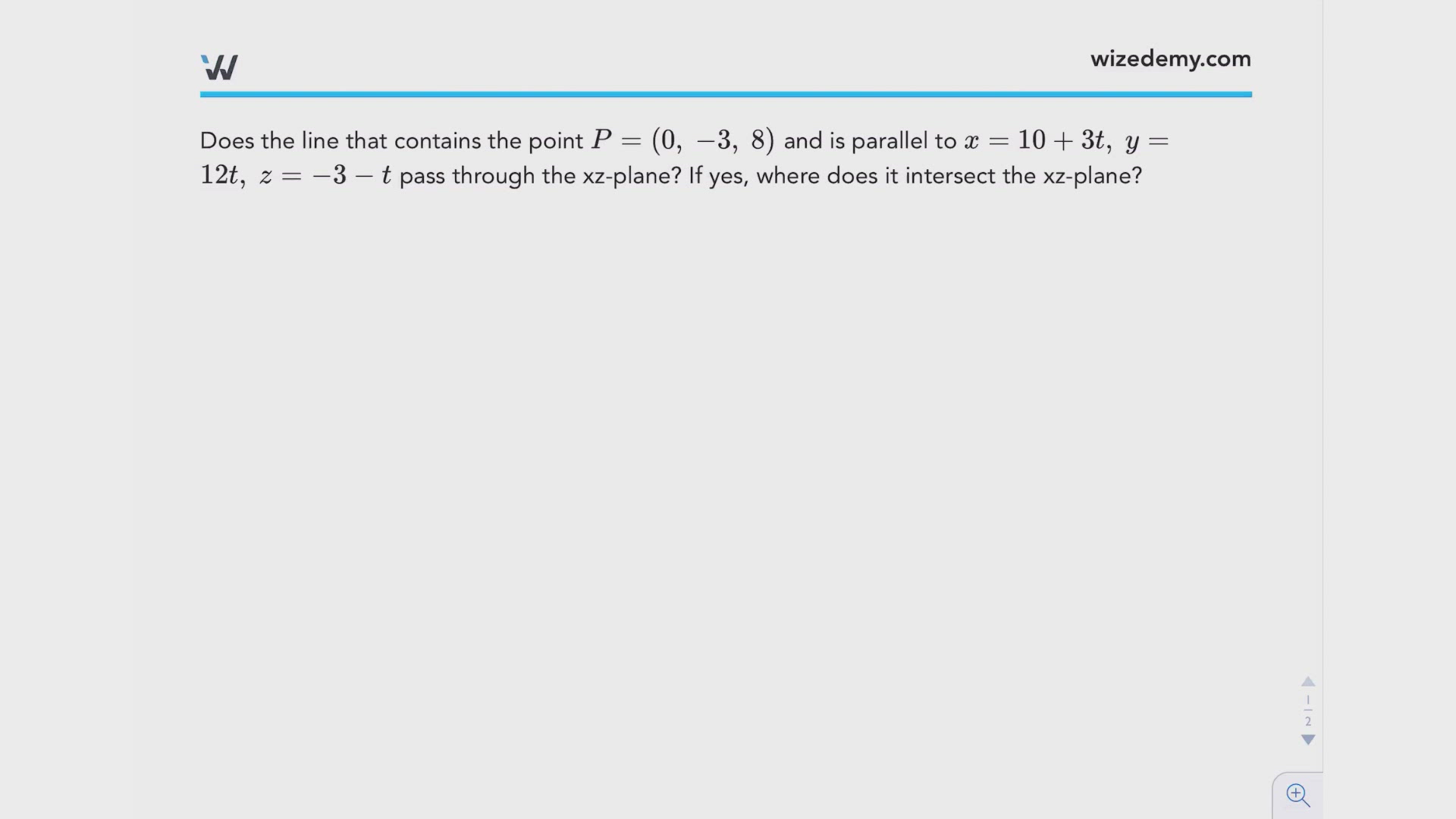
Does the line that contains the point P=(0, 3, 8) P=(0,~-3,~8)~ and is parallel to

x=10+3ty=12tz=3t \begin{array}{rcl} x&=&10+3t\\ y&=&12t\\ z&=&-3-t~ \end{array}

pass through the xz-plane?

If yes, where does it intersect the xz-plane?

Step 1:


Let's find the parallel line in vector form:
v= <10, 0, 3>+t<3, 12, 1>\vec{v}=~<10,~0,~-3>+t<3,~12,~-1>

Let a \vec{a}~be parallel to v \vec{v}~.

Therefore, a= <3, 12, 1>\color{magenta}{\vec{a}=~<3,~12,~-1>} and we have a point P=(0, 3, 8) \color{magenta}{P=(0,~-3,~8)}~ so the equation of the line parallel to v \vec{v}~is:
r= <0, 3, 8>+t<3, 12, 1>\vec{r}=~<0,~-3,~8>+t<3,~12,~-1>

Step 2:


Now, if this line passes through the xz-plane, then y=0y=0.

The parametric form will provide y:
y=y0+bt0=3+12tt=14y=y_0+bt \newline 0=-3+12t \newline t=\frac{1}{4}
So, the line will pass through the xz-plane at:
r= <0, 3, 8>+t<3, 12, 1>r=<0, 3, 8>+14<3, 12, 1>r=<0, 3, 8>+<34, 3, 14>r=<34, 0, 314>\begin{array}{rcl} \vec{r}&=&~<0,~-3,~8>+t<3,~12,~-1> \\\\ \vec{r}&=&<0,~-3,~8>+\frac{1}{4}\cdot<3,~12,~-1> \\\\ \vec{r}&=&<0,~-3,~8>+<\frac{3}{4},~3,~\frac{-1}{4}> \\\\ \vec{r}&=&<\frac{3}{4},~0,~\frac{31}{4}> \end{array}

Therefore, the line will intersect the xz-plane at the point.

Practice

Is the line through the points A=(5,1,3)A=(5, 1, -3) and B=(1,0,6)B=(1,0,6) parallel, orthogonal, or neither to the line r(t)= <1,4,2>+ t<3, 1, 9>\vec{r(t)}=~<1,4,2>+~t<3,~-1,~9>?