Wize University Calculus 3 Textbook > Vectors & Geometry of Space
Equation of Planes
Popular Courses
MATH 200
University of British Columbia
MATH 253
University of British Columbia
MATH 222
McGill University
MATH 262
McGill University
SC/MATH 2015 3.00
York University
MAT 2322
University of Ottawa
MATH 237
University of Waterloo
MAT235Y1
University of Toronto
MAT 2384
University of Ottawa
MATH 200
University of Victoria
MATH 251
Simon Fraser University
MATH 20C
University of California - San Diego
MAT237Y1
University of Toronto
MAT 2122
University of Ottawa
MATH 2214
Virginia Tech
MATH 10C
University of California - San Diego
SC/MATH 2310 3.00
York University
MATH 20E
University of California - San Diego
0:00 / 0:00
Equations of Planes
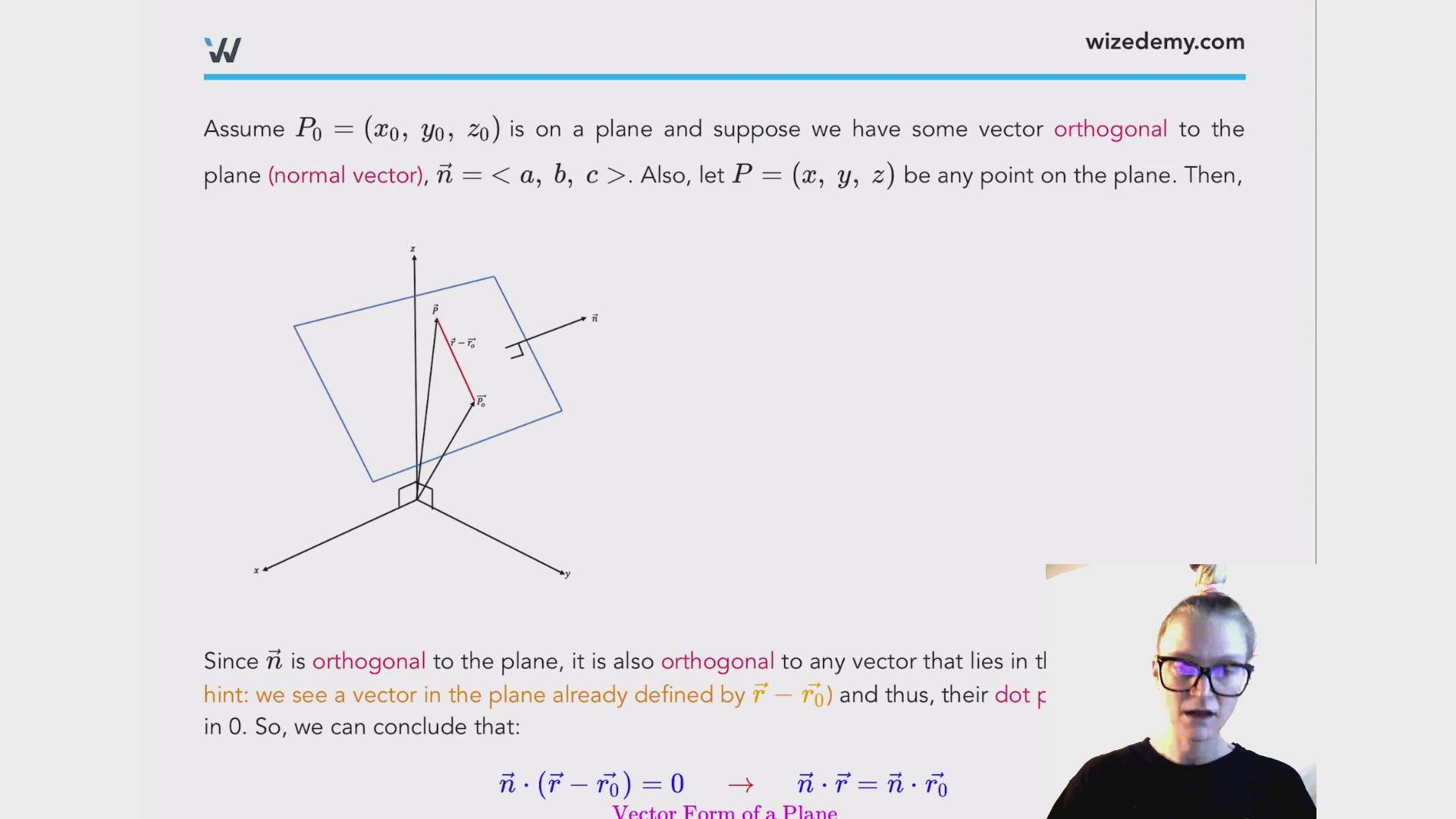
Assume for some plane in ,
- is on the plane
- Let be some vector orthogonal to the plane called a normal vector
- Let be any point on the plane
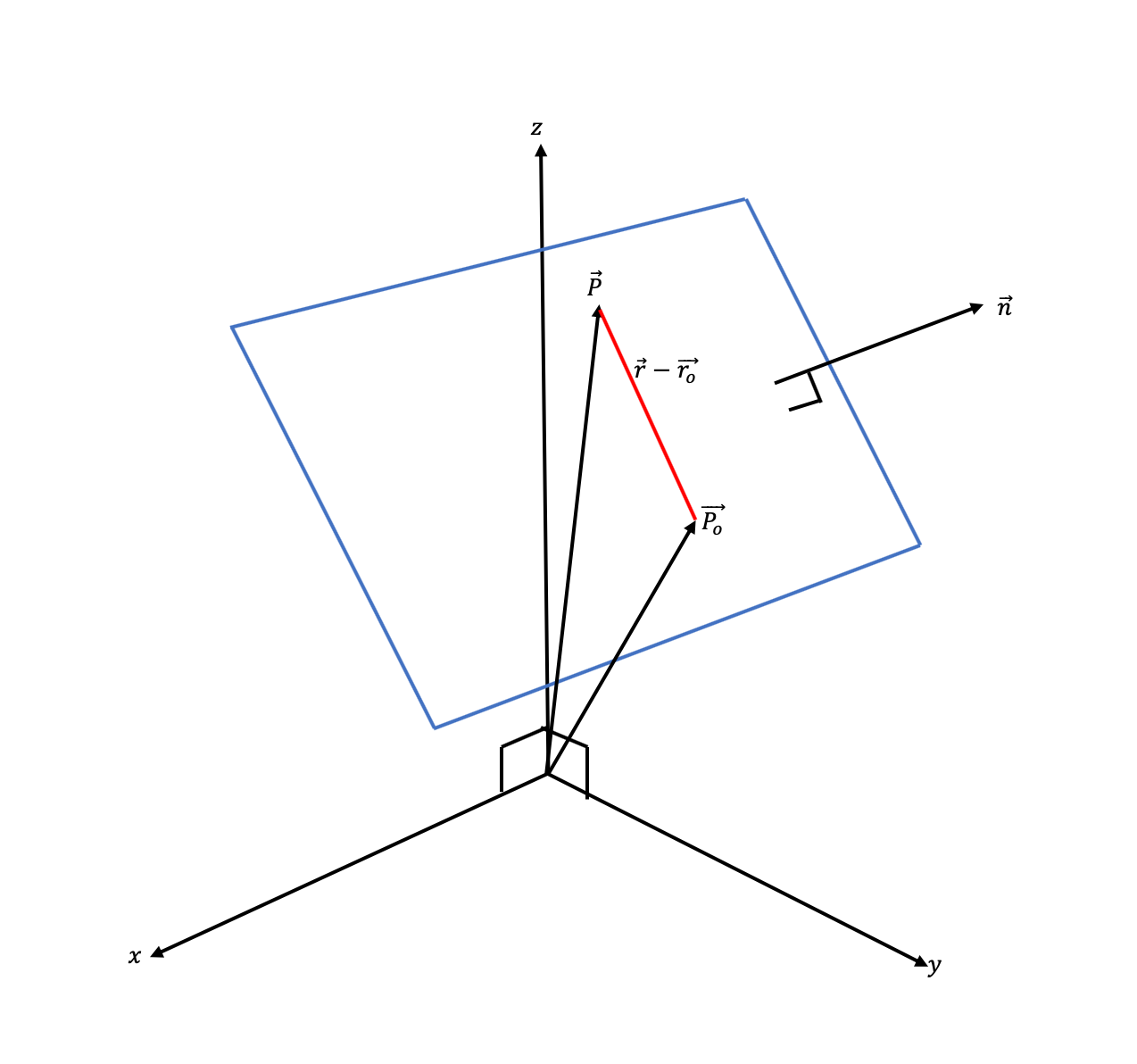
- Because is orthogonal to the plane, it is also orthogonal to any vector that lies in that plane.
- Let the vector be a vector that lies in the plane.
- Then, and are orthogonal to each other; thus, their dot product is 0.
Therefore,
- This is the vector form for the equation of a plane, where:
- The scalar form can be found by expanding the vector form.
- Therefore:
Wize Tip
The second form makes it easy to find the normal vector, since
Angle Between Planes
The angle between two planes is equal to the angle between two normal vectors.
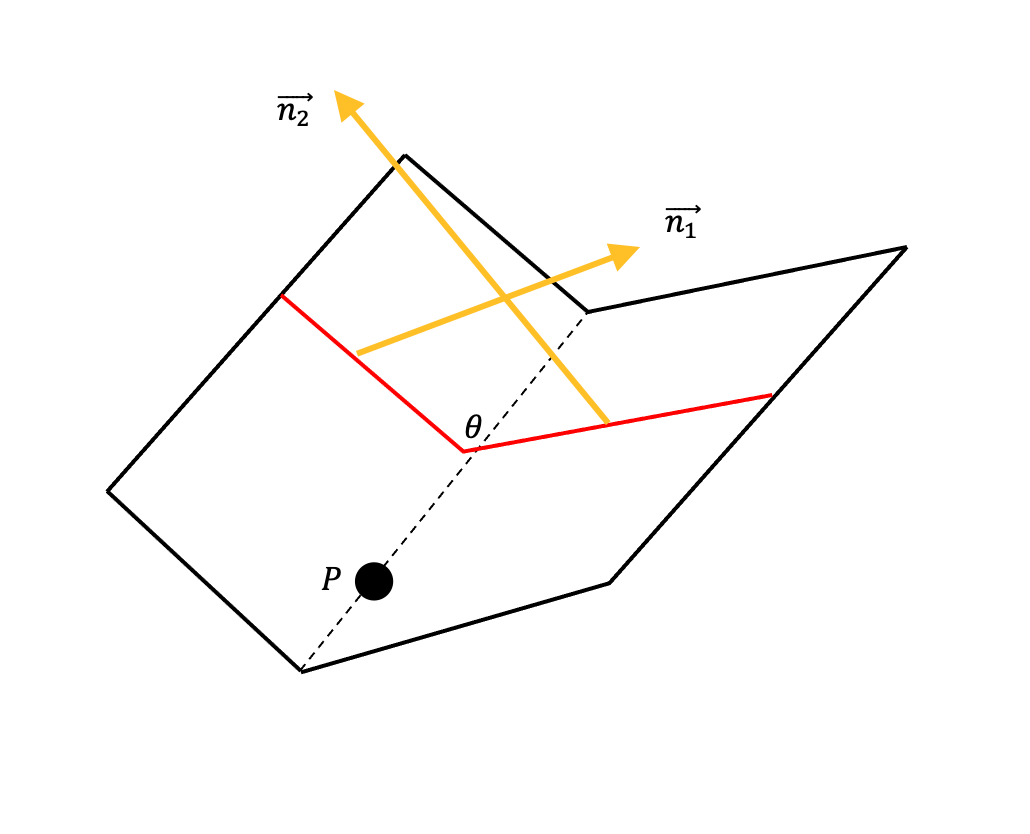
- The normal vector for two planes is and and the angle between the two planes is:
- The distance of a given point from plane is:
Write it Down
1. Two PLANES are parallel if their normal vectors are parallel (cross product of the normal vectors is 0)
2. Two PLANES are orthogonal if their normal vectors are orthogonal (dot product of the normal vectors is 0)
0:00 / 0:00
Example
Find the equation of the plane containing the points and .
In order to find the equation of a plane, we need a point and normal vector (the normal vector will be orthogonal to any two vectors that lie in the plane)
We know how to find two vectors that lie in a plane by turning our coordinate points into point vectors and then finding any two vectors between the three point vectors.
Then, any two vectors between these points is:
These two vectors lie in the plane as they were created with points that lie in the plane.
We want a vector that is orthogonal to the plane, which means it is also orthogonal to
The cross product of will give a vector orthogonal to the plane, which is the normal vector to the plane.
So, the cross product of is:
The normal vector will be:
and we can use any point for the equation of the plane.
The equation of the plane is:
Watch Out!
If we take the dot product, we are testing to see if these two vectors are orthogonal to EACH OTHER and we do not want that!!!
0:00 / 0:00
Example
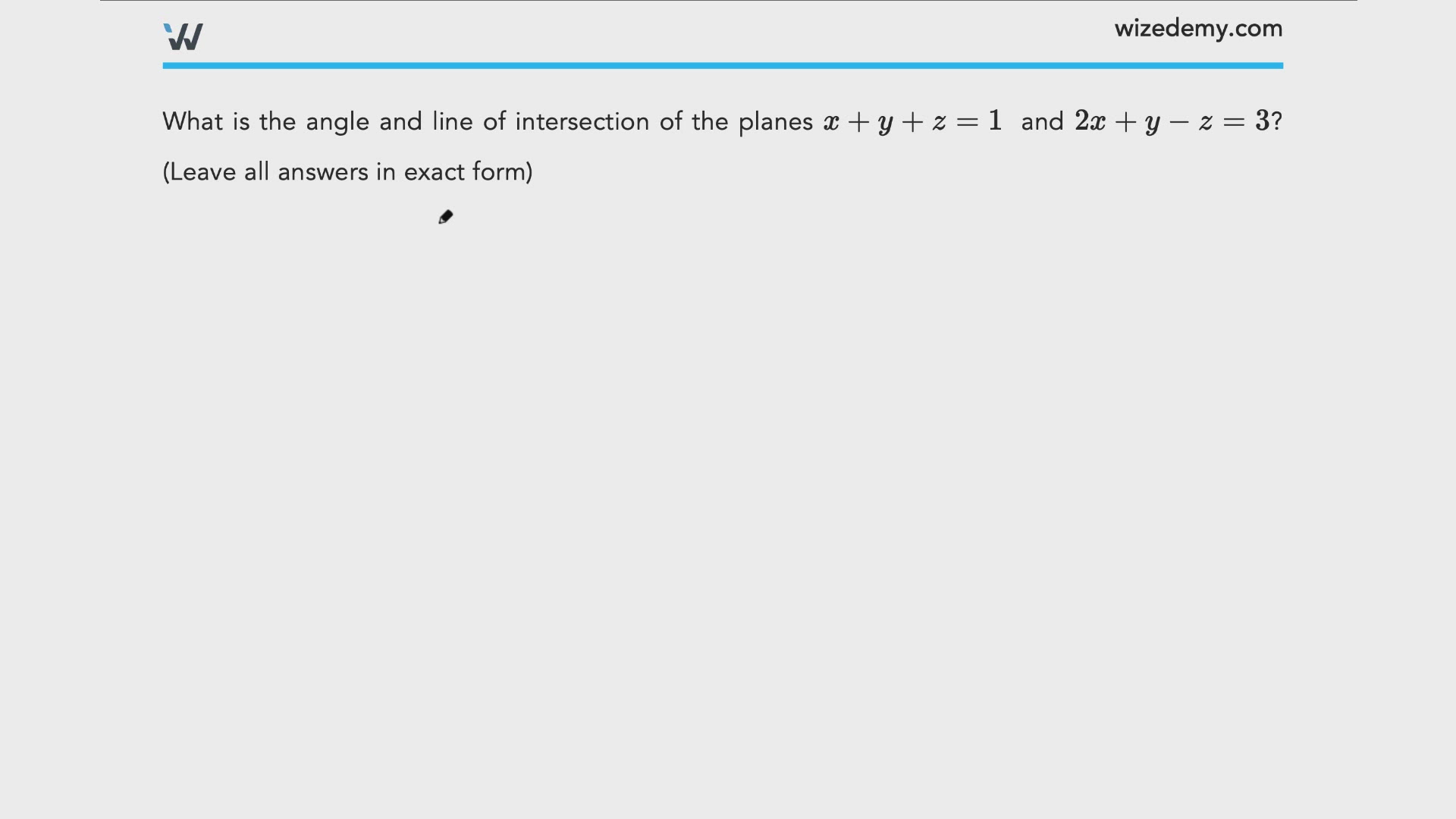
What is the angle and line of intersection of the planes and ? (Leave all answers in exact form)
Let's take a look at what two planes intersecting looks like:
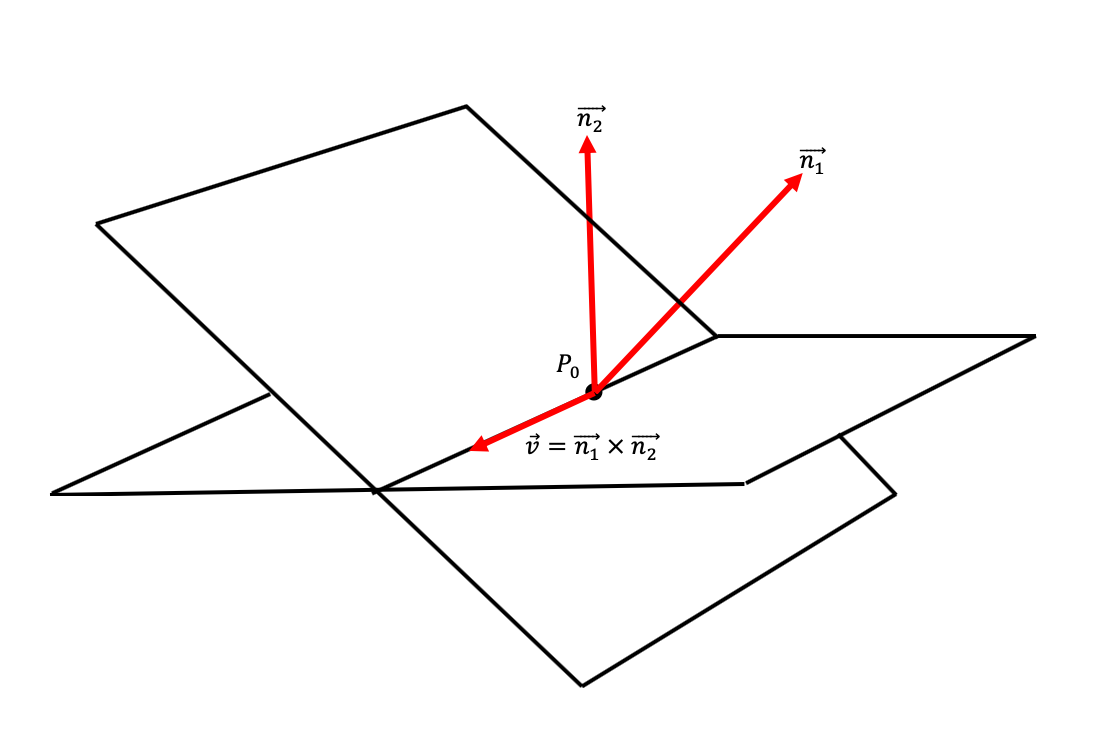
The angle of intersection can be found using but we need two normal vectors, to both planes.
They can be identified easily since both planes are in scalar form. Thus,
Then,
Now, will be parallel to the line of intersection:
Now, to find a point on the line, let's set x = 0:
So, our point will be P = (0, 2, -1)
The equation of the line, in vector form, is:
Practice
Let be a line that passes through the points
Let be the line that is defined as
Find the equation of the plane that contains
Practice
Consider the planes and
What is the line of intersection, L?