Wize University Calculus 1 Textbook > Applications of Differentiation
The Mean Value Theorem
Popular Courses
Calculus 1
University Study Guides
AP Calculus (AB) Exam Prep Course
AP Exam Prep
MATH 1LS3
McMaster University
MATH 249
University of Calgary
MATH 265
University of Calgary
Calculus 1
General Course
MATH 140
McGill University
MATH*1080
University of Guelph
MATH 134
University of Alberta
Calculus 1
University Study Guides
MAT 1320
University of Ottawa
MATH 100
University of Alberta
MATH 203
Concordia University
MAT 1330
University of Ottawa
MTH 140
Toronto Metropolitan University
SC/MATH 1013 3.00
York University
MATH 109
University of Victoria
SC/MATH 1506 3.00
York University
MATH-1720
University of Windsor
NMM 1412A/B
Western University

0:00 / 0:00
The Mean Value Theorem (MVT)
We can extend the idea of Rolle's Theorem with the Mean Value Theorem.
Mean Value Theorem
Suppose that a function is continuous on the interval , and is differentiable on the interval . Then there exists a value in the interval such that
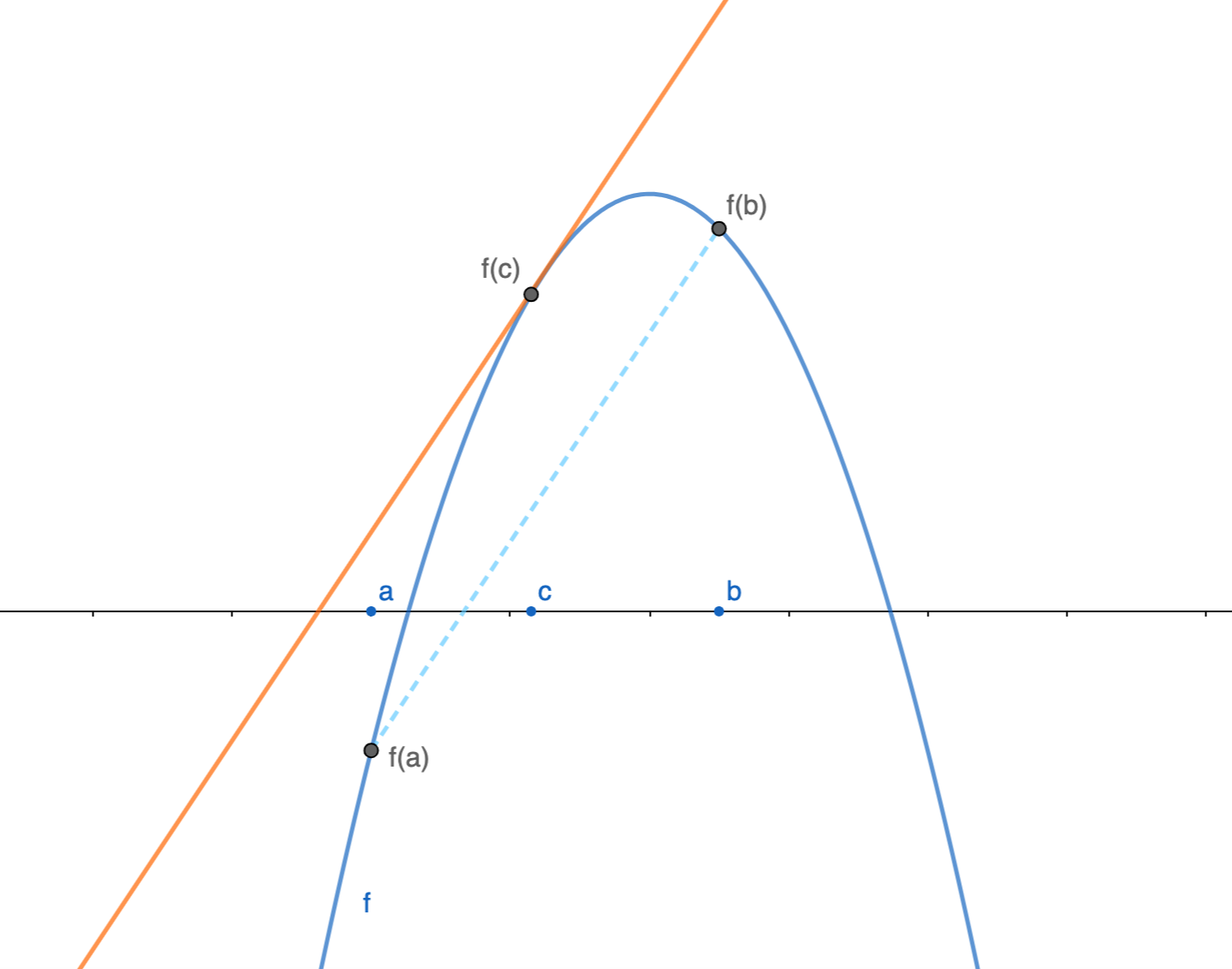
Note: In other words, since is continuous and differentiable, then in between every two points and , there is a point for which the slope of the tangent line at is equal to the slope of the secant line linking and
0:00 / 0:00
Example: Mean Value Theorem
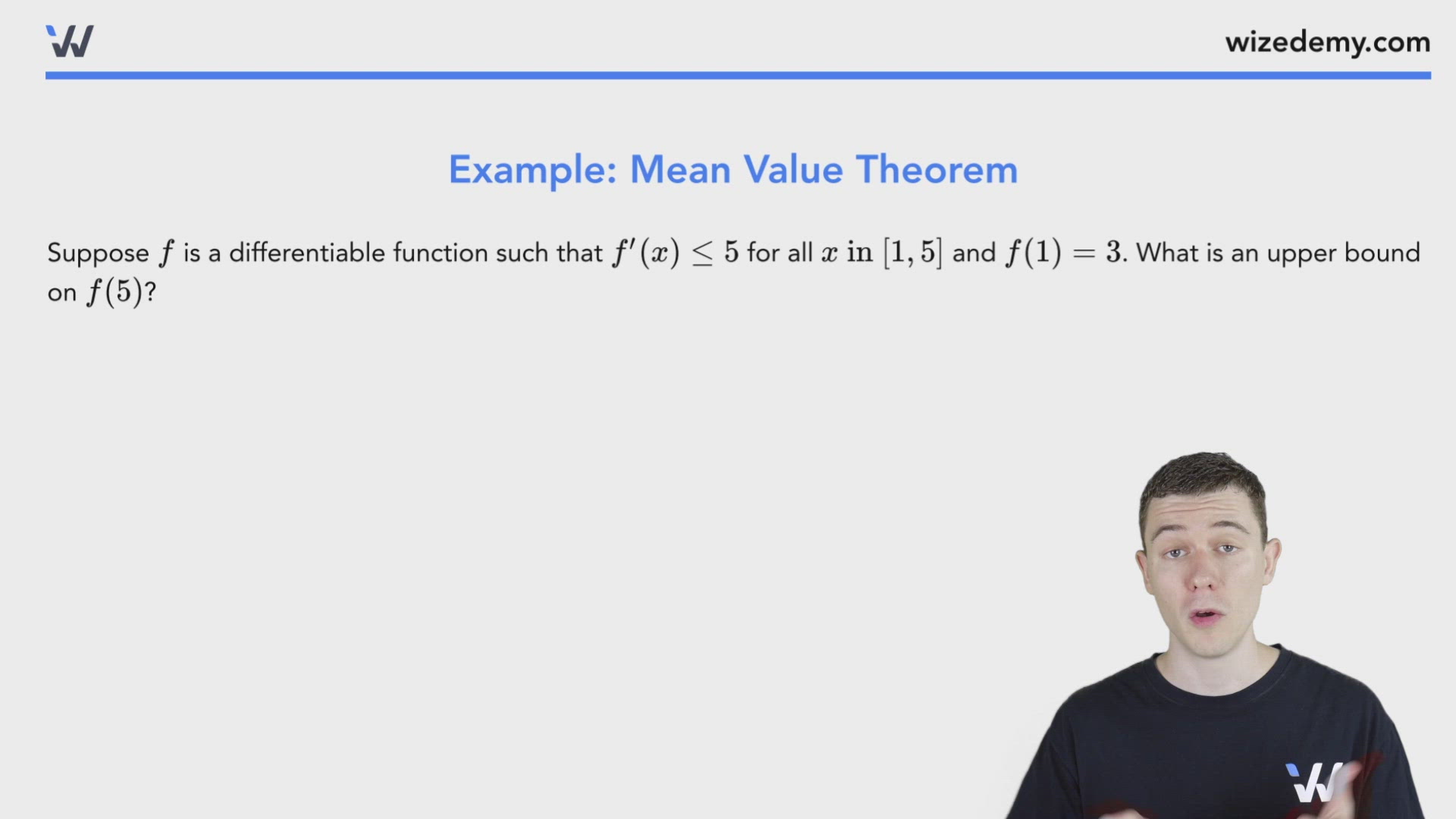
Suppose is a differentiable function such that for all and . What is an upper bound on ?
So is an upper bound for.
Given on the interval , what value of does the mean value theorem guarantee exists?