Popular Courses
MCAT
General Course
DAT
General Course
CHEM 2213A/B
Western University
Organic Chemistry
University Study Guides
Organic Chemistry
General Course
CHEM 233
University of British Columbia
CHEM 261
University of Alberta
Organic Chemistry
University Study Guides
CHEM 351
University of Calgary
CHEM 281
Queen's University
CHM 1321
University of Ottawa
CHM136H1
University of Toronto
CHEM 212
McGill University
CHEM 231
University of Victoria
CHEM 2OA3
McMaster University
CHEM 2223B
Western University
CHM 2120
University of Ottawa
CHEM 263
University of Alberta
SC/CHEM 2020 3.00
York University
CHY 142
Toronto Metropolitan University

0:00 / 0:00
VSEPR Theory
Valence-Shell Electron-Pair Repulsion (VSEPR)
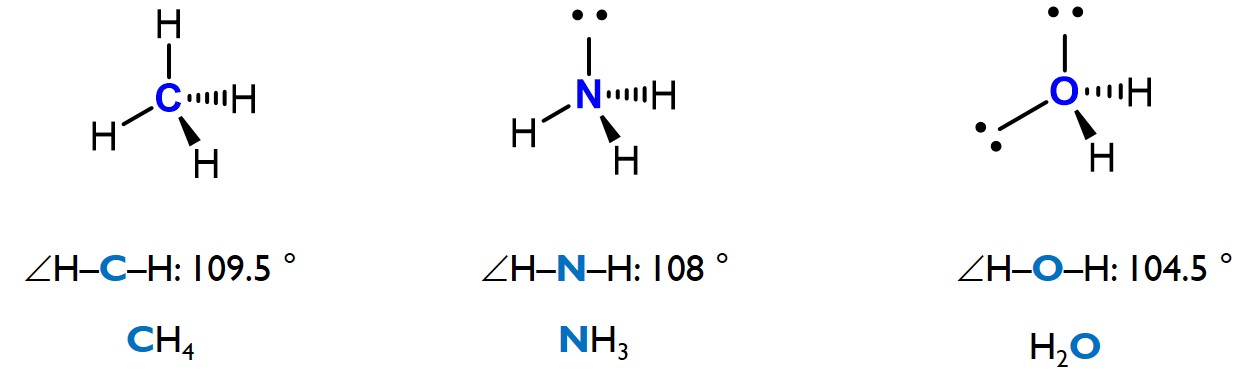
The geometry and shape of an atom in a molecule is dictated by the atom's hybridization (number of σ-bonds and π-bonds). It is important to consider lone pairs as they also occupy space! Some examples with carbon are below.

Wize Tip
In organic chemistry the magic numbers are 109.5° (around sp3 atoms), 120° (around sp2 atoms) and 180° (around sp atoms).
Imperfect Bond Angles
Sometimes atoms are forced to adopt a less-than-ideal geometry (due to the presence of a ring). This helps explain why five- and six-membered rings are more stable than their smaller and larger analogues.

The Effect of Lone Pairs
As mentioned above, lone pairs occupy space similar to atoms. In fact, the repulsion of lone pairs is greater than other electron pairs - this makes the "perfect angle" between atoms less than perfect.

0:00 / 0:00
Example: VSEPR
What are the bond angles at each of the atoms labelled (C1 and N2)?

- C1 is 180o
- N2 is 120o (beware resonance structures)

0:00 / 0:00
Example: VSEPR
What are the bond angles (assuming no lone pair distortion) at the following atoms (N3, C4, C5, B6):
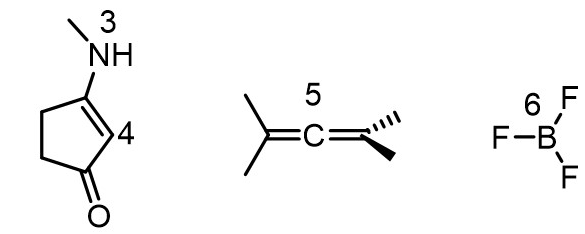
- N3: 109.5
- C4: 120
- C5: 180
- B6: 120 (remember, boron is electron deficient)

Mark Yourself Question
- Grab a piece of paper and try this problem yourself.
- When you're done, check the "I have answered this question" box below.
- View the solution and report whether you got it right or wrong.
Practice: VSEPR
Draw a Lewis structure and provide the bond angles at the central atom(s) for the following molecules:
- NCl3
- SO2
- BBr3