Popular Courses
MCAT
General Course
DAT
General Course
CHEM 2213A/B
Western University
Organic Chemistry
University Study Guides
Organic Chemistry
General Course
CHEM 233
University of British Columbia
CHEM 261
University of Alberta
Organic Chemistry
University Study Guides
CHEM 351
University of Calgary
CHEM 281
Queen's University
CHM 1321
University of Ottawa
CHM136H1
University of Toronto
CHEM 212
McGill University
CHEM 231
University of Victoria
CHEM 2OA3
McMaster University
CHEM 2223B
Western University
CHM 2120
University of Ottawa
CHEM 263
University of Alberta
SC/CHEM 2020 3.00
York University
CHY 142
Toronto Metropolitan University
0:00 / 0:00
Polar Bonds
Polar bonds are important because they dictate many of the properties of organic molecules you need to understand.
Watch Out!
Bonds can be polar or non-polar and molecules can be overall polar and non-polar! Make sure to pay attention for if you're asked to think about a bond or a molecule.
Polar Bonds
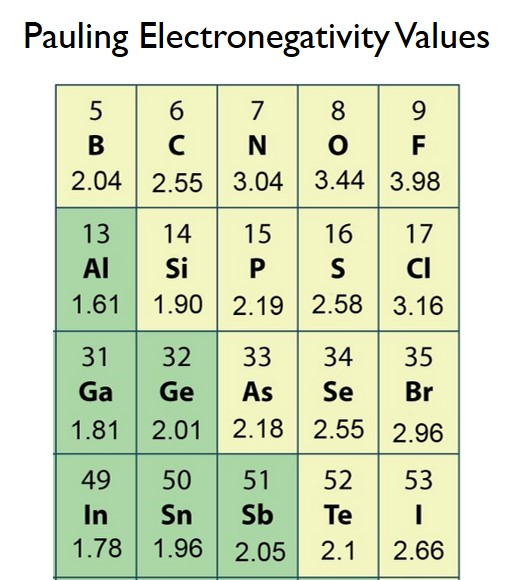
Recall that electronegativity is the tendency of atom to attract a bonded pair of electrons towards itself. A polar covalent bond (i.e. a polar bond) occurs between two different atoms with an electronegativity difference greater than 0.4.
We can denote a polar bond using a special dipole arrow or using delta positive/negative symbols.
Polar Molecules
For a molecule to be overall polar (posses a net dipole) it needs:
- At least one polar covalent bond
- Appropriate geometry
Having a difference in electronegativity (dipole) is not the only factor to consider when assigning a molecule as polar or non-polar. We must also consider molecular shape or geometry (VSEPR).

0:00 / 0:00
Example: Polar Bonds
Does BF3 or NH3 posses a greater overall dipole?
NH3 is more polar as it is trigonal pyramidal. The lone pair of electrons found on the central nitrogen atom contributes to the overall dipole.
BF3 is trigonal planar and all the B-F dipoles cancel out.
0:00 / 0:00
Example: Polar Bonds
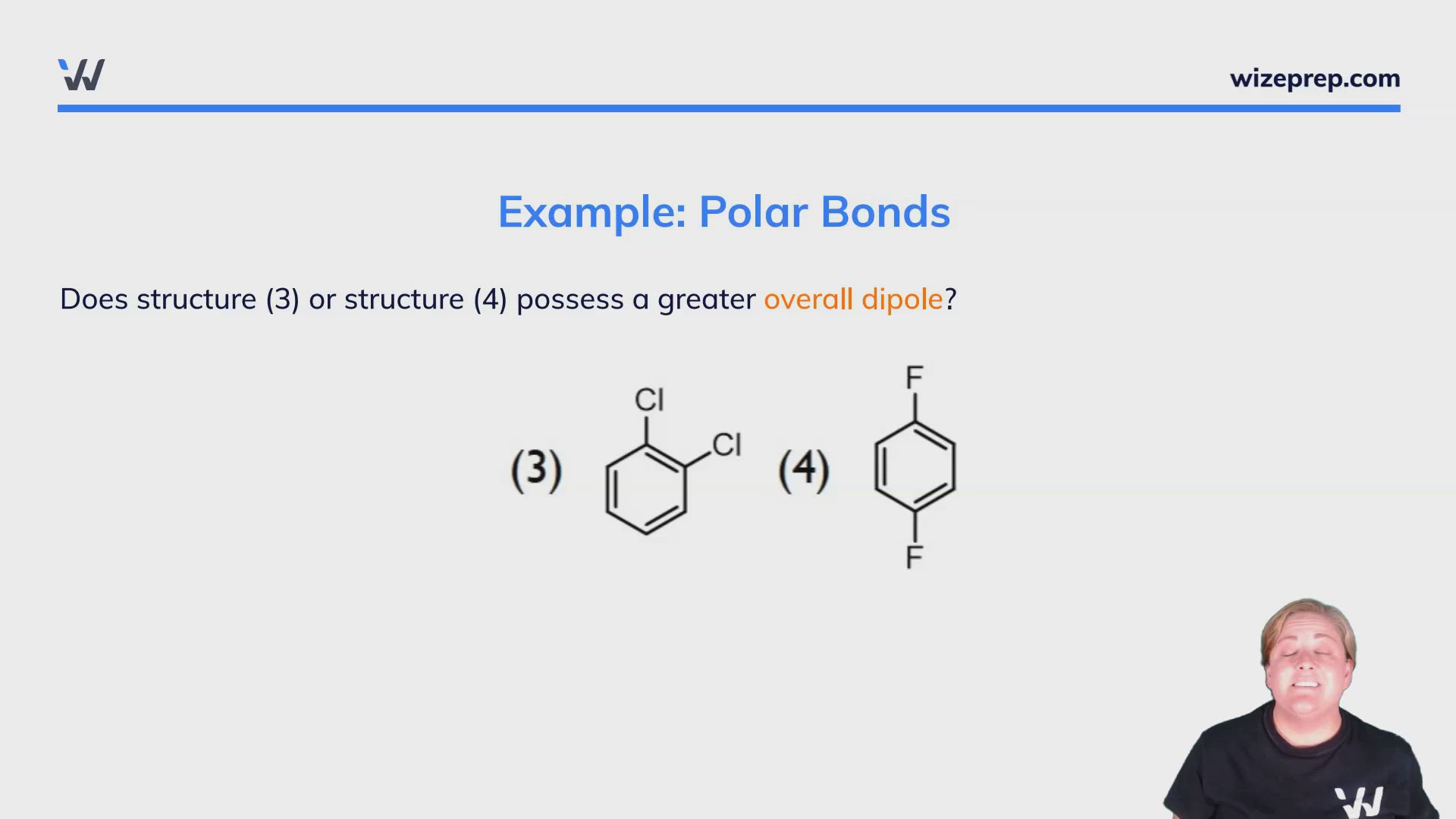
Does structure (3) or structure (4) possess a greater overall dipole?
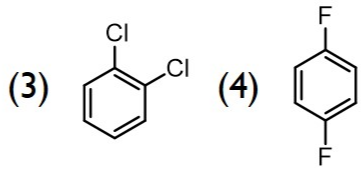
Both structures are planar, but in structure (4), the fluorine atoms are across from each other. This symmetry means the dipoles cancel each other out and the molecule has no overall dipole.
Practice: Molecular Polarity - Polar Bonds
Molecules that contain polar bonds always have an overall dipole. True or False?