Popular Courses
MCAT
General Course
DAT
General Course
CHEM 2213A/B
Western University
Organic Chemistry
University Study Guides
Organic Chemistry
General Course
CHEM 233
University of British Columbia
Organic Chemistry
University Study Guides
CHM 1321
University of Ottawa
CHM136H1
University of Toronto
CHEM 2223B
Western University
CHM 2120
University of Ottawa
CHEM 263
University of Alberta
CHEM 282
Queen's University
CHY 142
Toronto Metropolitan University
CHEM 222
McGill University
CHEM 353
University of Calgary
CHEM 2E03
McMaster University
CHEM 266
University of Waterloo
CHEM 2OB3
McMaster University
CHEM 250
University of Saskatchewan
0:00 / 0:00
General Reactivity
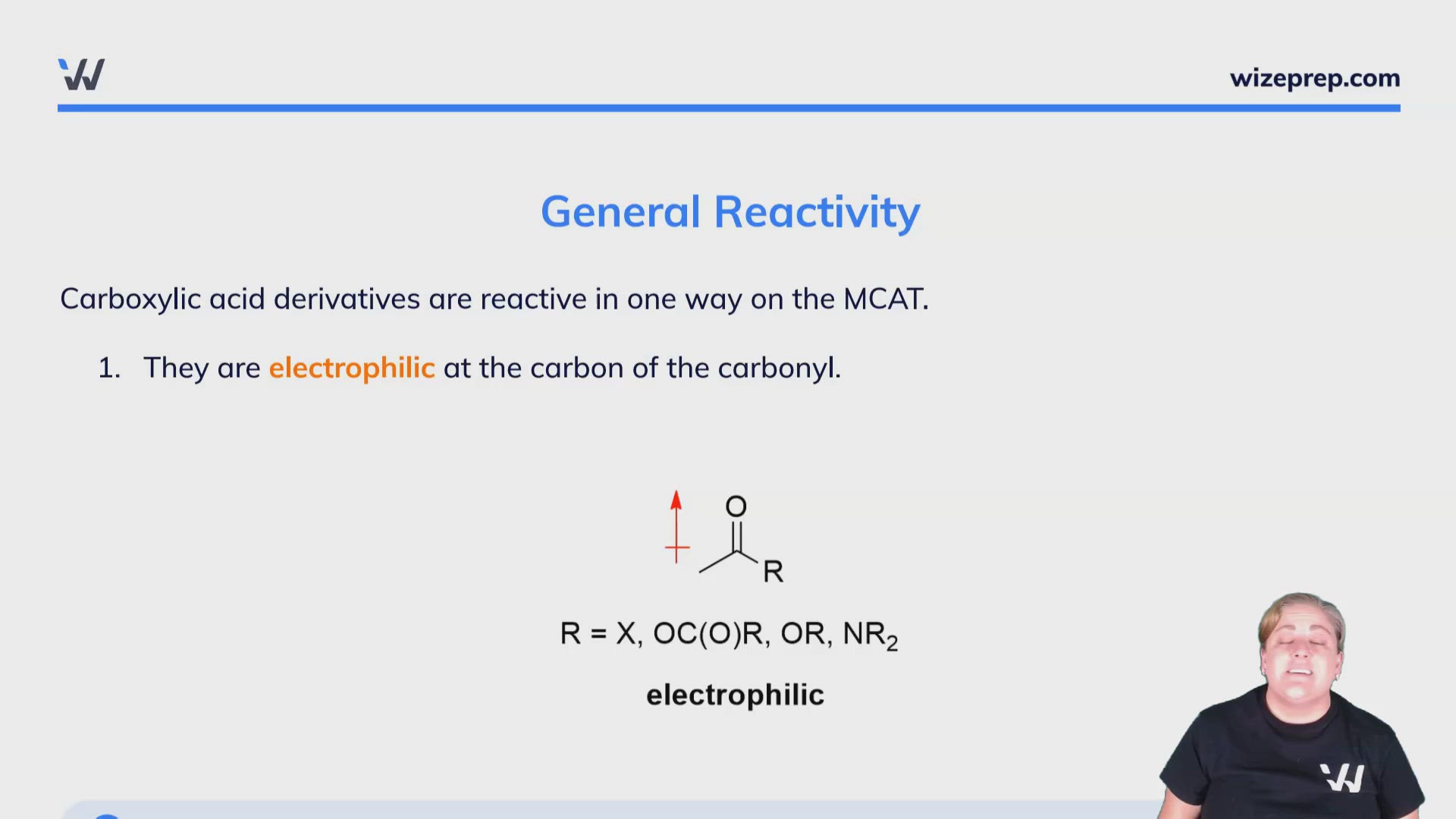
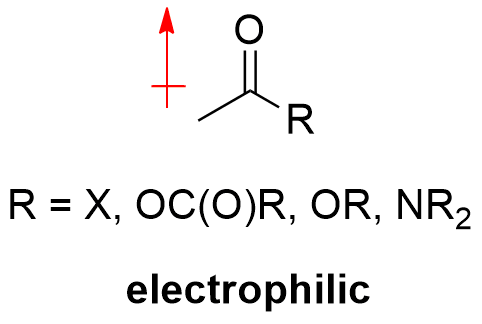
Carboxylic acid derivatives are reactive in one way.
- They are electrophilic at the carbon of the carbonyl.
Wize Concept
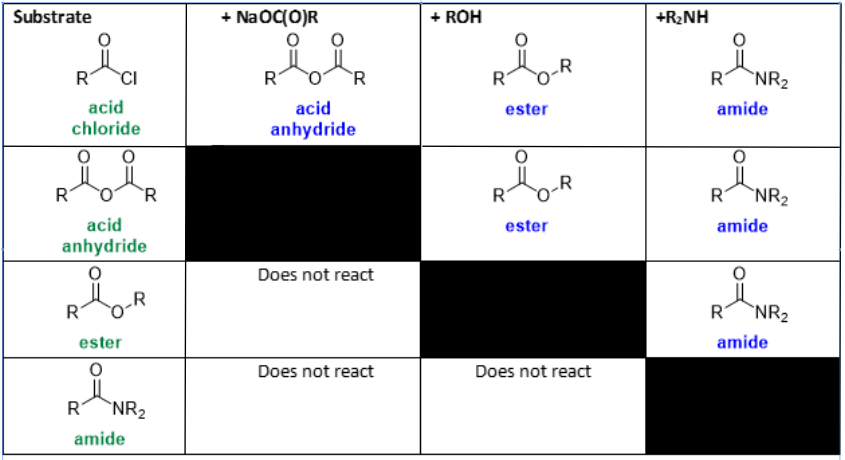
The order of reactivity is based on leaving group ability of the R group! The order is:
acid halide > acid anhydride > ester > amide
There are some other (less important!) factors effecting the reactivity of the carboxylic acid derivatives. They are:
- steric effects: the smaller leaving groups (Cl-, in acid chlorides) will depart faster than larger leaving groups (-OC(O)R, in acid anhydrides) leading to greater reactivity
- electronic effects: larger bond dipoles between the carbon of the carbonyl and the leaving group will lead to greater reactivity
- ring strain: cyclic derivatives (lactones which are cyclic esters and lactams which are cyclic amides) react faster than their linear analogues (especially when they are in 3- or 4-membered rings.
0:00 / 0:00
General Mechanism at the Carbonyl
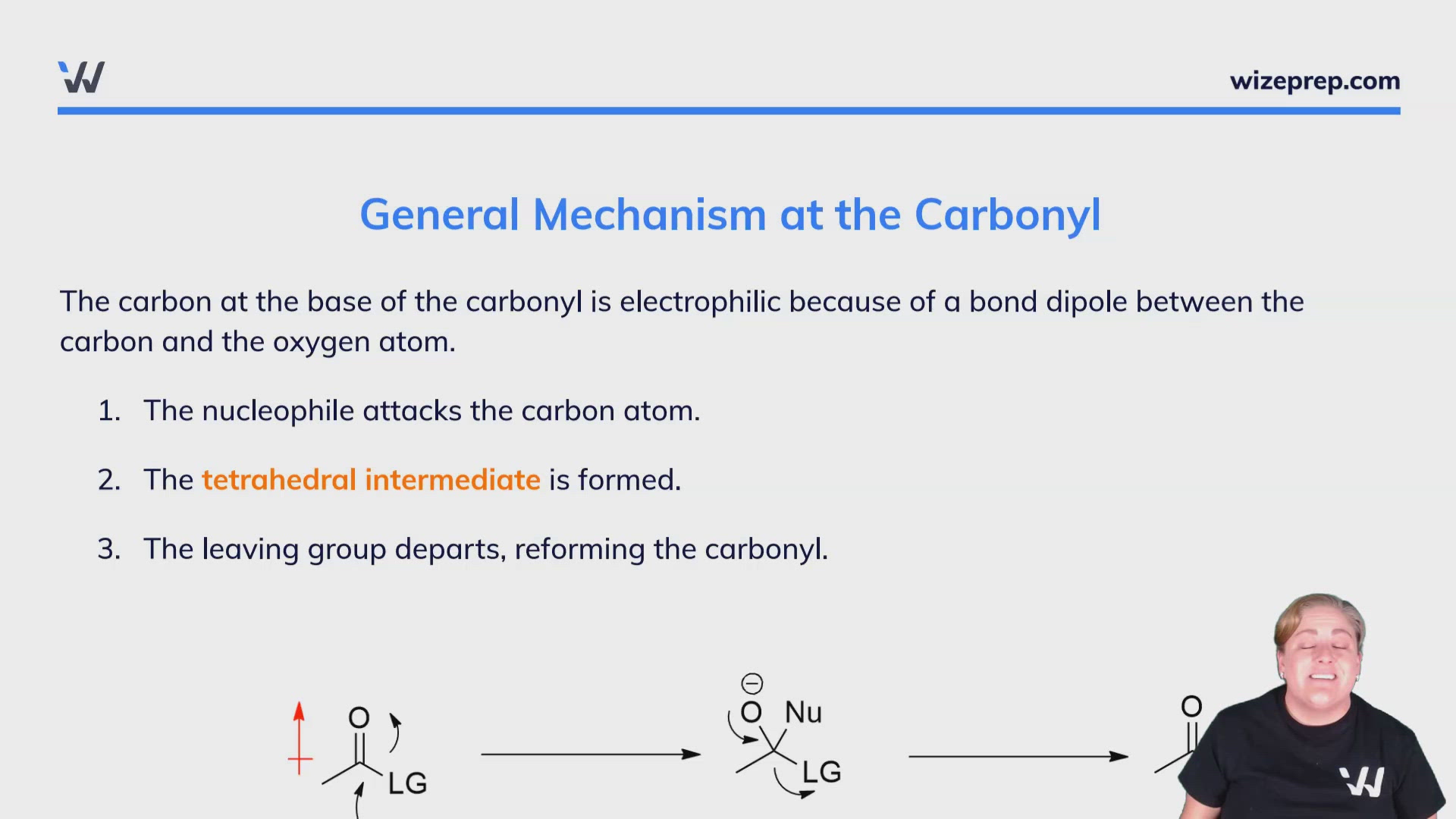
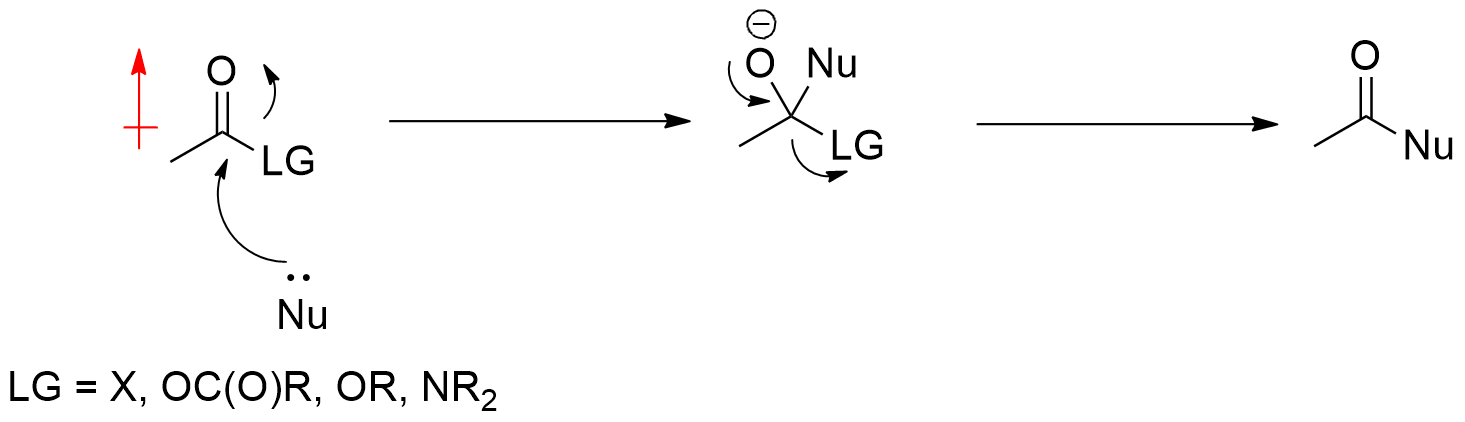
The carbon at the base of the carbonyl is electrophilic because of a bond dipole between the carbon and the oxygen atom.
- The nucleophile attacks the carbon atom.
- The tetrahedral intermediate is formed.
- The leaving group departs, reforming the carbonyl.
Wize Tip
This is called a nucleophilic substitution reaction (aldehydes and ketones undergo addition reactions).
Wize Concept
Since the tetrahedral intermediate has a good leaving group, the carbonyl is able to reform with departure of the leaving group.
Wize Tip
It will seem like there are lots of reactions for the carboxylic acid derivatives! However, they are all just variations of this reaction with different leaving groups and nucleophiles!
Rank the following species in order of decreasing reactivity:
I. Ester
II. Anhydride
III. Amide
IV. Acyl chloride
Summary Sheet: Carboxylic Acid Derivative Reactivity