Wize University Physics Textbook (Master) > Introduction to Vectors
Vectors and Their Components
Popular Courses
MCAT
General Course
PHYSICS 1201A/B
Western University
Intro to Physics
University Study Guides
Grade 12 Physics
Ontario High School
PHYSICS 1D03
McMaster University
AP Physics C: Mechanics Exam Prep Course
AP Exam Prep
Physics
General Course
High School Physics
US High School
Grade 12 Physics
Canada High School
PHYS 115
Queen's University
PCS 211
Toronto Metropolitan University
PHYS 204
Concordia University
PHYS*1300
University of Guelph
Intro to Physics
University Study Guides
Physics 30
Alberta High School
PHYS*1080
University of Guelph
PHYS 100
University of British Columbia
PHYS 131
McGill University
APSC 111
Queen's University
PHYS 102A
University of Victoria
0:00 / 0:00
Vectors and Their Components
- A Vector is a quantity that has both magnitude and direction such as velocity.
- A Scalar has magnitude but no direction such as speed.
- Two vectors are equal to each other as long as they have the same size and direction
- Vectors can be written in terms of their components based on different coordinate systems
- The most common coordinate system is XYZ -coordinate system which is also known as Cartesian coordinate system.
- Theses components are the shadow of the vector on different axis of the coordinate system
- A given vector in 2D space is shown as:
- where vectors , and are basic unit vectors in and directions, respectively. These unit vectors are:
- Unit vectors are vectors with length equal to 1 which are used to show directions.
- and are called components of vector
0:00 / 0:00
ٰVector's Magnitude
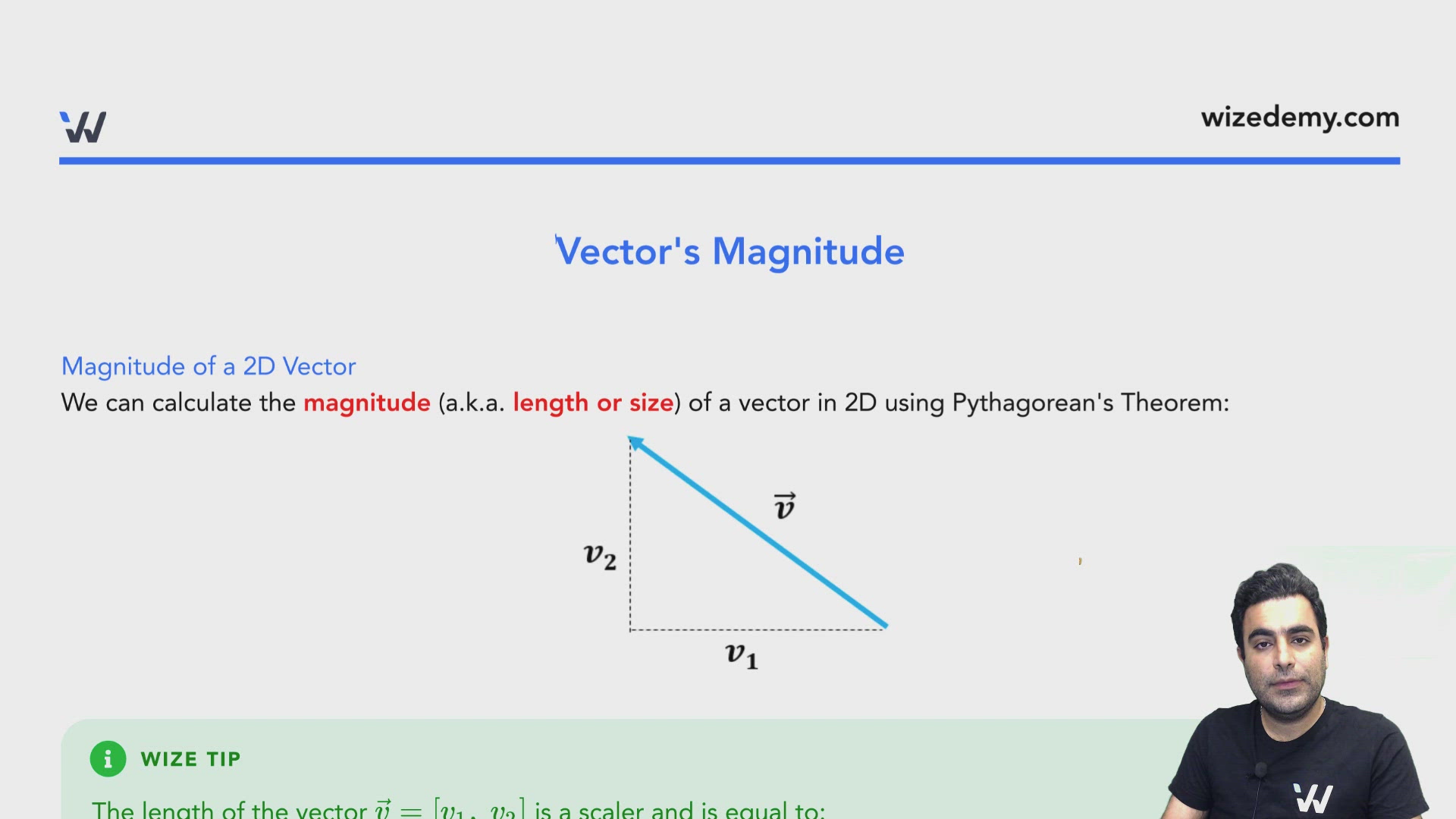
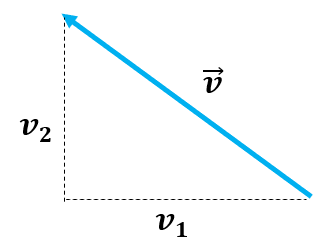
Magnitude of a 2D Vector
We can calculate the magnitude (a.k.a. length or size) of a vector in 2D using Pythagorean's Theorem:
Wize Tip
The length of the vector is a scaler and is equal to:
Magnitude of a 3D Vector
Similarly, We can calculate the magnitude of a vector in 3D using an extension of this formula.
Wize Tip
The length of the vector is
0:00 / 0:00
Components of a Vector Using the Angle It Makes Respect to x or y Axis
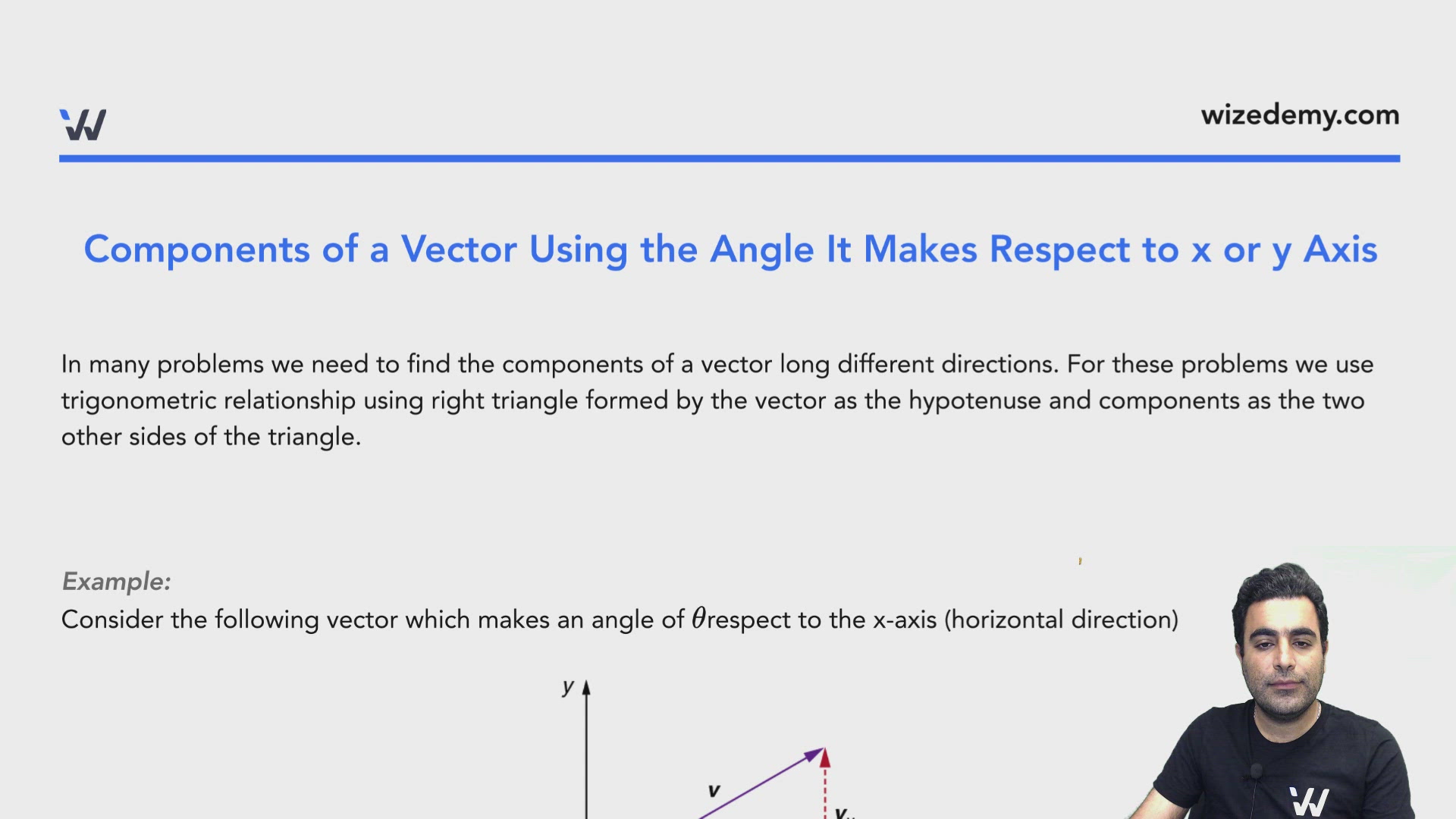
In many problems we need to find the components of a vector along different directions. For these problems we use trigonometric relationship using right triangle formed by the vector as the hypotenuse and components as the two other sides of the triangle.
Example:
Consider the following vector which makes an angle of respect to the x-axis (horizontal direction)

Components of this vector along x and y directions could be found as:
Watch Out!
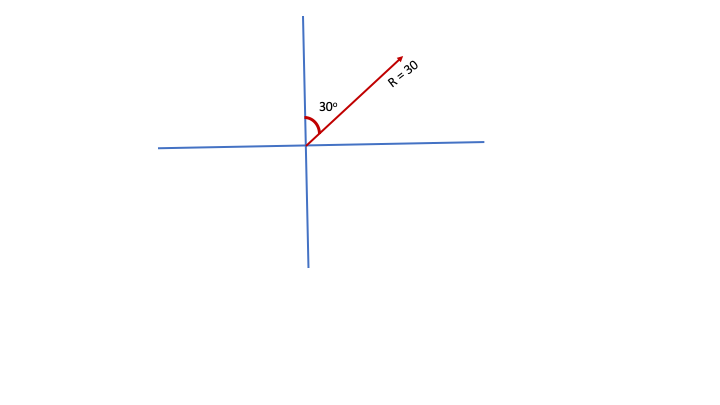
- Do not always assume that "x is cosine, y is sine". This depends completely on where we define the angle . Normally, is defined as an angle relative to the horizontal (x) axis, and these conventions will work, but when the angle is relative to the vertical (y) axis, the convention is flipped.
We can find the length of this vector and the angle it makes respect to horizontal x-axis using the following equation:
- Length of a vector in 2-D space is equal to:
- The direction of a vector usually is reported by the angle it makes with positive -axis (Counter-clockwise) using following formula:
0:00 / 0:00
Example: Vector Connecting Two Points
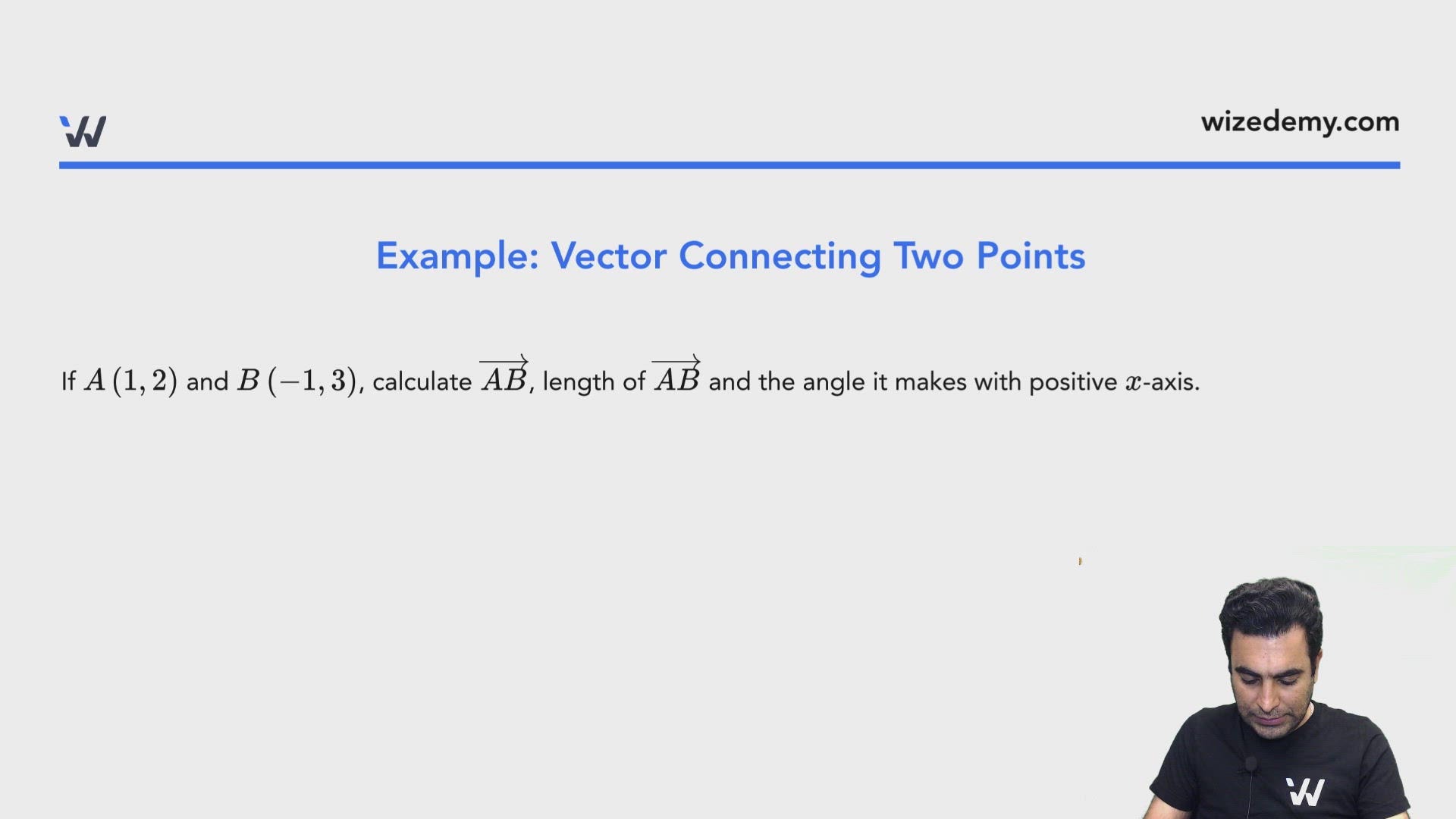
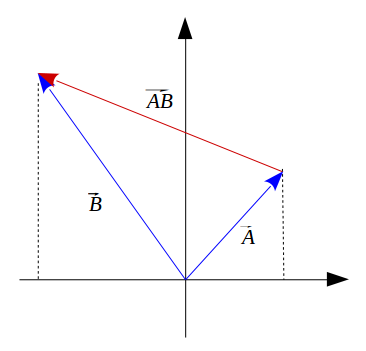
If and , calculate , length of and the angle it makes with positive -axis.
Solution:
Exam Tip
*With these types of examples, instead of memorizing some general rule, it's best to draw the picture and reason about whether to add 180, subtract from 180, add 90, etc, depending on what you drew.
A football is thrown with a horizontal velocity of 10m/s and a vertical velocity of 4.25 m/s. What is football's velocity?
Practice: Magnitude of a Vector
An aircraft's location is 200 miles from base, at a direction of 30° W of S, at an altitude of 35,000 ft. Find the distance between the aircraft and the base.
Note: 1 mile = 5280 feet