Wize University Physics Textbook (Master) > Foundations / Introduction / Measurement
Estimation and Order of Magnitude
Popular Courses
MCAT
General Course
PHYSICS 1201A/B
Western University
Intro to Physics
University Study Guides
AP Physics C: Mechanics Exam Prep Course
AP Exam Prep
Physics
General Course
PHYS 157
University of British Columbia
PHYS 211
University of Calgary
PHYS 204
Concordia University
PHYS*1300
University of Guelph
Intro to Physics
University Study Guides
PHYS*1080
University of Guelph
PHYS 100
University of British Columbia
PHY 1321
University of Ottawa
APSC 111
Queen's University
PHYS 102A
University of Victoria
PHYS 111
University of Waterloo
PHYS 110
University of Victoria
LE/PHYS 1800 3.00
York University
PHYS-1400
University of Windsor
PHY 1331
University of Ottawa
0:00 / 0:00
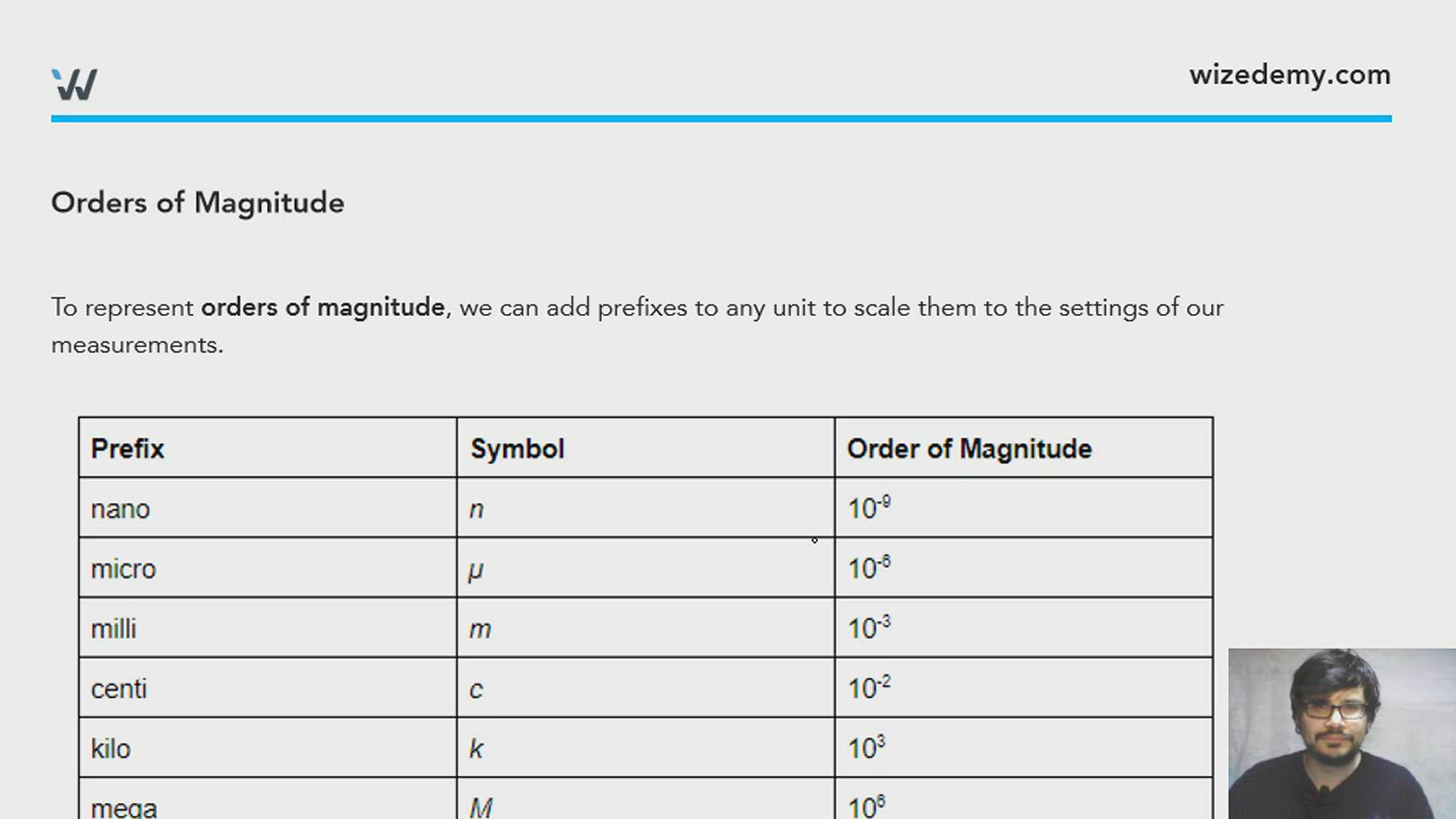
Orders of Magnitude
To represent orders of magnitude, we can add prefixes to any unit to scale them to the settings of our measurements.

For example, . Or in your computer, you might have of storage space. Plenty of space for cat pictures.
Hints for estimating within an order of magnitude:
1. Express the number you are using in scientific notation.
2. If the multiplier is < 3.2 (), the order of magnitude of the number is the power of 10. If the multiplier is > than 3.2, the order of magnitude is the power of 10 plus 1.