Wize University Physics Textbook (Master) > Introduction to Vectors
Vector Addition and Subtraction
Popular Courses
MCAT
General Course
PHYSICS 1201A/B
Western University
Intro to Physics
University Study Guides
PHYSICS 1D03
McMaster University
AP Physics C: Mechanics Exam Prep Course
AP Exam Prep
Physics
General Course
PHYS 115
Queen's University
PCS 211
Toronto Metropolitan University
PHYS 204
Concordia University
Intro to Physics
University Study Guides
PHYS*1300
University of Guelph
PHYS*1080
University of Guelph
PHYS 100
University of British Columbia
PHYS 131
McGill University
APSC 111
Queen's University
PHYS 102A
University of Victoria
PCS 120
Toronto Metropolitan University
PHYS 110
University of Victoria
LE/PHYS 1800 3.00
York University
PHYS-1400
University of Windsor

0:00 / 0:00
Vector Addition and Subtraction: Algebraic Method
In general, we can perform addition and subtraction operations on vectors either algebraically or graphically.
Algebraic Method
If we know the components of vectors, we can add/subtract them algebraically by adding/subtracting their corresponding components:

0:00 / 0:00
Vector Addition and Subtraction: Graphical Methods
We can add vectors using two different graphic methods described below:

Subtraction
Now what about subtraction? Say, I subtracted from . Well that would be the same as saying, add the negative of .
What is graphically? Well it should cancel when we add them together. So it must be exact same vector but flipped around.
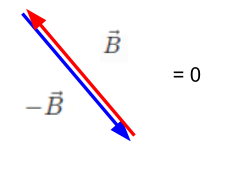
Alternatively, we can use the parallelogram method to find the subtraction of two vectors as shown in the picture.
0:00 / 0:00
Example: Finding Missing Corner of a Parallelogram
The coordinates of four corners of a Parallelogram in a Clock-Wise order are , , and . Find missing coordinates of .
Solution:
We can start by drawing a picture using the informations already given to us and use the properties of the vectors to find a vector which is related to the missing point.
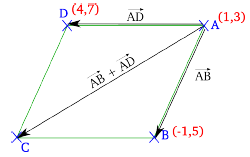
In the diagram shown, the unknown vector is

Mark Yourself Question
- Grab a piece of paper and try this problem yourself.
- When you're done, check the "I have answered this question" box below.
- View the solution and report whether you got it right or wrong.
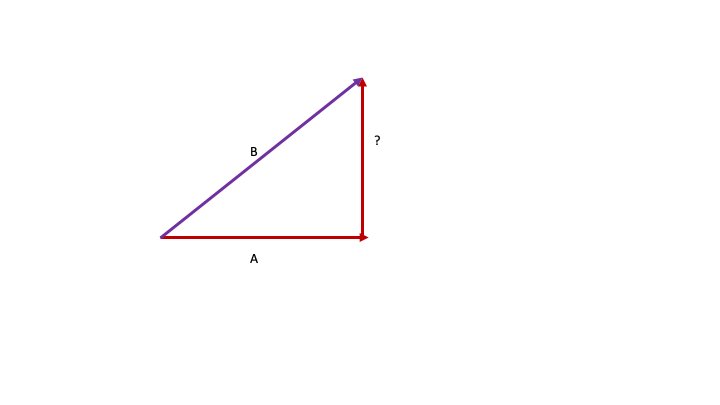
Two forces and are shown in the figure. Find the magnitude and direction of the resultant using law of vector addition.
