Wize University Physics Textbook (Master) > Motion in 1/2/3D: Kinematics
Basic Concepts of Kinematics
Popular Courses
MCAT
General Course
Intro to Physics
University Study Guides
PHYSICS 1D03
McMaster University
AP Physics C: Mechanics Exam Prep Course
AP Exam Prep
Physics
General Course
PHYS 115
Queen's University
PCS 211
Toronto Metropolitan University
PHYS 204
Concordia University
PHYS*1300
University of Guelph
Intro to Physics
University Study Guides
PHYS*1080
University of Guelph
PHY 1321
University of Ottawa
PHYS 131
McGill University
APSC 111
Queen's University
PCS 120
Toronto Metropolitan University
PHYS 110
University of Victoria
LE/PHYS 1800 3.00
York University
PHYS-1400
University of Windsor
PHY131H1
University of Toronto
PHY 1331
University of Ottawa
0:00 / 0:00
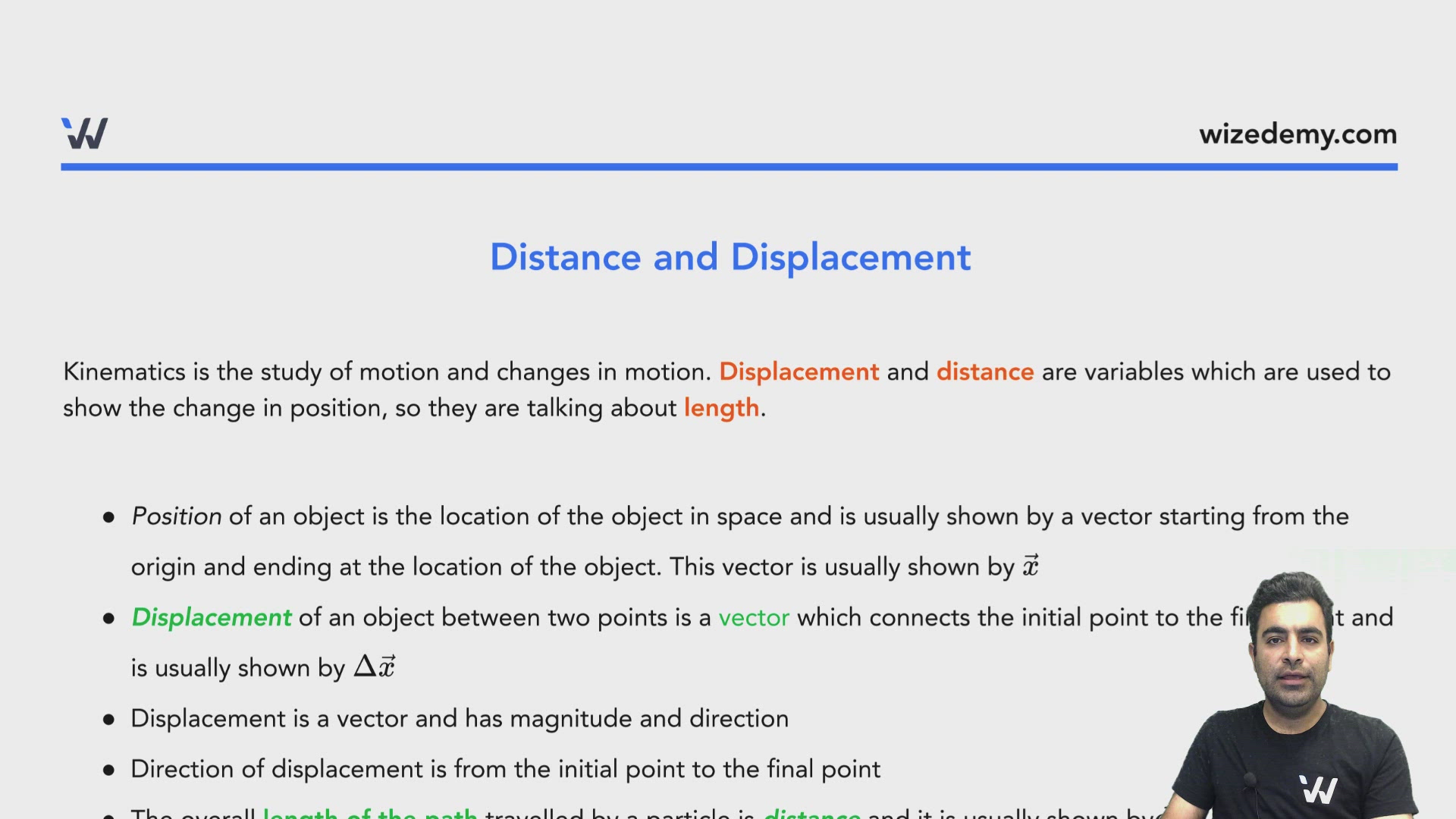
Distance and Displacement
Kinematics is the study of motion and changes in motion. Displacement and distance are variables which are used to show the change in position, so they are talking about length.
- Position of an object is the location of the object in space and is usually shown by a vector starting from the origin and ending at the location of the object. This vector is usually shown by
- Displacement of an object between two points is a vector which connects the initial point to the final point and is usually shown by
- Displacement is a vector and has magnitude and direction
- Direction of displacement is from the initial point to the final point
- The overall length of the path travelled by a particle is distance and it is usually shown by
Wize Tip
Distance is a scalar value and is path-dependent. Displacement is a vector value and gives the change in position between two time intervals so it is path-independent.
- Displacement between two positions and could be obtained using the following equation:
Total Displacements and Total Distances
Given a system with steps,
- Final Displacement
- Total Distance
0:00 / 0:00
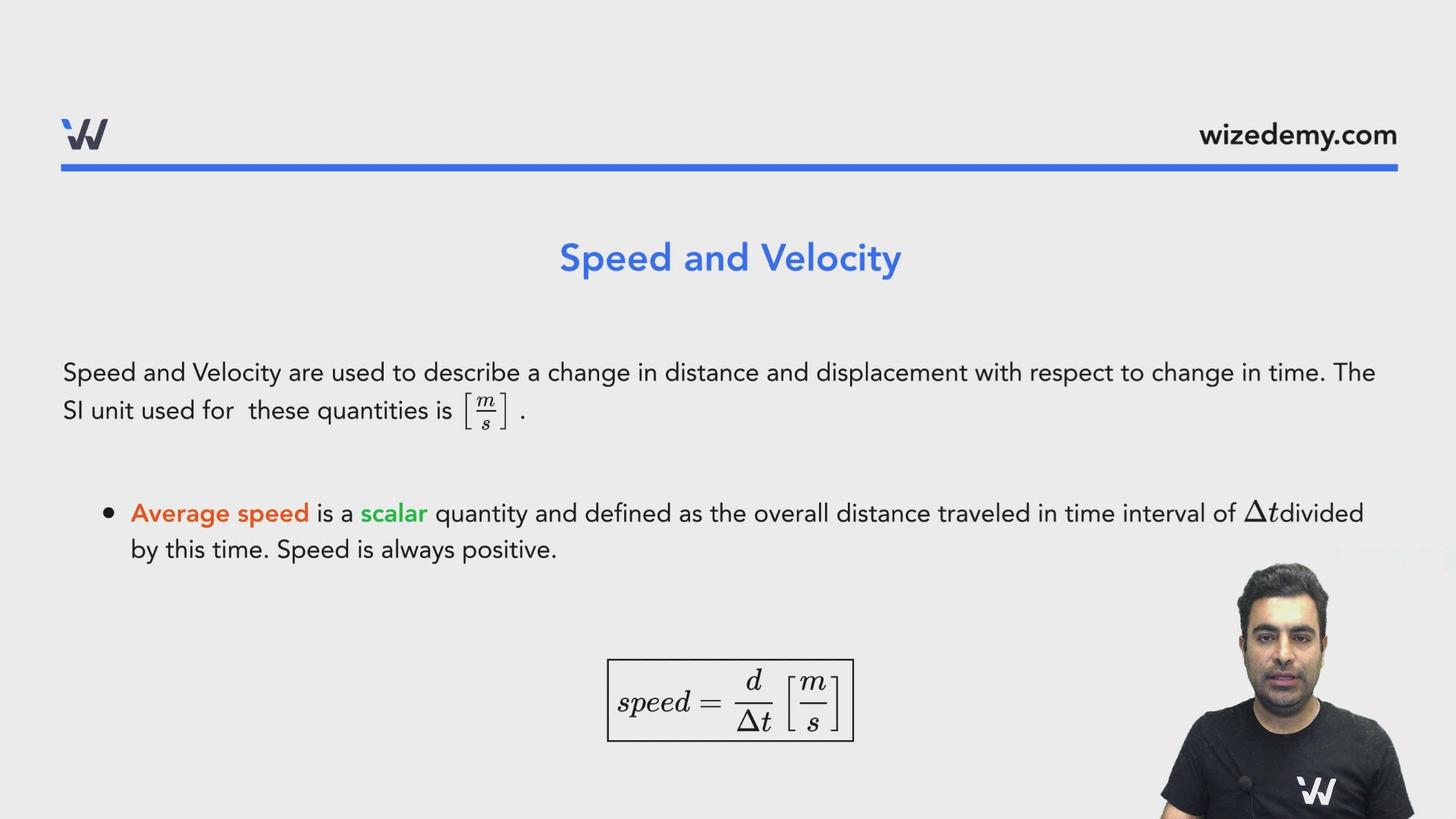
Speed and Velocity
Speed and Velocity are used to describe a change in distance and displacement with respect to change in time. The SI unit used for these quantities is .
- Average speed is a scalar quantity and defined as the overall distance traveled in time interval of divided by this time. Speed is always positive.
- is the distance travelled in meters
- Average velocity is a vector and defined as the ratio of displacement between two points and the time interval between two points:
- The direction of the average velocity is the same as the direction of displacement vector and is called the direction of motion!
- Average velocity is also called the rate of change in position
- Velocity can change in both direction and length (linear motion vs circular motion!)
- Velocity and speed are often given in or and should be converted into . This relationship might be useful for you.
Exam Tip
For approximation purposes it's useful to remember that is
Wize Tip
Instantaneous speed is still defined as distance divided by time, but the time interval being considered is as short as possible (or "infinitesimal") and it talks about speed at the moment!
0:00 / 0:00
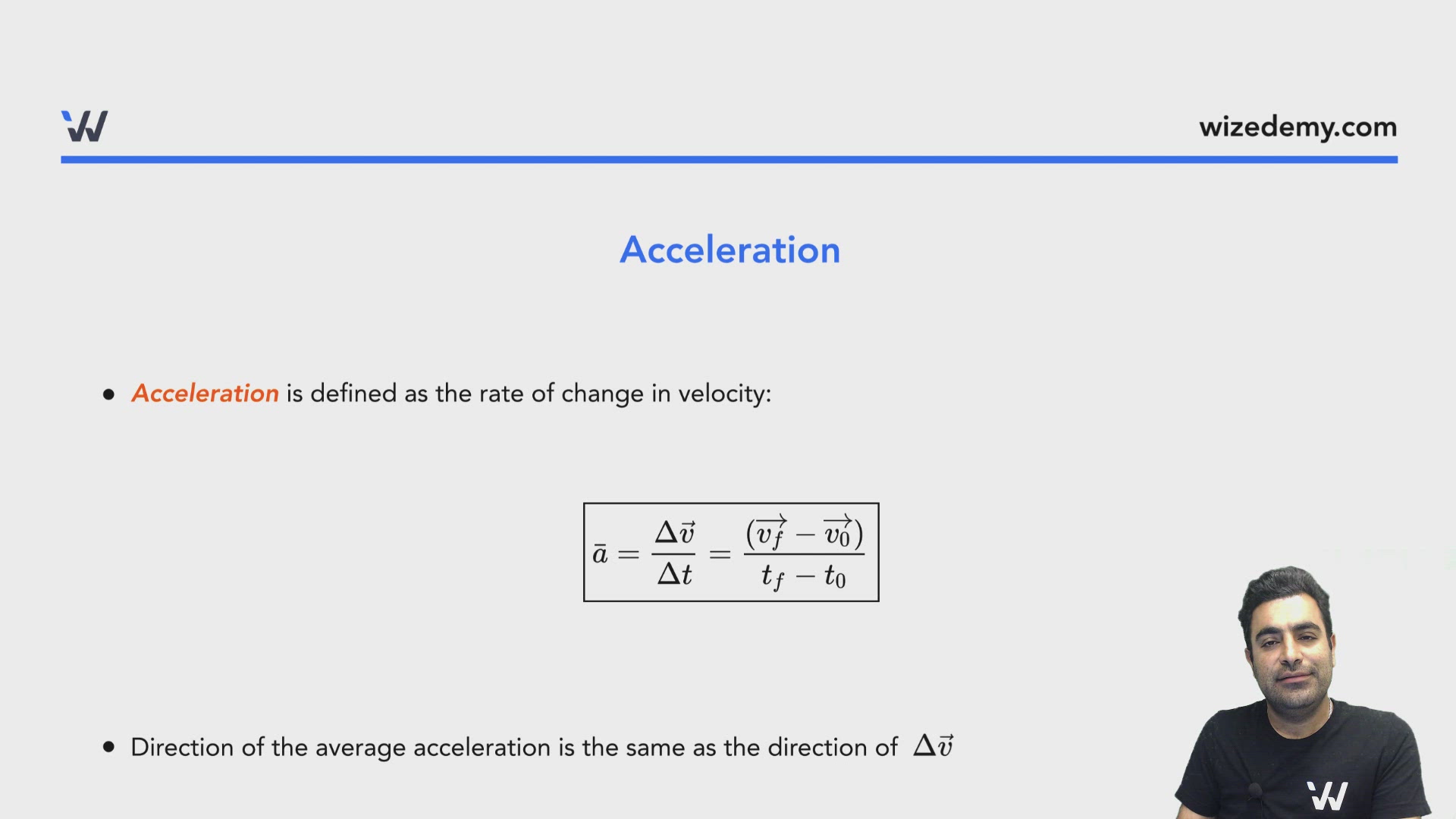
Acceleration
- Acceleration is defined as the rate of change in velocity:
- Direction of the average acceleration is the same as the direction of
Watch Out!
Acceleration, velocity, and displacement do not need to point in the same direction!
- An object is speeding up if and only if acceleration and velocity are pointing in the same direction.
- An object is slowing down if and only if acceleration and velocity are pointing in opposite directions.
- An object is moving at a constant velocity if and only if
Motion in One Dimension
Motion in one dimension means that the particle can only go backward and forward
- For one-dimensional problems vectors could be shown by positive and negative numbers representing pointing forward and backward respectively
- The origin is an arbitrary place with
- By convention, for points to the right of or above the origin and for points to the left of or below the origin
- and have positive sign if they are pointing toward positive
- and have negative sign if they are pointing toward negative
0:00 / 0:00
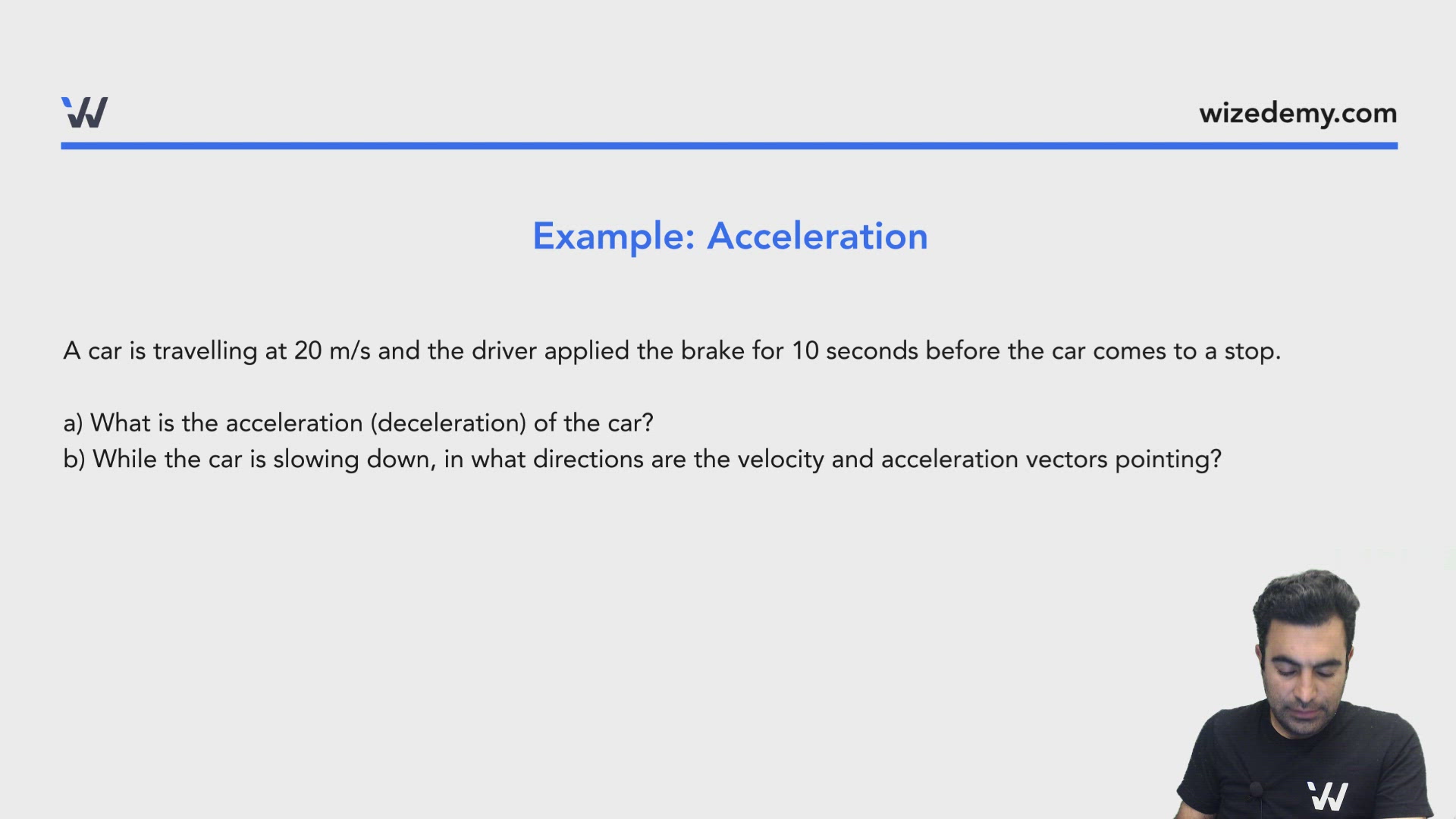
Example: Acceleration
A car is travelling at 20 m/s and the driver applied the brake for 10 seconds before the car comes to a stop.
a) What is the acceleration (deceleration) of the car?
b) While the car is slowing down, in what directions are the velocity and acceleration vectors pointing?
It's always nice to write down what we already know.
Part a)
Now to get the acceleration we just need to remember it is the change in velocity, over change in time.
So the acceleration of the car is -2m/s2 , the negative is telling us that it is opposite our velocity direction. This makes sense! We are decreasing our velocity as we brake.
Part b)
The car is still moving forward while it is slowing down. That is, the velocity points forward while acceleration points backward.
James is off on a rocket. He starts off at Earth, and launches off at 9am. He flies up 200km by 10am, and then another 150km by noon. He returns to Earth at 1:30pm. Give all answers in SI units.
a)What was his average speed for the whole trip?
b) What was his average velocity for the whole trip?
c) What was his average velocity from 10am to 1:30pm?