Create a free account to get started

Unlock full course notes by signing up

  • Video lessons taught by top educators
  • Practice questions with guided solutions
  • Written review notes for reference
  • Expert answers anytime from course tutors

Rolling without Slipping


Rolling without slipping is a combination of two motions:


1- A transitional motion of the center of the mass with the velocity of:


vcm=R⋅ω\boxed{v_{cm}=R\cdot\omega}


2- A rotational motion of all the points on the object


Figure below shows the velocity distribution with respect to distance from the point of contact.
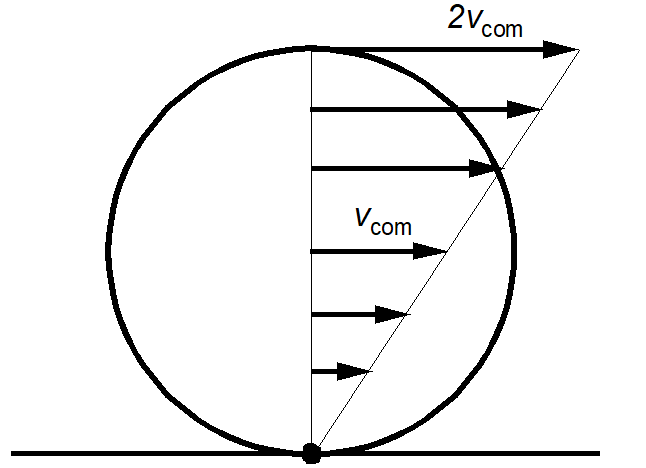


Image illustrating Note for Rolling Motion


Energy of a Rolling Object

Since a rolling object has both translational and rotational motion, the total kinetic energy for an object rolling without slipping is


K=12mv2+12Icmω2\boxed{K=\frac12mv^2+\frac12I_{cm}\omega^2}

where the first term is the translational kinetic energy of the center of mass and the second term is the rotational kinetic energy of the object.


Create a free account to get started

Unlock full course notes by signing up

  • Video lessons taught by top educators
  • Practice questions with guided solutions
  • Written review notes for reference
  • Expert answers anytime from course tutors

Example: Static Friction for Rolling Down a Slope


Show that the friction for a round object of radius R rolling (without slipping) down an incline of angle θ\thetahas magnitude given by


f=mgsin⁡θ1+mR2If=\dfrac{mg\sin\theta}{1+\dfrac{mR^2}{I}}


Image illustrating Example: Static Friction for Rolling Down a Slope

Let clockwise rotation be positive, and let the x and y directions be along the slope and perpendicular to the slope. Positive is up for y, and downward along the slope for x.


Solution:


Consider the forces in the x direction:

ΣFx=−fs+mgsin⁡θ=macm\Sigma F_x=-f_s+mg\sin\theta=ma_{cm}

Consider the net torque on the system relative to the center of mass: (Note that only friction has a non-zero torque about the object's center of mass)

Στ=Rfs=Icmαα=RfsIcm\Sigma \tau=Rf_s=I_{cm}\alpha \newline \alpha=\frac{Rf_s}{I_{cm}}

Because the object is rolling without slipping,

acm=Rαa_{cm}=R\alpha

Plugging this into the force equation:

−fs+mgsin⁡θ=m(Rα)−fs+mgsin⁡θ=m(R(RfsIcm))mgsin⁡θ=fs+m(R(RfsIcm))mgsin⁡θ=fs(1+m(R2Icm))fs=mgsin⁡θ1+m(R2Icm)-f_s+mg\sin\theta=m(R\alpha) \newline -f_s+mg\sin\theta=m\Big(R(\frac{Rf_s}{I_{cm}})\Big) \newline mg\sin\theta=f_s+m\Big(R(\frac{Rf_s}{I_{cm}})\Big) \newline mg\sin\theta=f_s(1+m(\frac{R^2}{I_{cm}})) \newline f_s = \dfrac{mg\sin\theta}{1+m(\dfrac{R^2}{I_{cm}})}

Note that in order to have rolling without slipping this static friction should be smaller than the maximum static friction which is equal to μsN\mu_sN. Otherwise, the object will slip during rolling.

Practice: Rolling Marble on a Loop-the-Loop Track


A marble starts from rest and rolls without slipping on the loop-the-loop track in the figure. Find the minimum starting height h from which the ball will remain on the track throughout the loop. Assume the marble's radius is small compared with R. The moment of inertia for a solid sphere is 25Mr2\frac25Mr^2.

Illustration for practice question: Conservation of Energy: Rolling Marble on a Loop-the-Loop Track


Enter your answer by using R = 70 cm (radius of the loop) and r = 1.0 cm (radius of the marble). Your answer should be in meters with three significant figures.

Create a free account to get started

Unlock full course notes by signing up

  • Video lessons taught by top educators
  • Practice questions with guided solutions
  • Written review notes for reference
  • Expert answers anytime from course tutors

Extra Practice