Popular Courses
MCAT
General Course
Intro to Physics
University Study Guides
AP Physics C: Mechanics Exam Prep Course
AP Exam Prep
Physics
General Course
PHYS 211
University of Calgary
PHYS 204
Concordia University
Intro to Physics
University Study Guides
PHYS*1300
University of Guelph
PHYS*1080
University of Guelph
PHY 1321
University of Ottawa
PHYS 131
McGill University
PCS 120
Toronto Metropolitan University
PHYS 110
University of Victoria
LE/PHYS 1800 3.00
York University
PHY 1331
University of Ottawa
PHYS 142
McGill University
PHYS 115
University of Waterloo
PHYS 117
University of British Columbia
PHYC 1190
Dalhousie University
ENGG 212
University of Calgary
0:00 / 0:00
Spring Force
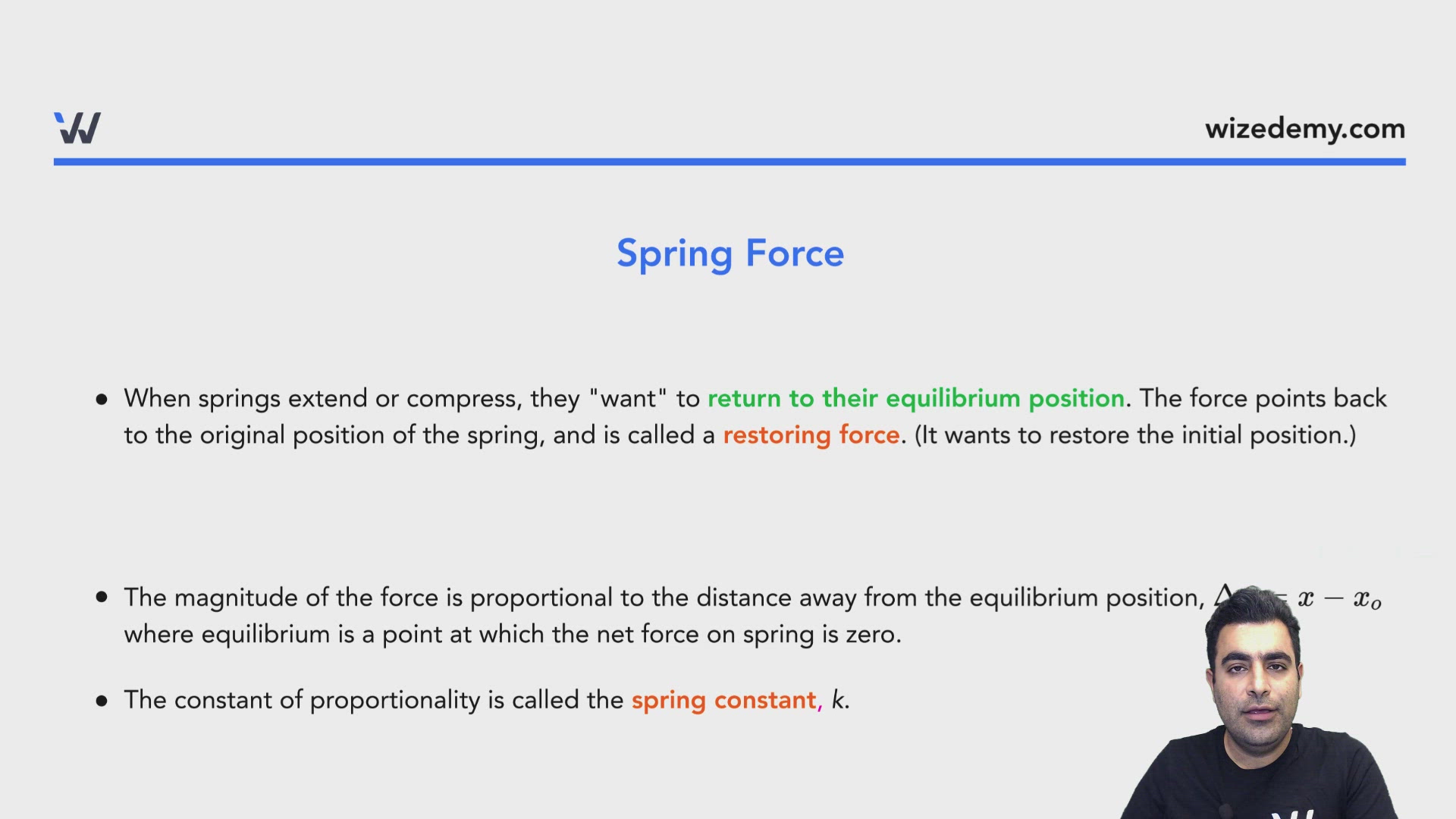
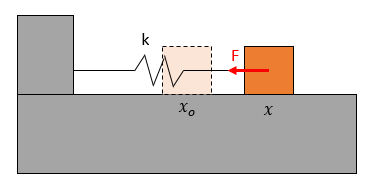
- When springs extend or compress, they "want" to return to their equilibrium position. The force points back to the original position of the spring, and is called a restoring force. (It wants to restore the initial position.)
- The magnitude of the force is proportional to the distance away from the equilibrium position, where equilibrium is a point at which the net force on spring is zero.
- The constant of proportionality is called the spring constant, k.
- The negative sign indicates that the force points to the initial position of the spring.
- This is called Hooke's Law.
- We can see from this equation that the spring constant must have units of N/m.
0:00 / 0:00
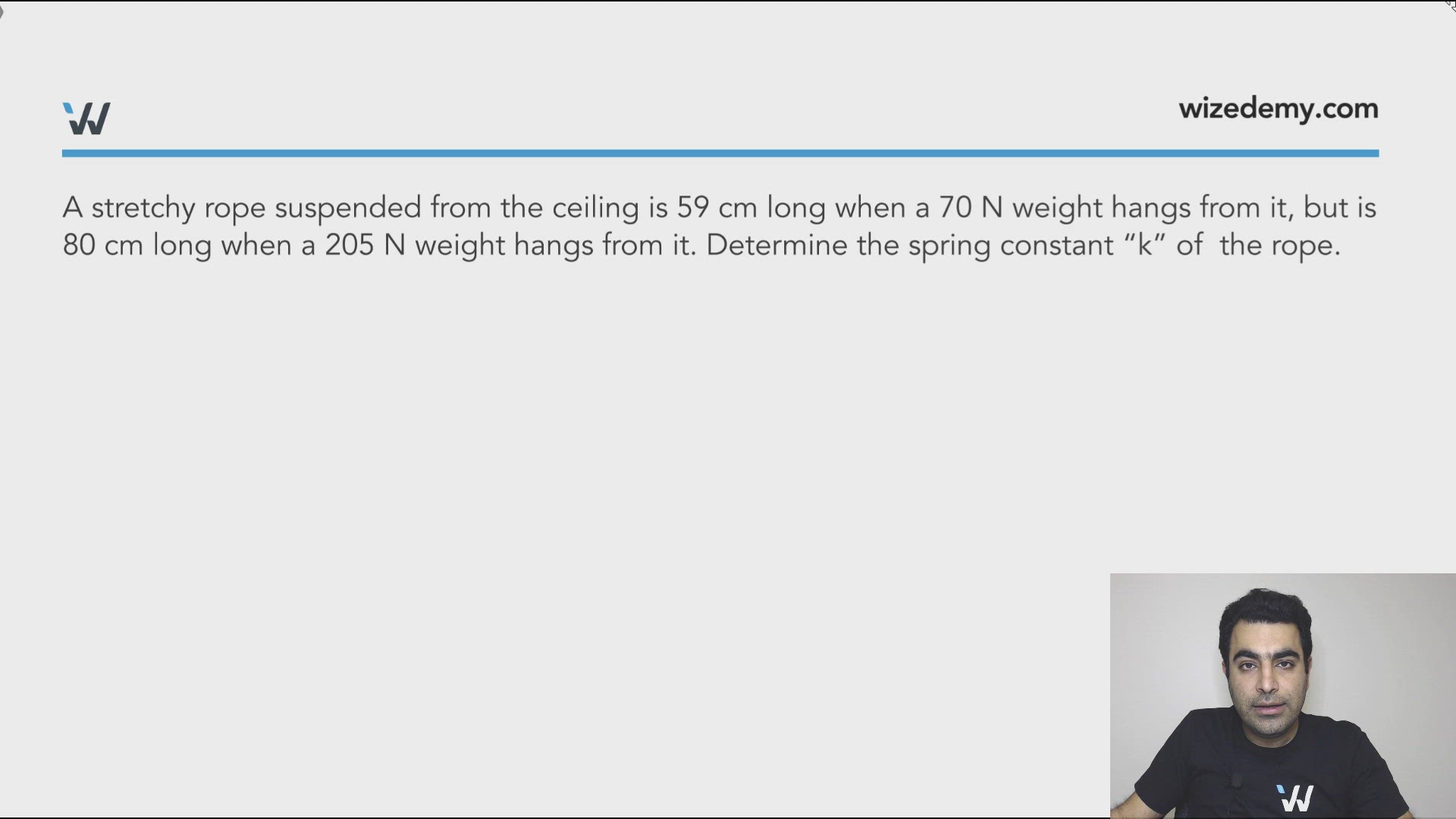
A stretchy rope suspended from the ceiling is 59 cm long when a 70 N weight hangs from it, but is 80 cm long when a 205 N weight hangs from it. Determine the spring constant “k” of the rope.
Solution:
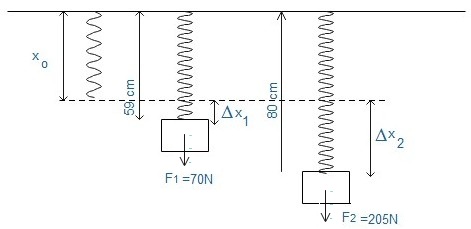
X1=0.59 m
F1=70N=mg
X2=0.8 m
F2=205N
k=?
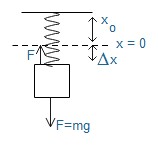
magnitude
2 equations , 2 unknowns
Practice: Hooke's Law
A spring with a spring constant (k) of 300 N/m is compressed 15 cm from its equilibrium position.
What is the magnitude of the restorative force acting on the spring?
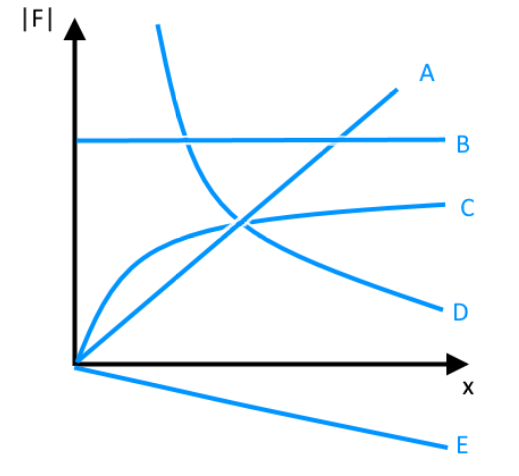
Which of the following curves best describes the dependence of the magnitude of the spring force as a function of displacement from equilibrium?