Wize University Physics Textbook (Master) > Heat and Temperature
Temperature vs Heat
Popular Courses
MCAT
General Course
Intro to Physics
University Study Guides
Physics
General Course
PHYS 157
University of British Columbia
PHYS 115
Queen's University
Intro to Physics
University Study Guides
PHYS*1080
University of Guelph
PHYS*1080
University of Guelph
PHYS 223
University of Calgary
PHYS 102A
University of Victoria
PHY 1122
University of Ottawa
PHYS 142
McGill University
ENGG 212
University of Calgary
ENGG 212
University of Calgary
PHYS 111
University of Victoria
PHYS 1050
University of Manitoba
PHYS 101
Simon Fraser University
PHYS-1300
University of Windsor
PHYS 121
University of Waterloo
PHYS 227
University of Calgary

0:00 / 0:00
Thermal Equilibrium
- Temperature can be interpreted as the average kinetic energy of the molecules of a material
- High temperature corresponds to high kinetic energy
- A thermometer is a device to measure the temperature of an object

- When you put a hot body ‘A’ in contact with a cold body ‘B’, interactions between these two bodies will occur eliminating the temperature difference between them
- At the point where there is no more interaction, the system of the two bodies is said to be in a steady state which is called thermal equilibrium
- At thermal equilibrium, ‘A’ and ‘B’ have the same temperature
- Heat flow or heat transfer is the energy transfer that happens only due to a temperature difference
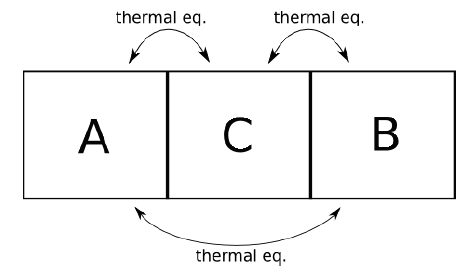
- The Zeroth Law of Thermodynamics states that if ‘C’ is in thermal equilibrium with ‘A’ and ‘B’, then ‘A’ is also in thermal equilibrium with ‘B’
Temperature Scales
1. Celsius Temperature Scale
- We set zero to the freezing temperature of pure water
- We set 100 to the boiling point of pure water
- Divide the distance between these two points into 100 equal degrees
2. Fahrenheit Temperature Scale
- The freezing temperature of water is 32 ºF
- The boiling temperature of water is 212 ºF
- The conversion relation between temperature in degrees of Celsius and degrees of Fahrenheit is:
3. Kelvin Temperature Scale
- The units are the same size as those in the Celsius scale
- The zero of temperature at Kelvin scale is equal to . This point is called absolute zero
- The relation between temperature in Kelvin scale and Celsius scale is:
- Kelvin is the standard unit of temperature
- Since the size of units are the same in Kelvin and Celsius temperature scales:
The temperature difference between the inside and outside of a home on a cold winter day is 50oF. Express the difference on
a) Celsius Scale
b) Kelvin Scale
a)
b)

Mark Yourself Question
- Grab a piece of paper and try this problem yourself.
- When you're done, check the "I have answered this question" box below.
- View the solution and report whether you got it right or wrong.
Peter was not feeling well. He checked his body temperature using a thermometer, it was 40oC. What is this temperature on the Fahrenheit scale? Do you think Peter is seriously ill!